BREAKING
Elon Musk endorsed my Top 26 Essential Papers for Mastering LLMs and Transformers
Implement those and you’ve captured ~90% of the alpha behind modern LLMs.
Everything else is garnish.
This list bridges the Transformer foundations
with the reasoning, MoE, and agentic shift
Recommended Reading Order
1. Attention Is All You Need (Vaswani et al., 2017)
> The original Transformer paper. Covers self-attention,
> multi-head attention, and the encoder-decoder structure
> (even though most modern LLMs are decoder-only.)
2. The Illustrated Transformer (Jay Alammar, 2018)
> Great intuition builder for understanding
> attention and tensor flow before diving into implementations
3. BERT: Pre-training of Deep Bidirectional Transformers (Devlin et al., 2018)
> Encoder-side fundamentals, masked language modeling,
> and representation learning that still shape modern architectures
4. Language Models are Few-Shot Learners (GPT-3) (Brown et al., 2020)
> Established in-context learning as a real
> capability and shifted how prompting is understood
5. Scaling Laws for Neural Language Models (Kaplan et al., 2020)
> First clean empirical scaling framework for parameters, data, and compute
> Read alongside Chinchilla to understand why most models were undertrained
6. Training Compute-Optimal Large Language Models (Chinchilla) (Hoffmann et al., 2022)
> Demonstrated that token count matters more than
> parameter count for a fixed compute budget
7. LLaMA: Open and Efficient Foundation Language Models (Touvron et al., 2023)
> The paper that triggered the open-weight era
> Introduced architectural defaults like RMSNorm, SwiGLU
> and RoPE as standard practice
8. RoFormer: Rotary Position Embedding (Su et al., 2021)
> Positional encoding that became the modern default for long-context LLMs
9. FlashAttention (Dao et al., 2022)
> Memory-efficient attention that enabled long context windows
> and high-throughput inference by optimizing GPU memory access.
10. Retrieval-Augmented Generation (RAG) (Lewis et al., 2020)
> Combines parametric models with external knowledge sources
> Foundational for grounded and enterprise systems
11. Training Language Models to Follow Instructions with Human Feedback (InstructGPT) (Ouyang et al., 2022)
> The modern post-training and alignment blueprint
> that instruction-tuned models follow
12. Direct Preference Optimization (DPO) (Rafailov et al., 2023)
> A simpler and more stable alternative to PPO-based RLHF
> Preference alignment via the loss function
13. Chain-of-Thought Prompting Elicits Reasoning in Large Language Models (Wei et al., 2022)
> Demonstrated that reasoning can be elicited through prompting
> alone and laid the groundwork for later reasoning-focused training
14. ReAct: Reasoning and Acting (Yao et al., 2022 / ICLR 2023)
> The foundation of agentic systems
> Combines reasoning traces with tool use and environment interaction
15. DeepSeek-R1: Incentivizing Reasoning Capability in LLMs via Reinforcement Learning (Guo et al., 2025)
> The R1 paper. Proved that large-scale reinforcement learning without
> supervised data can induce self-verification and structured reasoning behavior
16. Qwen3 Technical Report (Yang et al., 2025)
> A modern architecture lightweight overview
> Introduced unified MoE with Thinking Mode and Non-Thinking
> Mode to dynamically trade off cost and reasoning depth
17. Outrageously Large Neural Networks: Sparsely-Gated Mixture of Experts (Shazeer et al., 2017)
> The modern MoE ignition point
> Conditional computation at scale
18. Switch Transformers (Fedus et al., 2021)
> Simplified MoE routing using single-expert activation
> Key to stabilizing trillion-parameter training
19. Mixtral of Experts (Mistral AI, 2024)
> Open-weight MoE that proved sparse models can match dense quality
> while running at small-model inference cost
20. Sparse Upcycling: Training Mixture-of-Experts from Dense Checkpoints (Komatsuzaki et al., 2022 / ICLR 2023)
> Practical technique for converting dense checkpoints into MoE models
> Critical for compute reuse and iterative scaling
21. The Platonic Representation Hypothesis (Huh et al., 2024)
> Evidence that scaled models converge toward shared
> internal representations across modalities
22. Textbooks Are All You Need (Gunasekar et al., 2023)
> Demonstrated that high-quality synthetic data allows
> small models to outperform much larger ones
23. Scaling Monosemanticity: Extracting Interpretable Features from Claude 3 Sonnet (Templeton et al., 2024)
> The biggest leap in mechanistic interpretability
> Decomposes neural networks into millions of interpretable features
24. PaLM: Scaling Language Modeling with Pathways (Chowdhery et al., 2022)
> A masterclass in large-scale training
> orchestration across thousands of accelerators
25. GLaM: Generalist Language Model (Du et al., 2022)
> Validated MoE scaling economics with massive
> total parameters but small active parameter counts
26. The Smol Training Playbook (Hugging Face, 2025)
> Practical end-to-end handbook for efficiently training language models
Bonus Material
> T5: Exploring the Limits of Transfer Learning with a Unified Text-to-Text Transformer (Raffel et al., 2019)
> Toolformer (Schick et al., 2023)
> GShard (Lepikhin et al., 2020)
> Adaptive Mixtures of Local Experts (Jacobs et al., 1991)
> Hierarchical Mixtures of Experts (Jordan and Jacobs, 1994)
If you deeply understand these fundamentals; Transformer core, scaling laws, FlashAttention, instruction tuning, R1-style reasoning, and MoE upcycling, you already understand LLMs better than most
Time to lock-in, good luck!
Here's my enormous round-up of everything we learned about LLMs in 2025 - the third in my annual series of reviews of the past twelve months
https://t.co/HD9Zf85SG2
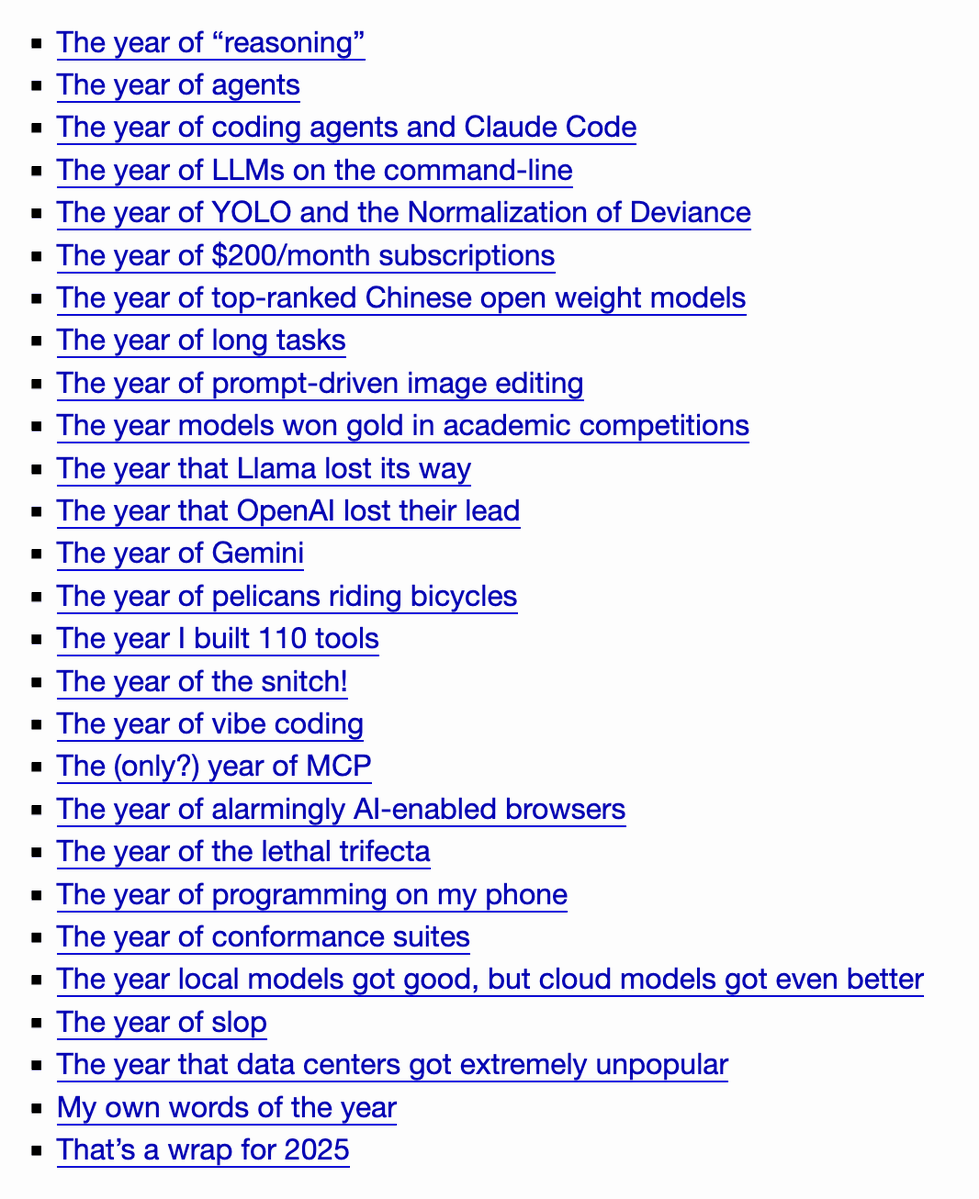
This year it's divided into 26 sections! This is the table of contents:
My pleasure to come on Dwarkesh last week, I thought the questions and conversation were really good.
I re-watched the pod just now too. First of all, yes I know, and I'm sorry that I speak so fast :). It's to my detriment because sometimes my speaking thread out-executes my thinking thread, so I think I botched a few explanations due to that, and sometimes I was also nervous that I'm going too much on a tangent or too deep into something relatively spurious. Anyway, a few notes/pointers:
AGI timelines. My comments on AGI timelines looks to be the most trending part of the early response. This is the "decade of agents" is a reference to this earlier tweet https://t.co/NiSn6jftqq Basically my AI timelines are about 5-10X pessimistic w.r.t. what you'll find in your neighborhood SF AI house party or on your twitter timeline, but still quite optimistic w.r.t. a rising tide of AI deniers and skeptics. The apparent conflict is not: imo we simultaneously 1) saw a huge amount of progress in recent years with LLMs while 2) there is still a lot of work remaining (grunt work, integration work, sensors and actuators to the physical world, societal work, safety and security work (jailbreaks, poisoning, etc.)) and also research to get done before we have an entity that you'd prefer to hire over a person for an arbitrary job in the world. I think that overall, 10 years should otherwise be a very bullish timeline for AGI, it's only in contrast to present hype that it doesn't feel that way.
Animals vs Ghosts. My earlier writeup on Sutton's podcast https://t.co/rSp1noyGBr . I am suspicious that there is a single simple algorithm you can let loose on the world and it learns everything from scratch. If someone builds such a thing, I will be wrong and it will be the most incredible breakthrough in AI. In my mind, animals are not an example of this at all - they are prepackaged with a ton of intelligence by evolution and the learning they do is quite minimal overall (example: Zebra at birth). Putting our engineering hats on, we're not going to redo evolution. But with LLMs we have stumbled by an alternative approach to "prepackage" a ton of intelligence in a neural network - not by evolution, but by predicting the next token over the internet. This approach leads to a different kind of entity in the intelligence space. Distinct from animals, more like ghosts or spirits. But we can (and should) make them more animal like over time and in some ways that's what a lot of frontier work is about.
On RL. I've critiqued RL a few times already, e.g. https://t.co/mYrMFVdVDW . First, you're "sucking supervision through a straw", so I think the signal/flop is very bad. RL is also very noisy because a completion might have lots of errors that might get encourages (if you happen to stumble to the right answer), and conversely brilliant insight tokens that might get discouraged (if you happen to screw up later). Process supervision and LLM judges have issues too. I think we'll see alternative learning paradigms. I am long "agentic interaction" but short "reinforcement learning" https://t.co/2L7FiaoKsw. I've seen a number of papers pop up recently that are imo barking up the right tree along the lines of what I called "system prompt learning" https://t.co/df5mJDdN3C , but I think there is also a gap between ideas on arxiv and actual, at scale implementation at an LLM frontier lab that works in a general way. I am overall quite optimistic that we'll see good progress on this dimension of remaining work quite soon, and e.g. I'd even say ChatGPT memory and so on are primordial deployed examples of new learning paradigms.
Cognitive core. My earlier post on "cognitive core": https://t.co/q2s1ihGy0T , the idea of stripping down LLMs, of making it harder for them to memorize, or actively stripping away their memory, to make them better at generalization. Otherwise they lean too hard on what they've memorized. Humans can't memorize so easily, which now looks more like a feature than a bug by contrast. Maybe the inability to memorize is a kind of regularization. Also my post from a while back on how the trend in model size is "backwards" and why "the models have to first get larger before they can get smaller" https://t.co/6k0FZRGXsb
Time travel to Yann LeCun 1989. This is the post that I did a very hasty/bad job of describing on the pod: https://t.co/fQgqaXPyp6 . Basically - how much could you improve Yann LeCun's results with the knowledge of 33 years of algorithmic progress? How constrained were the results by each of algorithms, data, and compute? Case study there of.
nanochat. My end-to-end implementation of the ChatGPT training/inference pipeline (the bare essentials) https://t.co/SIetgyoKWN
On LLM agents. My critique of the industry is more in overshooting the tooling w.r.t. present capability. I live in what I view as an intermediate world where I want to collaborate with LLMs and where our pros/cons are matched up. The industry lives in a future where fully autonomous entities collaborate in parallel to write all the code and humans are useless. For example, I don't want an Agent that goes off for 20 minutes and comes back with 1,000 lines of code. I certainly don't feel ready to supervise a team of 10 of them. I'd like to go in chunks that I can keep in my head, where an LLM explains the code that it is writing. I'd like it to prove to me that what it did is correct, I want it to pull the API docs and show me that it used things correctly. I want it to make fewer assumptions and ask/collaborate with me when not sure about something. I want to learn along the way and become better as a programmer, not just get served mountains of code that I'm told works. I just think the tools should be more realistic w.r.t. their capability and how they fit into the industry today, and I fear that if this isn't done well we might end up with mountains of slop accumulating across software, and an increase in vulnerabilities, security breaches and etc. https://t.co/8556ESSpyY
Job automation. How the radiologists are doing great https://t.co/FVUI872dkD and what jobs are more susceptible to automation and why.
Physics. Children should learn physics in early education not because they go on to do physics, but because it is the subject that best boots up a brain. Physicists are the intellectual embryonic stem cell https://t.co/p72Elk8lPV I have a longer post that has been half-written in my drafts for ~year, which I hope to finish soon.
Thanks again Dwarkesh for having me over!
Open-Source LLMs Will Close the Gap
Open-source AI is closing in on closed-source models. I believe in 2024 we'll finally see an open-source model that can rival GPT-4.
Top players (MSFT, Google, OpenAI) are doubling down on the plug-in ecosystem. Will Anthropic follow?
Windows Copilot sounds like both an app overlay (“summarize this doc”) and OS overlay (“turn on DND”), augmented via plug-ins.
Testing starts in June.
https://t.co/lbAVqMWLkL
Michael Cembalest, the brilliant market strategist at $JPM …highlighting how much of an outlier $SIVB was in two charts:
1. Highest risk, least sticky deposit base
2. Worst capital position
$42 billion of $170+ billion of deposits was yanked in 1 day. Doubt any other bank could see that speed.
Crazy day. After 22 years between SVB and FRB, I'm still at shock. My wife also works at SVB right now.
The news today was huge, and here is what I've pieced together across 100's of conversations yesterday/today.
🧵
@EricCressey Easiest way to win when you start a new job: Take something off your boss’ plate that they hated doing. Do it really well (better than they would have).
Total US #COVID cases
1M to 2 M- 44 days
2M to 3 M- 27 days
3M to 4 M- 15 days
4M to 5 M - 17 days
5M to 6 M - 22 days
6M to 7 M - 25 days
7M to 8 M - 21 days
8M to 9 M - 14 days
9M to 10M - 10 days
It’s not over. Wear a mask. 😷❤️
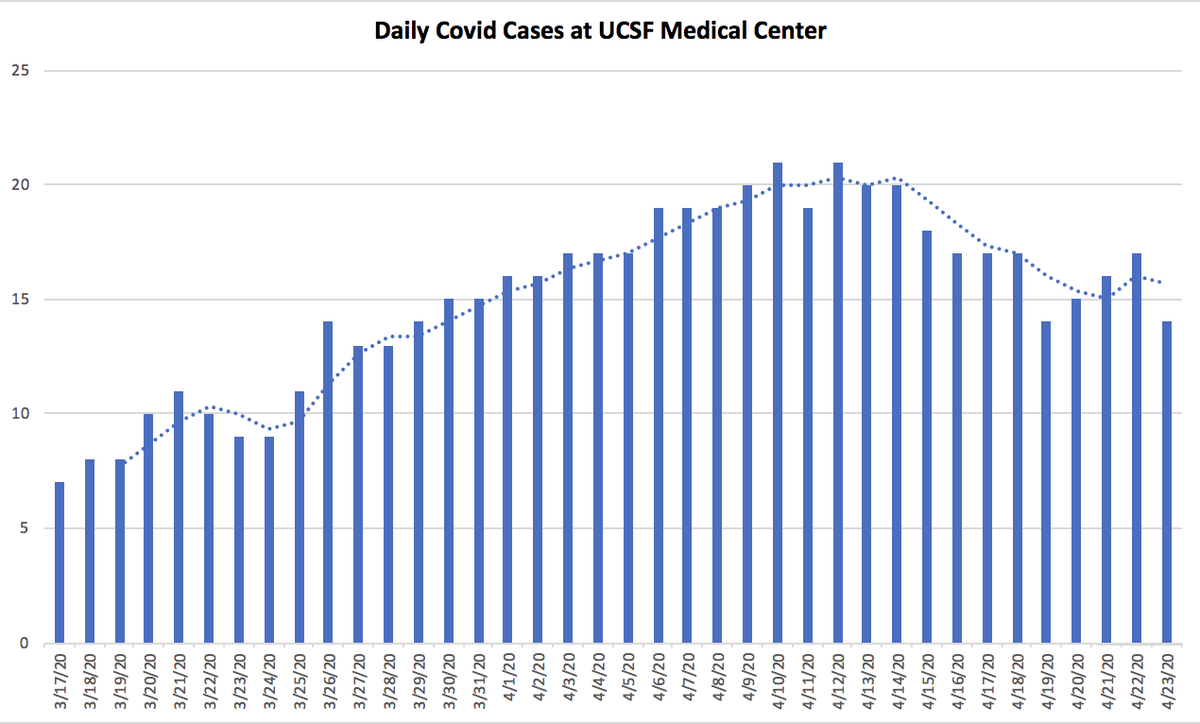
2/ First, a few updates: @UCSFHospitals: 14 inpatients (down from 17), 5 on vent. Still just 1 death @ucsf since start (Fig on L).
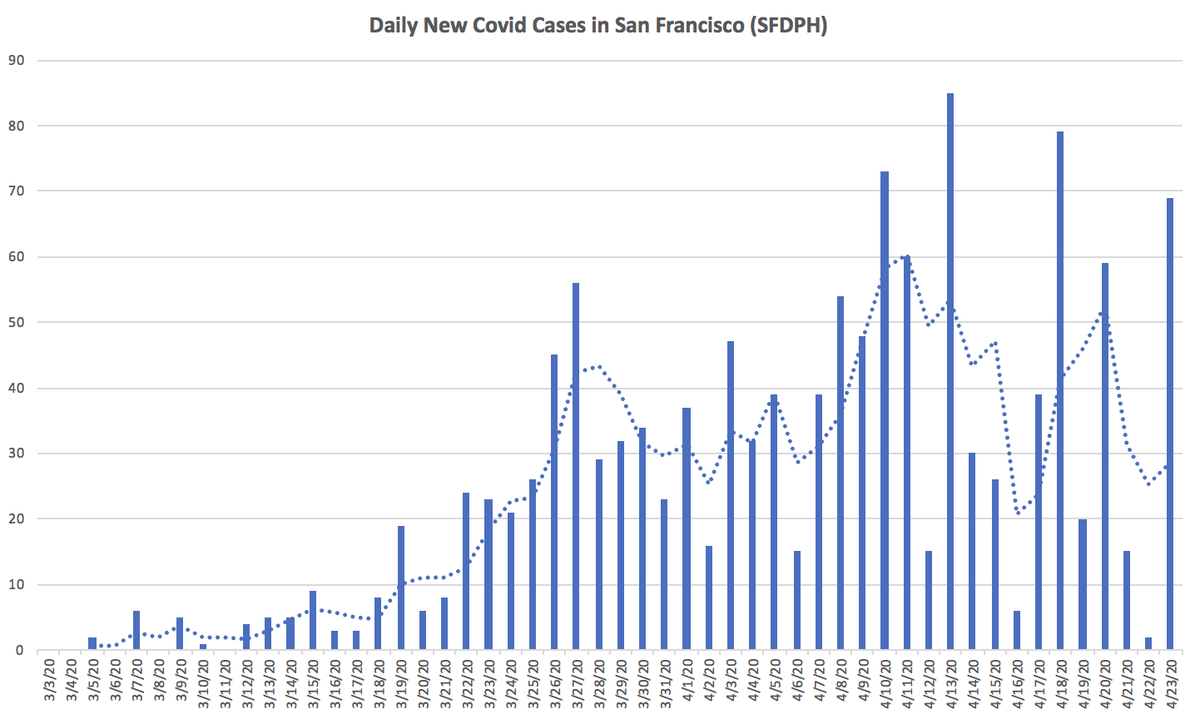
In San Francisco: 69 new cases, 1302 total. Citywide hospitalizations stable at 80, no new deaths for past 4 days; 21 total since start (Fig on R).
Population implosion could be the biggest problem facing our younger generations... World’s population is projected to nearly stop growing by the end of the century https://t.co/5lD5zDtHT4