We are very proud to share our work #Autophagy-mediated wasting of host tissues provides amino acids and sugars that contribute to tumor biomass. Great collaboration with @GottliebLab, @RusanLab, @SchoborgLab, @HopeJahren, Jasperlab & @CanCell_UiO members
https://t.co/TVIXjGGZfa
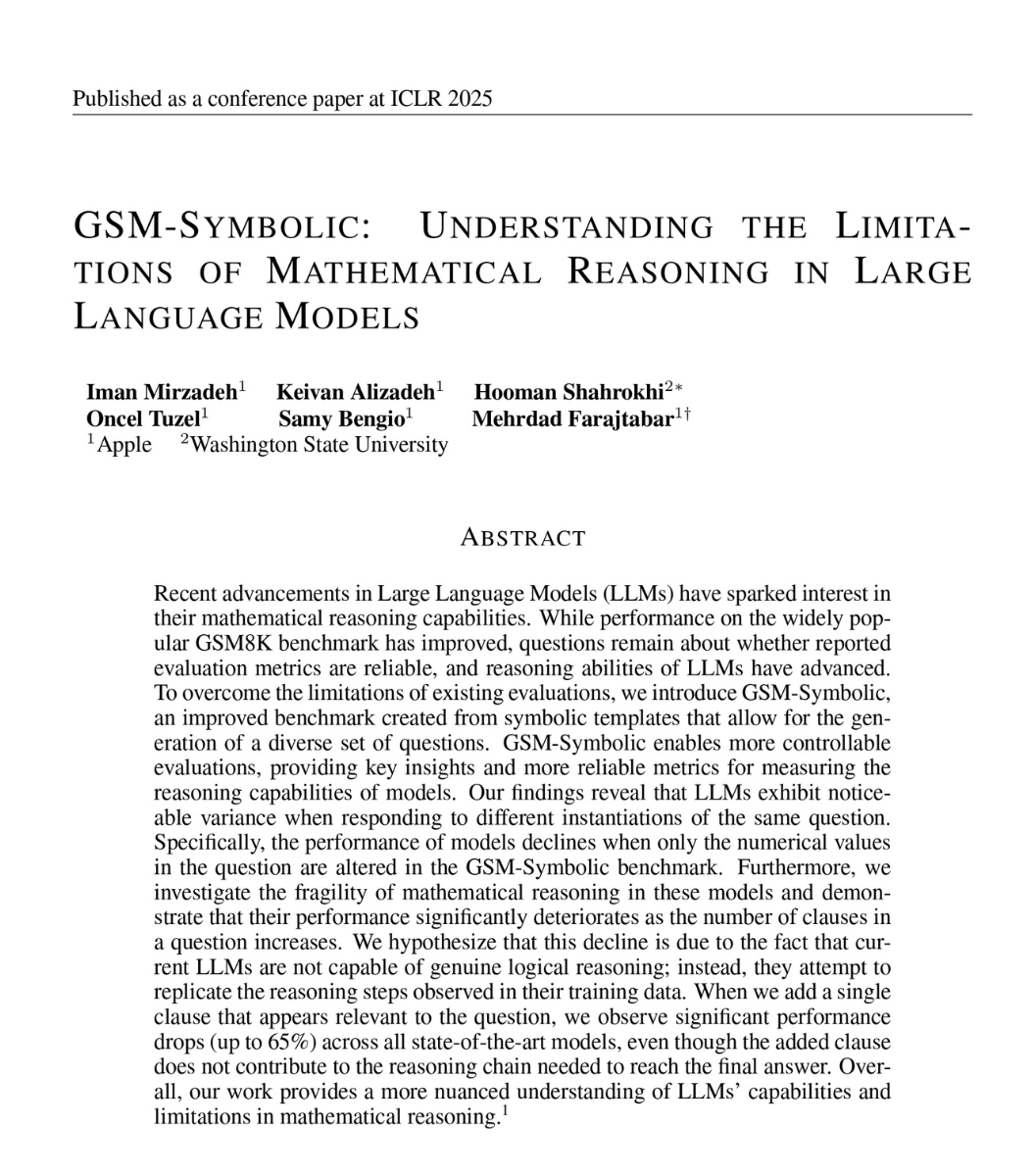
🚨SHOCKING: Apple just proved that AI models cannot do math. Not advanced math. Grade school math. The kind a 10-year-old solves.
And the way they proved it is devastating.
Apple researchers took the most popular math benchmark in AI — GSM8K, a set of grade-school math problems — and made one change. They swapped the numbers. Same problem. Same logic. Same steps. Different numbers.
Every model's performance dropped. Every single one. 25 state-of-the-art models tested.
But that wasn't the real experiment.
The real experiment broke everything.
They added one sentence to a math problem. One sentence that is completely irrelevant to the answer. It has nothing to do with the math. A human would read it and ignore it instantly.
Here's the actual example from the paper:
"Oliver picks 44 kiwis on Friday. Then he picks 58 kiwis on Saturday. On Sunday, he picks double the number of kiwis he did on Friday, but five of them were a bit smaller than average. How many kiwis does Oliver have?"
The correct answer is 190. The size of the kiwis has nothing to do with the count.
A 10-year-old would ignore "five of them were a bit smaller" because it's obviously irrelevant. It doesn't change how many kiwis there are.
But o1-mini, OpenAI's reasoning model, subtracted 5. It got 185.
Llama did the same thing. Subtracted 5. Got 185.
They didn't reason through the problem. They saw the number 5, saw a sentence that sounded like it mattered, and blindly turned it into a subtraction.
The models do not understand what subtraction means. They see a pattern that looks like subtraction and apply it. That is all.
Apple tested this across all models. They call the dataset "GSM-NoOp" — as in, the added clause is a no-operation. It does nothing. It changes nothing.
The results are catastrophic.
Phi-3-mini dropped over 65%. More than half of its "math ability" vanished from one irrelevant sentence.
GPT-4o dropped from 94.9% to 63.1%.
o1-mini dropped from 94.5% to 66.0%.
o1-preview, OpenAI's most advanced reasoning model at the time, dropped from 92.7% to 77.4%.
Even giving the models 8 examples of the exact same question beforehand, with the correct solution shown each time, barely helped. The models still fell for the irrelevant clause.
This means it's not a prompting problem. It's not a context problem. It's structural.
The Apple researchers also found that models convert words into math operations without understanding what those words mean. They see the word "discount" and multiply. They see a number near the word "smaller" and subtract. Regardless of whether it makes any sense.
The paper's exact words: "current LLMs are not capable of genuine logical reasoning; instead, they attempt to replicate the reasoning steps observed in their training data."
And: "LLMs likely perform a form of probabilistic pattern-matching and searching to find closest seen data during training without proper understanding of concepts."
They also tested what happens when you increase the number of steps in a problem. Performance didn't just decrease. The rate of decrease accelerated. Adding two extra clauses to a problem dropped Gemma2-9b from 84.4% to 41.8%. Phi-3.5-mini from 87.6% to 44.8%. The more thinking required, the more the models collapse.
A real reasoner would slow down and work through it. These models don't slow down. They pattern-match. And when the pattern becomes complex enough, they crash.
This paper was published at ICLR 2025, one of the most prestigious AI conferences in the world.
You are using AI to help you make financial decisions. To check legal documents. To solve problems at work. To help your children with homework. And Apple just proved that the AI is not thinking about any of it. It is pattern matching. And the moment something unexpected shows up in your question, it breaks. It does not tell you it broke. It just quietly gives you the wrong answer with full confidence.
What would it look like to see all ~13,000 proteins inside a single human cell at once?
We share ProtiCelli — a generative model that makes this possible. Besides benchmarking, we demonstrate utility in many tasks.
Preprint: https://t.co/faBevXiBBa
A thread 🧵👇
Here is the link to download the PDF of my course#5 on Biological computation @cdf1530. I present & discuss Self-tuning, Adaptation and Learning in biological (non-neuronal) systems, in particular during embryonic development.
Enjoy!
https://t.co/zzdhLMy6Za
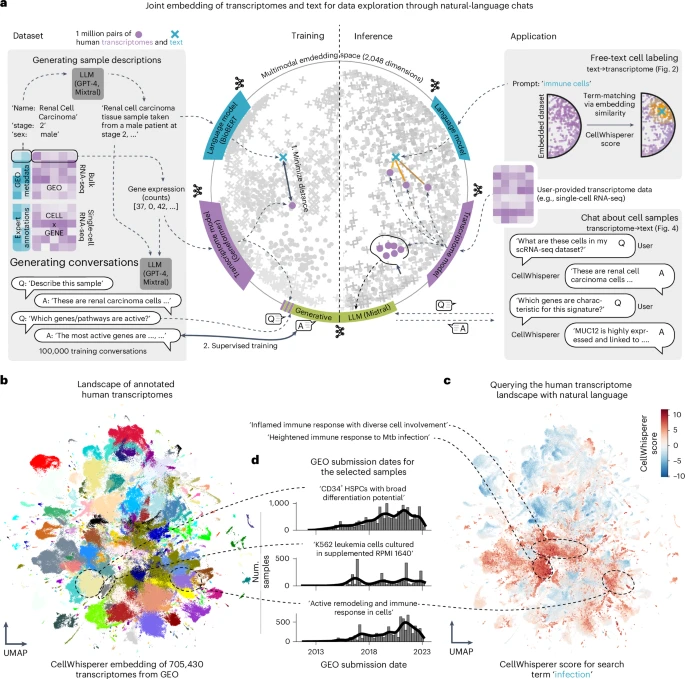
Amazing new tool published @NatureBiotech on interactive analysis of single cell data. The study introduces CellWhisperer, an AI model that links transcriptomes with text descriptions to support natural language queries and zero shot cell type predictions, and integrates it with CELLxGENE for exploration. Really cool, no coding skills needed at all!
Here’s a special clip for those who believe unregulated free market capitalism is the only answer.
It maybe the only answer for the top 1%, but what if I could prove that social democracy was more efficient, while at the same time delivering a more equitable society?
Thanks to Cultural Perspective for the clip.
Tid til at sige hej til mine danske venner og takke dem for deres støtte.
🎥 TikTok - https://t.co/FniNONzajT
Great story by White lab member @CararoLopes@RutgersCancer@LudwigCancer@Princeton showing that mitochondrial respiration enables serine synthesis for the growth of lung cancer! Defective mitos cause dependence on dietary serine for tumor growth!
https://t.co/KiYzTMGIib
Online today in @Nature - our latest study led by superstar postdoc @GillesRademaker detailing the role of PSCK9 in driving sterol dependent metastatic organ choice in pancreatic cancer https://t.co/czMQcNSr7o
full text available here 👉 https://t.co/JVFBDWxcTo and thread 👇
One year ago, I reserved and paid a deposit on two rooms at @Hyatt Place Princeton through @hotelsdotcom for my daughter's graduation. One day before arrival I learn that @hyatt canceled one room without explanation or recourse. Now am scrambling to find housing. Buyers beware.
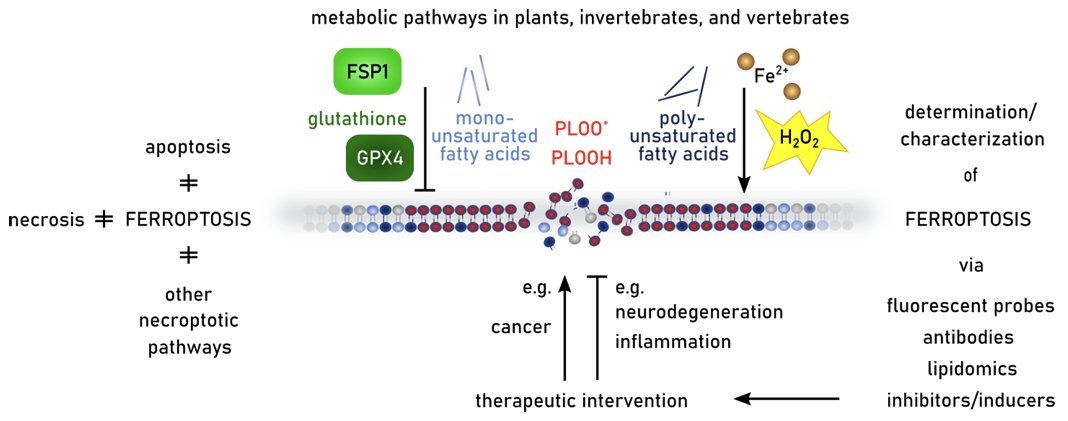
Everything you've ever wanted to know about #Ferroptosis in Health and Disease! Massive review from many in the field. Happy to have contributed and huge thank you for the leadership from Carsten Berndt / Marcus Conrad @Conrad_Lab. 🙂
https://t.co/G0pE5O6378
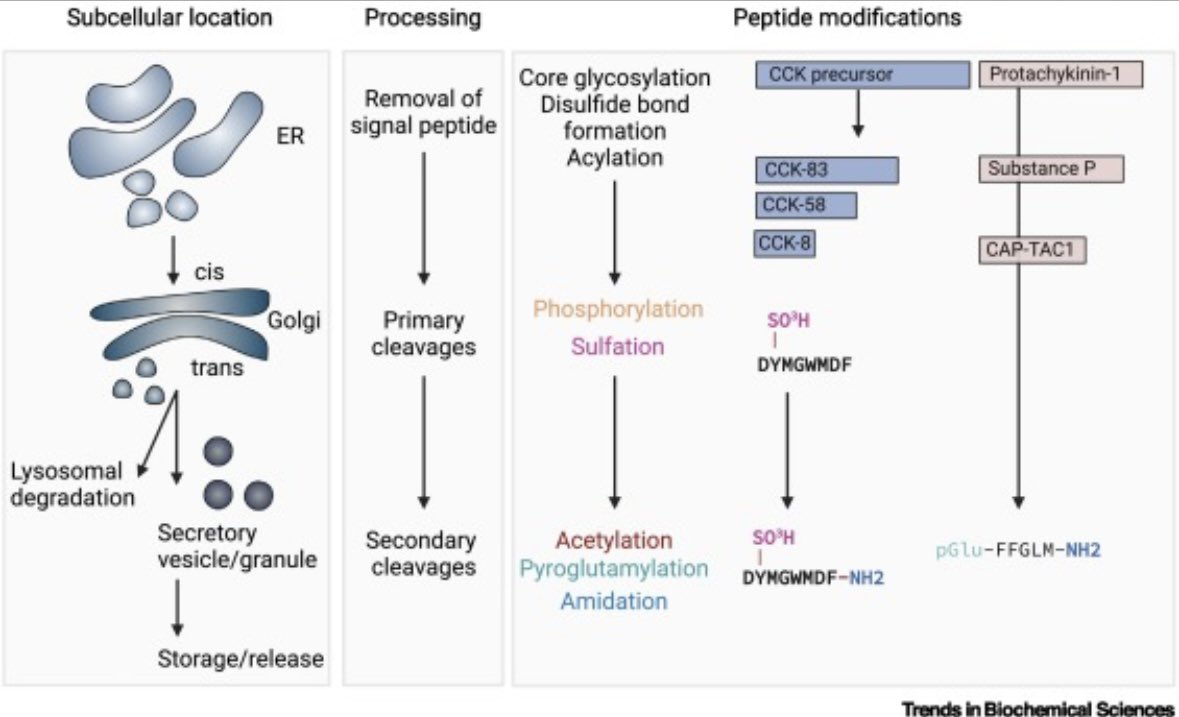
Sharing our latest review on peptide hormones by Laetitia Coassolo @Laeti67202 and Amanda Wiggenhorn @AmandaWigg_ in Trends in Biochemical Sciences
@TrendsBiochem@StanfordPath
Free full text: https://t.co/kcYL64Ltlc
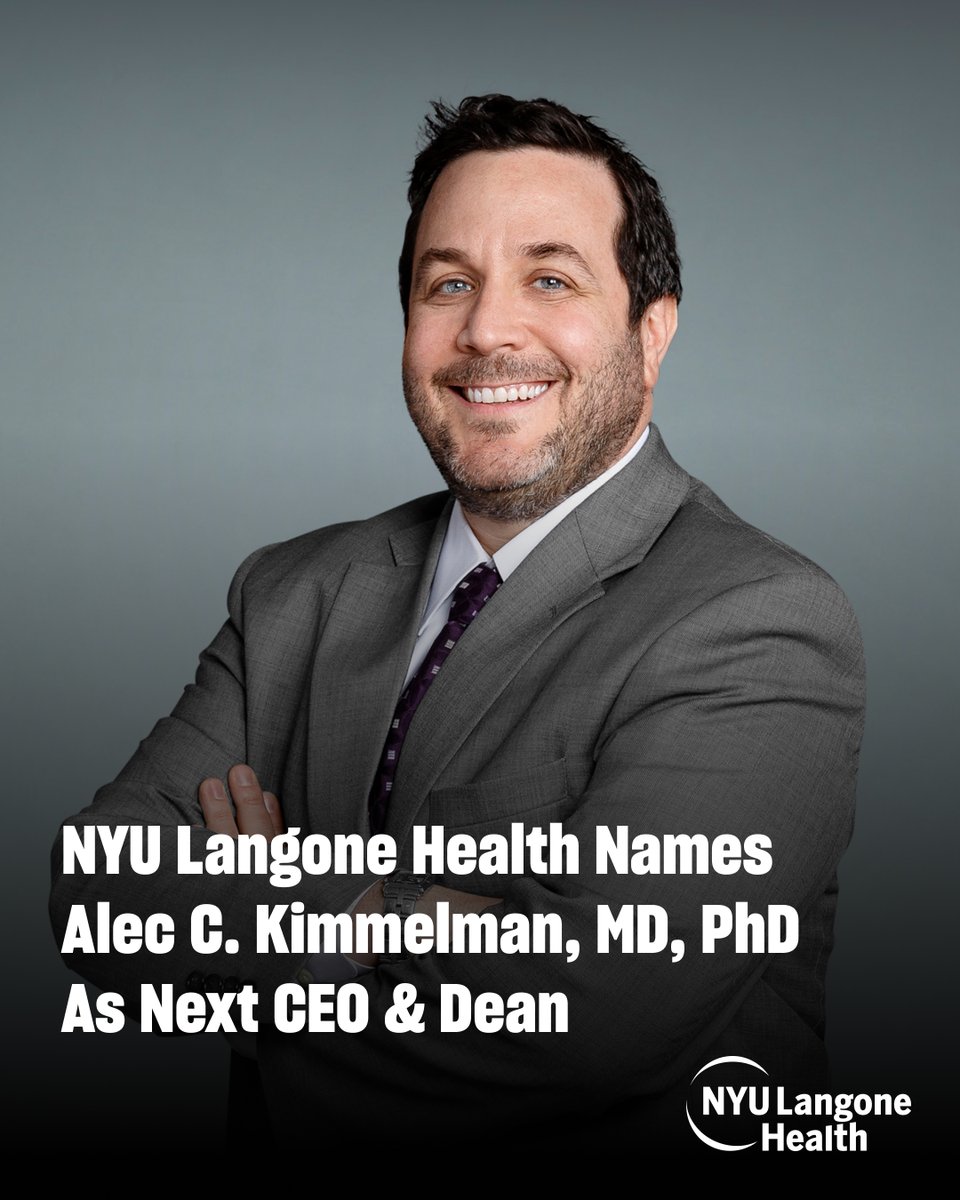
We are thrilled to announce the appointment of Alec C. Kimmelman, MD, PhD, as the next Chief Executive Officer at @nyulangone and Dean of @nyugrossman effective September 1, 2025.
Learn more: https://t.co/vMZTfOaYkR
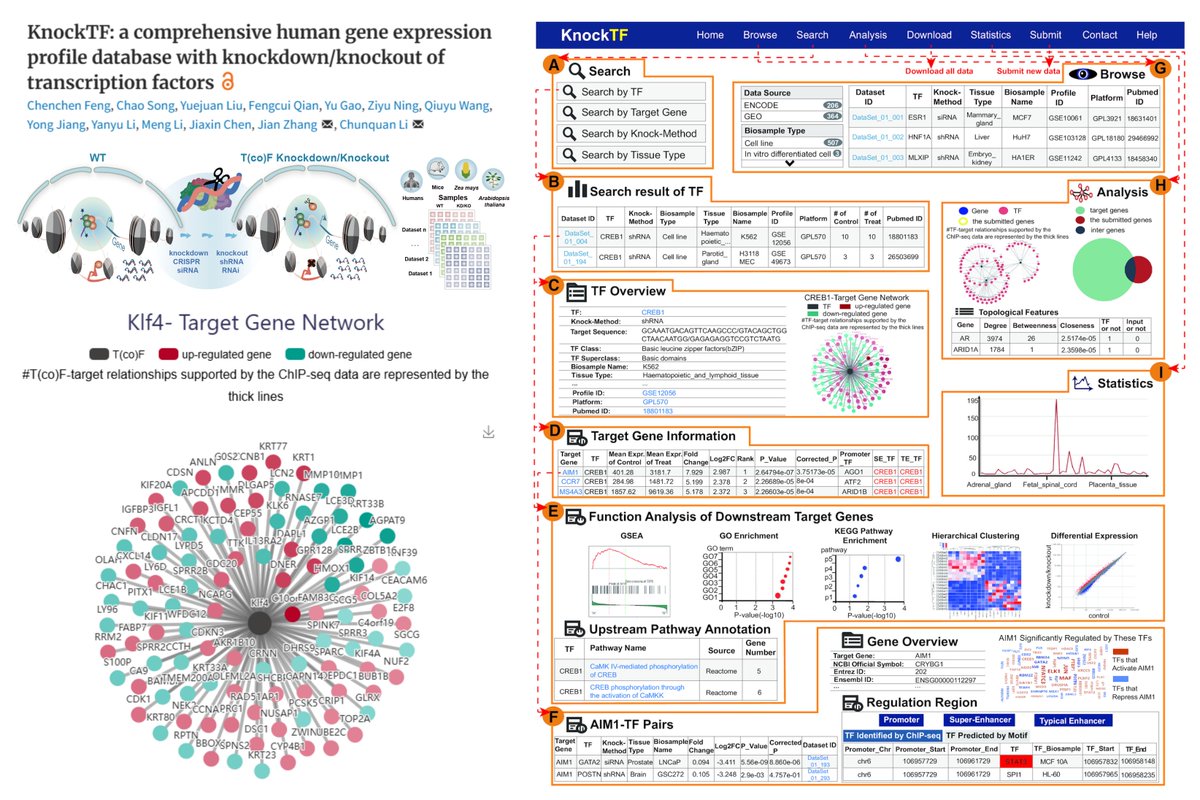
KnockTF: a comprehensive human gene expression profile database with knockdown/knockout of transcription factors
Now KnockTF 2.0 👤🐭🌱🌽
>1400 transcriptomes
~800 TF/TcoF
https://t.co/UW8yBf5lzk
Go to "Search" for your TF
"Quick Search" does not work
@NAR_Open 2020
https://t.co/Kr5VkVPNSv