Human Skills That Matter in the Age of AI!
Here is an interesting research study published in Nature that outlines some of the key human skills that hold up as AI takes over more of the technical work.
Hosseinioun, Neffke, Zhang, and Youn (2025) analyzed nearly a thousand occupations and 70 million job transitions, and their finding is simple: skills depend on other skills. The advanced, high-paying ones only become reachable once the broad, general ones are already in place. They call this nested human capital.
The general skills do the heavy lifting: language, reasoning, oral expression, and judgment. These anchor the base of the structure, and almost every specialized skill builds on top of them.
The authors also separate skills that rest on a strong foundation from those that float outside it. The aligned ones earn higher wages, need more education, and resist automation. The ones without a foundation carry a wage penalty that trails workers for years.
So a student who can run an AI tool but can't read critically or reason through a problem holds a skill with nothing under it. It looks like an edge but it works like a dead end.
There's a hard equity line too. Women, Black, and Hispanic workers tend to hold fewer of these nested skills, and limited English proficiency blocks access to the specialized ones built on language.
Eight reasons why your research paper got rejected and how to avoid them
Download the PDF by clicking the link below.
Follow Silvi on LinkedIn for more free resouces on academic writing.
https://t.co/KAR0fmEAP4
Este editorial de NATURE sostiene que la forma en que las nuevas generaciones consumen información está cambiando radicalmente. Concluye que si los científicos quieren seguir influyendo en el debate público, tienen que adaptarse a ese nuevo formato del ecosistema informativo y que la comunicación científica del futuro deberá ser cada vez más breve y visual.
Cada época moldea los instrumentos con los que busca la verdad, pero eso, a su vez, también transforma la capacidad para atenderla. En la cultura contemporánea, la atención parece dispersarse en haces cada vez más breves. Y el riesgo de que eso cambie nuestra forma de pensar es elvado. N. Postman advirtió que una sociedad puede llegar a preferir lo que entretiene a lo que explica. Así que el verdadero escollo estará en lograr que la búsqueda de la verdad sobreviva al cambio de formato. Habrá que ver si seguimos siendo capaces de distinguir entre información -que puede consumirse en segundos- y conocimiento -que exige concentración y tiempo-. Ninguna revolución tecnológica debería volver obsoleta esa importante diferencia
Mi #RadarDeLibros de hoy es sobre "De la relación entre los tragasapos y los tiranos" (@TallerDitoria, 2011) de William Hazlitt.
Un ensayo radical contra los profesionales de la opinión pública que ponen su inteligencia al servicio del poder.
https://t.co/MvndiQPvuc
3 hours lost. 4 citations that did not exist. 1 frustrated supervisor.
A PhD student I mentor learned this the hard way.
ChatGPT is not built for finding papers.
@Letras_Libres Uno de los muchos problemas está en la falsa creencia que a mayor número de artículos publicados, mayor financiamiento a las instituciones que emplean a los autores. Eso es falso, a las universidades publicas se les financia en función de su matrícula, y a veces ni por eso.
Investigadores que publican artículos cada cinco días, académicos que contratan empresas productoras de papers, abuso de la IA, entre otros casos, dejan ver una grave crisis en las universidades. Una crisis que es necesario reconocer para poder solucionarla. Por Agustín B. Ávila Casanueva
https://t.co/yXLaE4yVkz
Anatomy of a systematic review
Download the paper for free by clicking the link below.
Follow Silvi on LinkedIn for free resources on systematic reviews and meta-analysis.
https://t.co/8WqwI9fC9N
Did you know that Open Research Europe supports a wide range of article types?
Discover how to maximise your research outputs in the following blog post: https://t.co/jlLFWSd4YM
Los esperamos en el programa especial de @Imagen_Mx Multicast con motivo del despegue de la misión @NASAArtemis 2.
Miércoles 1 de abril, 16 horas tiempo del Centro. ¡No se lo pierdan!
🤖📚 Convocatoria abierta: dossier Inteligencia Artificial, Información y Desigualdades Sociales en la revista Investigación Bibliotecológica del IIBI-UNAM.
📅 Recepción de artículos hasta el 25 mayo 2026
🔗 Más información: https://t.co/rsyZUdZ3r7
Ya está abierta la convocatoria de becas de la @OEA_oficial, para estudiar maestrías y doctorados, presenciales o virtuales en diferentes áreas. Postúlate hasta el 30 de marzo a las 5:00 p. m., en ➡️ https://t.co/NJyKnSe0Zj
#ImpulsandoOportunidades
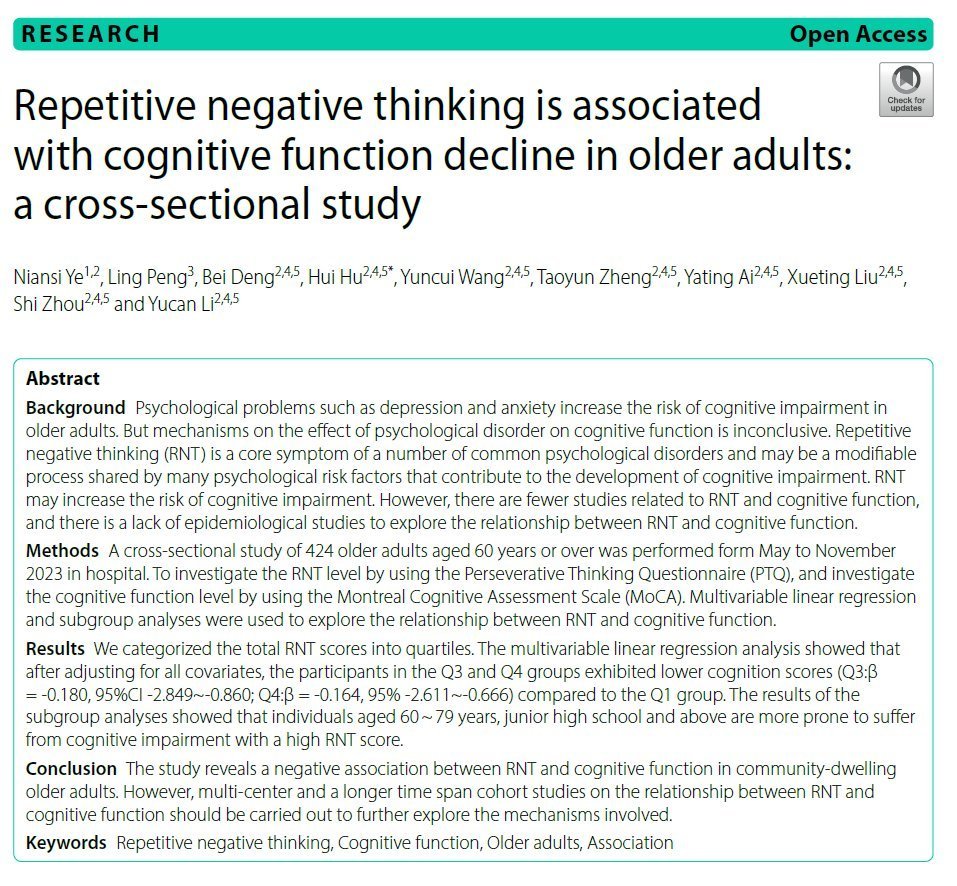
Repetitive negative thinking (RNT) may harm the aging brain.
A study of 424 adults aged 60+ found that higher levels of persistent negative thoughts were significantly associated with lower cognitive function scores.
Mental patterns matter for brain health.
DOI: 10.1186/s12888-025-06815-2
🧠 How does social media usage affect the young?
A recent study found that more than 2 hours of social media usage a day increased the odds of young people reporting loneliness.
🔗 Read the full article: https://t.co/hcH7dTQ3CT
#SocialMedia#FreeAccess