Filed to ESPN: Whether you needed a racer, a throwback to a simpler time, or even a role model of how to grow from kid lightning rod to grown family man, Kyle Busch was the one we looked to.
https://t.co/YfXZxCDEyJ
😂 spouse skepticism is real, but I can vouch that @mattressguy_ can make a believer out of even the most skeptical wife. Toddler, not so much. Can confirm he is not luring you to West Charlotte to kill you, other than with with kindness 😂 -#markedsafe
Dudes
Your wives will think you are getting scammed
But I promise you, if you buy outside of me
You will get scammed, but it won’t be by me
See not only do my mattresses typically cost less
But they also last longer
Get me on a 3 way call with your wife I got you fam
Let the Great Quail Hollow Debate commence: Why do pros love this week’s PGA Championship venue but everyone else doesn’t?
“Quail Hollow is like a Kardashian. It’s very modern, beautiful and well-kept. But it lacks a soul or character.” https://t.co/aqFE9PuZrj
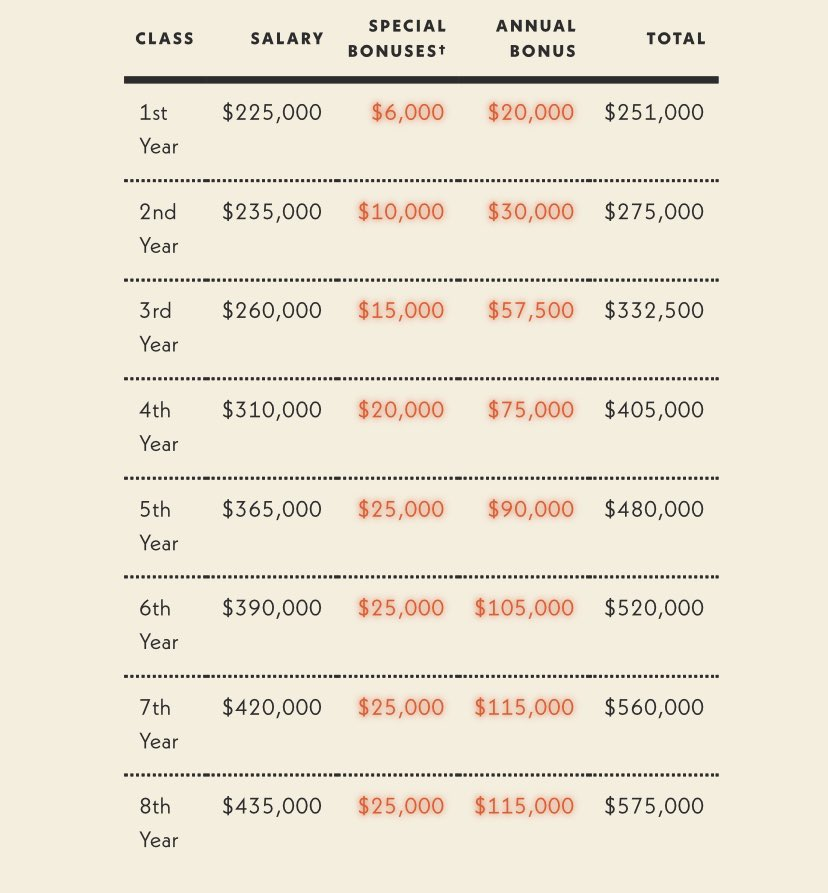
While everyone is stupidly bragging about the new biglaw salary chart which applies to less than 1% of lawyers, now is a good time for a reminder:
Except for complete anomalies, you're going to be financially screwed (or effectively waste three years) if you don't (1) go to an elite law school or (2) get a full-ride scholarship to a solid, regional law school (read: top 50).
Most people don’t realize that the legal profession is the land of “haves and have nots” based almost *entirely* off educational pedigree (and to some extent grades therein).
Most lawyers starting salaries range between $45k and $90k.
Another select group (the spike on the far right of the chart), starts at $225k on what’s called the “Cravath Scale” (the elite big law pay scale typically set by Cravath).
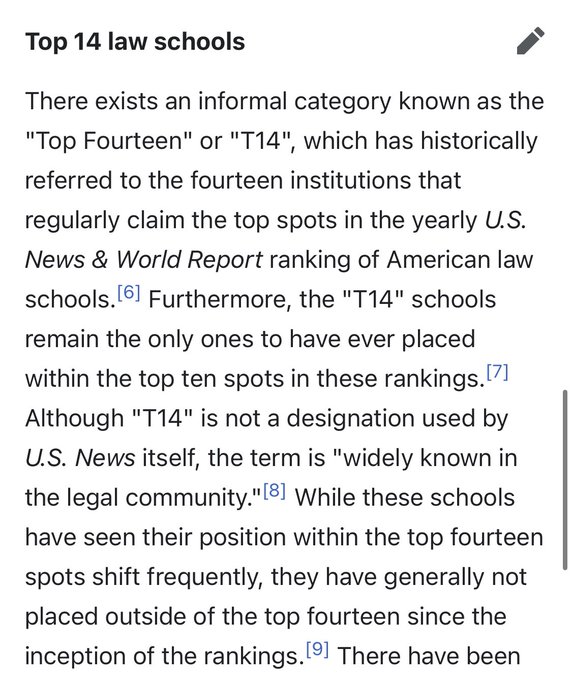
To be a part of the coveted Cravath Scale group, you almost *have to* go to a top-14 law school.
Why 14 schools? Historical pedigree stuff (see the Wikipedia excerpt). Who knows?
In the absence of a top-14 pedigree, to get a good ROI from your legal education, you need to go to a respected regional school (where you want to practice) on a *big* scholarship (read: most if not full).
This is because the non-discounted tuition of most law schools is now well into the six-figures (sometimes multiple six-figures).
The salaries, plus insane tuition rates, plus three years of foregone salary, plus increasingly high cost of living, make 90% of law school outcomes not financially desirable (and sometime overcomeable).
I don’t care what anyone says (especially those citing silly anecdotes about one-off success stories), if you don’t do either of these things, you’ll probably pay dearly.
Most law students don’t realize any of this until it’s too late!
You've been warned.
@Joel_Dahmen Joe's (cash only) as many have said, Ciao Italian, Benny's Trattoria, Blueberry's Grill, Joes Bar and Grill, Hot Fish Club in Murrells Inlet. Anything in Murrells should be less touristy.
She was such a fighter. Inspiring in how she went about her own challenges but also how she learned to live every day to it’s fullest. Amy and I were lucky to have known her and call her a friend.
Los Angeles Country Club is one of the world's most exclusive golf clubs.
• $250,000 initiation fees
• No celebrities or social media posts
And they use a 45-year-old tax loophole to save $80 million annually.
Here's how it works:
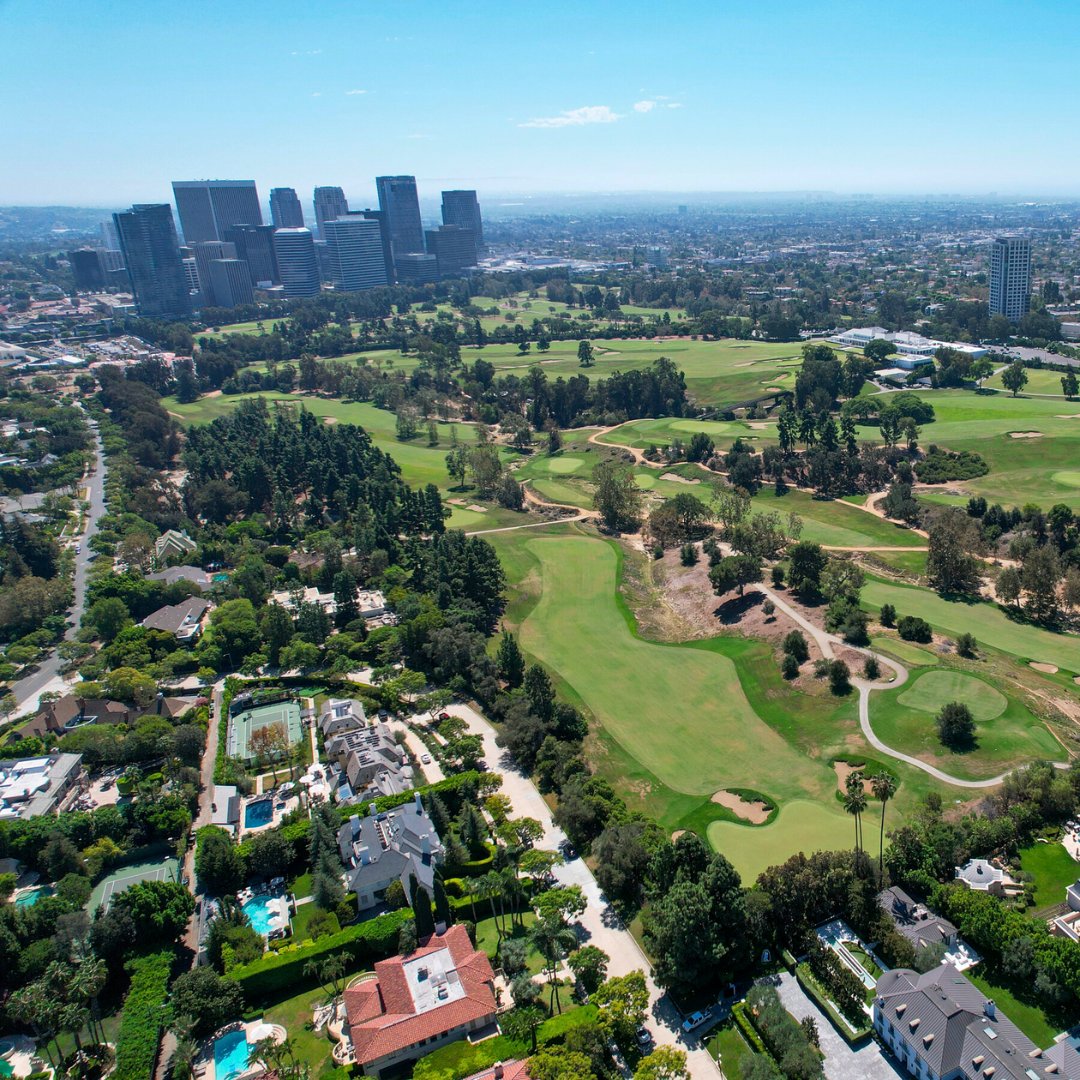
LACC sits on 320 acres in the heart of LA.
It's one of the country's nicest (and strictest) country clubs.
They don't allow celebrities to join, and every new member is handed a 1,000+ page rulebook.
LACC Rules
• No shorts (tailored pants only)
• Sport coats in the clubhouse after 6 pm
• No changing shoes in the parking lot
• No headphones, earbuds, or athletic clothes
• No photos or videos of the club on social media
Members can also only make phone calls from their parked car or a phone booth in the locker room.
And the club is so exclusive that many of the world's best players are seeing it for the first time this week.
Rory McIlroy, for instance, hasn't paid for a round of golf in 20 years. But he had never played LACC before this week's US Open, so he says he prepared by watching videos of the course on YouTube.
Still, the craziest part about LACC isn't its $250,000 initiation fee or its 1,000+ page rulebook.
The craziest part about LACC is its real estate.
The 320-acre piece of land sits smack dab in the middle of Beverly Hills — between the famous roads of Sunset Blvd, Wilshire Blvd, and Santa Monica Blvd.
The land alone is reportedly worth $8 billion, making it the second most valuable piece of real estate (not developed for housing) behind Central Park in NYC.
But here's the craziest part...
An $8 billion assessed land value would typically mean hundreds of millions in property taxes alone.
But LACC only pays $220,000 in annual taxes.
This is because of two rules:
1. LACC is owned by its members and registered as a non-profit. So they benefited when California voters passed a ballot in 1960 that lowered the value at which officials were allowed to assess non-profit golf courses.
This non-profit rule also applies to other LA-based golf clubs, like Bel Air Country Club, Brentwood Country Club, and Wilshire Country Club.
2. Then, in 1978, voters passed Proposition 13. This new law rolled back the assessed land value to its 1975 level and more or less froze that value in time.
So even if the market value of the land tripled in value, the property's assessed value can only grow by 2% a year or the rate of inflation, whichever is lower.
And Proposition 13 also capped property taxes at 1% of assessed value (vs. the previous average of 2.67%).
So, in simple terms, Los Angeles Country Club would be paying about $80 million (1%) in annual property taxes because its land is worth $8 billion-plus.
But because of these two laws enacted more than 45 years ago, LACC’s land is currently assessed at just $22 million, and they only pay $220,000 in property taxes.
LACC Tax Breakdown (estimates)
• True value of the land: $8 billion
• Assessed value of the land: $22 million
• Annual property tax savings: $80 million
Now, Proposition 13 wasn’t put in place specifically for golf courses — its true purpose was to protect homeowners who are older, retired, and living on fixed income from payment shock when their property values dramatically increase over a short period of time.
But given the financial savings it has provided exclusive golf clubs over the years, it’s no wonder why Los Angeles Country Club wants to keep things exactly as they are.
Ps. If you enjoyed this breakdown, subscribe to my podcast (top 25 in US sports) so you don't miss any episodes going forward!
Apple: https://t.co/oxtjqN8JOE
Spotify: https://t.co/LbK4dFSzNQ
DJR is one of the few guys in racing that has the pull to make things like this actually happen.
It’s nice to see him use that power for the good of our sport and so many others.