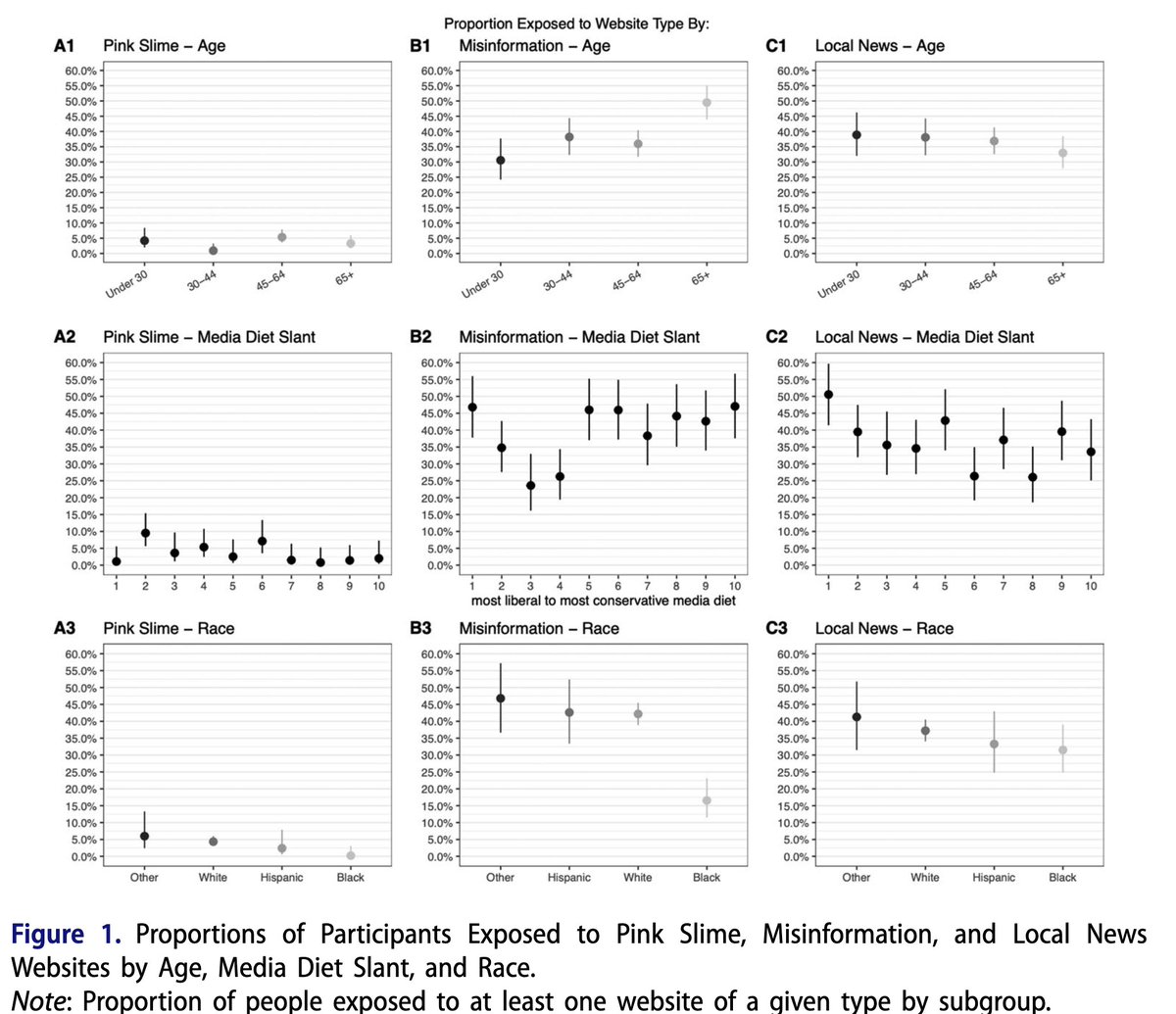
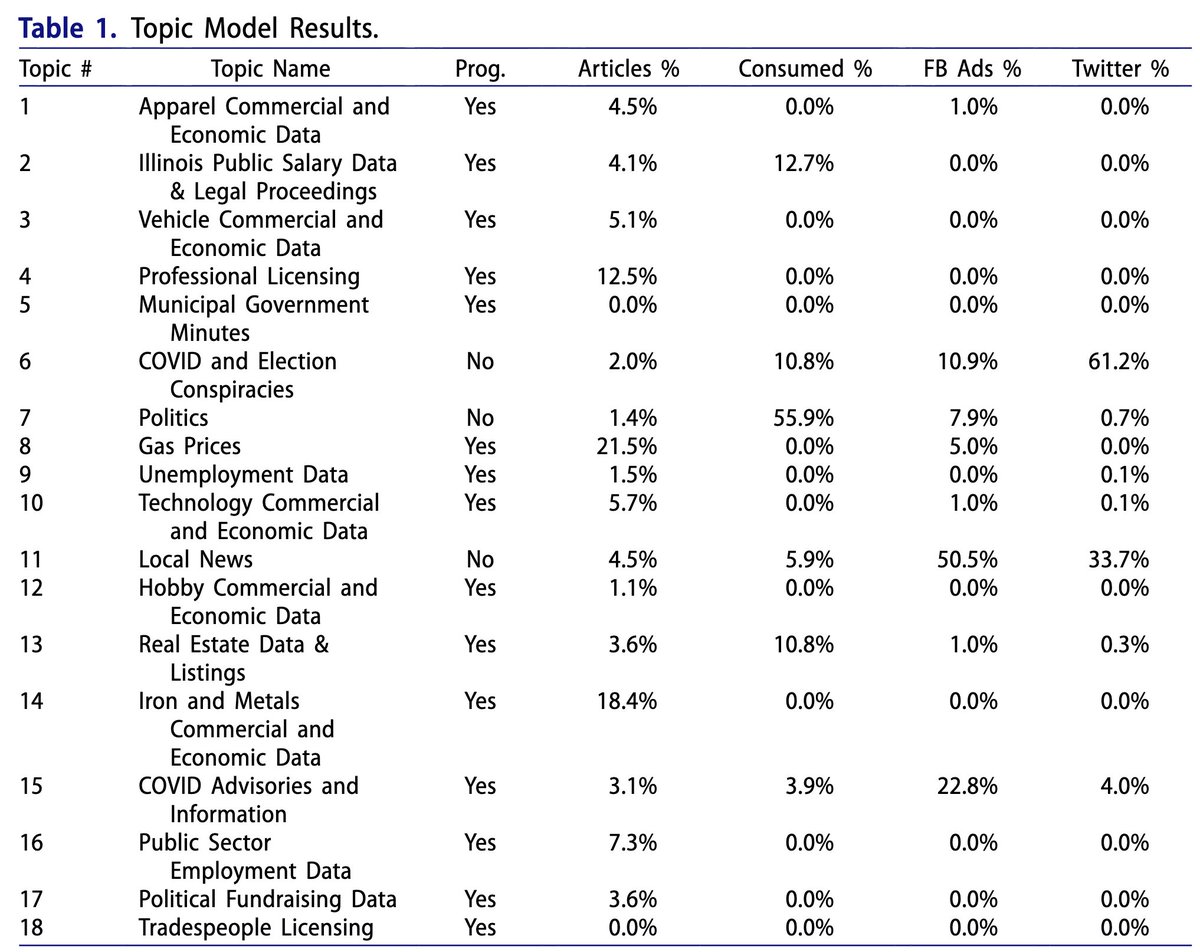
New work with @RyanMooreInfo in @djeditorialteam examines Americans' exposure to Pink Slime websites--partisan websites that masquerade as local news--and compares consumption levels to untrustworthy and genuine local news websites
Interested in learning more about the iSchool PhD program? Join us for one of our upcoming PhD info sessions, 10/28 https://t.co/5AcegzOyS3 and 10/30 https://t.co/LAjcoz0Ail
🚨 New Preprint! 🚨
“Detecting Synthetic, Doubting Authentic: AI Attribution Bias for Political Imagery”
📍 Link: https://t.co/KHPsvrWq1C
🧵 During the 2024 U.S. presidential election, many #GenAI political images appeared. But did voters mistake them for authentic? (1/)
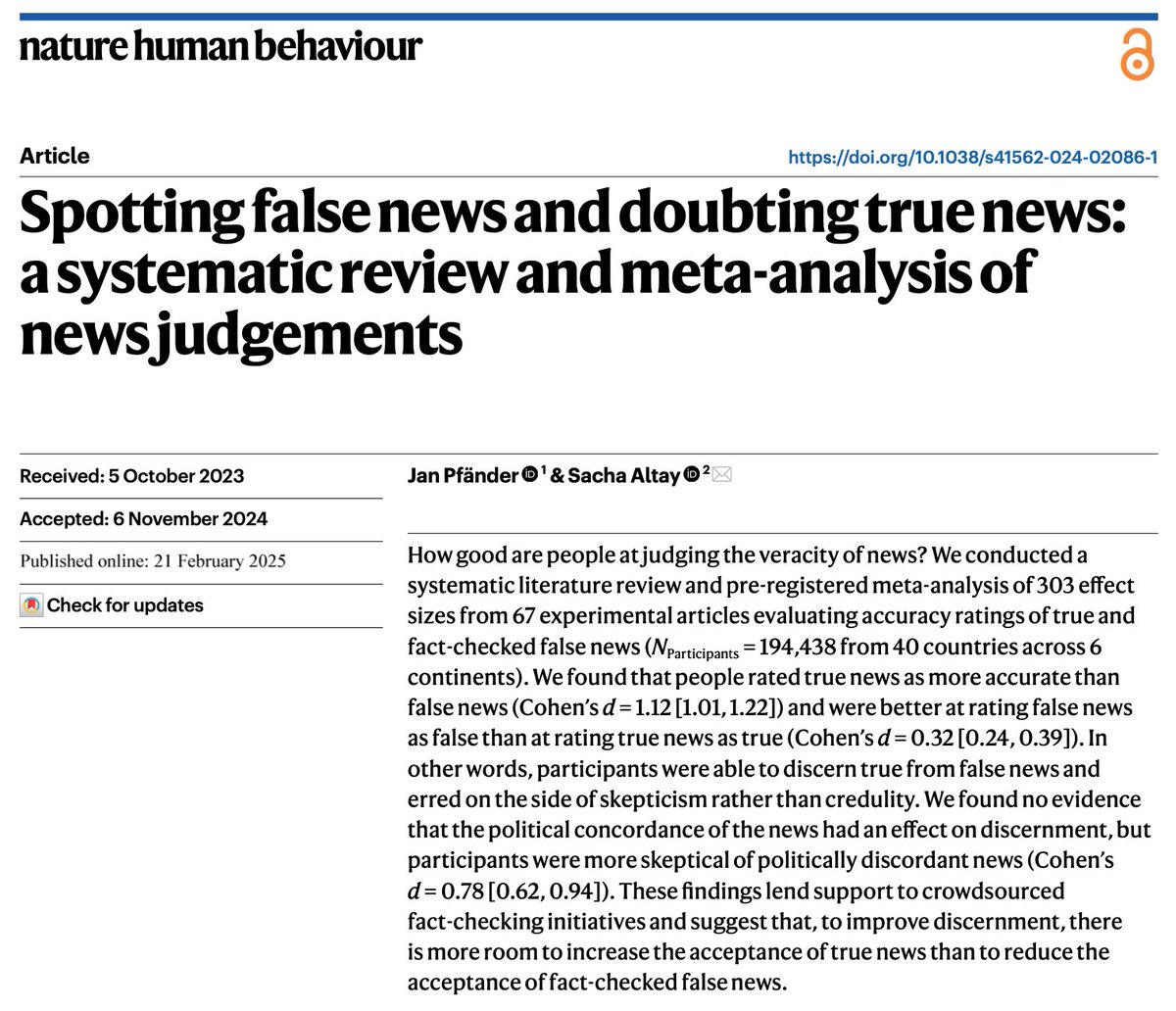
Out in Nature Human Behaviour 🔥
Can people tell true from false news?
Yes! Our meta-analysis shows that people rate true news as more accurate than false news (d = 1.12) and were better at spotting false news than at recognizing true news (d = 0.32).
I am very honored to have received the 2024 Emerging Scholar Award from @PsychScience@APSStudent. I want to take this opportunity to thank all my mentors and colleagues at @StanfordPsych and in the broader psych science community!
https://t.co/kvuhXmP7rr
[Please RT]
I’m recruiting PhD students to work with me at @UW!
I’m looking for students passionate about developing new *social media algorithms*, both broadly and within the scope of this NSF grant: https://t.co/oMaPj7phwE
More info: https://t.co/vnBqn40XWs
@UW / @UW_iSchool
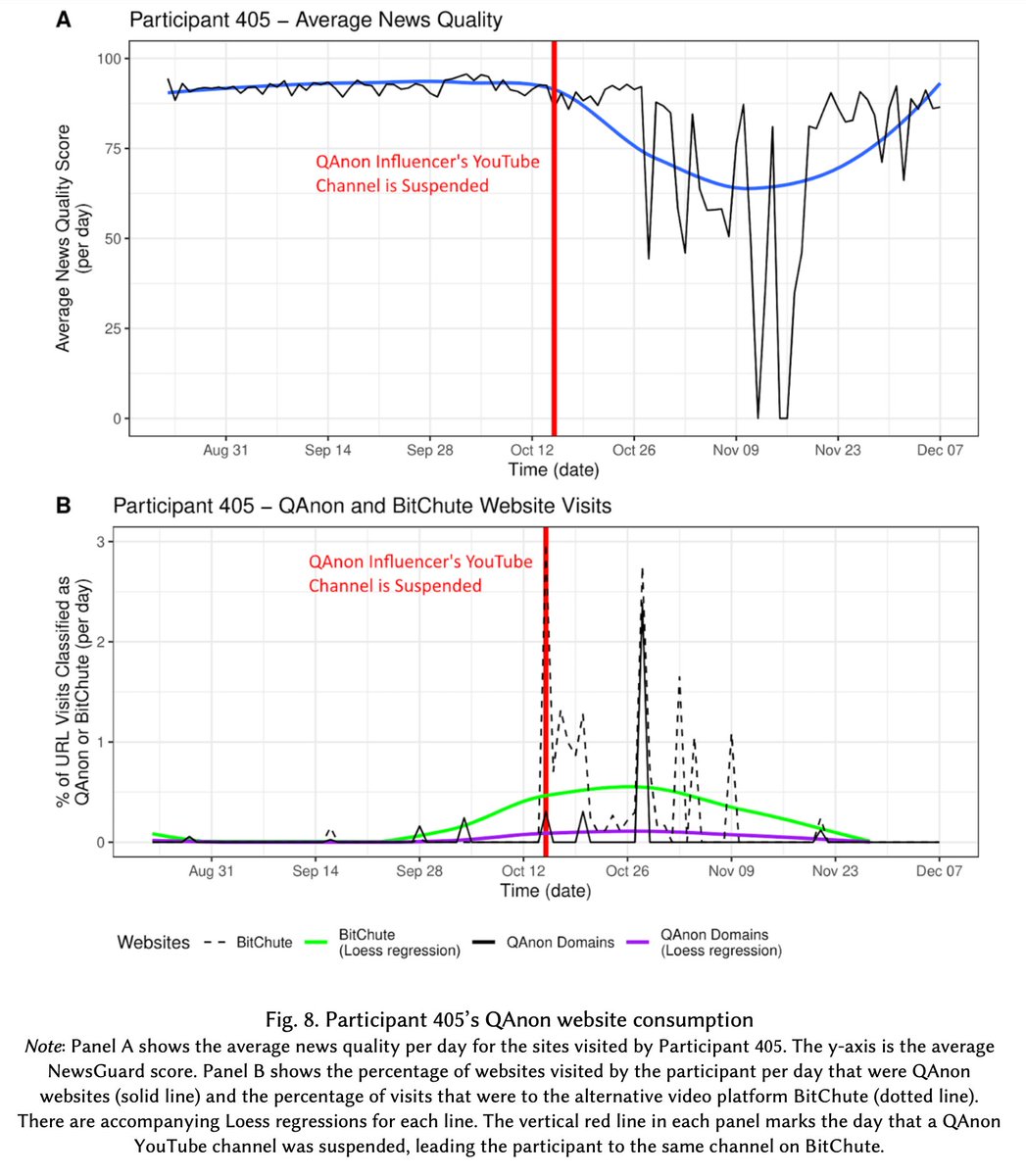
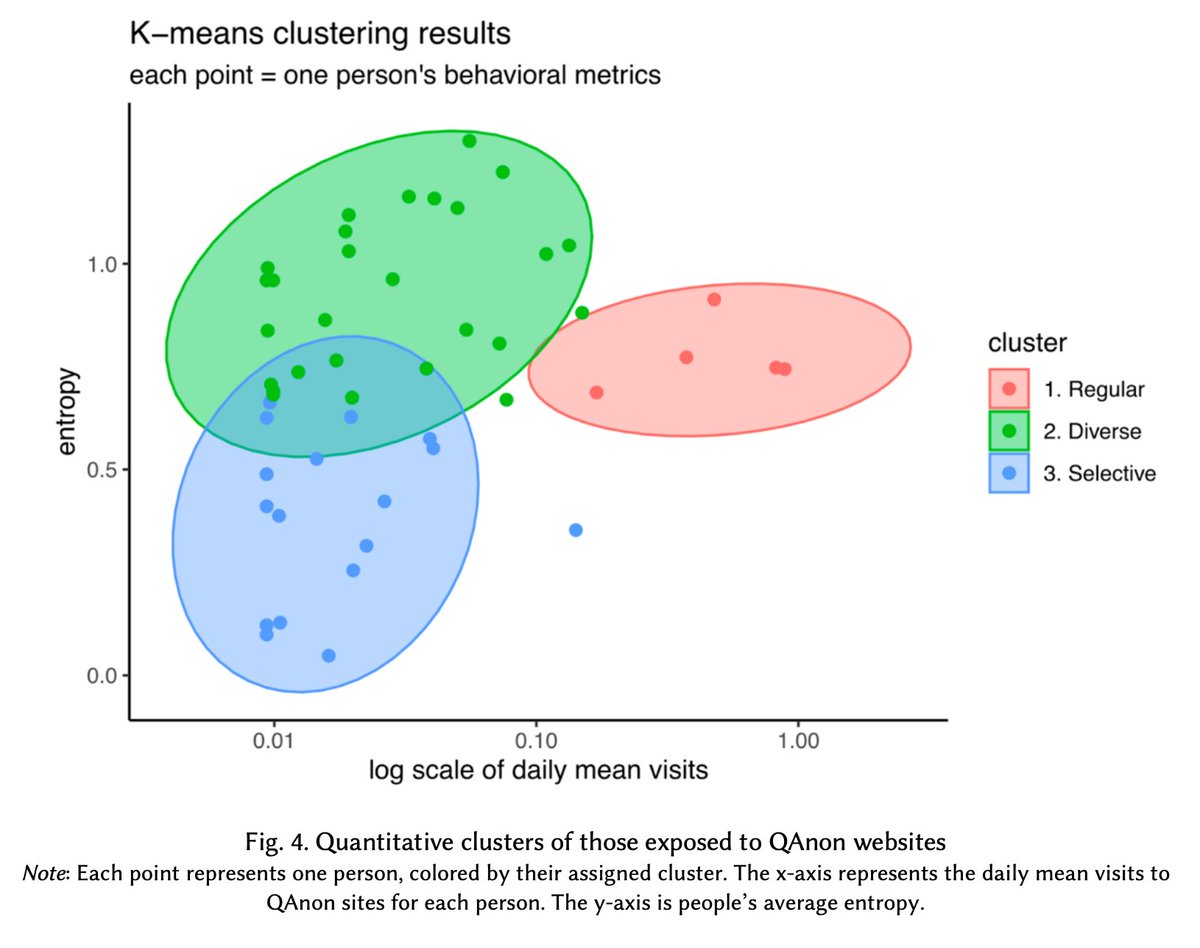
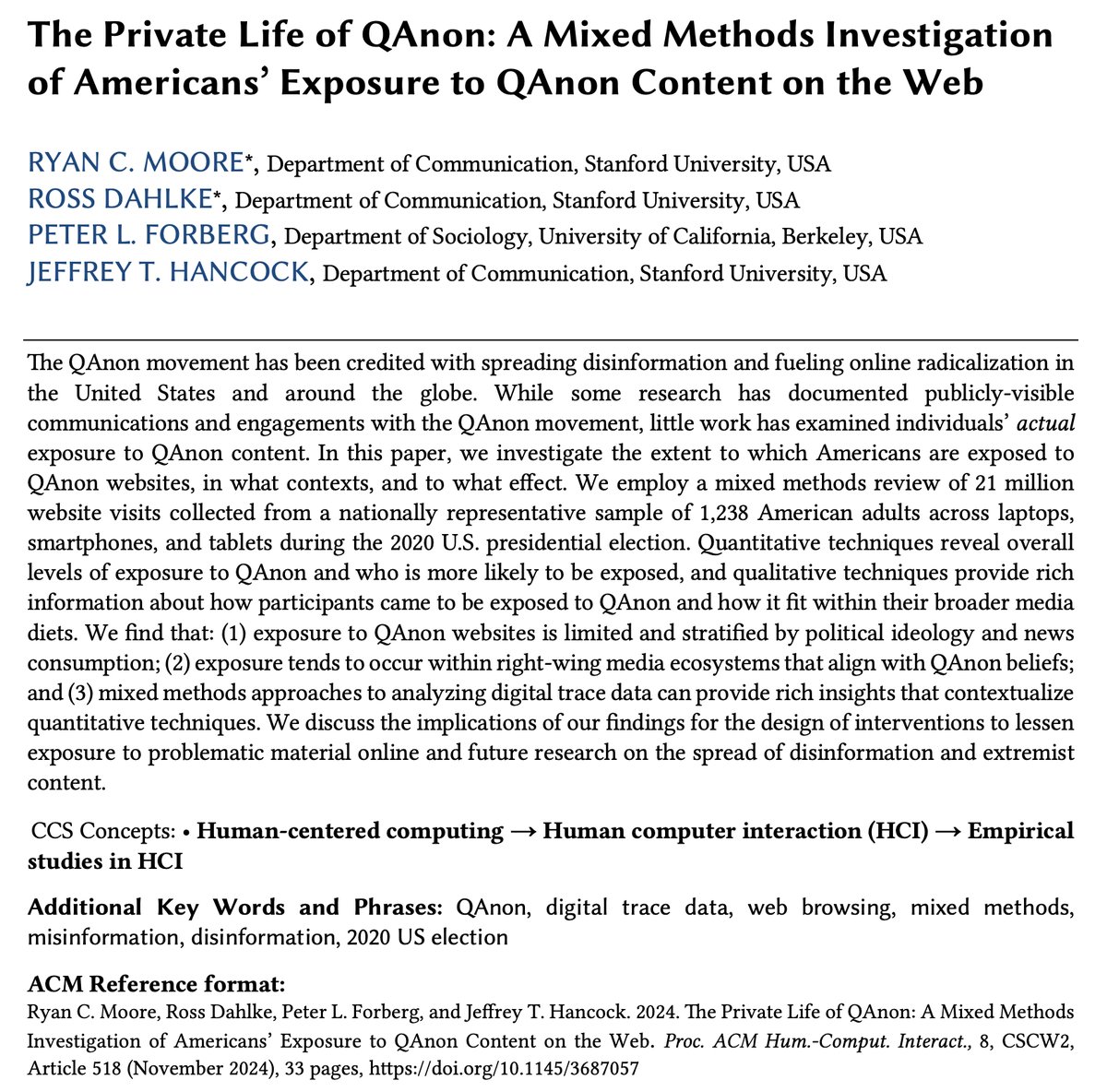
✨New from @RyanMooreInfo me @peterforberg @jeffhancock in #CSCW2024. We take a mixed-methods approach to studying American's exposure to QAnon, finding those on the political extremes are most likely to be exposed, but with distinct types of consumers https://t.co/cKl9INsnVK
Excited to present this work at #CSCW2024@ACM_CSCW next week in Costa Rica!
Please reach out if you’re interested in chatting. I’m especially keen to connect with folks who are working at the intersection of aging and tech.
How many Americans encountered QAnon during the 2020 presidential election? As many as 9.5 million, according to research from @RyanMooreInfo@Ross_Dahlke @peterforberg and @jeffhancock published in #CSCW2024. But who was exposed? Read on: https://t.co/WW2EZRUw4q
Our NIMH-funded grant on teen social media use & mental health with innovative data & methods is looking for a full-time research coordinator! Come work with us on this cool project! Please spread the word 📢📢
https://t.co/7zmM8edJp4
Have you ever worried that no one would respond to your message? Our #CSCW2024 paper proposes a commitment-based design in online groups to address this: https://t.co/YJa5ZULr6I (with @zhangyt0704 and @msbernst )
5 biggest challenges facing misinformation researchers https://t.co/MfseVCiwzA
1) Defining it
2) Everything is political
3) Harms hard to pin down
4) Companies own the data
5) The problem is global
I would add (related to #3), what's the direction of causation? Do people use misinformation to justify a position they already hold (e.g., part of a community that embraces) or did the misinformation lead to the belief? (Guess: complex & shifting combo).
by @kakape via @ScienceMagazine cc @Sander_vdLinden @STWorg @doritmi@DG_Rand@katestarbird@jonathanstea@ScienceUpFirst@MediaSmarts
One week until Election Day! If you're around the Stanford campus next Tuesday, join @rutheappel@ryanmooreinfo and me for our "Data Science & Democracy Day" presentation hosted by @StanfordData https://t.co/sfCFDRImev
How many Americans encountered QAnon during the 2020 presidential election? As many as 9.5 million, according to research from @RyanMooreInfo@Ross_Dahlke @peterforberg and @jeffhancock published in #CSCW2024. But who was exposed? Read on: https://t.co/WW2EZRUw4q
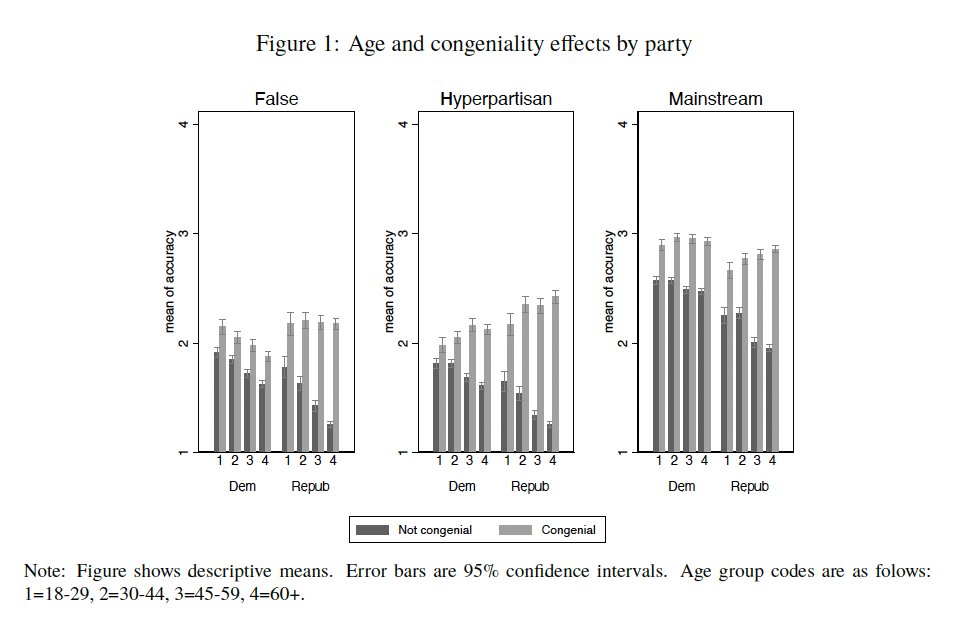
1 thing I wish I could've added: moving to a more realistic “supply” of false news – skewing right, instead of
balanced by slant – helps align findings from lab and field (shoutout @BernhardClemm). I wrote up a little extra supplement laying this out https://t.co/QBmxMb3rZc
We're hiring! Two tenure-track Assistant Professor positions available to start in Fall 2025: https://t.co/kxk1H80GWi
- Assistant Professor in Building Human-Centered, Ethical, and Responsible AI Systems
- Assistant Professor in Cultural Heritage Informatics
#higheredjobs
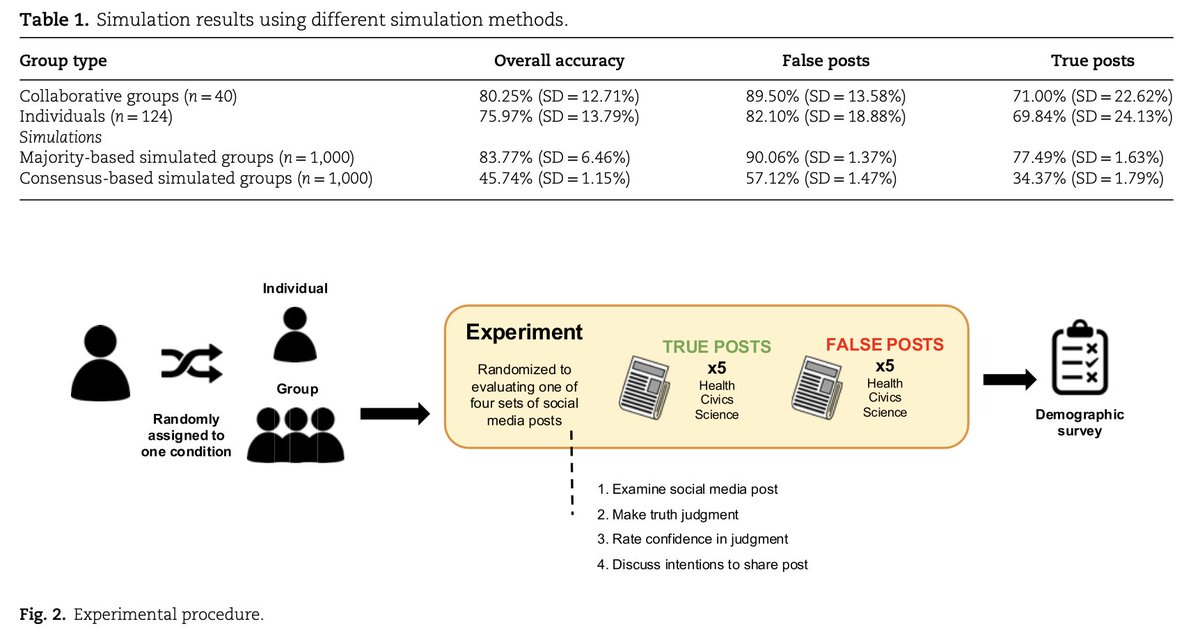
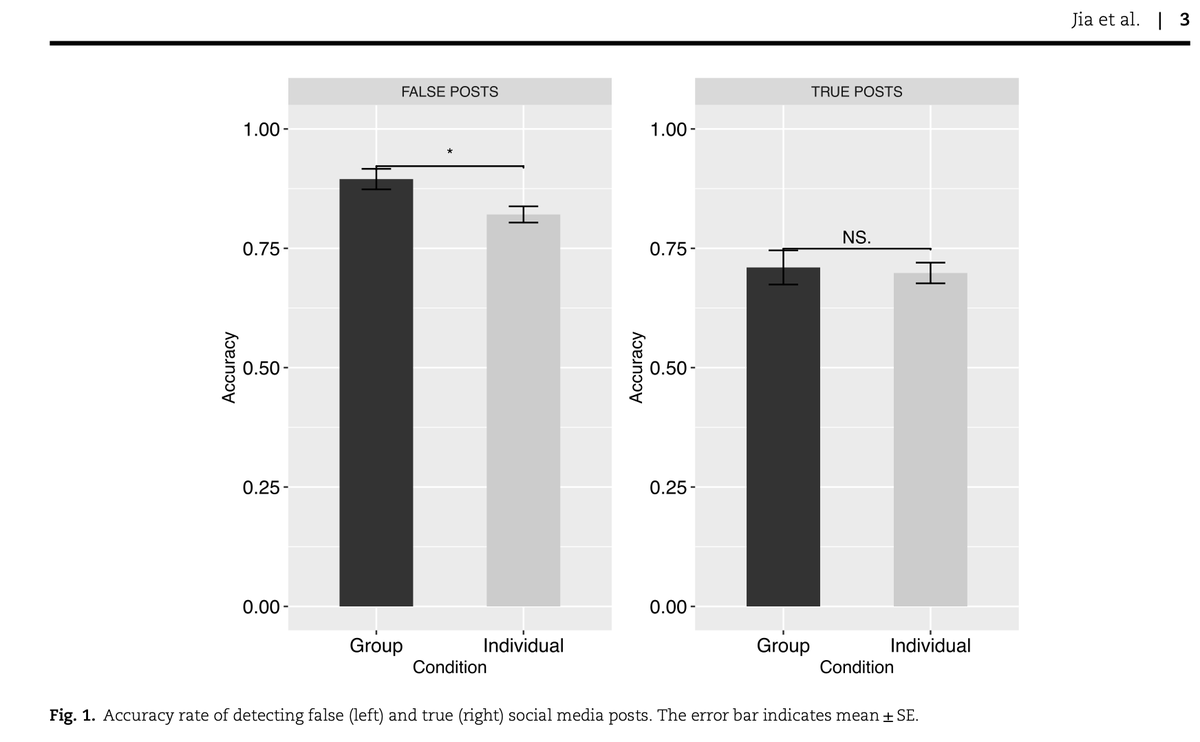
Can collaboration ameliorate our weaknesses in detecting misinformation? Our new @PNASNexus paper w/@angelaylee374@RyanMooreInfo@CidDecatur Sunny Xun Liu & @jeffhancock suggests a promising collaborative approach to combat
misinformation (1/10).
https://t.co/9i5EVJ12fN
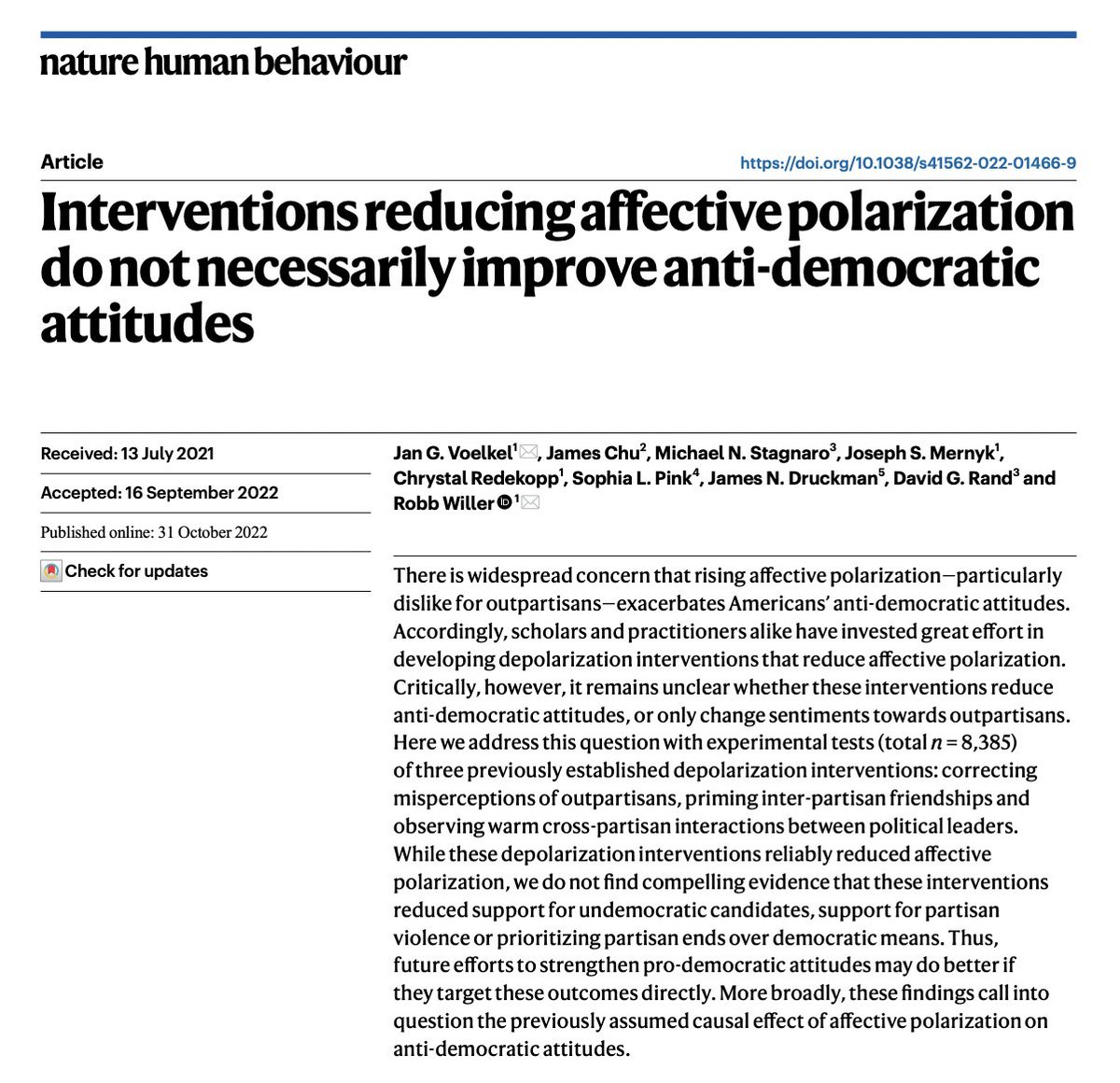
🚨 Strengthening Americans’ Democratic Attitudes🚨
For the last 4 years, we crowdsourced and tested ideas for ⬇️ antidemocratic attitudes & partisan animosity.
A 🧵 on all papers, published/IP @ScienceMagazine (🆕https://t.co/F9yarhq7nx🆕), @PNASNews (2x), @NatureHumBehav (2x).
















![msaveski's tweet photo. [Please RT]
I’m recruiting PhD students to work with me at @UW!
I’m looking for students passionate about developing new *social media algorithms*, both broadly and within the scope of this NSF grant: https://t.co/oMaPj7phwE
More info: https://t.co/vnBqn40XWs
@UW / @UW_iSchool https://t.co/ZkKp2l9nm0](https://pbs.twimg.com/media/GcQOJzxaAAEObfA.jpg)