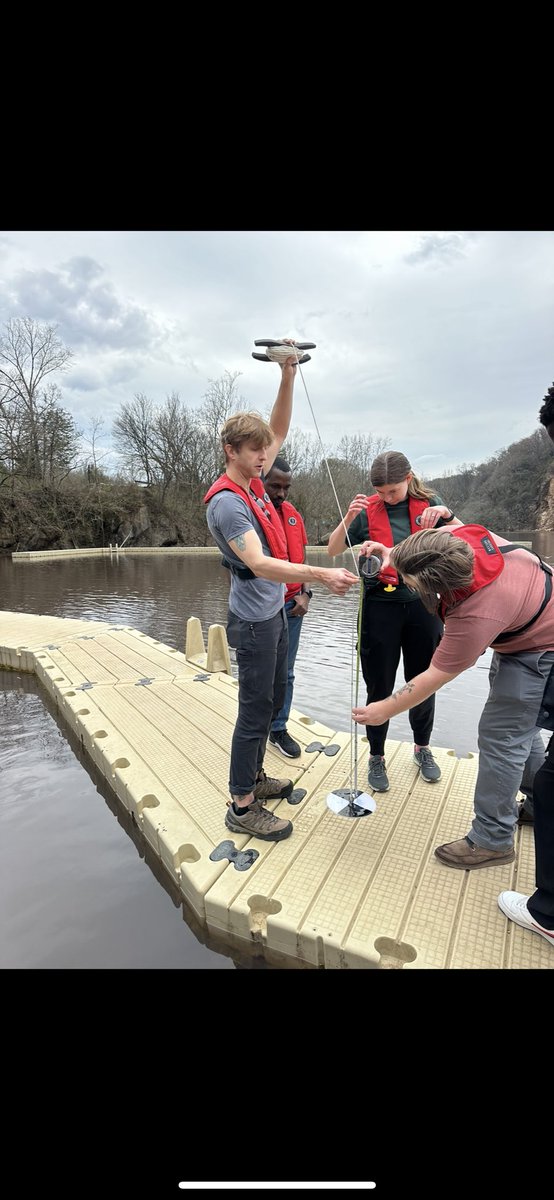
At 1 pm today, check out an interview with Zulimar Lucena, Supv. Hydrologist with the #USGS, on @KPRC2@HoustonLifeTV. Zuli will discuss #microplastics sampling 🌊🧪 in Galveston Bay and its tributaries -- work in collab with @TCEQ Galveston Bay Estuary Program and @UHCL_EIH.
USGS crews in Texas will continue to take measurements and monitor stations as the rain moves through Texas this weekend. Explore monitoring locations in your area, as well as radar, on the National Water Dashboard here: https://t.co/SDAN8RuoTO https://t.co/OPCvfSubml
USGS is measuring flooding across Texas & Oklahoma after 3 days of heavy rain. 21 streamgages showing flood conditions along I-35 corridor. More rain expected over the weekend.
Stay safe & check conditions👉https://t.co/TGcLo0Mq5q
Without the dedicated public servants at USGS, we’d have no information for flood warnings, bridge design, boating safety, or water availability for homes, businesses and farms. See the full infographic at https://t.co/r3ihO13pmU
#PublicServiceRecognitionWeek#PSRW
Are you ready for #GageGreatness?
The bracket reveal is here! 👇 10 Water Science Centers competing to claim the title of Greatest Gage... Which gage are you voting for?
Head over to USGS_Water on Instagram to vote in the first matchup! 🗳️
https://t.co/efLnIkCCsl
The complex interaction of water above and below ground is a key element of the hydrologic cycle. 💧 Here, a fiber-optic cable is deployed along the bed of a trout stream to measure temperature to identify areas where #groundwater is discharging into the stream.
#FieldPhotoFriday
USGS #flood maps saved lives - Crews measuring floodwaters across KY, IN & OH, confirmed recent USGS flood maps were very accurate. These maps help emergency managers make life-saving decisions in real-time.
@USACELRD @NWS@NOAA@USACEHQ
Founded #OnThisDate in 1879, the #USGS provides unbiased, reliable scientific information to manage natural resources and protect communities from natural disasters. Cheers to 146 years! 🎂🎉
#HappyBirthday
After years of detecting harmful algae in Sandusky Bay, #BGSU researchers discovered that a toxic algae called Planktothrix has essentially disappeared, highlighting the positive impact of ecological restoration.💧 #NationalWaterQualityMonth 📰 https://t.co/URajvdiAP3
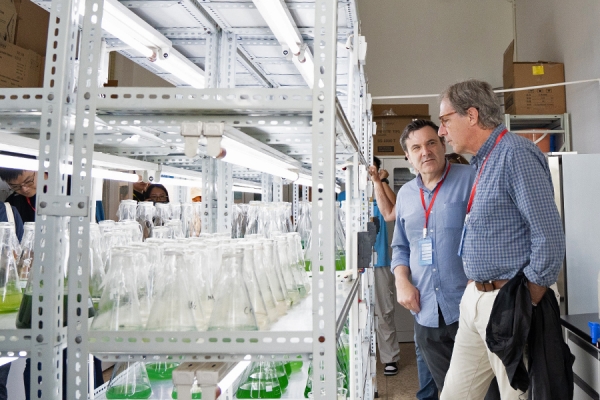
🧪@McKayGLIER and other scientists from @UWindsor's Great Lakes Institute for Environmental Research gathered in Kunming, China to address harmful algal blooms in freshwaters around the globe. Read more here: https://t.co/fMGBYs2W1U
#UWindsor#Windsor#YQG#GreatLakes#water
U-M lands $6.5M center to study links between Great Lakes algal blooms, human health
Great Lakes researchers at the @UMich have been awarded a $6.5 million, five-year federal grant to host a center for the study of links between climate change, harmful algal blooms and human health.
Increased precipitation, more powerful storms and warming Great Lakes waters all encourage the proliferation of harmful algal blooms composed of cyanobacteria.
Also known as blue-green algae, cyanobacteria can produce toxins harmful to humans, pets and wildlife. Though the pea-green summer blooms in western Lake Erie are the best-known in the region, cyanobacterial harmful algal blooms, or cHABs, now occur in all five Great Lakes.
"Toxic cyanobacterial harmful algal blooms are a growing threat to freshwater ecosystems, drinking water supplies and coastal communities worldwide, and the Great Lakes are ground zero for the climate-induced intensification of these blooms," said U-M environmental microbiologist Gregory Dick, who will serve as director of the Great Lakes Center for Fresh Waters and Human Health.
The center was founded at @bgsu in 2018 with funding from the @NIH and the @NSF. Due to the retirement of founding director George Bullerjahn at BGSU, the center's administrative home has moved to Ann Arbor with renewed funding from the two federal agencies.
The center will be co-directed by scientists at the @UToledoMed who focus on the human health aspects of cHABs.
While the center's core research projects and investigators won't change, its mission will evolve to pursue new directions stimulated by findings from some of the more than 70 research papers published in peer-reviewed scientific journals by center-funded scientists since 2018, Dick said.
One key finding by center-funded researchers from the University of Michigan is that cyanobacterial toxins can become airborne in tiny particles called aerosols when waves break against Great Lakes shorelines and piers.
But how much of a human health hazard do those aerosols pose?
To find out, two new center-funded research projects, one led by Andrew Ault of @MichiganChem and the other by David Kennedy and Steven Haller at the @UToledo, will assess the occurrence, transport and effects of aerosolized cyanobacterial toxins on human health.
Ault will team up with Allison Steiner of the @umclasp, Casey Godwin of @UMSEAS and Judy Westrick of @waynestate to study toxin release from cyanobacterial cells—as well as the aerosolization and transport processes—to test the hypothesis that climate change will increase human exposure to cHAB toxins through ingestion and inhalation.
Kennedy and Haller's project will focus on human health effects, with special emphasis on populations that are vulnerable due to preexisting conditions such as asthma. That study will involve the first-ever prospective assessment of the pulmonary health impacts of cHAB aerosols in susceptible populations in Lake Erie's Western Basin.
"Our region has long grappled with algal blooms, and communities are eager for answers regarding their impact on human health," said Kennedy, associate professor of medicine at the University of Toledo and co-director of Great Lakes Center for Fresh Waters and Human Health.
"Our study aims to provide vital insights, identifying at-risk populations and offering evidence-based information for healthcare providers and policymakers to enhance the health of our region."
Two other existing center-funded research projects will continue during the five-year renewal period.
One, led by Steven Wilhelm of the @UTKnoxville, looks at how climate change influences the proliferation and toxin production of various cyanobacterial harmful algal bloom species. The other, led by David Sherman of the @UMLifeSciences in collaboration with Ashu Tripathi of the U-M Natural Products Discovery Core, seeks to reveal the diversity, distribution and bioactivity of known and undiscovered cyanobacterial toxins and related compounds.
The center's four research projects are complementary and are unified by the goal of determining how climate change affects cHABs and how cHABs impact human health. Taken together, the projects will enable an assessment of the human health risks of cHAB toxins under current and future climate scenarios.
A Community Engagement Core led by Chris Winslow of @OhioState will connect the center's science to relevant communities, promoting communication of research outcomes to stakeholders.
"The threat to water resources in the Great Lakes—which hold about 95% of the surface fresh water in the U.S. and support a multibillion-dollar blue economy—is real," said Dick, who is also director of the U-M-based @CIGLR_UM and a professor in the @MichiganEarth and at the School for Environment and Sustainability.
"But despite these serious threats, key scientific questions surrounding the climate drivers and health impacts of cHABs remain unresolved. Our knowledge is not yet sufficient to predict how a changing climate will impact cHAB distributions, community composition or toxicity."
The center's studies will combine observation, experiment and modeling at the nexus of lake science, climatology, microbiology and biomedical science. U-M will partner with researchers at @bgsu, Ohio State University, the University of Toledo, Wayne State University, @michiganstateu, University of Tennessee, @UNC, @JMU, the @SUNY, and a Canadian allied partner, the @UWindsor.
More than 28 faculty researchers and dozens of students at the universities are expected to be involved.
In addition, center-funded researchers will develop new technologies for advanced monitoring and forecasting of cyanobacterial harmful algal blooms in collaboration with colleagues at @NOAA's Great Lakes Environmental Research laboratory and the U-M-based Cooperative Institute for Great Lakes Research.
The new technologies will include the use of an autonomous surface vehicle for cHAB sampling in Lake Erie's Western Basin, home to annual summer cyanobacterial blooms fueled by nutrient-rich runoff from croplands in the Maumee River watershed to the west.
Cyanobacteria blooms can result in higher water-treatment costs for local governments; they can prevent people from enjoying fishing, swimming, boating and visiting the shoreline; and they harm the region's vital summer economy.
In August 2014, nearly half a million people in the Toledo area were without tap water for more than two days after high levels of the cyanobacterial toxin microcystin were detected in Lake Erie.
In the wake of the Toledo water crisis, the Great Lakes Center for Fresh Waters and Human Health was launched to better understand the serious threats that chronic cyanobacterial harmful algal blooms pose to the region.
…And that’s a wrap on the new course - Advanced Micro Field Techniques! My students made local & national news identifying a toxic Plankothrix rubescens bloom during their field experiment - using metabolomics & metagenomics! Stay tuned for pub. So proud!
In a week I'll be joining two of my colleagues in a webinar to talk about our current project comparing cyanobacterial blooms in three bloom-prone regions of the Great Lakes.
https://t.co/WnkW9HwFJD
@GBullerjahn
Join @NEMWInstitute on March 18, 3pm ET for a #GreatLakes harmful algal bloom (HAB) webinar!
Topics: Upcoming HAB season, current work, research goals, and uses & impacts of HAB research. GLERL's Reagan Errera will serve as a @NOAA panelist!
Register: https://t.co/CysrPgH4K2
#ProudMentorMoment - Looking forward to my students publishing their findings & thankful for the SEC Emerging Scholars program @UTK for funding this course / project!
The final version of @ZepernickBN's paper is finally out as online early in the ISME J. Appropriate timing given low ice L. Erie '24 so far.
Declines in ice cover are accompanied by light limitation responses and community change in freshwater diatoms https://t.co/VrIfpduWLl