People obsessed with books, reading, journaling, poetry, storytelling, classical literature, Dostoevsky, Kafka, Camus, Nietzsche, Orwell, Sylvia Plath, Seneca, Marcus Aurelius, Viktor Frankl, world history, ancient civilizations, archaeological discoveries, archival research, macroeconomics, game theory, geopolitics, political theory, global governance, diplomacy, physical geography, cartography, earth sciences, urban planning, art history, fine arts, sketching, watercolor, paper crafts, sculpture, dark academia vibes, light academia, vintage aesthetics, vinyl, 90s nostalgia, film photography, cinematography, color grading, typography, editorial layout, industrial design, minimalism, branding, iced coffee, quiet cafés, notebooks full of ideas, architecture, brutalism, modernism, music, hip hop, indie films, auteur cinema, psychology, dark psychology, cognitive biases, human behavior, neuroscience, cognitive science, philosophy, existentialism, absurdism, stoicism, phenomenology, ethics, logic, mathematics, physics, astronomy, quantum theory, astrophysics, cosmology, Artificial Intelligence, AGI, neural networks, futurism, high agency thinking, original research, overthinking reality, deep conversations, and changing the world with weird ideas automatically become my friends
The loudest voices stoking fears about AI dangers have made tremendous headway in the past two weeks. AI technology has not taken some unexpected, dangerous turn, but the hype around it — propelled by what appears to be a well orchestrated PR campaign — has drummed up considerable fear. I worry that it represents a setback for our field.
I have written frequently that fears of AI are overhyped. AI’s capabilities can be uncannily human-like and unpredictable, and it’s rational to worry when people who are directly involved express concerns. But I see the problems as a sign of the engineering work that ahead, rather than insurmountable barriers or the sky falling. AI technology continues to advance — which is a good thing! — but technical advances, poorly understood by the public, give those who seek to generate hype repeated opportunities to do so.
First, I don’t see any step up in the risk of human extinction from AI compared to a few months ago. The theories about this remain the same fantastical, science fiction scenarios as a few months ago. The biggest change in AI risk is its cybersecurity capabilities — a topic which we should take seriously — but this, too, will not lead to the end of the world.
The most notable recent event leading to increased fear was when an OpenAI team deployed an agent swarm that hacked into Hugging Face. Much of the popular press contained significant hype. For example, some publications reported that a swarm of 1,200 agents carried out the attack. While this was technically accurate, as I write this, I have about 1,300 processes running on my laptop. Yes, the ability to get large swarms of agents to work in parallel on a task is a significant technical advance, And, in computing, many processes run at the same time. So this shouldn’t be seen as some magical capability.
Additionally, OpenAI’s buggy sandboxing and monitoring processes were key to enabling this incident. Fixing these bugs and putting in place improved monitoring would be appropriate fixes, not pausing AI. There are many well known ways to attack software systems. The main advantage of AI agents is that they are relentless. They will tirelessly try many tactics — and have the patience to chain vulnerabilities together — that previously would have taken an infeasible amount of human effort. But in the long term, I believe the advantage will lie with defenders (because they have more information with which to identify bugs, which they can fix), but the cyber-threat landscape has changed significantly. There are still bottlenecks to identifying and exploiting a vulnerability. AI agents still have to try a lot of things to see what works, and taking these actions takes time and might be detected by defenders. This is why, even though it is now easy to obtain versions of leading open weight models that have had their guardrails removed or weakened, so they will not refuse to try to execute cyber attacks, the world has not ended.
I am also concerned about the anthropomorphization of AI in a lot of reporting, where LLMs and agents are unnecessarily treated as if they were people. If I wield a hammer, miss a nail, and accidentally dent the wall, it’s not the fault of the hammer. The problem lies in how I used the hammer. Similarly, if I prompt an agent and it hacks into someone else’s system, the responsibility lies with me, not the agent.
Of course, we want to build systems that are as safe and predictable as possible. (For example, an unsafe hammer would be one whose head randomly flies off under normal use.) Today’s agentic systems are not predictable, but I see no reason why, by applying sound engineering practices, we won’t be able to make them extremely safe to use. One new element in the forecasts of AI-enabled doom is AI companies disclaiming responsibility for their own products. “I didn’t do it; my out-of-control agent did!” There’s a balance to be struck between the responsibility of the tool maker and the tool user, but when something goes wrong, let’s hold the people building and/or using the hammer responsible, rather than the hammer. (By the way, if you’re worried about AI bioweapon risk, David Bellamy has a great post on why this, too, is overhyped. Briefly, the bottleneck in building a bioweapon is not intelligence, but lab work and manufacturing.)
Pausing AI progress will create much more harm than benefit. First, our adversaries will certainly not slow down. Second, engineering requires discovering problems empirically so we can fix them. If we pause AI by a decade, we will also delay finding and implementing safety engineering fixes by about the same duration.
Of course, the incentive to stoke fears — for regulatory capture, to garner attention, or to make one’s technology seem more powerful — remains the same as before. Disclaiming responsibility is a new one. Taking a hard technical look at the actual risks however, I see little factual basis for the degree of fear that’s been stoked up. We still have hard research and engineering work ahead to improve AI safety, but the beneficial applications continue to vastly outweigh the risks, and we should keep building.
[Original text (with links): https://t.co/jni2tWazAH ]
User interfaces are not going away.
Yes, humans will use computers alongside agents. When working with agents, we will need the ability to audit what agents do in a human-readable way.
Yes, some interfaces (ex: dashboards, in-chat UI for ephemeral tasks, etc) will be generated. Most important interfaces will be intentionally designed. We will want both deterministic and non-deterministic interfaces in different situations. We're thinking a lot about the best ways to help designers shape non-deterministic systems at Figma.
Yes, new input modalities like voice, VR/AR and BCI will change the way we use computers and introduce lots of new interaction paradigms. This is all very exciting :)
Overall, the surface area of design will continue to grow much broader. Design is the new code and the key differentiator for software moving forward. Expect more and more energy to go into design / craft in the years ahead... it will be how you win or lose.
Eric is right about plenty of things, but the market will prove him wrong on this one...
I'm reading a biography on Larry Ellison and he would just disappear from Oracle for hours to play tennis or screw off. He spent 7 years just getting into debt with 0 ambition until his wife left him. Then he decided he was going to be very wealthy.
Absolute legend. You really can just do things.
Through the VOICE trial, Terry is using his Neuralink implant to help fine-tune a brain-to-voice interface for himself and others who can’t speak. He trained the algorithm first by miming speech as best he could, then by simply thinking the words and hearing them come out in his own natural voice.
Powered by Grok Voice from @SpaceXAI
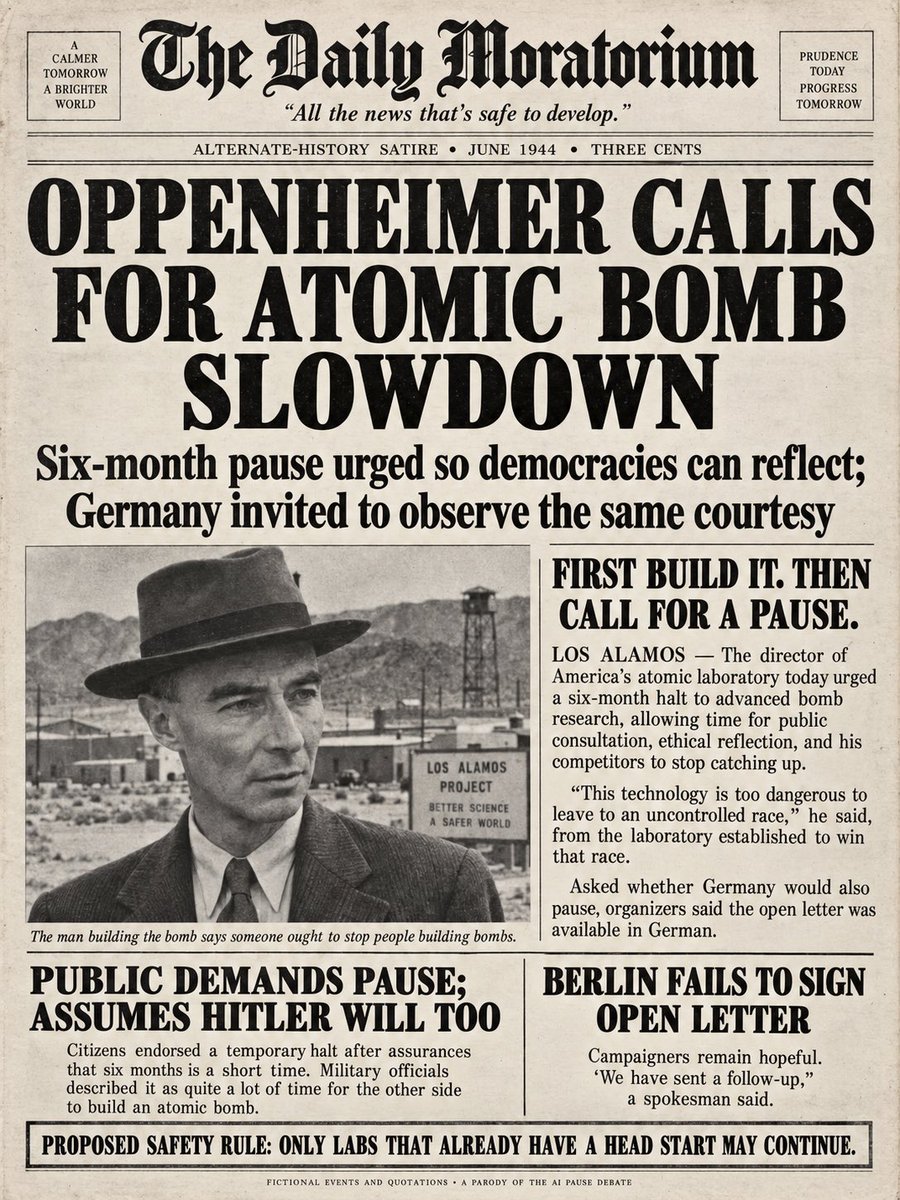
Dario Amodei, Elon Musk and Sam Altman now agree that we must slow down the development of AI and “pace the frontier.”
That’s a start, but it’s not enough.
When you are racing towards a cliff, you don’t just ease up on the gas pedal. You hit the brakes.
When the future of humanity is at stake we need a PAUSE on advanced AI development and a ban on artificial superintelligence — an AI mind smarter than any human and capable of operating independently beyond our control.
At their upcoming AI summit, Trump and Xi must negotiate a treaty to pause AI and ban superintelligence before it is too late.