Prioritizing and interpreting disease-associated genetic variants remains one of the greatest challenges in human genetics. Today, we’re thrilled to introduce AlphaGenome Atlas 🧬, a genome-wide platform providing precomputed predictions for the regulatory effects of all ~9 billion possible single-letter changes and >100M observed indels in the human genome.
Here is what Atlas delivers:
1. Variant Prioritization via AVI
To prioritize variants, we developed the AlphaGenome Variant Impact (AVI) score. AVI predicts a unified score per variant, where higher values indicate greater disruption. It achieves state-of-the-art performance across diverse benchmarks. As a proof-of-concept with our collaborators at @broadinstitute, AVI prioritized a deep-intronic variant in DNM1, helping solve a previously unexplained rare epileptic encephalopathy case by revealing a brain-specific cryptic splice site.
2. Multi-Layer Molecular Interpretation
Variant prioritization is only half the battle; researchers also need to understand why a variant matters. Atlas decomposes variant effects across multiple interpretable layers:
•Feature Attributions which decompose each variant’s score into specific biological modalities driving the impact.
•Cell-Type Specificity: Precomputed predictions with AlphaGenome across hundreds of biosamples reveal the exact cellular context in which a variant acts.
•Regulatory Grammar: Over 2,600 de novo DNA motifs (and >250B genome-wide instances) show when variants directly disrupt critical regulatory binding "words".
Explore the resource:
🌐 Interactive browser & precomputed data: https://t.co/RtXWwMoUhv
- 🎥 Video: https://t.co/KAQk11KIFI
- 📖 Blog: https://t.co/2cJSgVF0aG
- 📄 Preprint: https://t.co/JATG5dESX2
Single-cell atlases continue to map the diversity of cell states, but how can we use them to interpret non-coding genetic variants?
Excited to share AlphaGenome 2, our model for predicting cell-type-specific regulatory activity and variant effects from DNA sequence.
https://t.co/Sc2srWbTIe
A few detailed case studies are presented in the paper. Checkout the precomputed E2G and GWAS variant predictions https://t.co/eapEhM6QNe. Really proud of the work by the amazing team!
AlphaGenome 2 brings AG1 to single cell resolution and improved cell type specificity. On single-cell eQTL, AG2 nearly doubles recall over fine-tuned AG1 and Scooby at 90% precision. Imputing missing modalities and generalization to unseen cell states are new capabilities added.
Announcing a major milestone achieved by my team @GoogleDeepMind: we have proven key security properties of the machine code underlying the Signal messaging protocol. This is the first time the actual production code of a widely deployed protocol has been formally verified – by any method, with or without AI – and at this depth.
More than a research breakthrough, it’s a prime example of how frontier AI can be a force multiplier to counter the speed and scale of modern cyber threats.
Formal verification offers a higher standard of security; however, it’s extremely complex and time consuming, which is why in many cases it’s considered to be impractical. Similar efforts could take teams decades of combined effort. We did it in a month’s time.
Using AlphaProof Code, Google DeepMind's new agentic framework for formal verification that runs on LLMs including Gemini Carbon, we verified the Signal protocol down to the actual code running on devices. This milestone lays the groundwork for a future in which vital systems, from medical device firmware to power grid software, ship with mathematical proof that their protections work.
Reaching that future will take continued research from our community. In that spirit, we're open-sourcing our formal specifications and verification artifacts so others can build on this work.
On a personal note, this moment is of deep significance to me. I started my own research journey more than two decades ago as an intern working on checking the consistency of complex software systems. Seeing this grand challenge made practical with modern AI is extraordinary.
I'm extremely proud of my team members: Swarat Chaudhuri, Andrew Ferraiuolo, Anton Kovsharov, Tej Chajed, Sam Schlesinger, Karn Seth, Jonathan Katz, and Charles Sutton for taking on this grand challenge and delivering, and grateful to the Signal team for their partnership.
https://t.co/kN1eRYQ8fF
The @GoogleDeepMind#Genomics team in London is hiring a Student Researcher for 2027. We're looking for PhD students with strong experience in machine learning (post-training and RL) and an interest in applying these methods to genomic models. Link to apply:
Today we’re releasing GDPx, a benchmark for measuring agentic capabilities across the most valuable domains.
GDPx is a true frontier-level benchmark: even the best model scores just 12% (1/7)🧵
At @GoogleDeepMind, we believe one of AI's most transformative impacts is empowering scientists to solve society's hardest problems.
Over the past year, we've evolved our coding agent, @Google@Antigravity, to accelerate end-to-end scientific workflows combining our latest Gemini models with science-specific:
• breakthrough models like AlphaFold and AlphaGenome
• new interfaces like the Biomolecular Structure Viewer
The impact of this integration has been transformative for the pace of our research. As an example, in a single session using Antigravity, our researchers working on antimicrobial resistance surfaced a novel antimicrobial peptide candidate.
To support academic researchers leverage these tools, we've launched an Antigravity for Science credits program and are looking forward to what this enables:
https://t.co/R4hlX3sgxL
Read the antimicrobial resistance case study:
https://t.co/aZKsOaaUiP
Gemini 4 Argon is now globally available.
Built to solve your hardest problems from start to finish, the model brings frontier capabilities across coding, enterprise workflows, and cyber defense.
Very happy to announce that our team @GoogleDeepmind has pushed the boundaries of generative biology, achieving the successful synthesis of AI-designed proteins that are both functional and watermarked.
This proof-of-concept watermarking of the building blocks of life is enabled by SynthID Bio, our new protein watermarking method. It is designed to safeguard the new era of AI-powered generative biology and strengthen global biosecurity.
You can read my thoughts here on why watermarking AI-designed proteins is an important research breakthrough: https://t.co/dfoSdh8ynz
Prioritizing and interpreting disease-associated genetic variants remains one of the greatest challenges in human genetics. Today, we’re thrilled to introduce AlphaGenome Atlas 🧬, a genome-wide platform providing precomputed predictions for the regulatory effects of all ~9 billion possible single-letter changes and >100M observed indels in the human genome.
Here is what Atlas delivers:
1. Variant Prioritization via AVI
To prioritize variants, we developed the AlphaGenome Variant Impact (AVI) score. AVI predicts a unified score per variant, where higher values indicate greater disruption. It achieves state-of-the-art performance across diverse benchmarks. As a proof-of-concept with our collaborators at @broadinstitute, AVI prioritized a deep-intronic variant in DNM1, helping solve a previously unexplained rare epileptic encephalopathy case by revealing a brain-specific cryptic splice site.
2. Multi-Layer Molecular Interpretation
Variant prioritization is only half the battle; researchers also need to understand why a variant matters. Atlas decomposes variant effects across multiple interpretable layers:
•Feature Attributions which decompose each variant’s score into specific biological modalities driving the impact.
•Cell-Type Specificity: Precomputed predictions with AlphaGenome across hundreds of biosamples reveal the exact cellular context in which a variant acts.
•Regulatory Grammar: Over 2,600 de novo DNA motifs (and >250B genome-wide instances) show when variants directly disrupt critical regulatory binding "words".
Explore the resource:
🌐 Interactive browser & precomputed data: https://t.co/RtXWwMoUhv
- 🎥 Video: https://t.co/KAQk11KIFI
- 📖 Blog: https://t.co/2cJSgVF0aG
- 📄 Preprint: https://t.co/JATG5dESX2
A huge congratulations to the entire team and all our incredible collaborators! Sincere thanks as well to the open-source genomics community whose foundational tools helped make this work possible.
We can’t wait to see the discoveries the community makes with AlphaGenome Atlas 🧬
To make AlphaGenome Atlas even easier to use in computational biology workflows, we also built an AlphaGenome Agent Skill 🤖
Instead of writing custom query scripts or parsing raw tables, you can interact with AlphaGenome Atlas in natural language directly with Google Antigravity! 🤖👇
https://t.co/6vHJUkTerc
🚀Please help share widely! We're excited to launch the new #AI4BIO#Fellows Program @SCSatCMU to recruit exceptional early-career scientists pursuing bold, independent research at the intersection of AI and biology.
Fellows will be supported by The Center for AI-Driven Biomedical Research (#AI4BIO) @SCSatCMU and co-mentored by two CMU School of Computer Science faculty members, with opportunities spanning AI models, computational biology, and autonomous science, including engagement with the CMU AI Science Foundry (https://t.co/rR79xzCoEv).
We are looking for truly exceptional candidates who want to help define new directions for AI-driven biomedical discovery.
📅 Apply by November 15, 2026.
🧬 Program information: https://t.co/iZW5Dg5ue2
🤖 Application via Interfolio: https://t.co/6mSLILbEvr
We’re hiring in my group at Calico. We build Borzoi and its successors—deep learning models that predict how every nucleotide shapes cell-type-specific gene regulation—and apply them to interpret human genetic variation.
Scaling laws are powering AI. It’s time to scale biology.
Today we’re launching the Virtual Biology Initiative to generate the data to unlock scaling laws in biology and build accurate predictive models of the cell.
Digital representations of proteins are already expanding our understanding of life at the molecular level, and accelerating the design of molecules and medicines. Accurate digital representations of the cell could reveal the mechanisms that are responsible for disease, and show how to reverse them.
The protein data bank, and worldwide repositories of protein sequence biodiversity were created through decades of work by the scientific community. The advances in artificial intelligence for proteins would not have been possible without them.
The cell is orders of magnitude more complex, and we will need to create the data in just a few years rather than decades.
This will require a coordinated global effort. We're partnering with Broad, Wellcome Sanger, Arc, Allen, Human Cell Atlas, Human Protein Atlas, NVIDIA, and Renaissance Philanthropy.
Biohub is contributing to this effort as both a funder and a builder. We are developing microscopy to observe millions of cells in living organisms, and cryo-ET to resolve the cell in atomic detail. We're building instruments that expand the range of modalities and parameters that can be simultaneously measured. We’re developing molecular, cellular, and tissue engineering to create models of disease and design interventions.
The data we generate will be available to the worldwide scientific community.
We’re also committing $100M over the next five years to support work beyond Biohub.
We invite other scientific teams and funders to join.
Link: https://t.co/93Nw1QT5iZ
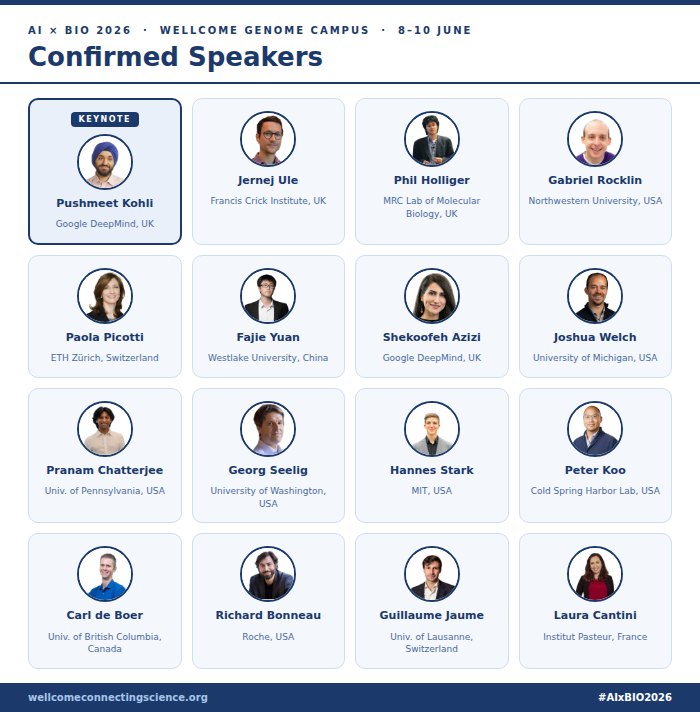
Join us at #AIxBIO 2026🧬8-10 June, Wellcome Genome Campus UK! We have amazing lineup of speakers and scientific committee. From gene regulation to protein design to drug discovery, abstract deadline 27 April.
Excited to co-host #AIxBio 2026 (8–11 June) at @wellcomegenome / @sangerinstitute in Cambridge, UK!
Join an amazing speaker lineup alongside co-hosts , @ferruz_noelia, Jun Cheng, Jussi Taipale @BenLehner, @deboramarks,
The conference will explore five themes:
🔬 Solving the gene regulatory code
🧪 Solving proteins — data, structure and design
💊 Solving chemistry and therapeutics
🫀 Solving cells, tissues and organs
⚙️ AI methods development
Abstract submissions are open — deadline 27 April 2026.
Selected abstracts will be featured in the main programme alongside invited talks.
Register and submit your abstract here:
https://t.co/jNn3fgODPh
#AIxBio #AI #Biology #MachineLearning #Genomics
@Nature's @ewencallaway writes about how hackathons using AlphaGenome are solving rare disease mysteries.
"The event helped diagnose someone with a rare condition called Rothmund–Thomson syndrome... [which] affects eyes, skin and other organ systems."
Discoveries like this are why we @GoogleDeepMind believe advancing science is one of the most meaningful motivations for developing AI.
Read more: https://t.co/xmEYWmiEmI