TESLA QUIETLY REVEALED A MASSIVE AI INFRASTRUCTURE PLAY.
Tesla filed a trademark application for "MEGAPOD", signaling plans to turn its Supercharger network into a massive distributed AI computing platform.
The USPTO filing describes MEGAPOD as - "Modular data center hardware systems for artificial intelligence computing, comprised of computer servers, computer hardware for artificial intelligence."
The wording suggests Tesla is developing self-contained, scalable AI server modules that can be deployed across thousands of locations rather than building only centralized data centers.
This will act like a modular unit combining AI compute hardware with Tesla energy systems (Megapack, Powerwall, Superchargers) to act as a single node for power management and AI workloads.
The filing follows Musk's March comments about turning Tesla's 7 GW Supercharger network into one of the world's largest distributed AI compute platforms.
If realized, Tesla's 'MEGAPOD' Could Turn Superchargers Into AI Data Centers.
THIS IS ABSOLUTELY INSANE.
A company's AI bill jumped 700% in a single day because Anthropic changed how it charged for AI usage.
Workato had been paying one flat monthly fee to use Anthropic's AI. In May, Anthropic moved them to pay per token pricing, where every single prompt costs real money. The bill went up 7 times overnight.
Its own CIO said AI companies had been subsidizing usage for years just to get everyone hooked, and the moment that stopped, the real cost hit all at once.
This is happening everywhere right now, not just at one company.
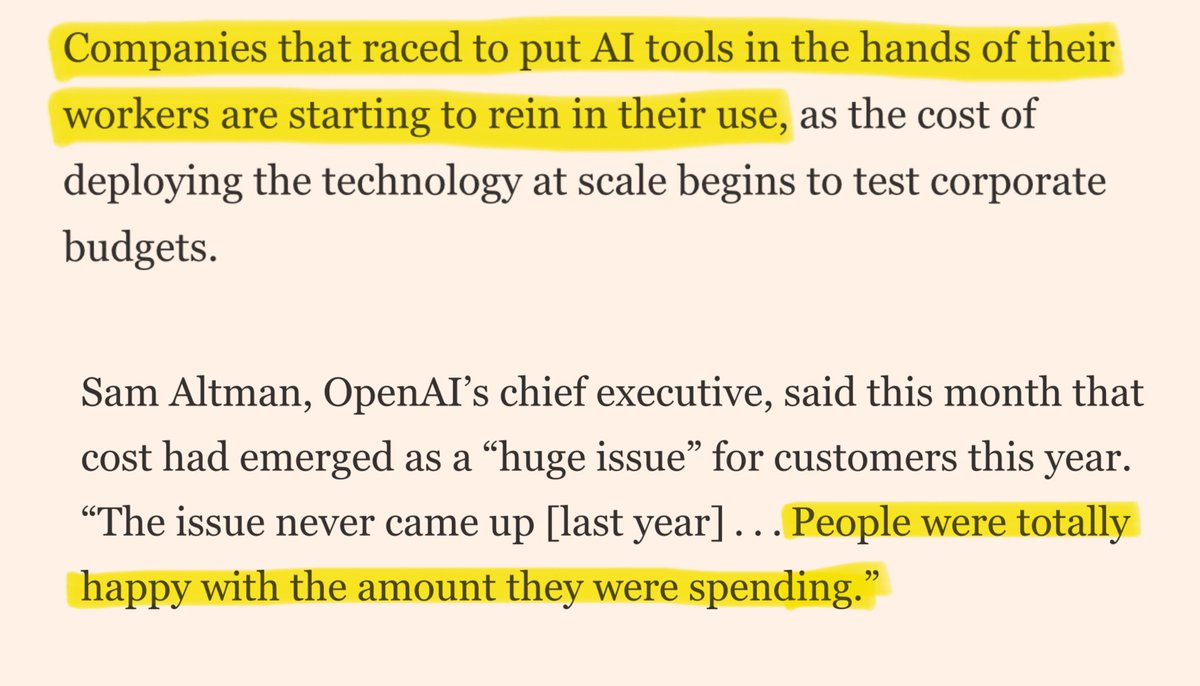
Amazon, Walmart, Cisco, Uber, and Meta are all now capping how much AI their own employees can use.
These are the exact companies that spent the last two years forcing AI onto every employee as fast as possible.
Uber burned through its entire 2026 AI budget by April and now caps employees at $1,500 a month.
Amazon told staff to stop using AI "just for the sake of using it" after engineers were caught running agents just to climb internal leaderboards.
JPMorgan published an internal note this month titled "AI Bills Are Out of Control." Some JPMorgan employees are reportedly spending more on AI every month than their own salary.
Here is why this is not just a cost story inside a few companies.
It is a direct threat to two trillion-dollar IPOs.
OpenAI and Anthropic both filed confidentially for IPOs this month, both targeting valuations near $850 billion or higher, and neither company is profitable. OpenAI reportedly loses $1.22 for every dollar of revenue it makes.
OpenAI's losses tell the same story from a different angle. In 2024, OpenAI lost $5.09 billion. In 2025, that loss grew to $38.5 billion, nearly 8 times higher in a single year. Costs are growing faster than revenue at exactly the moment OpenAI needs Wall Street to believe the opposite is happening.
Their entire pitch to public investors is that enterprise spending keeps climbing. The exact backlash forcing Amazon and Uber to cut back is happening at the precise moment both companies need Wall Street to believe the opposite.
OpenAI already sees the danger. The Wall Street Journal reported this week that OpenAI is weighing steep token price cuts specifically to stop losing customers to Anthropic, whose Claude Code product helped its revenue jump from $9 billion to $47 billion annualized in five months.
But cutting prices only works until someone undercuts you.
Artificial Analysis benchmarked every major AI model on identical tasks and tracked the total cost. Anthropic's flagship model cost $4,811 to run the full test.
OpenAI's cost $3,357. China's DeepSeek cost $1,071. Another Chinese model, Kimi, cost $948. China is not trying to match American AI on quality. It is making premium priced AI look completely unnecessary.
Bain surveyed nearly 1,000 companies on AI returns. 40% said their actual cost savings came in below 10%, despite everything they spent.
One investor told Axios that a CFO accidentally spent half a billion dollars on Claude in a single month before anyone even noticed.
OpenAI and Anthropic are about to ask public markets to value them like the future of software itself.
Their own biggest customers are proving in real time that they will not pay whatever it costs to get there.
Here's what 10x revenue did to the best company of the last bubble.
March 2000. A company becomes the most valuable on earth. It makes the essential hardware behind the defining technology of its time. Revenue growing 50% a year. The undisputed leader. The safe way to own the future.
Cisco.
The internet was real. The routers were real. The growth was real. At the peak it traded near 30x revenue.
Then it fell 90%.
It took until December 2025 to see that price again. 25 years and 8 months to break even, while the business roughly tripled its revenue.
The business won. The stock took 25 years.
You didn't buy the company. You bought the multiple.
Researchers show that Claude Code is 98% not AI.
Anthropic never gave us the architecture for Claude Code. There were no docs. Just a tool that every developer is currently obsessing over.
Until it leaked recently.
A research team pulled the source code, analyzed all 500,000 lines, and found something ridiculous.
Only 1.6% of the codebase actually interacts with the AI model.
The core of Claude Code is literally just a simple while-loop. It asks the model what to do, runs a tool, and repeats.
So what is the other 98.4%?
It is hardcore, traditional software engineering.
The researchers found a massive, complex infrastructure designed entirely to babysit the AI and keep it from hallucinating or destroying your computer:
- A 7-mode permission system acting as a security bouncer.
- A 5-layer context compaction pipeline so the AI doesn't forget its goal.
- A subagent delegation mechanism with strict worktree isolation.
- Four different extensibility hooks to manage external tools safely.
Every startup right now is trying to build a better AI model to get better results.
Anthropic did the exact opposite.
They took an existing model and built a fortress of deterministic software around it.
They realized that the AI doesn't need to be smarter. It needs to be managed.
Now we know why Peter Thiel packed his bags for Argentina.
Milei just submitted his AI legislative framework to Congress, where he proposes:
- zero regulation on AI development,
- a brand-new "non-human corporation" category for AI/robot-operated entities with limited liability
-a low-tax regime with flexible governance rules.
The Dutch East India Company gave the world the limited liability company in 1602. Milei wants Argentina to do the same for autonomous AI agents in 2026.
Today, we are launching the first stage of Project Orion.
Our early pre-training run of Orion-100B achieves upward of 65% of data-center training efficiency on hardware costing a fraction of the price.
Orion-100B is the first proof point for a simple idea: that underutilized compute around the world can be turned into frontier training capacity.
We believe that this work presents, for the first time, an economically compelling case for training large models using distributed approaches.
BREAKING: Mastercard is introducing always-on stablecoin settlement on Solana.
3.7 billion cards. 210+ countries. One of the largest payment networks on earth, now settling onchain.
Today a crazy quantum story just got wilder.
On March 31, the Google Quantum AI team published a landmark result on Shor's algorithm for elliptic curve cryptography. Technically, the paper was a bombshell: a dramatic 10x improvement over the state-of-the-art. As a stunt and wakeup call to the blockchain space, those optimisations were illustrated on secp256k1, the elliptic curve underlying Bitcoin and Ethereum signatures.
But perhaps the most striking part of the paper was sociological, not technical. Instead of following standard academic process, the optimisations were kept secret, hidden behind a zero-knowledge (ZK) proof. Google's accompanying blog post mentions they "engaged with the U.S. government". The ZK proof demonstrates the existence of algorithmic improvements without leaking details. Academic censorship with ZK, a historic first!
As a co-author of the Google paper I witnessed some of the context surrounding this censorship. To be honest, multiple aspects of that context don't sit well with me. As much as I believe the general public ought to know more, I am limited in my ability to whistleblow. Though let me be clear about one thing: the Google team's professionalism has been absolutely exemplary, and they deserve nothing but praise.
Censorship has a way of backfiring. The Streisand effect, where an attempt to bury something only draws more attention to it, is exactly what's unfolding today. First, Google's key optimisation has been rediscovered by the French. And in a thrilling turn of events, a collaborative Shor-at-home challenge just launched. The initiative, available at ecdsa[.]fail, breached a new Shor world record in a matter of hours.
Let's start with the rediscovery. Just two months after Google's paper, French quantum expert André Schrottenloher cracks the main secret optimisation. His paper, titled "Optimized Point Addition Circuits for Elliptic Curve Discrete Logarithms", landed on the arXiv today. Big congrats to André, who beat several other nerdsnipped experts to it. In a blog post also published today, Craig Gidney, the world expert on Shor optimisations, revealed that he'd been sitting on this very optimisation for a whole year under censorship pressure.
Interestingly, André missed a handful of minor optimisations, both from Google's original publication and from improvements found since. It's plausible there's still plenty of juice left to squeeze out of Shor, and this is exactly what the ecdsa[.]fail challenge is about. The verifier program developed for the ZK proof does double duty, automatically filtering for valid submissions. Dozens of compounding small and micro improvements are rolling in. As of the time of writing there's an 8.4% improvement to Google's circuit, as measured by the product of logical qubit count and Toffoli gate count. Nice!
The nerdsnipping ran deeper than anyone expected. Over the last few weeks it became clear it extended well beyond André and other quantum experts. Behind the scenes, a small army of amateurs quietly got to work. Inspired by Karpathy-style autoresearch, they turned AI on Shor. Ironically, the verifier program for the ZK proof makes an ideal reward function for AIs. The barrier to entry for this modern style of research is refreshingly low, with several non-experts, even a teenager, finding nice optimisations. Get in touch if you'd like to join a Telegram group with fellow autoresearchers :)
Part 2: neutral atoms and qday
The story doesn't end with Google. On the same day Google went public, a stealthy startup called Oratomic published its own Shor paper in a coordinated release. It made a splash, ultimately becoming the most upvoted paper on scirate[.]com, a website ranking arXiv papers.
Oratomic's claim was wild. By building on Google's logical optimisations and applying custom physical optimisations for neutral atoms, they claimed just 10K physical qubits were sufficient to run Shor's algorithm on secp256k1. That number is mind-bogglingly low.
Knowing essentially nothing about neutral atoms when Oratomic's paper landed, I was intrigued and decided to learn more about the tech. I fell straight down the rabbit hole and spent a couple hundred hours on the topic. I got a little obsessed and watched every YouTube video I could find and spoke to a bunch of experts.
My conclusion? The tech is real, very real. Even Google recently decided to start a neutral atom lab, a notable pivot from their sole focus on superconducting qubits. If you care about qday, i.e. the day a quantum computer will break the first piece of cryptography in production, neutral atoms demand your attention. I shared some of my learnings on Shor and neutral atoms in a 30min talk at the ZKProof cryptography conference. You can find it on YouTube by searching "zkproof neutral atom".
Here's an interesting observation about this duo of breakthrough papers: neither Google nor Oratomic say a word about what their results mean for qday. No timelines. Zero. Nada. That is especially baffling given that the whole point of whitehat quantum cryptanalysis is to inform qday estimations and help the general public make good decisions.
So let me attempt to partially fill the silence, similarly to what Scott Aaronson did in his April 29 post. Given everything I know, including scary non-public information, I now put the odds of qday by 2032 at 50%. 10% by 2030.
Anecdotally, the US government has its own date: 2035. Originating at the NSA and later adopted by NIST, it's when branches of the US government will be disallowed from using quantum-vulnerable cryptography. In plain language: with hindsight, that date is a joke and should be discounted entirely. I don't see how NIST avoids being forced to pull it forward by years.
Part 3: post-quantum cryptography
There are good reasons to sound the alarm today, but please do not panic. Rushing carelessly towards immature post-quantum cryptography is a recipe for disaster. IMO a good target date for migration is 2029, roughly 3.5 years out. 2029 happens to be the date selected by Google, Cloudflare, and the Ethereum Foundation.
These days most of my time goes to safely migrating Ethereum towards post-quantum cryptography as part of the broader lean Ethereum effort. There's a lot to do. We need to rip out and replace BLS signatures at the consensus layer, KZG commitments at the data layer, and ECDSA signatures at the execution layer.
The plan to get there is compelling, and is based on hash-based cryptography. Within the Ethereum Foundation we've developed a Swiss army knife called leanVM (github[.]com/leanEthereum/leanVM) powered by the magic of hash-based SNARKs. Thanks to truly exceptional work by Emile, Thomas, and others, its performance is derisked. Regarding security, leanVM is a jewel, a minimal zkVM crafted for end-to-end formal verification and maximum security.
Want to help? There are two $1M initiatives. First, the Proximity Prize (proximityprize[.]org). Solve a long-standing mathematical conjecture in coding theory, improve hash-based SNARKs, and go home a millionaire. Second, the Poseidon Initiative (poseidon-initiative[.]info), offers $1M for breaking Poseidon, the SNARK-friendly hash function.
JUST IN: 🇺🇸 Treasury Secretary Scott Bessent urges lawmakers to advance the Clarity Act:
"There most important thing we can do is to make digital assets come into the United States. Make the U.S. the home."
"I would encourage the House and the Senate to get Clarity done."
BREAKING: SpaceX has officially filed its S-1 registration statement with the US SEC ahead of its record-setting IPO.
Details include:
1. SpaceX intends to list its shares on the Nasdaq under ticker symbol $SPCX
2. SpaceX posted Q1 2026 revenue of $4.69 billion
3. Elon Musk will be CEO, CTO, and Chairman of the Board after the IPO
4. SpaceX holds $15.8 billion in cash as of March 31st
5. SpaceX is seeking to raise a record $80 billion in its IPO with an expected IPO date of June 12th
More details to come shortly on this historic IPO.
Karpathy's career moves are the single most accurate map of AI's center of gravity over the last decade.
2015: co-founds OpenAI when the frontier is pure research. 2017: leaves for Tesla when applied neural networks at scale become the hardest unsolved problem. Stays five years building Autopilot. 2023: returns to OpenAI during the GPT-4 sprint. Stays 12 months. 2024: launches Eureka Labs to teach the world how LLMs work.
Now he's at Anthropic.
The "get back to R&D" line tells you something specific. Karpathy spent two years on education. His YouTube lectures reach millions. Eureka Labs had real momentum. He walked away from a growing education business to join a company that went from $87 million in annual revenue to $30 billion in 28 months.
When the person who teaches the world how neural networks work decides the opportunity cost of teaching is too high, the R&D window just entered a phase that won't stay open. He's pricing his own time against the frontier, and the frontier won.
The career pattern is the real signal. Five years at Tesla. Twelve months at OpenAI the second time around. An OpenAI co-founder chose Anthropic. Draw whatever conclusions you want from that sequence.
JANE STREET JUST EXPOSED THEIR NEXT TARGET: ETHEREUM.
The same firm behind the daily 10 AM Bitcoin dump, the same firm sued for insider trading in the $40 billion LUNA collapse, and the same firm with $567 million frozen by Indian regulators could now be targeting Ethereum.
The data reveals a massive, coordinated exit from Bitcoin and a violent rotation into Ethereum.
IBIT : down 71% in a single quarter.
FBTC : down 60%.
Strategy $MSTR : down 78%.
Bitcoin miners IREN, Cipher, TeraWulf, Core Scientific: all cut.
Over $800 million in Bitcoin exposure erased in 90 days. Now look at what they were buying at the same time.
ETHA : nearly doubled.
FETH : sharply raised.
Galaxy Digital: from 17,000 shares to 1.5 million. That is an 8,700% increase in one quarter.
Total new Ethereum ETF exposure added: $82 million.
In Q4 2025, the quarter right before this dump, Jane Street increased their MSTR position by 473%. They loaded up aggressively and Then in Q1 2026 they cut 78% of it.
In India, SEBI documented this exact structure across 18 expiry days. Build the long position in the underlying first. Then set up the derivatives. Then move the market. The cash position is the setup cost and The options book is where the money gets made. And the options book is the one thing a 13F will never show you.
Ethereum is the easier target. Bitcoin futures open interest sits at $60 billion. Ethereum's is slightly more than half that at roughly $34 billion. A smaller market means a smaller amount of capital can move the price further.
In India, Jane Street moving the Bank Nifty index using stock purchases. Ethereum's market cap is $273 billion against Bitcoin's $1.6 trillion. That is a 5.8x size difference. The same amount of capital creates nearly 6 times the price impact in ETH.
The ETF market for Ethereum is also still early. Bitcoin ETFs hold roughly 6.67% of all circulating BTC supply. Ethereum ETF penetration is less than that, which means there is no institutional demand floor yet to absorb a coordinated sell.
They are not rotating into Ethereum because they are bullish on Ethereum. They are rotating into Ethereum because It is easier to move.
seems really accurate and if true it's very risky cause essentialy what gets repressed are bond markets real returns and consumer purchasing power
as you said: the only problem in this big picture would be bond markets breaking into no-fly zone yield returns
huge printing ahead