experimenting with a lil personal project: an AI-native macOS dock with custom modes (writing, building, etc.) to help me stay focused
my agent is able to customize mode behavior and add new modes, it uses jev to classify my activity + notifications in real time & act on them
@mdanassaif well done on copying @plumbyapp after it’s been published on your product directory. Good way to show trust.
Please remove @plumbyapp from markedingdb
Ok guys, I’ve been looking into Malala Yousafzai’s charity, the Malala Fund and I have some questions.
According to its 2024–2025 financial reports:
Revenue: $16.48 MILLION
Expenses: $23.34 MILLION
Net assets: $42.97 MILLION
That means the charity spent approximately $6.86 MILLION MORE than it brought in‼️
And then there are the executive compensation figures:
CEO: Approximately $372,000
Chief Adviser: Approximately $320,000
COO: Approximately $241,000
The charity’s tax filings also disclose FIRST CLASS or PRIVATE travel for officers or key employees. ✈️ WTF?!
But here’s what I’d like to know:
How much of that $18.94 MILLION in program spending actually reaches girls and local educational organizations?
How much goes toward salaries, consultants, advocacy campaigns, and travel?
What measurable educational results can donors independently verify?
And why did a charity with $16.48 million in annual revenue spend over $23 million that year?!? 🤯
When you’re raising millions in the name of educating vulnerable girls, I don’t think asking where the money goes is unreasonable.
Charity should be about the cause, not the celebrity attached to it.
It now makes sense why Malala looked so comfortable dining at Claridge’s. Malala lives a life like a rockstar.
https://t.co/oacIR4mik1
🗞️ if your team is too busy doing their 'normal job' to experiment with AI, you're preparing them to be replaced
https://t.co/KTaIgFpvpK
In this post, I guess this's the last time I'll say it. AI use is no longer optional if you wish to be employed. What follows is advice for current employees and hiring managers on how to hire in 2026 to source AI-first candidates.
I am done with this shit. It is over. The state of engineering right now is horrible. It has been half a month since I started a new role at a big company. Nobody knows anything here. The specs, code, tests, PRDs, tickets, resolution of those tickets, reports, etc., everything is made by Claude Code. Nobody on my team likes this. They are being forced to ship as much as they can. I have heard multiple times from higher management that pushing code is not a bottleneck, so why are we slow? People are working 12 to 13 hours a day just to press enter. Nobody is reading anything. Humans in corporate are doing nothing on their own. Everyone, literally everyone, from an L1 to an L7 engineer here is doing the same thing. Talk to Claude. There is no sense of victory. Nobody is resolving bugs. In reality, nobody is thinking anymore. Everything is done by LLMs. It is so soul-sucking. I would not mind it, to be honest, if we were at least given the time to check out the code and see what is going where. But no, the goal is to just ship. No matter what happens.
“People are working 12 to 13 hours a day just to press enter.”
We are turning an entire generation of technical experts around the world into the equivalent of retirees pushing a button in front of casino slot machines.
Essentially the brain rot of doom scrolling social media is coming for your development team…
This will have lots of long run implications on companies. Most important of which, is that it will make existing moats even more brittle.
The value of automated software is not making the software faster.
It is understanding your intention and making the software BETTER.
Better edge.
Better design.
Better alpha.
But if you don’t slow down and map out your intention, you will just make your shitty code faster.
We built 8090’s Software Factory to do this: when execution is a costless commodity, what really matters?
Over time, companies will realize that it’s:
1. Intention
2. Governance
3. Verification
4. Evidence
This is what will separate orgs consuming tokens and companies encoding their edge. This generally requires top down leadership from the CEO to the CFO/CIO.
Bottoms up tool adoption only increases costs and accelerates slot machine behaviors.
Good luck to all the players.
Today we’re introducing Qaf Pro, our paid plan.
Pro will cost $19/mo and $99/year initially.
I want to share a bit about our funding and what will happen to the free plan.
We’re building Qaf without VC funding (despite the much appreciated offers).
This is because of my belief that most Islamic apps are not compatible with venture.
In traditional venture, you build the company to ultimately get an exit, i.e. the company goes public or gets acquired.
Islamic apps don’t have the revenues ($100M+/yr) to go public, and there’s little interest in other companies acquiring them. With the exception of PE firms that would sell user data and try to squeeze every dollar out of users - which we’re not ok with.
One path is to raise a seed, series A, and likely struggle to have revenues for a series B, becoming a zombie company. All while being pressured by investors to increase revenues.
The alternate path is to build a self-sustaining business. Keep the team small and expenses low, get to a break even point, then be able to prioritize the mission over financial returns.
This is what we’re trying to do insha’Allah.
So far, Qaf has been funded from our main business (Agentset) and by the team taking no salary or an embarrassingly low one.
The difference between Qaf and other Islamic products is that it’s an AI product, and tokens are expensive.
Our current token burn is $2,000 per day, or $60,000 per month. This is now covered by credits, but they’ll run out quickly.
So we have to add limits to the free tier. I expect most of our users to still be on the free tier and we want it to provide as much value as possible.
As tokens get cheaper (glm 5.3 flash et al.) and we get to the breakeven point, I’m hoping that insha’Allah we can increase limits on the free plan, to the point where upgrading is totally optional.
In the meantime, if you want to support Qaf’s mission - the best way to do it is by getting a pro subscription.
We've spun up an exploratory platform where you can find an experimental open-weight LLM inference API. Free, no SLAs. Test your own use cases and tell us what works and what doesn't 🫡
No promises this becomes a permanent product: https://t.co/CE6YWbrTHz
We’ve decided to open-source a multi-agent harness we use internally at YC.
We call it “QM” and it’s meant to be easy to customize, like Hermes or OpenClaw, but useful for a whole company. We use it across accounting, legal, events, and engineering (including building QM itself!).
The whole project is under an MIT license. It is cloud-first and has Slack and web UI natively.
A bespoke software revolution? I don't buy it.
It'll exist. It already exists. Small consultants and big consulting firms have made custom software for years. It almost always sucks. It’s bloated, confusing, and because the client pays, it’s built wrong in all the ways.
Who’s excited about bespoke software? Software makers! Of course they're excited about building bespoke software — that's what they do. X is full of them. Your feed is full of people who love making software talking about making software. Of course they’re excited about the revolution. Echo, echo, echo...
Most people don’t like computers. Nobody in tech wants to say that out loud. People tolerate computers. They use them because they have to. Given the choice, most would rather not think about them at all.
So when someone suggests that AI means everyone will build their own custom tools, ask who "everyone" is. The three-person accounting firm drowning in client paperwork? They want the paperwork gone, not a new system to maintain. The regional logistics company with 40 trucks? They want the routes optimized, not Joe spouting off about this new system he’s been messing around with. The law firm billing 70-hour weeks? They want leverage on their time, not a software project to design.
They don’t hate technology. But building and maintaining their own critical systems isn’t their wheelhouse, regardless of how much faster and easier it’s become. It's another job on top of the job.
Will these people use AI? Absolutely, for all sorts of things. Will some outliers go deep and build real custom systems? Sure, but they're almost always people who already had some pull toward software. The curiosity was already there. They were dabblers before.
Giving everyone access to software building tools doesn't mean everyone becomes a builder. A powerful excavator doesn't turn a homeowner into a contractor. Most people just want the hole dug by someone else. They don’t want the responsibility either.
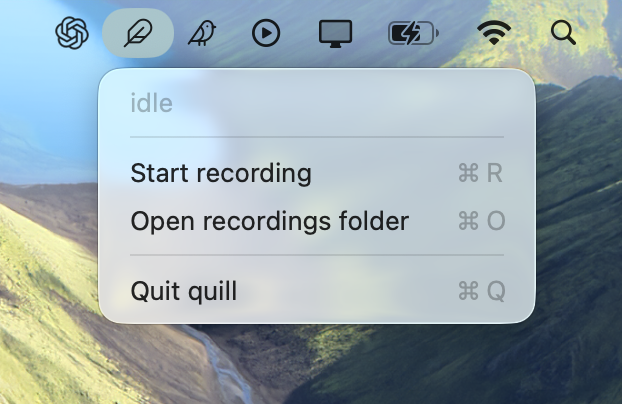
continuing my war on paid software that should be free, today's victim is: granola.
quill gives you the same thing for free and completely private, just start recording and after you stop it, the entire audio gets transcribed into a default folder.
completely open source as always
Funny how the smallest, simplest bit of UI makes the biggest difference.
Opus 4.8 44% █░░ (440k/1.0M) · high
session 61% (↻2h11m) · All 74%
Dashline is one line at the bottom of my Claude Code terminal, and it keeps us sane.
Context on the left, budget on the right. That's it.