This is a holy war, this is a battle ground
You might think I’m exaggerating, I’m not. They are spending BILLIONS trying to enslave you
They believe you are slaves and they are your masters
Crush them, destroy them. It’s them or us, and you better bet if it’s not them it’s us
An exciting thing to explore was also the interaction with the Linux kernel hand-off, so that we can have systems smoother and more compatible than we ever thought possible before!
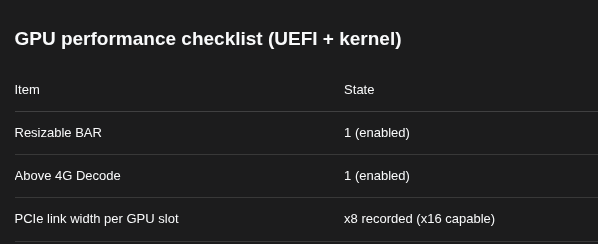
I decompiled the UEFI image so that we can FINALLY get to the bottom of the cryptic BIOS settings that no MB manufacturer documents.
Saving a BIOS profile will create an NVRAM efivar that you can read in Linux, you can then use the decompiled UEFI image to explain the BIOS settings! GROUNDBREAKING
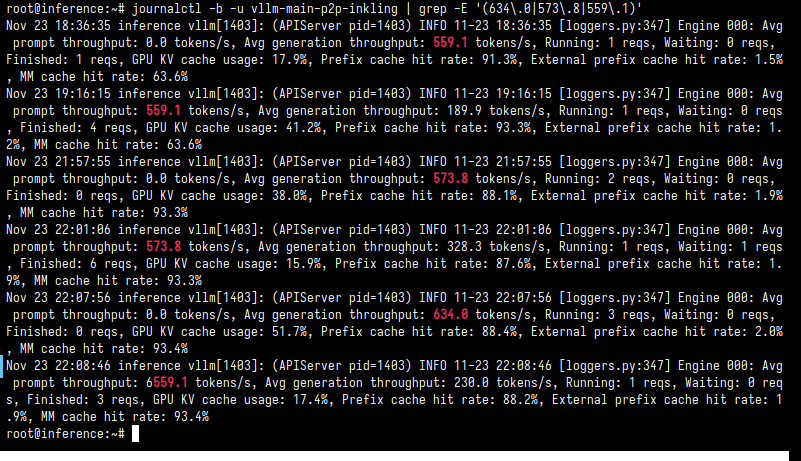
Reached 634 t/s decode with Inkling on x2 5070Ti
journalctl -b -u vllm-main-p2p-inkling | grep "Avg generation throughput" | sed 's/^.*\(Avg generation throughput: .* \).*/\1/g' | cut -d' ' -f4 | sort -n
The best way to get accurate performance numbers from actual sessions of a whole day's use.
(Yeah some of us still regex!)
TRUMP AND VANCE BECAME CONVINCED THAT JENSEN HUANG WAS A SINGULAR FIGURE PROTECTING OPEN SOURCE MODELS AND PREVENTING CLOSED-SOURCE MODEL COMPANIES FROM BECOMING TOO POWERFUL - SOURCE.
@halfofmynamewas@murasametech They seem to display a lower price than everybody else when they're out of stock so it prevents you from buying it elsewhere, I'll believe it when I see them in stock.
Okay, what the heck?! This wasn't supposed to happen! 🤯😱
Every RTX 20 / GTX 16 card ships with a 256 MB "window" into its memory. That's all the CPU or another GPU can see of it at once: a keyhole into several GB of VRAM
I FOUND A HACK that opens the window to cover ALL of the card's memory, 16-32× bigger, at every boot. No flashing, no Linux kernel patches: I just move the GPU's own USB-C controller out of the way🤯
Combined with my earlier RTX 3090/3080 writeup, this unlocks GPU-to-GPU P2P on Turing too: one card writes straight into the other's memory, no detour through system RAM.
I'm literally shaking with excitement. This could open the door to P2P and other low-level hacks on a lot of older Turing cards 🚀
Result: P2P between an RTX 2060 and a GTX 1650 SUPER, two different chips(also previously not tried!). 20× less delay between the GPUs, up to +78% faster data exchange, and as fast as my RTX 3080 pair in the same slots.
What it took:
🔌 Remove the GPU's built-in USB-C + UCSI controllers at boot. They sat in the same PCIe address range and blocked the window from growing
📐 Grow the window with noon-at-cgn's geforce-bar1-resize, big enough for each card's whole memory. Gone at power-off, reapplied at every boot
🔓 Patched NVIDIA driver modules, with P2P switched on per card
🎭 A tiny LD_PRELOAD shim, because CUDA refuses P2P between two different chips even when the driver says yes
✅ Integrity test: 1.3 TB of GPU-to-GPU copies, 0 errors
Full guide (experimental!):
https://t.co/56rceKR37G
@Hateful_Select@cmassimo_exe@Pirat_Nation Pretty sure it's faster than 4090, according to the performance I see in AI between 5070Ti and 4090, they don't even compare.
But in terms of the CPU, I'm sure everything can be made faster by stripping off all the bloat and complex instructions and x86 compatibility etc.
@YuvrajInfer Nice. Is this related, why I noted batching seemed to work best at 512 and there were no significant gains at higher on Blackwell?
https://t.co/Pq20UpMs8k
vLLM Inkling2 Mini: --max-num-batched-tokens is the context pool lever for maximizing the context size 📈
⚠️512 DOUBLES the available pool size with no performance cost relative to 1536
You can achieve >331k on 2x 16GB 5070Ti with Inkling2 Mini unquantized and 400+ t/s decode
this might be the next big paradigm shift in AI.
MIT proved that:
- you don't need RL to fine-tune LLMs.
- you don't need PPO.
- you don't need GRPO.
- you don't even need backprop.
They used Evolution Strategies to fine-tune LLMs with zero gradients, zero backprop, zero Adam.
Instead of calculating complex mathematical gradients backward through billions of parameters, they just let the model evolve.
You slightly mutate the weights. You test the output. You keep what works and discard the rest.
Here is why this changes everything.
Backpropagation is the ultimate memory bottleneck in modern AI. It is the main reason fine-tuning massive models requires giant, million-dollar server clusters.
By stripping out gradients, optimizers, and complex RL pipelines entirely, MIT just opened the door to a training paradigm that is radically simpler and completely bypasses the old hardware walls.
We spent the last decade treating backpropagation like an unbreakable law of physics.
Turns out, nature figured out a better algorithm millions of years ago.
The next generation of AI might not be engineered.
It might be evolved.
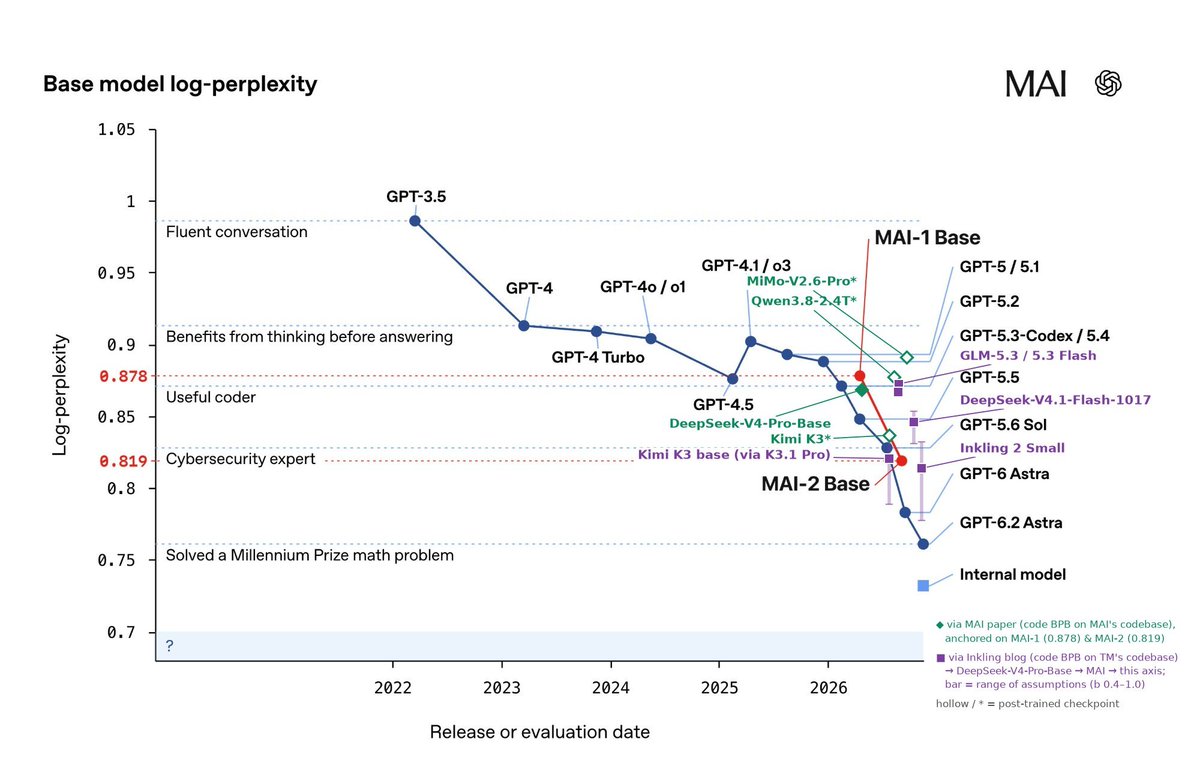
Inkling 2 Small really is a crazy model.
Only 594B (17B active) params, 68 hours, 8.4T and what looks like a better pretrain than 5.6 Sol.
Updating towards Sol being even smaller than we think
@stepbystepnomad@Cavemtech Kind of crazy to build 8-10 GPU rig just to have expert offloading, for which one 16GB GPU would be sufficient.
And for 4-GPU a consumer PCIe 5.0 board with x4 lanes for each card is more than enough for tensor parallel.
vLLM Inkling2 Mini: --max-num-batched-tokens is the context pool lever for maximizing the context size 📈
⚠️512 DOUBLES the available pool size with no performance cost relative to 1536
You can achieve >331k on 2x 16GB 5070Ti with Inkling2 Mini unquantized and 400+ t/s decode