🚀Sage-A1.5 by Shanghai AI Lab is here — pushing 35B agentic intelligence to the next level 🔥
🤖 35B MoE (3B active)
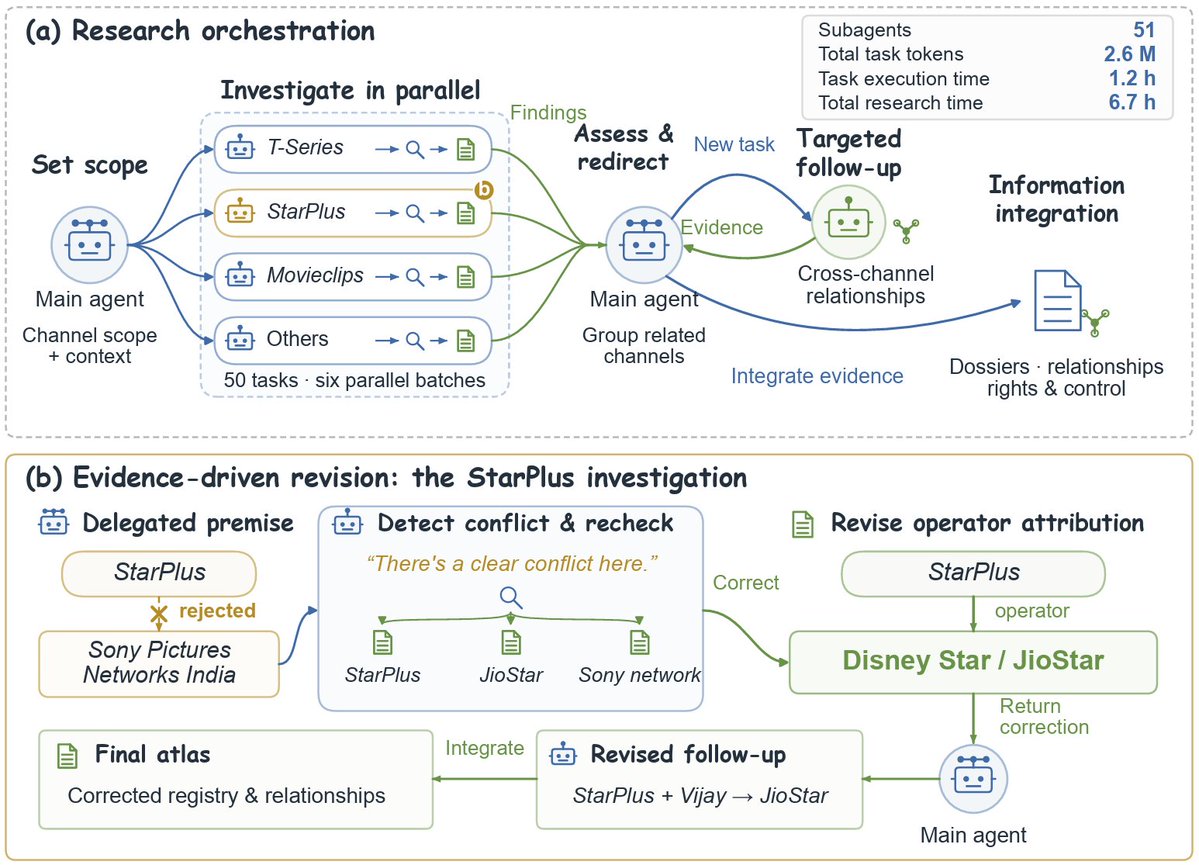
🧩 Agentic Orchestration & Verification — spawns parallel subagents & self-corrects on the fly
🔄 RSI Data Flywheel — evolved via real scientific discovery workflows & tens of thousands of synthesized environments
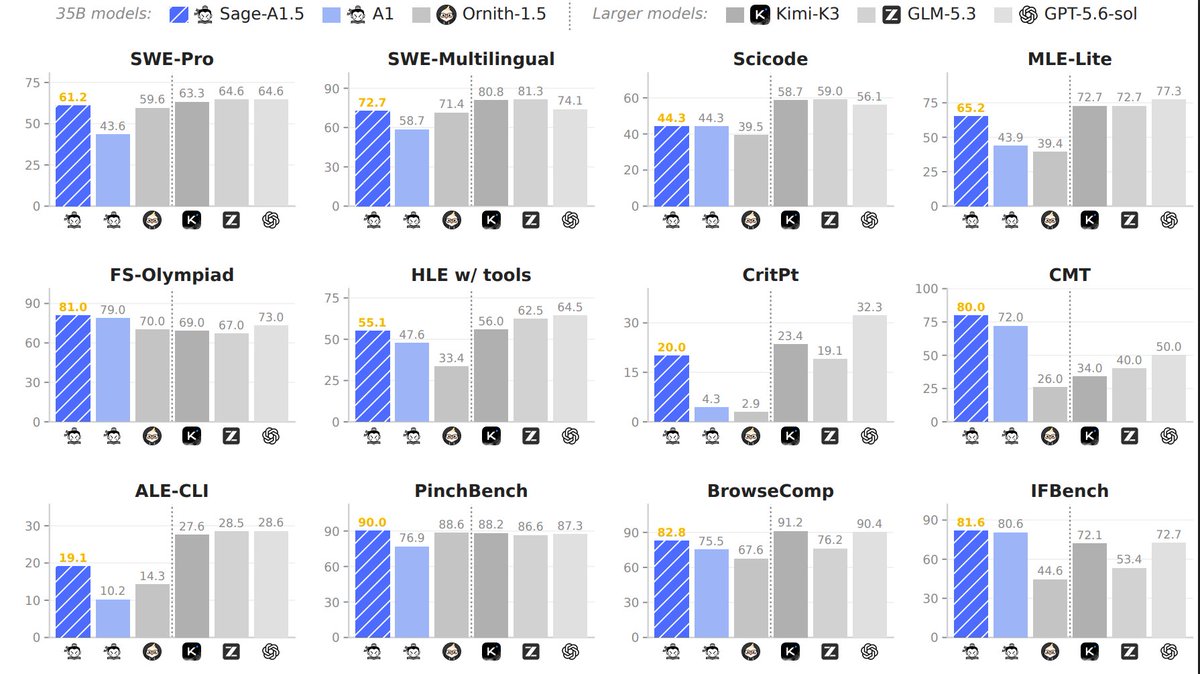
🚀 Beats frontier giants on FS-Olympiad, FS-Research, CMT & PinchBench, and hits 61.2% on SWE-Bench Pro
💻 Runs locally via vLLM(@vllm_project), SGLang(@sgl_project), llama.cpp & LM Studio (Q4_K_M ~20GB)
Scale the Horizon, Compose the Capabilities 👇
🔗 Model:
@huggingface
https://t.co/cGDUmMyPJl
@ModelScope2022
https://t.co/ntTyK7bLuv
🕹️ Try it free:
https://t.co/zdsic6BsGL
Jiesong Zhang, a member of Disheng Xu’s team and the paper’s author, developed ideas and arguments through dialogue with an internal version of Intern-S2.
Bin Dong and Ruochuan Liu’s team at Peking University used SHEAF to formalise all four main theorems.
Paper:
https://t.co/bhp0qdttOe
Code:
https://t.co/5WaLIhU2a8
🚀Mathematicians and Shanghai AI Lab’s Intern-S2 have resolved Ghys’s conjecture in complex dimension three—a problem open for over 30 years.
🥳All four main theorems have been formalised and checked in Lean.
🤗Read the story: https://t.co/8ZrzATXPl8
🚀Mathematicians and Shanghai AI Lab’s Intern-S2 have resolved Ghys’s conjecture in complex dimension three—a problem open for over 30 years.
🥳All four main theorems have been formalised and checked in Lean.
🤗Read the story: https://t.co/8ZrzATXPl8
😃“From research questions to verifiable results” is the promise.
😉The proof? It ships.
🚀Meet Atria Dawn Preview @AtriaASI — an agentic foundation model for long-horizon tasks and controlled self-evolution, built on the Intern large model.
🌦️ 1 min → global weather forecast
🖥️ 20 min → OS from scratch
🧠 AI building AI, with verification in the loop Not uncontrolled RSI.
Verifiable. Reproducible. Controllable.
Open preview ↓
🌐 https://t.co/FrbzXjUWO6
💻 https://t.co/Hy1RZWskxn
🤗 https://t.co/WeUxKLbDai
🤖 https://t.co/pyYn4MRp8f
🐦 https://t.co/L41CISVoJO
#AtriaDawn #AgenticAI #RSI #OpenSource
SGLang has Day-0 support for Intern-S2-397B from @intern_lm, a 397B multimodal foundation model built for scientific intelligence and long-horizon agents.
> New pre-training paradigm: learns directly from raw scientific literature pages, no parsing needed
> Scientific reasoning: RL across 20+ domains, from biomolecule design to material generation
> Long-horizon agents: black-box agentic RL in large-scale sandboxed environments
Run it now with SGLang!
Benchmark-leading scientific reasoning meets long-horizon agent capabilities. Intern-S2-397B is now available in BF16 and FP8.📜 Apache 2.0.
🤖 https://t.co/7AU8iTCZG0
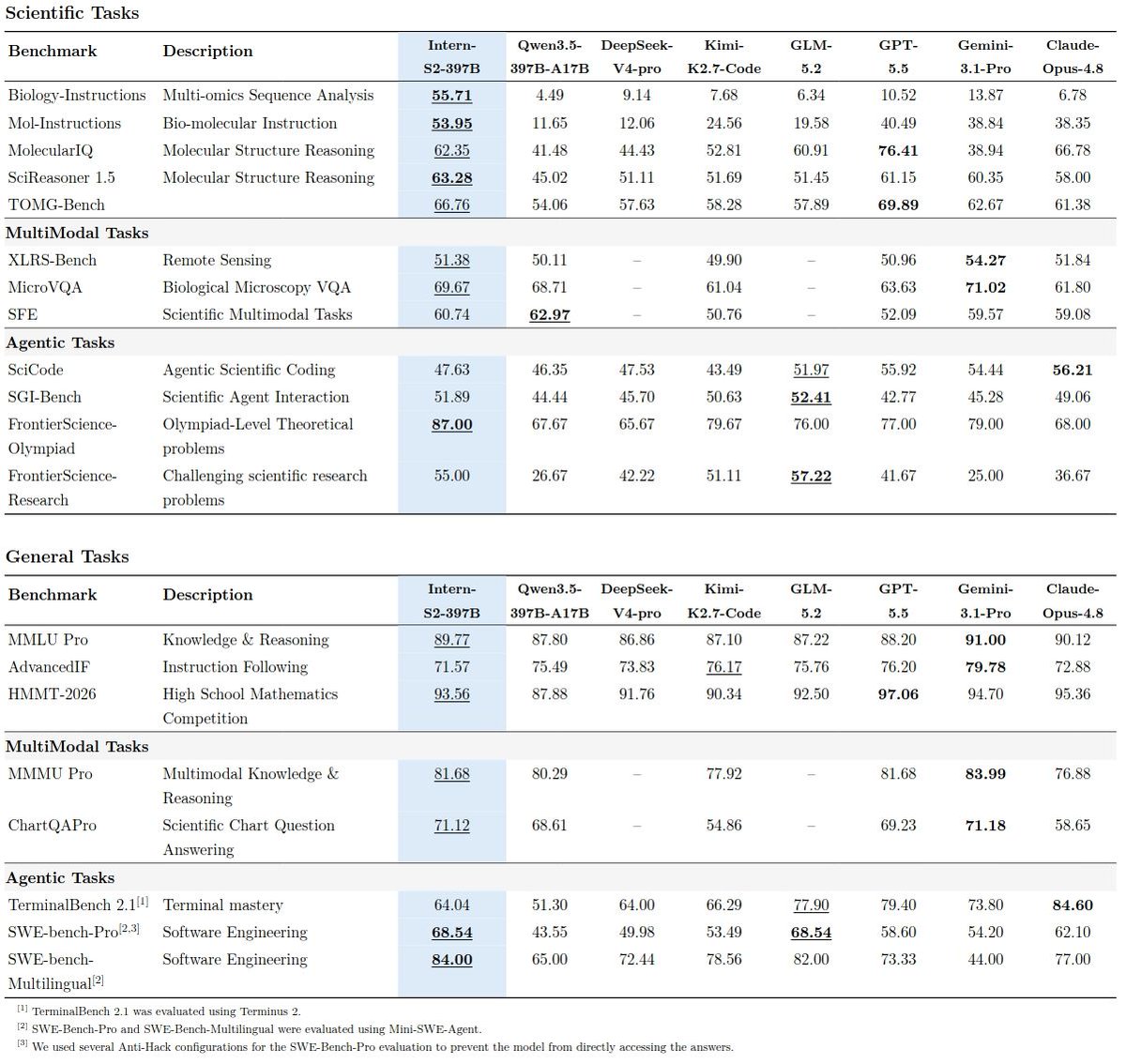
🏆 Scores 87.0 on FrontierScience-Olympiad and 84.0 on SWE-bench Multilingual, leading the reported comparison on both. Several specialized scientific benchmarks also see top results.
🔬 Raw scientific pages become training material directly, preserving text, visuals, symbols, and their relationships without intermediate parsing.
🧪 Joint training across 20+ scientific domains covers scientific reasoning, biomolecular interaction design, material generation, and time-series forecasting.
🛠 Long-horizon agent RL strengthens tool use and sustained execution, with thinking and non-thinking modes available.
🚀 Day-0 support for @intern_lm Intern-S2-397B is now available in vLLM!
Built for long-horizon scientific research, Intern-S2 brings strong multimodal, reasoning, coding, and scientific agent capabilities.
Run it with vLLM today 👇
🔗 https://t.co/T1zPZOf1vp
🚀 Day-0 support for @intern_lm Intern-S2-397B is now available in vLLM!
Built for long-horizon scientific research, Intern-S2 brings strong multimodal, reasoning, coding, and scientific agent capabilities.
Run it with vLLM today 👇
🔗 https://t.co/T1zPZOf1vp
🚀 Introducing Intern-S2-397B, our new multimodal foundation model designed for long-horizon scientific research and powerful scientific agents.
1⃣Strong general capabilities across knowledge, coding, and agents, ranking among the top open-source models.
2⃣Outstanding performance on scientific tasks including Biology-Instructions and Mol-Instructions, with strong capabilities in scientific understanding, generation, and design.
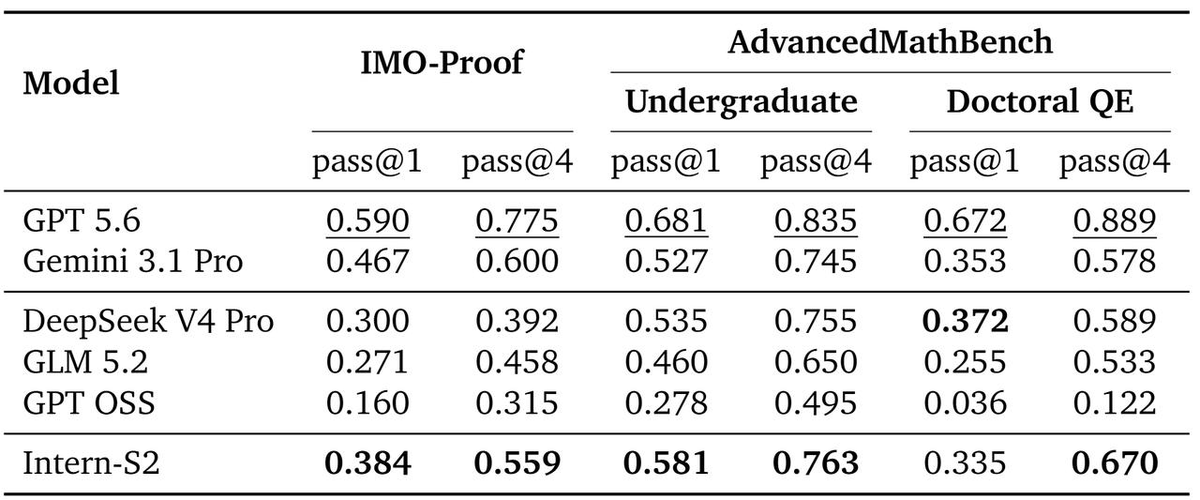
3⃣Achieves leading results among open-source models on IMO-Proof and AdvancedMathBench, reaching the level of top closed-source models such as Gemini 3.1 Pro.
4⃣Explores a new architecture for continuously expanding specialized scientific knowledge, building a stronger foundation for long-cycle scientific research.
👏Now supported by vLLM (@vllm_project ) and SGLang ( @lmsysorg ) — with more ecosystem integrations on the way.
🤗 Model:
@huggingface https://t.co/XI5vh8naoi
@ModelScope2022
https://t.co/MVE9qTaATm
🤗 Try it now:
https://t.co/OpebPDIv5x
👏Proud to congratulate Prof. Bowen Zhou, Director and Chief Scientist of Shanghai AI Lab, on being named to the 2026 #TIME100AI “Thinkers” list.
🤗His vision inspires our work at Shanghai AI lab: advancing models for scientific discovery while strengthening AI safety and reliability.
😉Read more:https://t.co/TrUT069Z3L
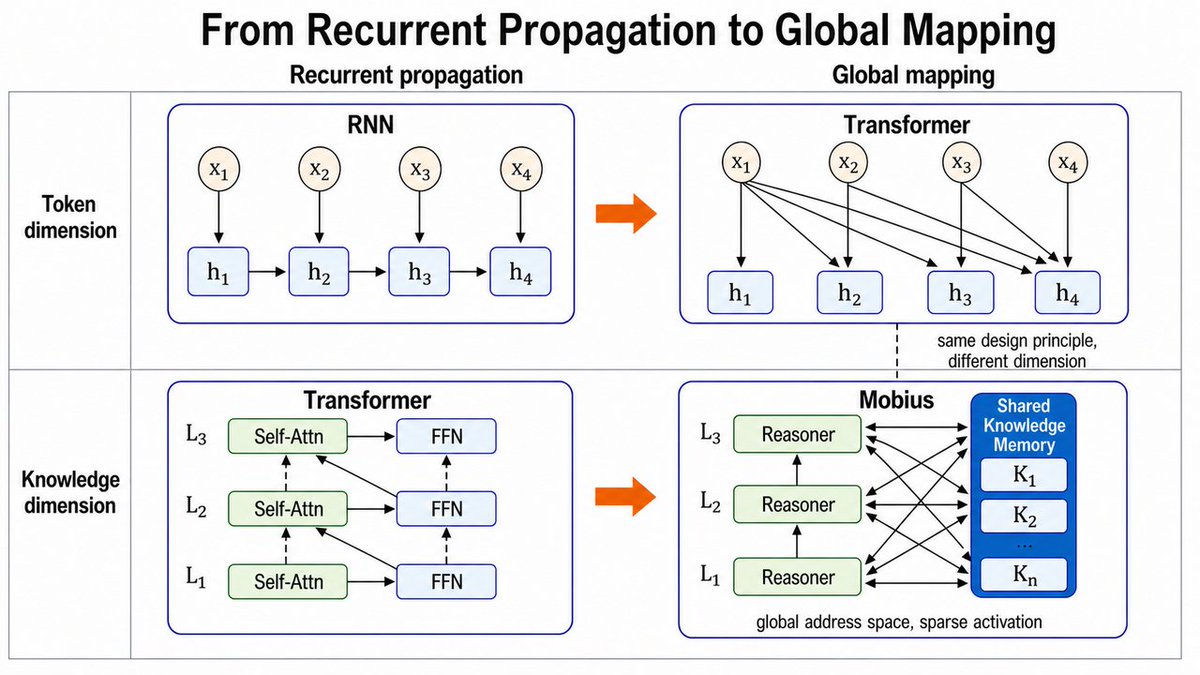
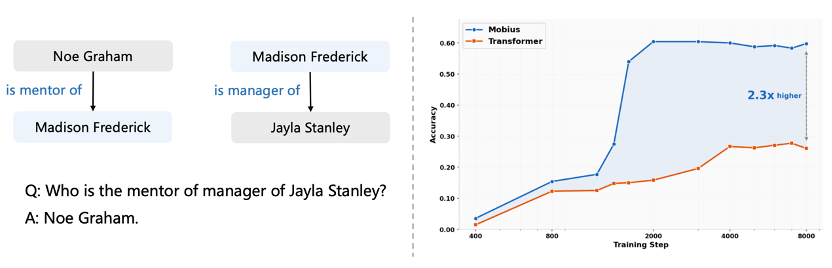
🔥Shanghai AI Lab open-sourced Mobius, whose transformation from Transformer bears a striking parallel to the RNN → Transformer shift:
(A) Token-level recurrence → full connectivity.
(B) Knowledge-level recurrence → full connectivity.
🤠The last revolution pushed foundation models to new heights. Round two begins?
🧐vs. Transformers:
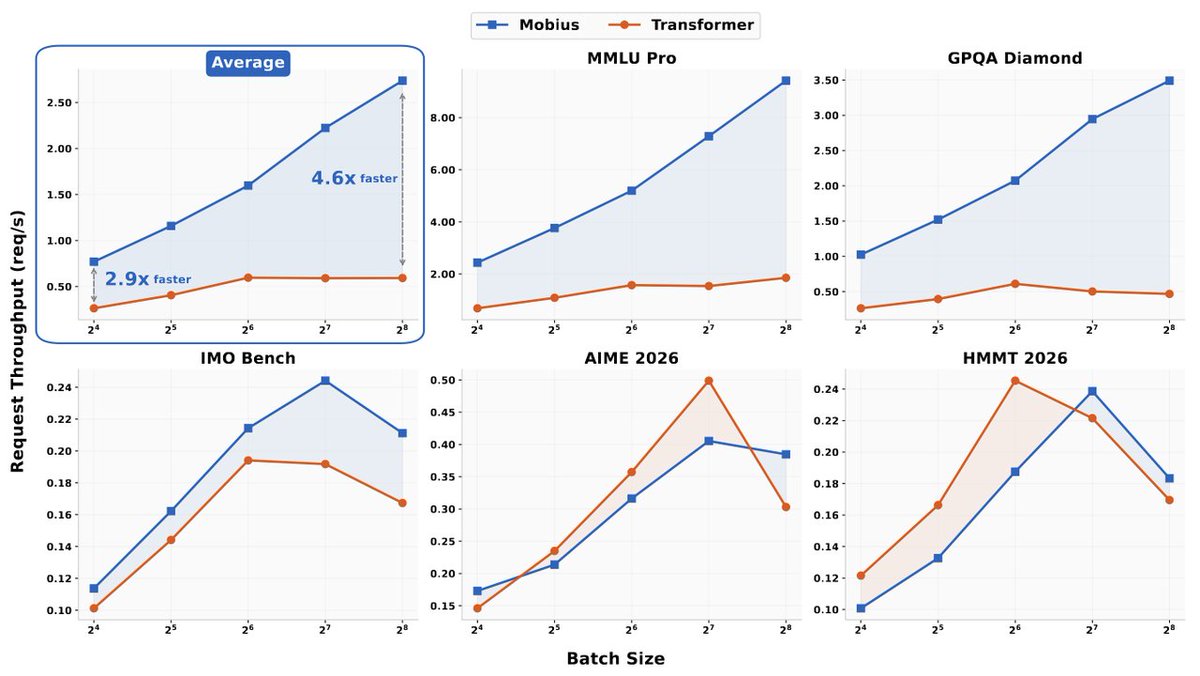
⚡ ~4× faster reasoning
📚 Same MMLU, 40% less data
🧩 2× better compositional generalization
🫡Mobius has been supported by XTuner, LMDeploy, vLLM(@vllm_project), and SGLang(@lmsysorg)
, its experimental setup and training pipeline will be publicly available in the future:
🔗 GitHub:
https://t.co/mCXJKr48aT
🤗 Model:
@huggingface
https://t.co/ac62kHKVUw
@ModelScope2022
https://t.co/jGsSgx8H2f
🔬 Arch Space:
https://t.co/J3xlrFuei3
This design suffers from excessive memory-access and communication overhead. Is there any chance we could borrow infrastructure optimizations from self-attention to mitigate this? @tri_dao
Same formula, new variable: RNN→Transformer upgraded token connectivity; Transformer→Mobius upgrades knowledge connectivity. Could Mobius be the next Transformer-level shift? @YesThisIsLion@ilyasut
Bowen Zhou, distilled the consensus into three operational principles:
AI can act on behalf of humans, but it cannot assume responsibility on their behalf.
Every authorization humans give to AI should be revocable, and every action should be accountable.
The pace at which agency is delegated should never exceed our ability to verify AI.
The principles define boundaries of responsibility, control, and capability. An agent's autonomy should not be determined only by what the model can do. It should also be limited by what people can verify, stop, and trace.
The panelists proposed a broader governance path.. Nicholas B. Dirks argued that governance cannot wait for a crisis, and that universities, scientific institutions, and nonprofit organizations must help build public oversight.
Mark Nitzberg proposed making AI safety a shared global science. Aviation operates safely across borders because countries agree on airworthiness standards, share incident data, conduct interoperable tests, and recognize one another's certifications. AI needs common evaluation methods, safety standards, testing systems, and incident reporting for the same reason: "Failures don't respect borders."
#WAIC2026
Bowen Zhou, Director and Chief Scientist of Shanghai AI Laboratory,asked Nicholas B. Dirks whether external evaluations, red teaming, and third-party verification were enough to justify handing real-world authority to AI.
"No," Nitzberg replied.
He compared AI systems to bridges. Engineers do not build a bridge first and then attack it to discover whether it is safe. The builder carries the burden of proof during design. Increasingly powerful agents, Nitzberg argued, should likewise be safe by design, with evidence before deployment that their overall behavior remains understandable and controllable.
That is why AI safety has become urgent now. Rules in aviation, finance, and medicine have often followed air crashes, financial crises, or public-health disasters. But AI cuts across all of those sectors. Its speed, scale, and cross-border reach make disaster an unacceptable starting point for governance.
Nicholas B. Dirks pointed to a second difficulty: People are already using systems they do not trust, and adoption will continue to grow. Engineering verifiability does not automatically become social trustworthiness. Trust also requires independent oversight, clear responsibility, continuous monitoring, and assessment at every stage of deployment.
#WAIC2026
The word "agent" carries two very different meanings.
In AI, an agent is a system that can perceive, plan, and act. In law, an agent receives authority but also assumes a duty of loyalty and can be held accountable. Today's AI agents can receive the first of those things. They cannot assume the rest in the way a person or company can.
Authority is beginning to flow to machines while responsibility remains in human society.
Mark Nitzberg, the Executive Director of the Center for Human-Compatible AI and Head of Strategic Outreach at Berkeley AI Research,described this as a gap between engineering and law. A human agent who fails in a duty can be investigated and sanctioned. A probabilistic black-box system has no engineering equivalent of a fiduciary duty. Closing that gap, he argued, requires AI that is well-founded, legible, and steerable: built from components people can reason about, understandable in operation, and stoppable or changeable at any time.
Lan Xue,Dean of Schwarzman College and the Institute for AI International Governance at Tsinghua University,noted that classic principal-agent problems have not vanished. Information asymmetry, moral hazard, and misaligned objectives all persist. What has changed is the accountability chain. A machine cannot be punished, so responsibility must be redistributed across design, development, deployment, and use.
Nicholas B. Dirks, President and CEO of The New York Academy of Sciences,warned that delegation is never only about handing off a task. In the pursuit of efficiency, people may also delegate goals, judgment, and principles. "If we are only thinking about AI that way," he said, "we are already beginning to forget about our values."
#WAIC2026 #agent
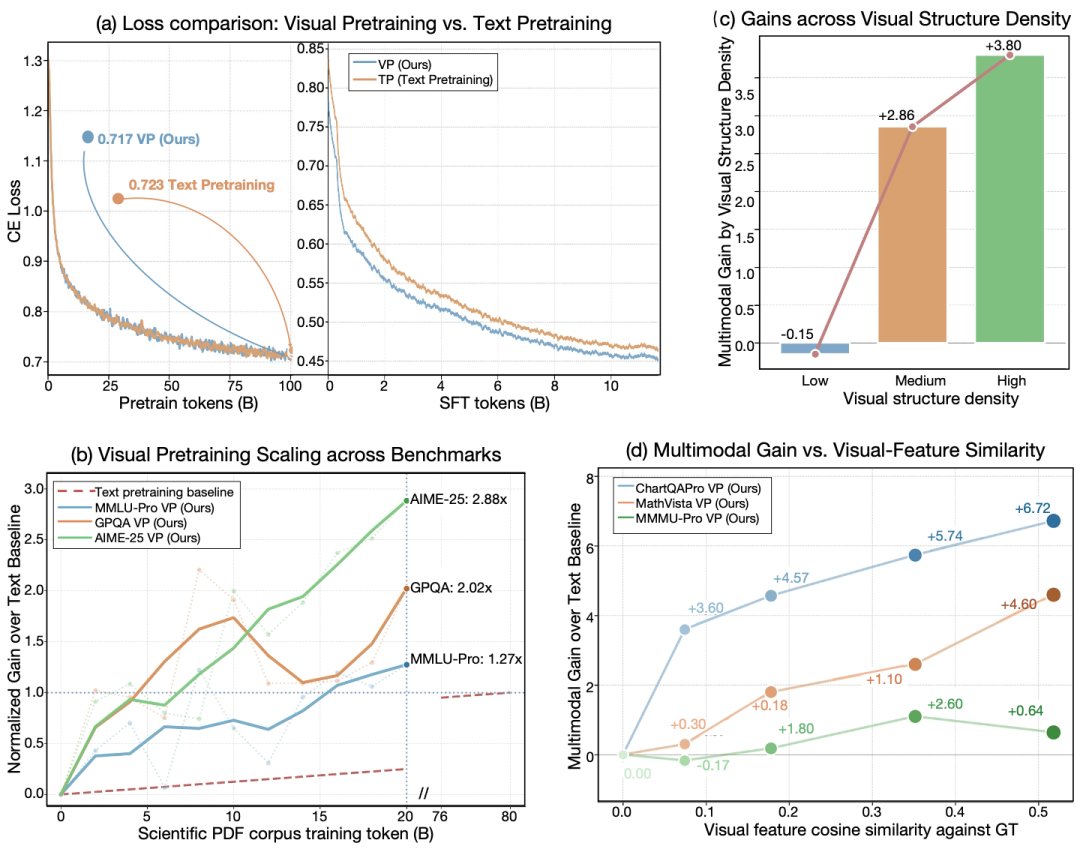
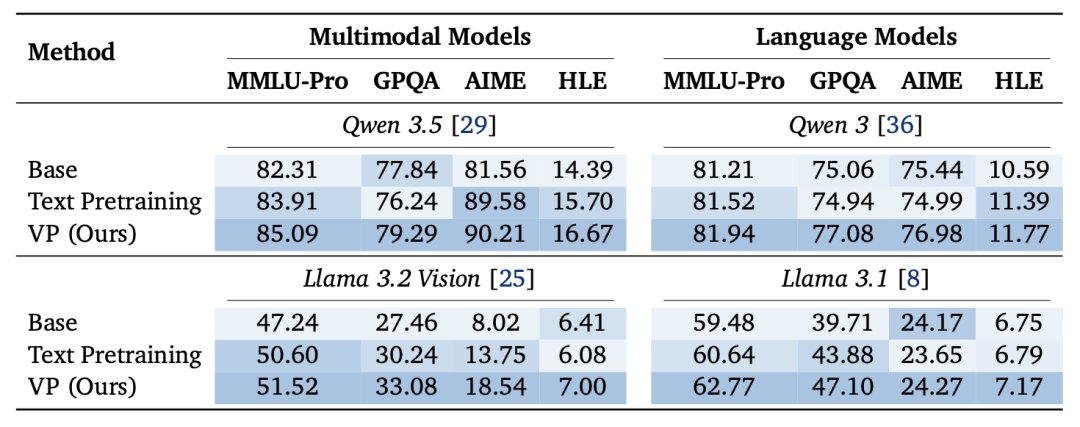
🔥Introducing Visual Pretraining (VP) 👀: a new, scalable pretraining paradigm for foundation models.
😉It enables models to learn directly from visual documents 📖 and outperforms text-only pretraining across backbones and benchmarks.
📈 Explore the paper and our most capable multimodal foundation model trained with Visual Pretraining as part of its training recipe.
📄 Paper:
https://t.co/2qO7HgKUfj
🤗 Hugging Face Paper:
https://t.co/3tkS5KRcz1
🤖 Intern-S2-Preview (35B):
https://t.co/bGyNzKqrlG
🤖 Intern-S2-Preview-397B:
https://t.co/CV7IdiN39D