Millionaires and Millions will be made following the AI Buildout
Remember and follow this as we grow your account to retirement the next 5-10 Years.
The roadmap happens in phases:
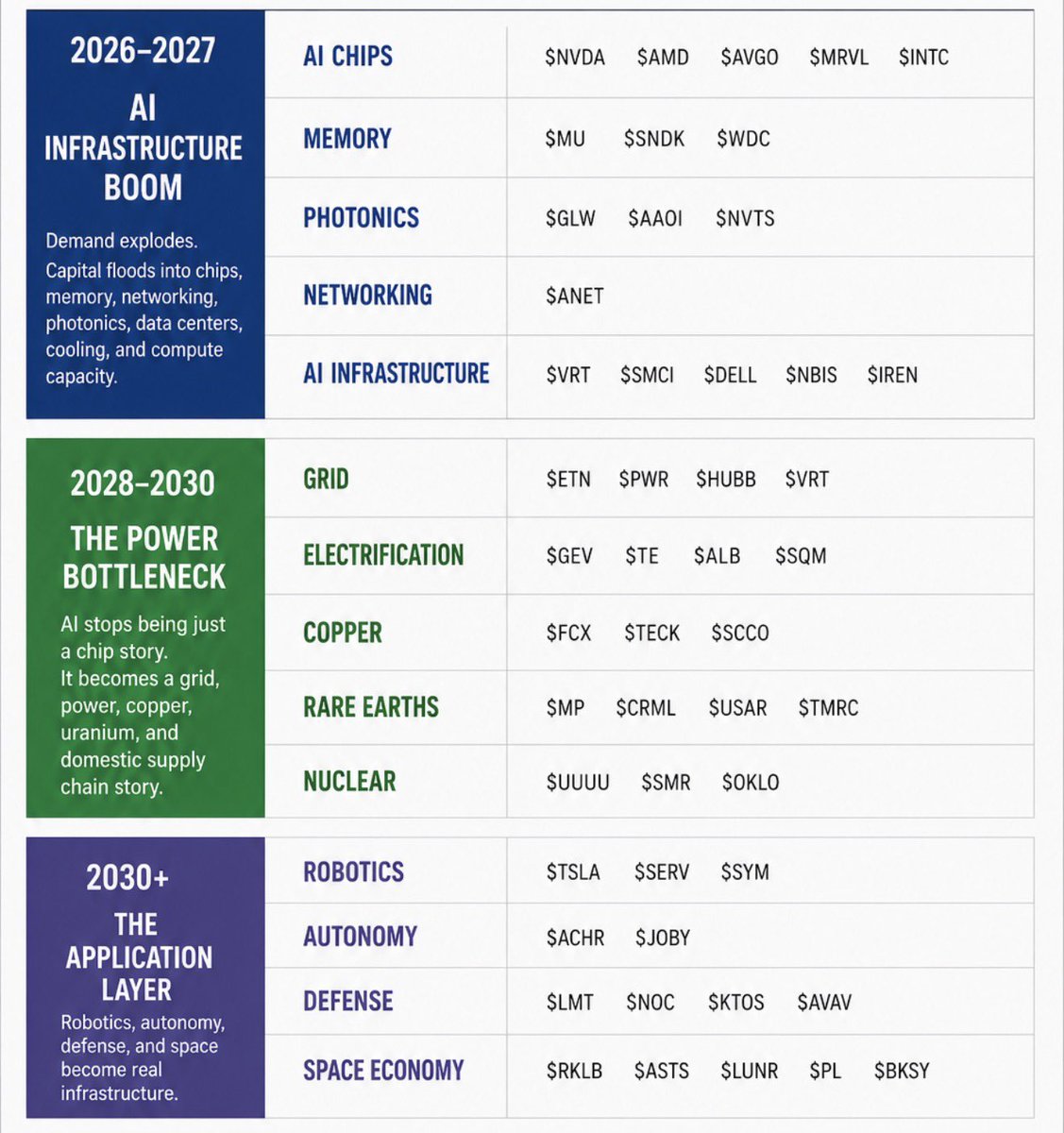
2026–2027: Build the AI Stack
AI Chips: $NVDA $AMD $AVGO $MRVL $INTC
Memory: $MU $SNDK $WDC
Photonics: $GLW $LITE $NVTS
Networking & Connectivity: $ANET $QCOM
Infrastructure: $SMCI $DELL $NBIS
Data Centers: $IREN $APLD
Electrical Equipment: $POWL
2028–2030: Build the Power
Grid: $ETN $PWR
Power Producers: $CEG
Electrification: $GEV $TE
On-Site Power: $BE
Copper: $FCX
Rare Earths: $MP $USAR
Nuclear: $UUUU $SMR $OKLO
Cybersecurity: $CRWD
AI Applications: $PLTR $SNOW
2030+: Build the Future
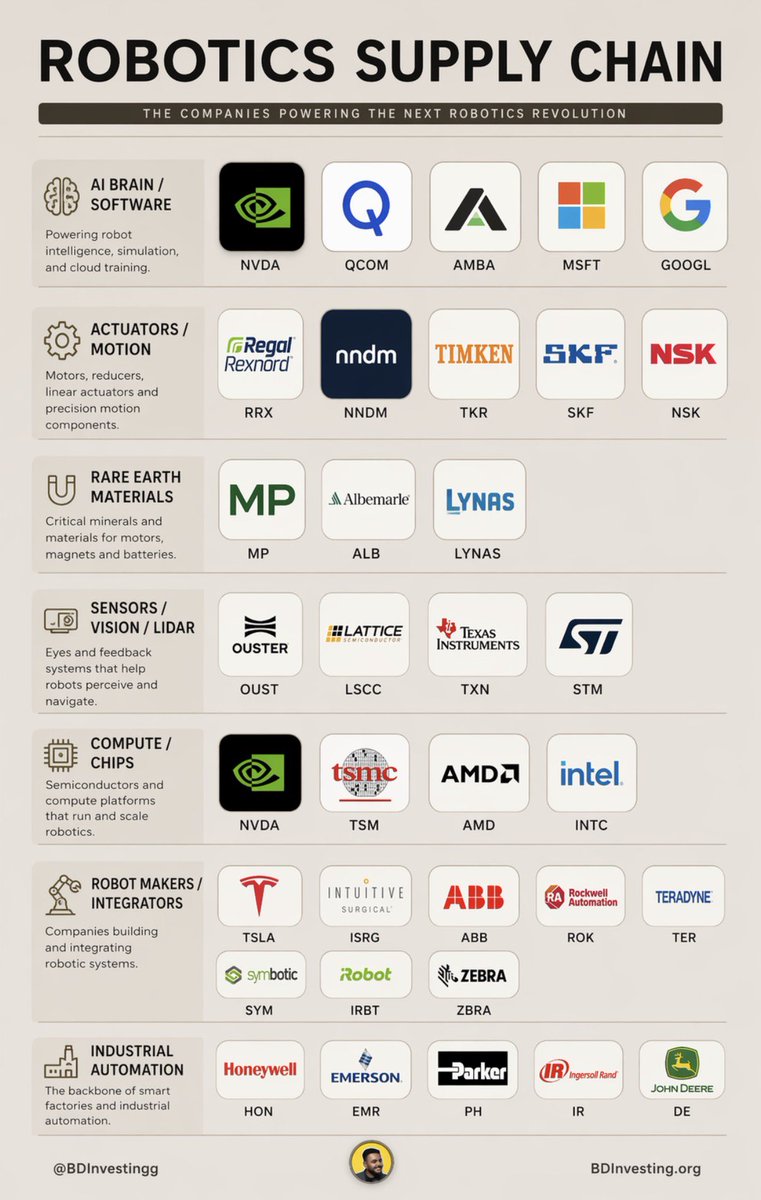
Robotics: $TSLA $SERV $SYM
Autonomy: $ACHR $JOBY
Drones: $AVAV $KTOS $ONDS $RCAT
Defense: $LMT
Space: $RKLB $ASTS $LUNR
Quantum: $IONQ $QBTS $RGTI
We will be positioned early together before sector rotations happen.
if you’re also curious about robotics hardware and don’t know a lot (like me), i found the best place to start!!
this website has an interactive breakdown of literally every component in a humanoid: skeleton, motors, batteries, reducers, sensors, all the way to cost breakdowns and sourcing
you can click through real robots (like boston dynamics, apollo) and watch the spec sheets update live
also just a joy to use https://t.co/DU0djS1aml
The humanoid robot market is projected to reach $7.5 trillion by 2050 and most investors are looking at the wrong companies (Save this).
Everyone is focused on the robots themselves but a humanoid robot is just a collection of precision components and right now, a handful of industrial suppliers quietly control the bottlenecks that every single robot company on earth depends on.
That component diagram above is your investment map.
The most critical component in any humanoid robot is the reducer, the precision gearbox that converts motor speed into torque for each joint.
Every shoulder housing, knee joint, hip actuator runs through one and right now, one Japanese company controls 85% of the global market for the dominant type, strain-wave harmonic reducers.
That company is Harmonic Drive Systems (6324.T / HSCDF).
Harmonic Drive is a confirmed supplier to multiple major humanoid programs and the entire global industry depends on its output.
Revenue was ¥55.6 billion in FY2025 and order books are accelerating as OEM production ramps and it is the closest thing to a monopoly in the entire humanoid supply chain.
The second reducer type, cycloidal RV reducers, which dominate heavier joints like hips and shoulders is controlled by Nabtesco (6268.T / NCTKY), also Japanese, with roughly 60% global share.
FY2025 revenue hit ¥307.9 billion, up 9.8% year over year, with operating profit up 60% in the same period.
Both companies are so embedded in the supply chain that even the Chinese robot manufacturers racing to commoditize components still rely on Japanese reducers for precision critical applications.
Together, actuators and reducers represent 30 to 51% of the entire hardware bill of materials for a humanoid robot.
When you're talking about a billion robots by 2050, the companies that supply those components are not riding a theme, they are the theme.
The next layer is bearings and precision transmission. SKF (https://t.co/m5gvlP4X1U), the Swedish industrial bearing giant, announced a joint venture on July 2, 2026 with Chinese precision component maker Leaderdrive specifically to supply high precision transmission components for humanoid robot joints.
SKF is taking a 60% majority stake, targeting both the Chinese market, the world's largest and fastest growing humanoid robotics market and international expansion through its global sales network.
SKF has the manufacturing scale, the quality systems, and the global distribution and it is now directly positioned inside the humanoid supply chain at the joint level.
The force and torque sensor market is the next critical bottleneck because every foot, wrist and ankle in a humanoid robot needs a sensor that tells it exactly how much force it is applying, the thing that lets a robot grip a fragile object without crushing it.
The global humanoid force/torque sensor market was $700 million in 2025 and is forecast to reach $6.4 billion by 2032, growing at 37.1% annually.
Novanta (NOVT) is the publicly traded play here because its ATI Industrial Automation subsidiary, acquired specifically for its robotics sensing capabilities launched the Varo force/torque sensor in early 2026, purpose-built for humanoid platforms.
Novanta also owns Celera Motion, which supplies advanced motion control components to robot joints and it is one of the few US-listed companies with real, shipping revenue from humanoid component supply.l
The broader motors and drives layer belongs to Nidec (6594.T / NJDCY), a Japanese company with ¥2.61 trillion in annual revenue that revealed a full six-axis humanoid drive solution at IREX 2025 meaning it can supply the complete motor stack for an entire robot from a single vendor.
And Yaskawa Electric (6506.T / YASKY), which just acquired Tokyo Robotics and posted FY2026 operating profit up 70% year over year, is moving aggressively from industrial arms into humanoid platforms.
The pattern across all of these companies is identical, decades of precision manufacturing expertise built for industrial automation and automotive, now being redirected into a market that is about to be orders of magnitude larger.
Bullish on the supply chain because every humanoid robot needs the same critical components and make sure to follow me @MelvinInvests for more overlooked opportunities.
Most investors are watching the chip companies while the real money is sitting two layers upstream (Save this).
What you're looking at is the entire semiconductor supply chain, the companies, layers and dependencies that take a chip from raw silicon wafer to finished hardware inside a data center.
And once you understand how this chain works, you realize that the best investments in AI aren't the chips themselves but rather the companies that every chipmaker on earth cannot operate without.
The chain starts with raw materials.
Shin Etsu, Siltronic, and GlobalWafers supply the silicon wafers that every chip is built on.
Wolfspeed and Coherent supply silicon carbide wafers for power chips and these are quiet, unglamorous oligopolies where supply takes years to expand and demand is structurally growing.
Before any chip gets manufactured, it has to be designed and that's where Synopsys and Cadence come in, two companies that together control 73% of the global EDA software market and combined generate over $12 billion in annual revenue.
Every GPU, every TPU, every hyperscaler custom ASIC passed through their tools before a single transistor was ever laid down.
You literally cannot design a chip without them. At Computex 2026, both companies unveiled agentic AI tools that automate chip design steps that used to take weeks, and Jensen Huang endorsed Cadence's autonomy roadmap from stage meaning AI is making their software more valuable.
Cadence posted Q1 2026 revenue of $1.47 billion, up 19% year over year, and raised full year guidance to $6.2 billion.
Then comes the most important monopoly most people have never seriously studied.
ASML is the only company on earth that manufactures EUV lithography machines, the tools that physically print circuits onto silicon at advanced nodes below 7nm.
Every advanced chip fab on the planet, TSMC, Samsung, SK Hynix, Intel is entirely dependent on ASML and has no alternative.
Each machine costs $300 to $400 million and takes over a year to build and ASML raised its 2026 revenue guidance to €36 to €40 billion and entered the year with a backlog of €38.8 billion, larger than its entire annual revenue target.
SK Hynix alone committed $8 billion for 30 machines and the new High NA EUV systems, the next generation priced above $400 million each are just entering production with margins that will only expand as volume scales.
KLA Corporation runs the quality control layer, and almost nobody outside the industry talks about it.
As chips get smaller and more complex, the cost of a single undetected defect rises exponentially which means inspection intensity per wafer increases with every new node.
KLA holds approximately 70% market share in wafer level packaging process control, a position it gained 14 percentage points in a single year as advanced AI chip packaging accelerated.
Revenue in its March 2026 quarter came in at $3.415 billion, up 11% year over year, and the company's own internal targets point to $26 billion in annual revenue by 2030, roughly double where it is today.
Here is the investment thesis in one paragraph.
Hyperscalers are spending over $700 billion on AI infrastructure, and the race is only getting bigger.
Every single dollar of that capex flows through this supply chain before a single AI query gets processed.
And the companies at the chokepoints of that chain, ASML with its EUV monopoly, Synopsys and Cadence with their EDA duopoly, KLA with its inspection dominance have no real competitors, multi-decade moats, and revenue that grows almost mechanically every time a new AI chip gets designed and manufactured.
Long Upstream companies and make sure to follow me @MelvinInvests for more overlooked opportunities in semiconductors.
At 3Cr, your life changes dramatically.
1) Setup a tax base abroad. Move your liquid money. And, start paying 0% capital gains.
2) This move comes with frictions. Setting up a tax base, paying money upfront, 250K LRS etc whatnot.
Most people give up here.
And, accept their fate.
But: if you power through this phase, new opportunities open up like never before.
3) Example: if you have a UAE tax base. You can easily invest across: US equities, derivatives, SEA equities, you name it.
It takes 1 min to move 1Mn$, legally. Friction is 0.
4) No nonsense of dealing with currency depreciation, unreliable laws, filing 100 forms for every little move.
You can focus your mental energy growing your wealth. Not on compliances.
5) On top of this: new income streams open up. For eg. Wheel strategy -- you sell Puts 15% OTM. Once you get the stocks, you sell call 15% OTM.
This is a solid active investing strategy with 0% tax.
****
Is the pain worth it? 100% yes. Numbers prove it.
3CR.
Let's say this grows at 13% with 0% capital gains.
₹3 Cr × (1.13)^30 = ₹3 Cr × 39.12 = ₹117.36 Cr
Total gain = ₹114.36 Cr
If you pay 12.5% (and other BS taxes), you will end up paying: 14.30Cr for a passive investment strategy.
If you undertake active investing, this number would be much higher.
Now you decide if paying X lakhs/year as the setup fee is worth it.
****
No Indian fund manager/CA will tell you this. Because if they tell you this, you will leave them & the system, lol 😅
Power is the next bottleneck when it comes to AI
$VST — Runs power plants that sell electricity directly to the grid. More AI demand = more revenue, no middleman.
$GEV — Makes gas turbines and grid equipment. Builds the hardware that keeps electricity flowing when demand spikes.
$SMR — Developing small nuclear reactors that can be built faster and cheaper than traditional plants. Clean baseload power.
$CCJ — Mines uranium. Every nuclear plant needs fuel. More nuclear = more CCJ.
$VRT — Keeps data centers cool and powered efficiently. The gear inside the building that stops AI servers from melting.
$IREN — Buys cheap power and runs data centers on it. Profits from the gap between electricity cost and compute revenue.
The market is finally realizing Physical Ai is the next bottleneck , stocks to buy :
$OUST — Lidar sensors for robots and autonomous vehicles to perceive their environment.
$AMBA — AI vision chips for cameras, drones, and edge robotics.
$MP — Mines rare earth materials used in robot motors and actuators.
$SYM — Autonomous warehouse robots for picking and fulfillment.
$QCOM — AI processors and wireless chips for edge robots and autonomous devices.
$AMD — GPUs and CPUs powering the data centers that train physical AI.
$TER — Tests the semiconductors inside every robot and autonomous system.
I think @ren_stocks has to be my favorite account who post breakdowns like these.
Covering stocks top to bottom in the simplest way possible for everyone.
If you love those breakdowns go show him some love!!
I genuinely don't understand why everyone isn't using this yet
Andrej Karpathy, a co-founder of OpenAI, posted a simple idea that hit 16 million views: stop using AI to write code, use it to build a second brain.
You point Claude Code at a folder, drop in any source, an article, a transcript, a PDF, and Claude reads it, links it, and files it into a living wiki of everything you know. It compounds like interest, the more you feed it, the smarter it gets.
Here's the whole thing:
> Install Obsidian, create a vault, open it in Claude Code
> Paste Karpathy's wiki idea file and tell Claude to build it
> Claude makes three folders: raw for sources, wiki for its pages, a CLAUDE.md that runs it
> Drop any source into raw and say "ingest this"
> Ask questions across everything, forever
Five minutes to set up, and you never start from a blank chat again.
Full step-by-step guide with Claude and Obsidian, link below.
Bookmark this
The hottest job in AI right now isn't AI Engineer.
It's FDE.
(Forward Deployed Engineer)
a16z just launched an 8-week fellowship for the people deploying AI into real enterprises.
They're looking for builders who:
• Deploy AI systems into production
• Work directly with customers
• Build agentic workflows
• Think in systems, not features
• Combine technical depth with product intuition
You'll join leaders from:
@OpenAI, @cursor_ai , @databricks , @ElevenLabs , @harvey , @Google , @Snowflake , @Ramp, Rippling etc.
The biggest AI breakthroughs won't happen in research papers.
They'll happen inside companies figuring out how to make AI actually work.
Apply by June 26.
https://t.co/4BEHgLklUt
The AI supercycle is in year 3 of 15. You didn't miss it.
You'd make millions by knowing whats coming and buying dips until 2030+
Pay attention, we just finished Phase 1 2023-2025
chips · memory · connectivity
$NVDA → Designs the GPUs every AI model trains and runs on.
$MU → Makes high-bandwidth memory inside every AI server.
$COHR → Moves data at light speed between GPUs optically.
$MRVL → Custom silicon connecting every chip in a hyperscaler's cluster.
$AVGO → Builds Google's, Meta's, and Apple's custom AI chips quietly.
$AMD → Only credible GPU rival to NVDA for AI training.
PHASE 2 — The grid gets built (2026–2027)
power · cooling · networking
$IREN → AI-native data centers built to scale compute and power.
$WULF → Energy-efficient infrastructure hosting the world's most power-hungry AI workloads.
$VRT → Cooling and power systems keeping AI data centers running.
$ETN → Electrical gear powering every hyperscale AI facility being built.
$CEG → Nuclear energy feeding AI's insatiable around-the-clock power demands.
$ANET → High-speed switches moving massive AI workloads across GPU networks.
$GEV → Gas turbines physically delivering power to data centers.
$SMCI → Liquid-cooled GPU server racks — pick-and-shovel for AI density.
PHASE 3 — The massive bottleneck (2027–2029)
materials · space · autonomy
$MP → Mines rare earth materials used in AI hardware and defense.
$USAR → Domestic minerals securing U.S. AI manufacturing independence.
$ASTS → Satellites delivering AI connectivity to every corner of Earth.
$RKLB → Low-cost rockets launching satellites powering AI communication networks.
$KTOS → AI-driven autonomous weapons systems entering mass military deployment now.
$TSLA → Leads real-world AI through robotics, autonomy, and manufacturing.
$SYM → AI-powered warehouse robots automating global logistics at scale.
$ALAB → Chip packaging bottleneck — critical past 100K GPU nodes.
$PLTR → Software turning AI compute into defense and enterprise decisions.
PHASE 4 — Full automation (2030+)
platforms · agents · quantum
$MSFT → Deploys AI agents across every enterprise software product it sells.
$GOOGL → Controls AI search, cloud, and consumer distribution globally.
$META → AI assistants across 3 billion users in social and commerce.
$CRM → AI agents inside enterprise sales — 150K customer moat.
$NOW → AI workflow OS for Fortune 500 enterprises.
Quantum
$IONQ $RGTI $QUBT — next-gen compute unlocking exponential AI breakthroughs.
♻️ RESHARE this post and make 1 comment, I'll share when to add these stocks in June.
My highest-conviction picks right now:
Satellite & Space: $ASTS, $RKLB, $OPTX
AI Infrastructure: $NBIS, $PENG, $HLIT
Defense: $EOS.AX, $KRKNF, $OPTX
Humanoid Robotics: $AMBA, $OUST, $VPG
Memory & Semiconductors: $MU, $SNDK, $MX
Quantum Computing: $INFQ, $LAES, $IONQ
Data Center Power: $CEG, $BE, $FCEL
Fintech: $HOOD, $SOFI, $COIN
Optical Networking: $ADTN, $HLIT, $LITE
Different sectors, same thesis: real businesses, clear growth catalysts, and valuations that the market still hasn't fully priced in.
These are the names I'm positioned in for the next several years.
$NOW can easily triple from $125 by Jan 2027.
Remember, token use is expected to 2800% in 5 years says $GS.
So these 24 stocks can still 10x-20x:
(COMPUTE / GPU)
1. $NVDA — Every token touches a GPU. 24x tokens = 24x chip demand, full stop.
2. $AMD — MI300X gaining enterprise traction. Second GPU source as hyperscalers diversify suppliers.
3. $INTC — Gaudi AI accelerators + x86 CPUs running inference at the edge and enterprise.
(NETWORKING)
4. $ANET — AI clusters need ultra-low latency switching. 24x tokens = 24x network traffic routed.
5.$AVGO — Custom AI ASICs for hyperscalers. Token volume drives ASIC and switching orders higher.
6. $CSCO — Data center fabric and ethernet switching. Every agent call crosses Cisco infrastructure.
7. $CIEN — Optical networking backbone connecting AI data centers. Bandwidth demand scales with tokens.
(MEMORY / STORAGE)
8. $MU — HBM3E stacked on NVDA GPUs. More inference = direct memory bandwidth demand explosion.
9. $WDC — Flash storage holds model weights and KV caches. Agent scale drives NAND demand structurally.
10. $STX — Hard drives store cold AI training data. Data center storage TAM expands with every model.
(POWER / COOLING)
11. $VRT — More tokens = more heat. Liquid cooling demand explodes alongside data center power density.
12. $ETN — Electrical infrastructure for AI data centers. Power management is the #1 buildout bottleneck.
13. $GEV — Gas turbines and grid solutions powering new data center campuses requiring gigawatt-scale energy.
14. $VST — Power generator selling directly to hyperscalers. AI energy contracts already locked in long-term.
(CLOUD PLATFORM)
15. $MSFT — Azure hosts majority of enterprise agents. Token spend flows straight through its cloud margin.
16. $AMZN — AWS Bedrock is the enterprise agent backbone. More agents, more API calls, more revenue.
17. $GOOGL — TPU infrastructure + Gemini API. Every token processed on Google Cloud prints margin.
(ENTERPRISE AGENT LAYER)
18. $NOW — Enterprise agents run on its platform. Every workflow automated burns more tokens daily.
19. $CRM — Agentforce deploys AI agents across sales, service, and marketing. Per-action token billing scales.
20. $PLTR — AIP platform runs AI agents on enterprise and government data. Token volume is its revenue driver.
(AI INFRASTRUCTURE)
21. $NBIS — Pure-play AI infrastructure at ground level. Token supercycle lifts the entire compute ecosystem.
22. $SMCI — Builds GPU server racks for data centers. Every NVDA chip needs a SMCI chassis to run.
23. $DELL — AI server sales to enterprises exploding. Token growth drives hardware refresh cycles faster.
24. $ARM — Chip architecture inside every mobile and edge AI device. Royalties scale with token proliferation.
$NOW is the most undervalued right now. This is why Jensen Huang says the market has made a mistake on it.
♻️ RESHARE this post and write 1 comment, I'll DM you the best $NOW contract to buy and hold.
Anthropic engineer:
"You can build 5 assistants in one afternoon. Each one handles a task you've been doing manually every single day."
In 45 minutes he builds 5 focused agents from scratch on camera.
Most people are still doing code review, testing, and documentation by hand every single day
Watch the session, then save all templates below 👇
The next 5-10 years will RETIRE you.
MILLIONAIRES will be made from the AI super cycle build out.
Here’s how I and those following me will position:
2026–2027: AI Infrastructure Boom
Money floods into chips, memory, networking, photonics, data centers, cooling, and compute capacity.
AI Chips: $NVDA $AMD $AVGO $MRVL $INTC
Memory: $MU $SNDK $WDC
Photonics: $GLW $AAOI $NVTS
AI Infrastructure: $VRT $SMCI $DELL $NBIS $IREN
2028–2030: The Power Bottleneck
It becomes a grid, power, copper, uranium, and domestic supply chain story.
Grid: $ETN $PWR $HUBB $VRT
Electrification: $GEV $TE $ALB $SQM
Copper: $FCX $TECK $SCCO
Rare Earths: $MP $CRML $USAR $TMRC
Nuclear: $UUUU $SMR $OKLO
2030+: The Application Layer
Robotics: $TSLA $SERV $SYM
Autonomy: $ACHR $JOBY
Defense: $LMT $PLTR $KTOS $AVAV
Space: $RKLB $ASTS $LUNR $PL $BKSY
I’m trying to help you position and become a MILLIONAIRE. I will make sure it happens.