The human brain is strikingly modular, with distinct networks for language, formal reasoning, social reasoning, and physical reasoning. Is this a fundamental principle of how intelligent systems are built, or an accident of biological evolution?
In our latest preprint, we find that a similar modular organization emerges in Large Language Models, another class of intelligent system.
Brains and LLMs are shaped by entirely different kinds of optimization (biological evolution vs. gradient descent). That they arrive at the same modular design anyway suggests modularity may be a fundamental property of intelligent systems.
🌐 Web: https://t.co/ZKrnTSSuSf
📄 Paper: https://t.co/ZibBXz3PUy
💻 Code & data: https://t.co/uBo5iOYNjy
Using circuit analyses across 46 tasks spanning four cognitive domains, we find:
1️⃣ Tasks that draw on the same network in humans recruit overlapping units in LLMs, while tasks drawing on different networks recruit distinct units.
2️⃣ These units are causally linked to model behavior. Ablating the units critical for one domain impairs performance in that domain (−26% accuracy) but barely touches the others (−2.5%).
This project has been in the works for a while :) Huge thanks to my advisors @jacobandreas@ev_fedorenko@devarda_a, and to @Nancy_Kanwisher for valuable conceptual input and feedback throughout. #MIT
Really appreciate Drs. Lizhen Chen and Jason Liu for highlighting our work on TEAD1 condensates. The graphical abstract they drew helped demonstrate the functional change of TEAD1 condensates when they go from small to large. @NatureCellBio
https://t.co/JBalNRl4uH
Excited to see our new paper out in @naturemethods. Spatio-DARLIN enables robust and efficient in situ lineage tracing in mice at single-cell resolution (https://t.co/wle3IQxqWx). Big shoutout to my talented trainee @GauJarning, Zhanhao Zhang, and amazing collaborator @ShouwenW.
📢 Delighted to share that our lab has recievd Advanced Research Grant (ARG) from
@ANRFIndia
Grateful to ANRF, our collaborators
@shaileshgenome, Dr Praveen Soni (Raj. Uni), entire research team for their support. We look forward to recruit motivated Reserch Fellows in our team
🪡Can nanoscale curvature drive chemistry?🧪 We show that high-curvature γ-Al₂O₃ nanoneedles localize heat into hotspots ♨️, lower apparent activation barriers 📉, and enable CF₄ decomposition, revealing new ways of activating resilient molecules 😳🌍https://t.co/WTxzRO61FF
The 1st ever preprint from the Tang Lab! 🥳
Our results show that, after overlearning, value processing shifts from the ventral striatum to the orbitofrontal cortex, moving from stimulus value to abstract state value representations.
https://t.co/GNWWOM6xMe
@biorxiv_neursci
In their July Nature Genetics study, researchers at the Flatiron Institute’s Center for Computational Biology (CCB) used advanced mathematical models to analyze data from more than 5,000 research participants with autism. The work revealed four distinct groups that link autism-related traits with underlying genetics. This work could open the door for more precise diagnoses and personalized support in autism interventions.
https://t.co/95fQAGqPTB
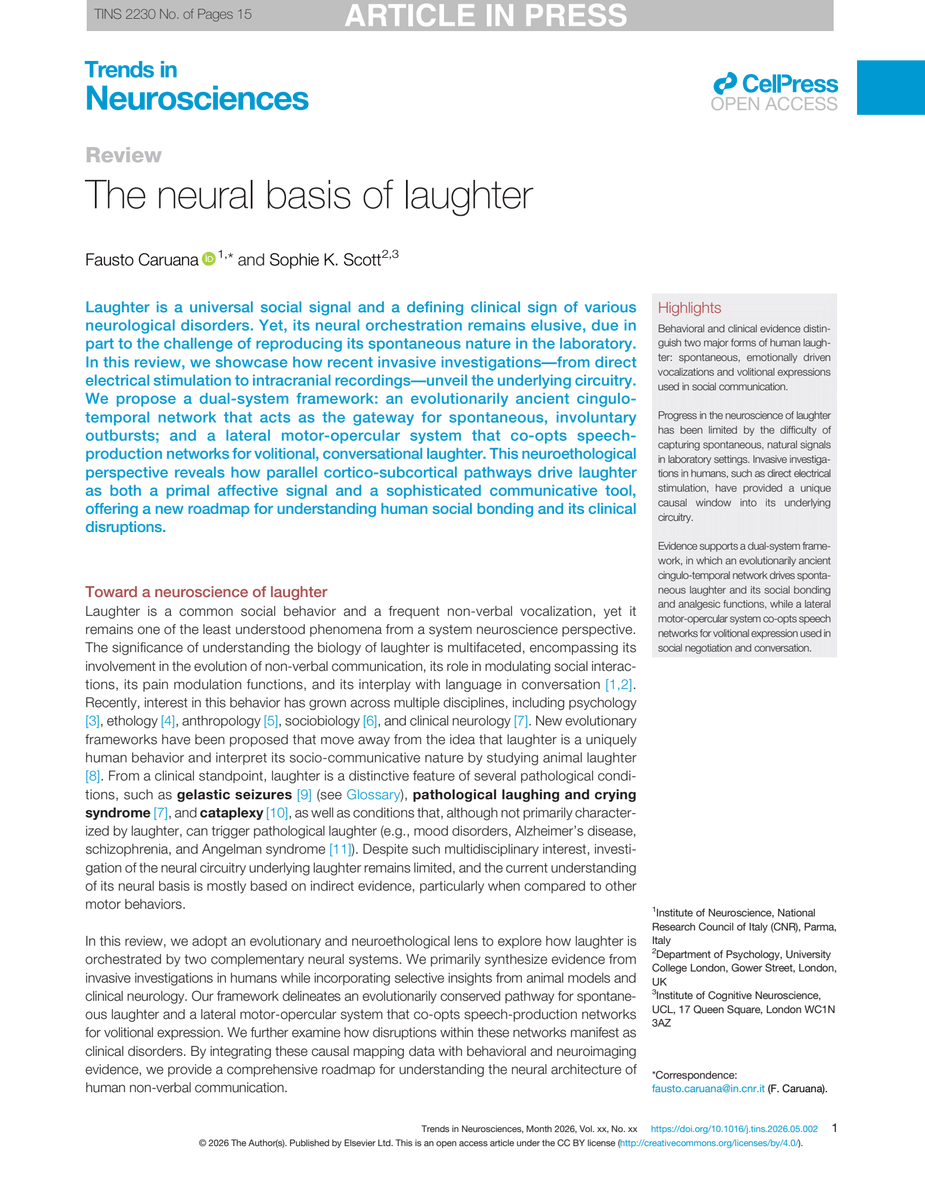
Spontaneous and conversational laughs come from two different parts of the brain.
Learn more in Trends in Neurosciences: https://t.co/aesQlabGei
Fausto Caruana & Sophie K. Scott
Perspective:
Advancing mechanobiology from single molecules to complex cellular systems.
This Perspective highlights the need for advanced tools, models, & theoretical frameworks to better understand the complexity of mechanobiological systems.
https://t.co/1VQWUcqfFp
#Article
Investigating the Application of Pomegranate-Loaded Chitosan Nanoparticles as Contrast Agents for Enhancing Breast Cancer Detection via Diffuse Reflectance Spectroscopy by Hala S. Abuelmakarem, et al.
https://t.co/S0iBGUy11C
@MDPIOpenAccess#laser#diffusereflectance
New in @NatureMaterials, we report a strain-insensitive, wet-tissue-adhesive elastomer–hydrogel biphasic bioelectronic platform (ElHyX) for physicochemical monitoring and adaptive therapy. Congrats to Jiahong and the team! @Caltech
https://t.co/VIBcWeXWke
Very excited about this project, led by @zach_ladwig
We show that the individual lateral prefrontal cortex has reliable and highly detailed network organization missed in past group approaches.
Full🧵 coming soon!
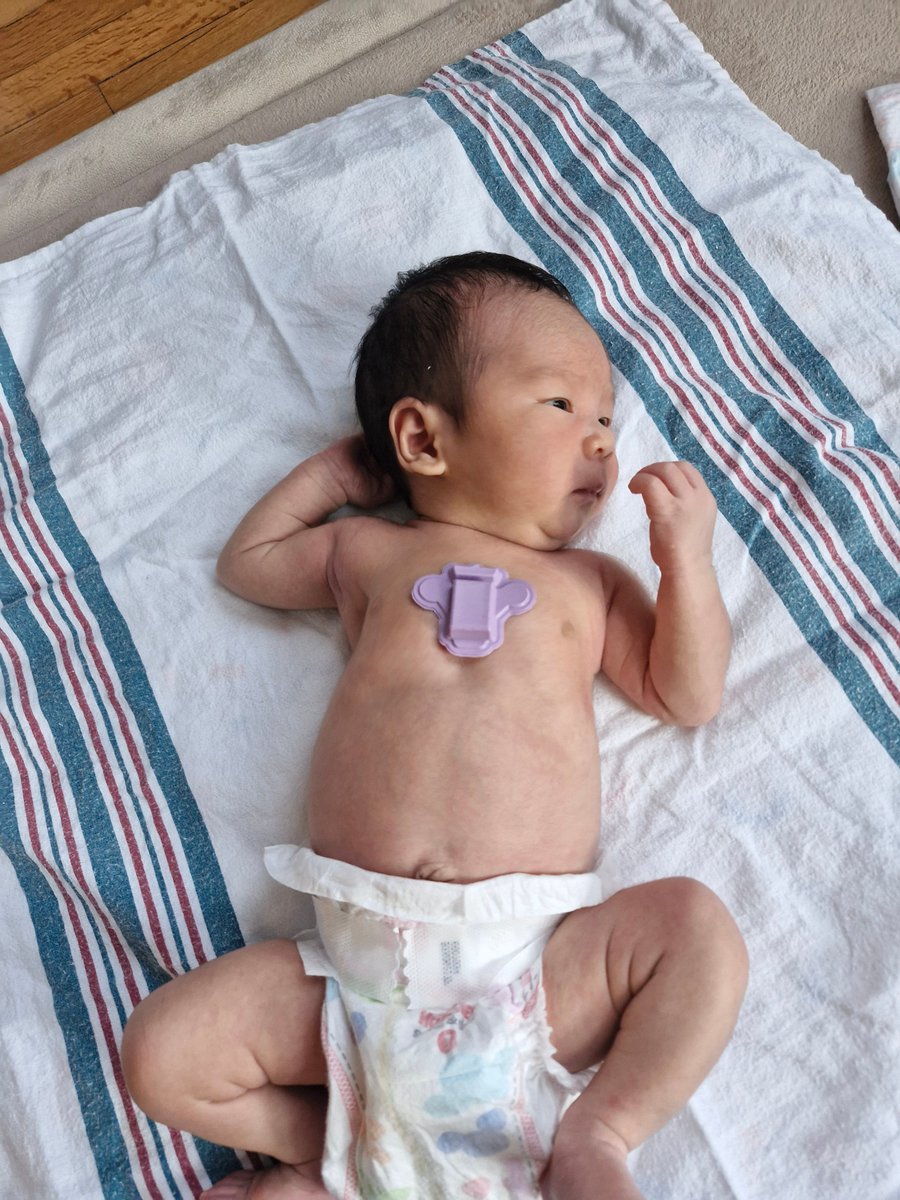
A wearable lie detector? – well, somebody had to build it! Our paper, titled ‘Wireless, skin-interfaced multimodal sensing system for continuous psychophysiological monitoring—A wearable polygraph device,’ published in Science Advances (https://t.co/TbShE9iVxJ), and highlighted in this press release from @NorthwesternU (https://t.co/C1IGOXJNzW), introduces a device capable of precisely measuring the full suite of parameters (and beyond!) captured by state-of-the-art polygraph systems, but in a soft, wireless wearable form that mounts on the chest. Our emphasis is not on lies specifically, but instead on stress in general, and particularly for its relevance to medical care, as demonstrated in various representative cases – from pain experienced by infants, to sleep disruptions in babies with Down syndrome, to confusion in adults with hearing impairments, to strains experienced by medical students in training for emergency room care. The devices leverage the concepts of hybrid soft electronics for continuous measurements of body sounds, body movements, skin impedance, temperature and thermal transport. The results yield heart rate, heart rate variability, respiration rate, variability and depth, sweat gland activation, cardiac amplitude (as a rough surrogate for blood pressure), near-surface blood flow and skin temperature. Machine learning algorithms rely on these data streams to determine stress. The paper presents not only a broad range of uses, as mentioned above, but also validations – from correlations to commercial polygraph instruments, to tools for pupillometry, to nurse scoring sheets, to polysomnography systems. Fun project, with many additional applications in sports, worker safety, etc – complementing previously published work from our group and impressive papers from others that consider stress biomarkers in sweat, but without the cumbersome process of collecting and chemically analyzing this class of biofluid. In fact, the platform introduced here involves only biophysical sensors, bypassing the need for disposable components and avoiding the various confounds (hysteresis, drift, lack of specificity, inadequate sensitivity and others) associated with biochemical measurements. Thanks to former postdoctoral fellows in the group – Prof. Sun Hong Kim (University of Seoul), Prof. Jaeyoung Yoo (SKKU), Prof. Tianyu Yang (ASU), Prof. Seonggwang Yoo (Inje University) and Dr. Seunghee Cho (Samsung) – for their leadership and to many current group members – Dr. Taewan Park and others -- for their contributions. Also grateful to our collaborators across the medical school, specifically Prof. Debbie Weese-Mayer, Dr. Khaytin Ilya and Dr. Jana Jaffe, and in the Department of Communication Sciences and Disorders. Finally, thanks to @amanda_mo for the nice writeup and press package for the Northwestern release.
We developed a flexible temperature sensor using laser-induced graphene (LIG). Unlike conventional thermocouples, both legs are made from LIG using different laser settings, enabling high-sensitivity sensing on curved surfaces.
https://t.co/7KtpcGZMe4
@KAUST_PSE@kaust_me
We developed a wireless, passive strain sensor with no wires and no power needed.
Using RF tech and coupled piezoresistive electrodes, we achieved high-sensitivity capacitive sensing in a fully printable, low-cost device.
https://t.co/7KtpcGZMe4