🤯 Midjourney -- yes, the AI image company -- just shipped a brand new type of imaging machine. 🤯
- 100x faster than an MRI.
- 10x cheaper.
Full body scanned in 60 seconds instead of an hour in a tube. Ultrasound based, MRI-level resolution.
And it's real -- not a concept, a working machine. You step into a shallow pool of warm water, a ring of half a million sensors sends sound through your body from every angle, and ~60 seconds later you have a 3D map of your insides down to a fraction of a millimeter. No radiation, no tube, no lying still.
They're not even building it as a hospital machine -- they're building a spa. The scan is a side-effect of a place you'd want to hang out anyway.
Lastly, it is built by 9 people. NINE PEOPLE.
You can just do things.
Hey @Ask_WellsFargo
I am looking to get experience letter from wellsFargo india, i have sent so many emails and so many follow-ups.
Can you please suggest the right way and fastest way to get the letter.
Thanks.
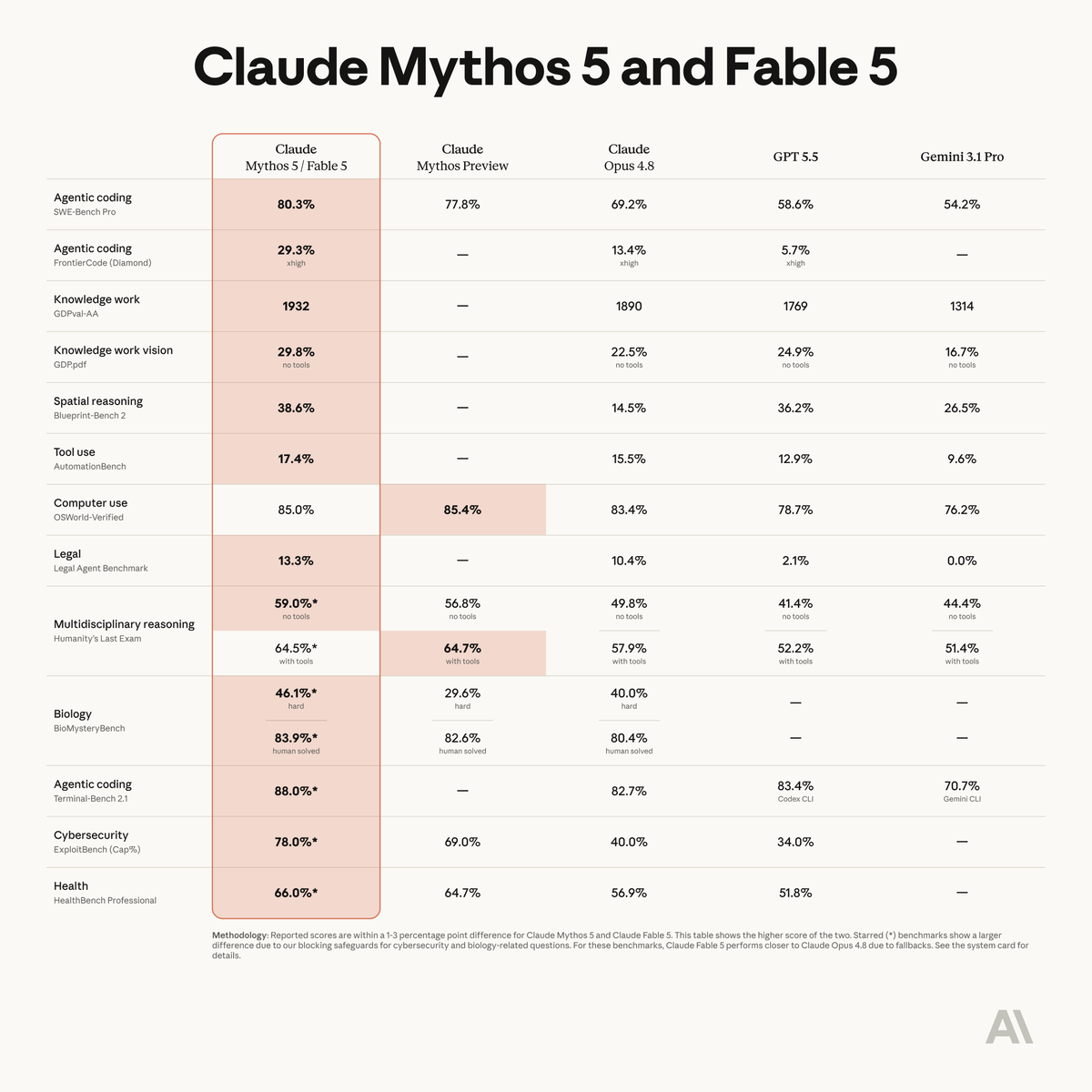
Fable 5 is state-of-the-art on nearly all tested benchmarks, with exceptional performance in software engineering, knowledge work, scientific research, and vision.
The longer and more complex the task, the larger Fable 5’s lead over our other models.
Anthropic has confidentially submitted a draft S-1 registration statement to the Securities and Exchange Commission.
Pending completion of SEC review, this gives us the option to pursue an initial public offering.
Read more: https://t.co/onGZAhRLvD
Excited to share our most powerful new Claude Code feature: dynamic workflows!
Mention "workflow" in a prompt and Claude will dynamically create an orchestration plan that it strictly follows, allowing you to confidently trust that every stage happens in the right order even across 100s of agents.
"agent debt" is like technical debt but for agents. When you hack together an agent workflow fast and never clean it up, the system prompts conflict, the memory gets polluted, the tools overlap. 6 months later the agent is doing weird things and nobody knows why lol.
#AI#May'26
The Obsidian community is weirdly intense. Like showing someone your home gym. It's a flex now. The quality of your knowledge base (second brain?) is becoming a status symbol among builders. @obsdmd#Obsidian
New blackboard lecture w @reinerpope
How do chips actually work – starting with basic logic gates, and working up to why GPUs, TPUs, FPGAs, and the human brain each look the way they do.
0:00:00 – Building a multiply-accumulate from logic gates
0:16:20 – Muxes and the cost of data movement
0:25:59 – How systolic arrays work
0:39:00 – Clock cycles and pipeline registers
0:51:40 – FPGAs vs ASICs
1:03:14 – Cache vs scratchpad
1:07:16 – Why CPU cores are much bigger than GPU cores
1:11:49 – Brains vs chips
1:15:22 – A GPU is just a bunch of tiny TPUs
Look up Dwarkesh Podcast on YouTube/Spotify/etc to watch. Enjoy!
Elon Musk's first wife once described what it's like to watch him fail.
She said he doesn't react the way normal people react. When a rocket explodes, most people in the room go silent. Some cry. Some start calculating the financial damage.
Musk pulls out his phone and starts making calls. Not emotional calls. Engineering calls. "What failed. When can we fix it. When's the next launch." His voice doesn't change. His face doesn't change. The rocket that just cost $60 million is already in the past. The next one is all that exists.
She said it was the most unsettling thing she'd ever witnessed. Not because he was cold. Because he genuinely wasn't affected. The failure didn't register as failure. It registered as data. An experiment that produced results. Results that inform the next experiment.
This is why he wins. Not because he doesn't fail. He fails more spectacularly than anyone in history. He wins because failure occupies zero psychological space. It enters as data and exits as action.
Most people lose not because they fail but because they spend weeks processing the failure before acting again. Musk spends zero seconds. The gap between failure and next attempt is a phone call.
Andrej Karpathy just joined Anthropic.
His new boss is the man who realised AI could train itself.
You've probably never heard of him.
Meet Nick Joseph 🇺🇸
> Harvard grad. No PhD. No fame.
> First job: ranking charities at a nonprofit called GiveWell.
> That's where he first heard the words "AI safety."
> He laughed it off. Models weren't even dangerous yet.
> Joined Vicarious ~ a startup trying to build AGI through robots.
> Then OpenAI. Quietly. On the safety team.
> Worked on something nobody was paying attention to: teaching GPT-3 to write code.
> Then he watched it work.
> A model. Writing the same code that trained it.
> That was the moment. The future cracked open in front of him.
> December 2020: he walked out of OpenAI with 10 others.
> Built Anthropic from zero with Dario and Daniela Amodei. 🚀
> Today he runs the team that trains every version of Claude.
> 40+ engineers. 27,000+ academic citations.
> Two podcasts ever: one on AI safety (80,000 Hours, 2024), one on scaling laws (YC, 2025). Zero about himself.
May 19, 2026: Andrej Karpathy joins Anthropic.
He reports to Nick.
The loudest minds get the headlines.
The quiet ones run the labs. 🐐
Personal update: I've joined Anthropic. I think the next few years at the frontier of LLMs will be especially formative. I am very excited to join the team here and get back to R&D. I remain deeply passionate about education and plan to resume my work on it in time.
A 24-year-old ex-OpenAI researcher just turned $225M into over $13.67B in under 2 years.
And his portfolio just revealed something even more extreme than his returns.
Leopold Aschenbrenner was fired from OpenAI in April 2024.
After that, he wrote a 165-page thesis predicting AGI by ~2027.
Then he launched a fund and did something unusual:
He fully positioned around that thesis.
He initially avoided the obvious AI winners:
Zero $NVDA
Zero $MSFT
Zero $GOOGL
Zero $AMZN
Instead, he targeted what AI physically runs on.
His early “AI infrastructure” longs included:
• Bloom Energy $BE
• Lumentum $LITE
• SanDisk $SNDK
• CoreWeave $CRWV
• Iris Energy $IREN
The thesis was simple:
AI isn’t just software.
It’s constrained by:
• power
• bandwidth
• storage
• compute infrastructure
And those bottlenecks were massively mispriced.
The results were explosive:
• Bloom Energy: +1,422%
• Lumentum: +1,331%
• SanDisk: +3,130%
• IREN: +583%
• CoreWeave: +166%
This is what turned his initial $225M into ~ $5.5B by end of Q4 2025.
Fast forward to his latest SEC filing (Q1 2026):
His disclosed exposure has surged to $13.67B equivalent across 42 positions.
A near 3x jump in a single quarter.
But the structure of the portfolio changed dramatically.
He didn’t just stay long AI infrastructure.
He built a two-sided portfolio;
Massive bearish positioning on semiconductors (puts totaling ~$7.46B):
• $SMH ETF PUT: $2.04B
• $NVDA PUT: $1.57B
• $AVGO PUT: $1.01B
• $AMD PUT: $969M
• $MU PUT: $583M
• $TSM PUT: $535M
• $ASML PUT: $494M
• $ORCL PUT: $1.07B
• $INTC PUT: $159M
At the same time, he STILL holds long exposure to the AI infrastructure stack:
• $BE : $878M
• $SNDK: $724M
• $CRWV: $556M
• $IREN: $401M
• $CORZ: $389M
• $APLD: $320M
• $RIOT: $142M
• $CLSK: $104M
• $SEI: $62M
• $TE: $43M
• $KEEL: $38M
• $BTDR: $29M
• $PSIX: $26M
• $WYFI: $20M
• $BW: $19M
• $SHAZ: $18M
• $PUMP: $13M
• $HIVE.NE: $6M
He also added CALL OPTIONS on select names:
• $MU CALL: $422M
• $SNDK CALL: $388M
• $TSM CALL: $354M
• $CRWV CALL: $140M
• $BE CALL: $55M
So the positioning is not a simple “AI is over” trade.
It’s more specific:
He still believes AI infrastructure expands aggressively…
…but thinks semiconductor leaders may have pulled forward too much optimism.
In other words:
He is long the physical buildout of AI
and short the market’s most crowded AI expectations
at the same time.
From $225M → $5.5B → $13.67B…
The real signal isn’t just performance.
It’s that his view of AI has evolved from:
“AI wins”
to
“the winners of AI may not be who the market thinks.”
Are you going to ignore him again?
New article: a visual tour of recent LLM architecture advances, from Gemma 4 to DeepSeek V4.
I focus on long-context efficiency tweaks like KV sharing, per-layer embeddings, layer-wise attention budgets, compressed attention, and mHC.
Link: https://t.co/KO81y3kTH7
Grok Build is a fully interactive CLI, which means you can actually use your mouse to click. No flickers.
Especially useful as I find myself running 5+ agents at a time and jumping between plans.