Anthropic engineer:
"You're not supposed to prompt Claude. You're supposed to build a system that prompts itself."
In 45 minutes she shows exactly how Anthropic builds agents that remember, fix their own mistakes and get smarter with every run.
This beats any paid course on agents I've seen.
Watch it, then read the guide on building loops below.
Andrew Ng just dropped a free 1-hour course on building agentic knowledge graphs from scratch
Watch it today, then read the article below on how to become a graph engineer.
Save and bookmark this no matter what. It'll be the most productive thing you do this week
[↓ Save this playbook before it disappear in your feed]
• 00:00 : What agentic knowledge graphs are and why agents need them
• 03:07 : How to construct your first agentic graph
• 14:00 :How multi-agent systems get architected on top of graphs
• 23:00 : How to build agentic graphs with Google's ADK
• 01:06:03 : Why graphs are the future of agentic AI
A senior Google engineer just dropped a 19-page PDF on "Loop Engineering" for LLM and agentic systems.
Act → Observe → Learn → Repeat
• Act: the LLM proposes a code transformation (tile this loop, parallelize that one).
• Observe: a compiler runs it and reports back - is it valid? faster? slower? by how much?
• Learn: the LLM reads that feedback and adjusts its next move.
• Repeat until it stops finding improvements.
The agent gets smarter purely from grounded feedback inside its own context window.
This 19-page PDF totally changed the way I’m building agentic systems today.
Read it now, then explore the article below.
10 codelabs from #GoogleCloudNext to start building today:
1. Build rich agent experiences (ADK + A2UI).
Improve user interaction through intuitive, high-quality interfaces that allow users to interact with agentic systems seamlessly → https://t.co/21LvLJ7kDh
2. Build a multi-agent system.
Create the architecture required to make multiple agents work together to achieve a shared goal → https://t.co/MCv4mKifj0
3. Beyond the Simple SELECT: AlloyDB NL2SQL.
Democratize data access by building systems that allow users to query complex databases using natural language, supported by high-speed vector search → https://t.co/eqnxc8e6Ly
4. Beat fraud with an AI Shield (Spanner & BigQuery Graph).
Implement real-time reasoning with Spanner and BigQuery Graph databases. Analyze complex relationships in your data to prevent fraud at the point of transaction → https://t.co/L2c81fKTHH
5. Build secure agents by protecting access and data.
Protect the reasoning engine with Model Armor and IAM to manage agent access and ensure that sensitive data remains protected during execution → https://t.co/37nMd1FgNI
6. Ground agents with Google Maps Platform.
Use Geo-intelligent logistics to ground your agents in real-world location data to optimize field operations and logistics in real-time → https://t.co/NCb6LymayQ
7. Deploy and scale agents on Agent Engine.
Learn how to deploy agents as containerized microservices that scale dynamically with your workload → https://t.co/fY9WKYE2Xs
8. The ultimate guide to Cloud Run: from zero to production.
Achieve rapid deployment using this lab as a blueprint for moving from a local prototype to a production-ready, auto-scaling platform on Cloud Run → https://t.co/nZLRgEn7Vs
9. Developer Keynote: building agents with Skills.
Learn the ins and outs of AI agent development, including Agent Development Kit (ADK), prompting, Agent Skill usage, and MCP → https://t.co/fJ72HbFwgJ
10. General Keynote: forecasting with AI Agents.
Transform unstructured chaos into actionable business intelligence in seconds → https://t.co/iBBPXpoYoB
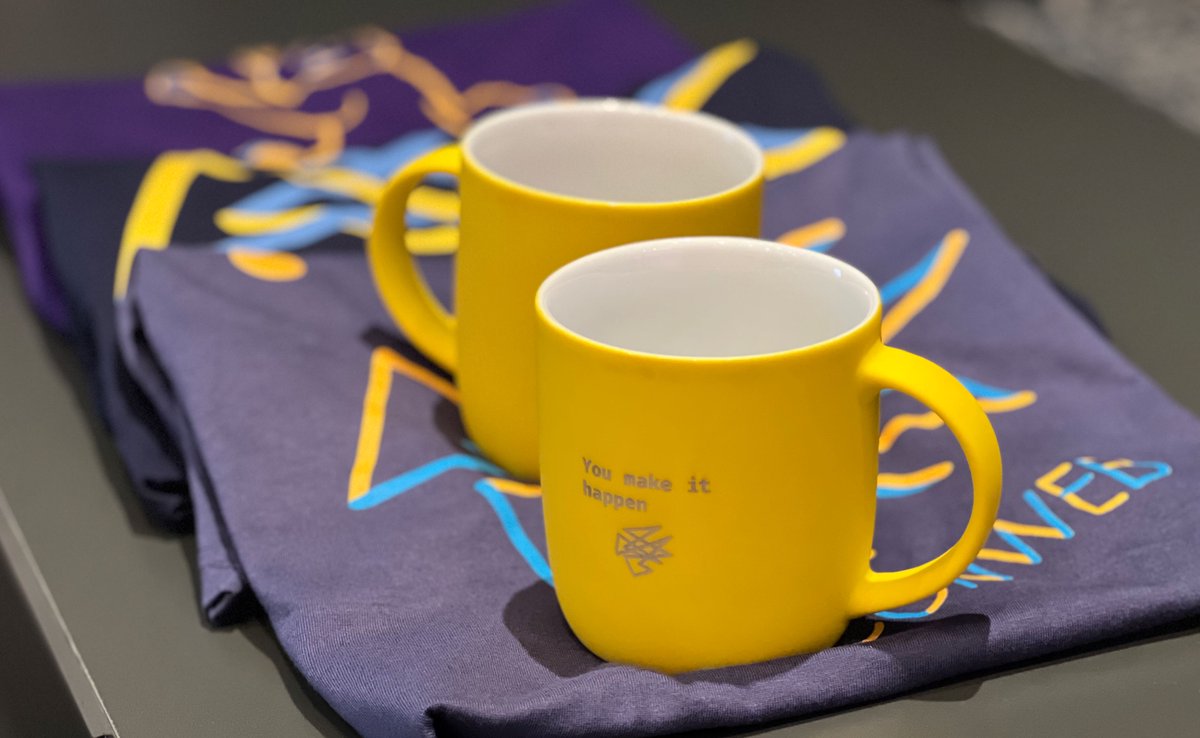
At every @PyConWeb we had leftover shirts reserved for speakers, volunteers etc. Also shiny yellow mugs. Want some? Time to share! Pick a size and I'll ship it (within EU) 💛💙🐍 #pysanta
IRedis is a terminal client for redis with auto-completion and syntax highlighting. IRedis lets you type Redis commands smoothly, and displays results in a user-friendly format
https://t.co/5iXXSnklbd
I’m sick of hearing about “hard work” and how it magically makes your dreams come true.
Hard work is a multiplier but it needs proper direction.
Working on the right things will get you way farther than working hard on things that don’t matter.
🤔 Remember when you requested a UI for DVC and CML? The day has come! 🎉
😍 UI for ML experiment tracking
💪🏼 The power of Git to track, preserve and reproduce experiments
📈 Graphs to compare experiments
🚀 Run CML in the cloud or Kubernetes
👉🏽 https://t.co/XfHKkm0WJG
I’ve recently struggled to understand Python concurrency:
- How threads & processes work on your OS vs Python
- The role of CPUs, hardware & the GIL
- Understanding beyond rules of thumb
After tons of research, I wrote this w/the answers plus more 👇🧵
https://t.co/a6PoEN9dUQ
Interactive deep learning book with code, math, and discussions. Available in multi-frameworks. Adopted at 140 universities.
https://t.co/onev7qsJhi
#deeplearning
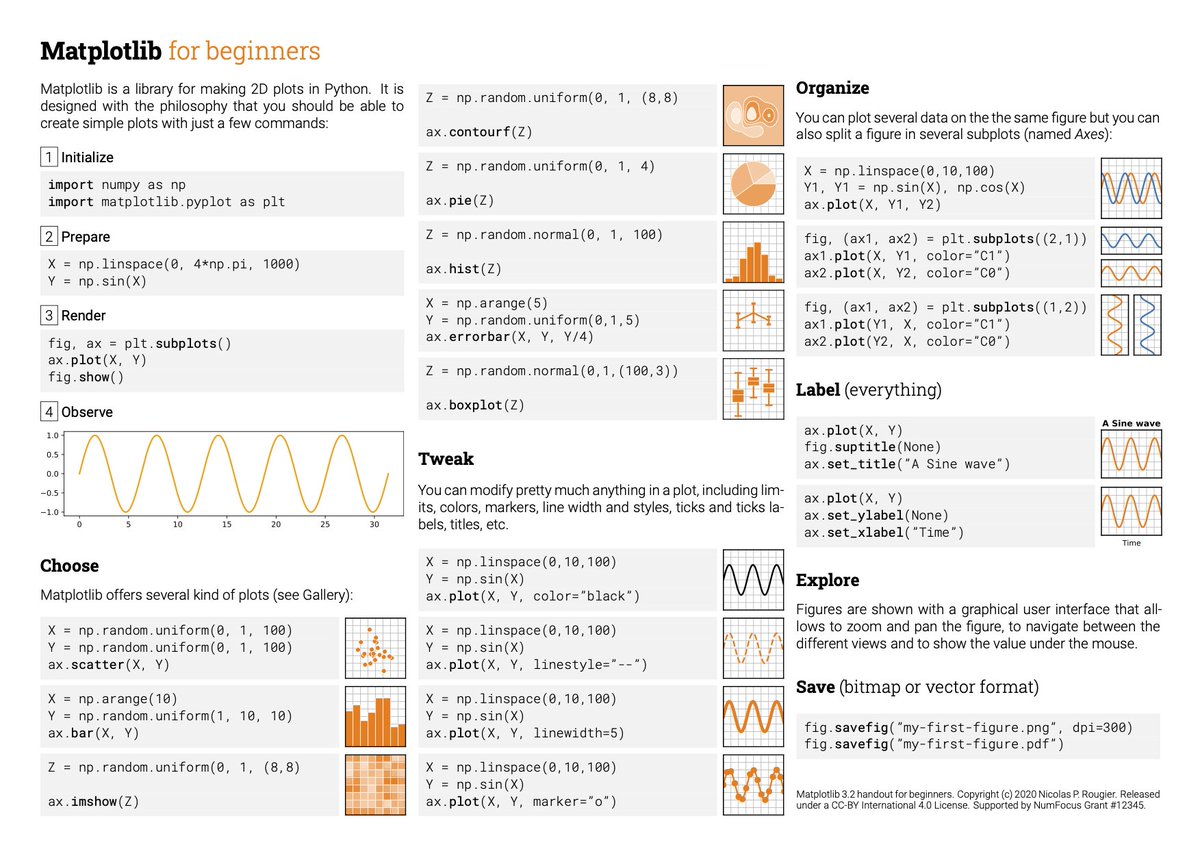
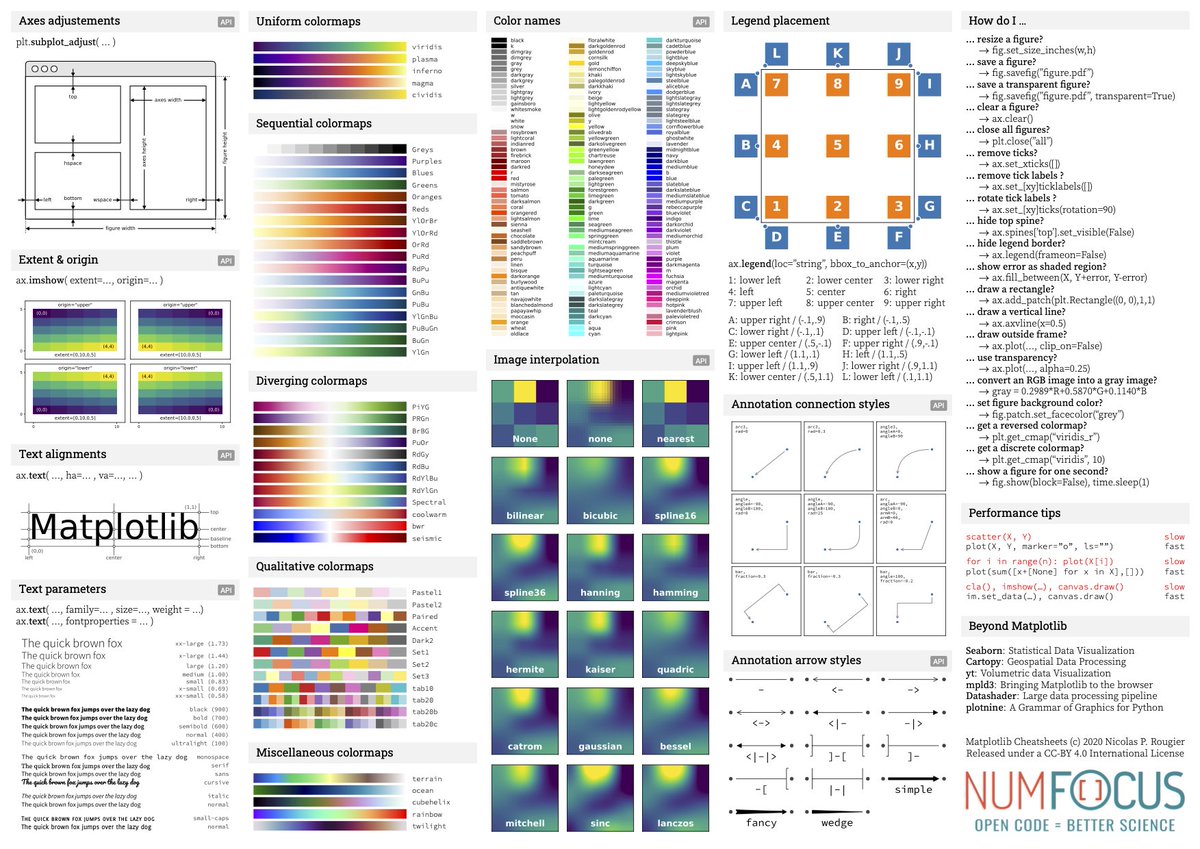
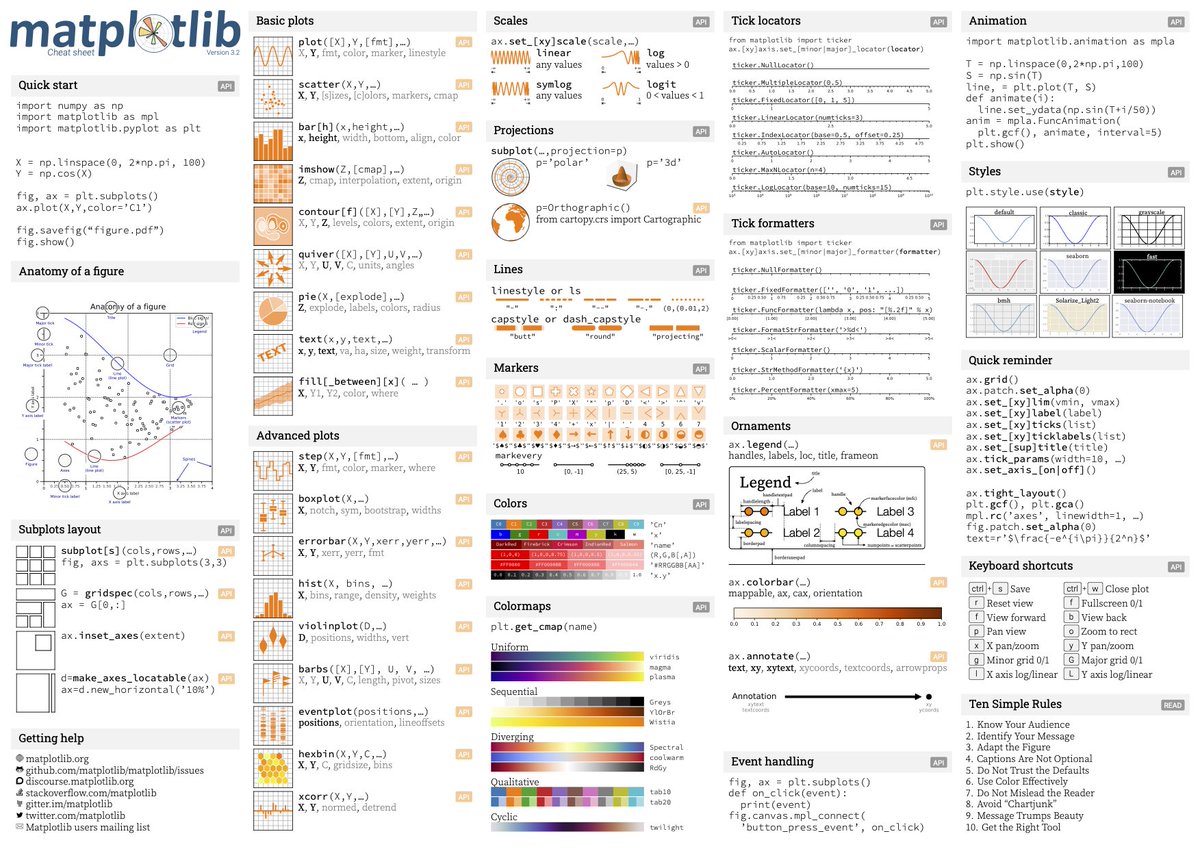
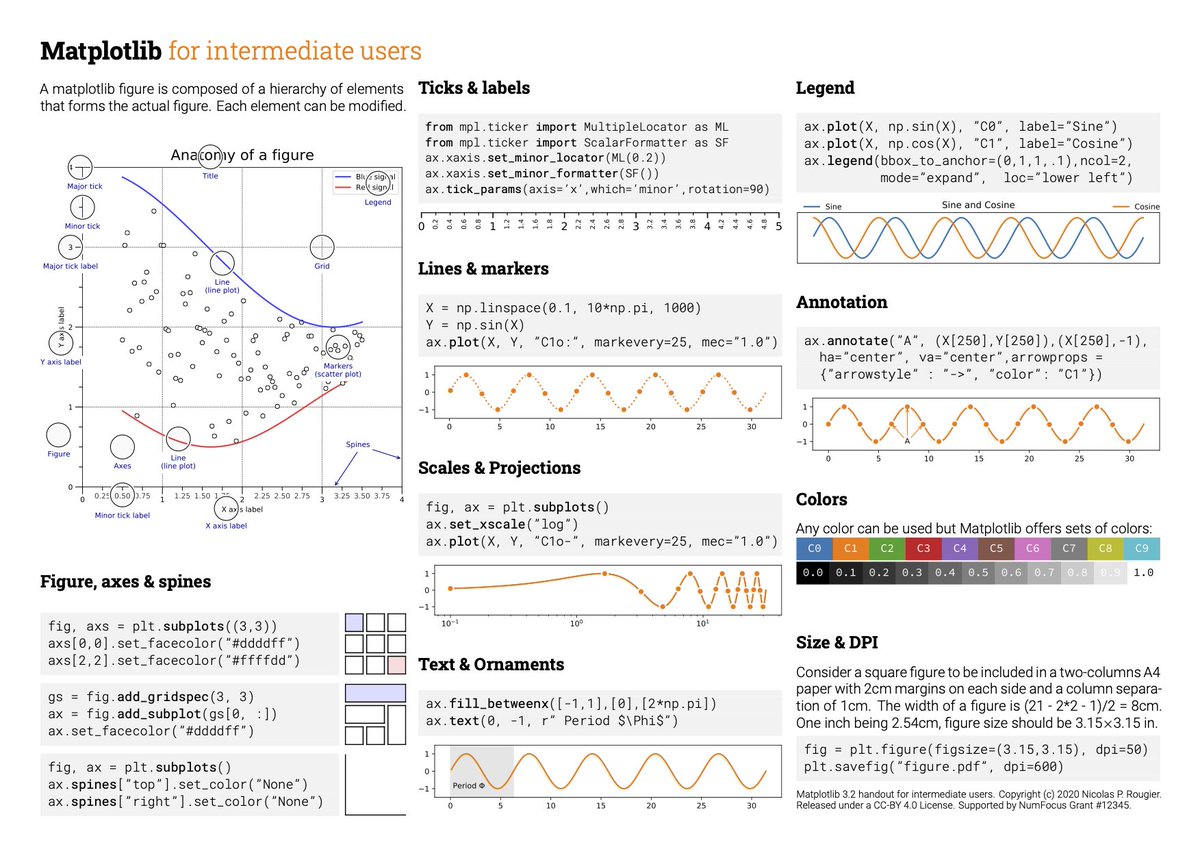
Thanks to @NumFOCUS, @matplotlib now has brand new cheatsheets (1 & 2) and handouts (beginners, intermediate and tips). See https://t.co/VYQ2qOGFy3. #Python#SciPyConf2020
For Databricks users, we've also built Model Serving directly integrated into the #MLflow Model Registry, so that the versions of a model you promote to staging or production are immediately deployed. Of course, you can still serve models elsewhere too. https://t.co/p2BHSltbb7
After Delta Lake last year, we are now donating MLflow to the Linux Foundation, to provide a vendor-neutral home that will further broaden adoption and contributions to the #MLflow project. The project has 2.6 million downloads per month. A crazy number!
https://t.co/5cCDJ0tRVT