We'll be spending a lot more time trying to understand the outputs of language models. A few thoughts, tips & tricks:
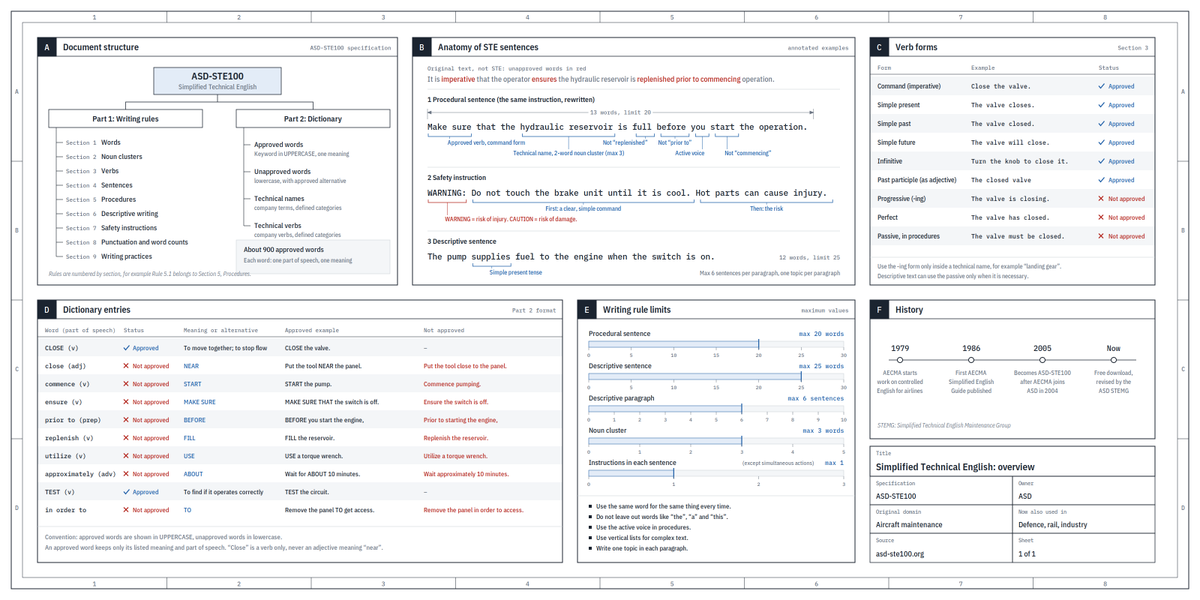
Writing. Something I've had success with: Ask your LLM to explain something in ASD-STE100, it's a controlled language specification originally developed for aerospace maintenance documentation. LLMs well-versed in this language and it comes with heavy constraints on clean writing style that I often find a lot more readable. Sometimes I've tried to soften it a bit e.g. ask for "80% of the way to ASD-STE100" because the spec is quite stringent. But even better:
Diagrams / images. Instead of writing, ask your LLM to create a diagram. These can be a lot easier to process, parse, and understand. But even better:
Web pages. Ask for output "in HTML" to get a beautiful, interactive webpage. LLMs are getting really good at frontend and can create beautiful experiences, animations, etc. But even better:
Explainer videos. The output format I am most bullish on is fully custom / bespoke explainer videos generated on any arbitrary topic. Experiment with things like "Create a 3b1b style video explainer on X. Use my ElevenLabs API key for audio narration". (you'd need an API key for the latter or you can ask your LLM to find you decent free alternatives that use your local compute). This is actually starting to work!
In summary:
- As LLMs get better, they will do more and more of the legwork autonomously, and a lot more of our work will rise up the abstractions into oversight and understanding.
- Luckily, LLMs can help here too because as intelligence and code are increasingly abundant, you can ask for large, custom, discardable software artifacts (e.g. web apps, video explainers) that would have never made sense to create before. Push the boundaries here and you'll be surprised.
TCP packets are so polite that they shake hands with each other before transferring data. They also say "bless you" when another packet sneezes. UDP packets on the other hand, just scream their data into the void & hope someone's listening. It's the "yolo" of networking protocols
New from our security teams: Our AI agent Big Sleep helped us detect and foil an imminent exploit. We believe this is a first for an AI agent - definitely not the last - giving cybersecurity defenders new tools to stop threats before they’re widespread.
my weekend project to learn about bluetooth mesh networks, relays and store and forward models, message encryption models, and a few other things.
bitchat: bluetooth mesh chat...IRC vibes.
TestFlight: https://t.co/P5zRRX0TB3
GitHub: https://t.co/Yphb3Izm0P
Introducing Jules, an AI coding agent powered by Gemini 2.5 Pro.
Jules works asynchronously across your repo on tasks like fixing bugs or refactoring, helping you cross multiple things off your to do list at the same time. Plus, stay updated with Codecasts, a daily podcast of your repo's recent commits.
Try it for free, globally, at https://t.co/pKENn6cr9R
.@huggingface papers forum is a great resource for filtering the best AI papers of the last month.
What is the equivalent of this for other fields? Trying to build up a good information pipeline/blog roll.
Have you tried out the MCP Server extension yet?
Integrate Burp Suite with AI Clients using the Model Context Protocol (MCP).
Not got Pro? Don’t worry, this extension is compatible with Community, too!
#BurpSuite#MCP
You can now connect GitHub repos to deep research in ChatGPT. 🐙
Ask a question and the deep research agent will read and search the repo’s source code and PRs, returning a detailed report with citations. Hit deep research → GitHub to get started.
Today we are rolling out an updated Gemini 2.0 Image Generation model with 🖼️:
- Better visual quality
- More accurate text rendering
- Lower block rates
- Higher rate limits
- $0.039 per image generated
So excited to get this into the hands of devs : )
Introducing Meta Perception Language Model (PLM): an open & reproducible vision-language model tackling challenging visual tasks.
Learn more about how PLM can help the open source community build more capable computer vision systems.
Read the research paper, and download the code and dataset: https://t.co/GgJEPXTH8W
AGI isn’t just about intelligence—it’s about impact. If we get it right, it could become the greatest force for solving humanity’s biggest challenges.
#AGI#ResponsibleAI#AI
AI is entering the ‘Era of Experience’—models now learn from real-world interactions, moving beyond static datasets. This shift could redefine AGI development.
In the race to build smarter AI, let’s not forget to build fairer AI. Intelligence without inclusivity is just another bias in code.
#AI#AGI#EthicalAI#InclusiveTech#AIForGood