Last summer we rushed out of lockdown into an amazing experimental run, that is finally published in Nature! And moreover, our cover was selected! Amazing times! :D
https://t.co/ehNbgaaZcK
@QuantumPSA@ICFOnians
@BrtCorriere 3 settimane dalla spedizione, 4 giorni in consegna, 3 email mandate e nessuna risposta da voi, oltre che nessun pacco. Sarà anche Natale, ma non mi sembra accettabile
@TMBinfo Seguimos aquí con el buen jueves! Justo ahora vimos un X95 que saltó las paradas del canal olímpico y se fue directamente a Barcelona. Que divertido!
@TMBinfo Desafortunadamente no, estamos esperando un X95 en Castelldefels hasta Barcelona desde más de una hora...no es el atasco, ya que se ven pasar en la otra dirección! Que está pasando?
**New Paper in Nature Human Behaviour**
If there is something that many democracies have in common is a great degree of polarization. But what issues divide a population? And how can we detect them?
In 2022 we ran two digital democracy experiments in France 🇫🇷 and Brazil 🇧🇷. During their 2022 presidential elections, we launched platforms that allowed people to build a collaborative government program. People were asked to combine proposals drawn from the official candidates’ programs.
In the paper we first applied traditional tools from social choice theory to identify the proposals agreed upon by the participants. We found, for instance, that participants from both Brazil and France valued proposals to improve the minimum wage and the healthcare system, no matter if they self-identified with the political left or right.
But this data also allowed us to identify proposals that drove a wedge among the participants. To do this, we first split the population of participants into “halves.” We then compared the scores that a proposal would get if we considered only participants from the left, or the right, or participants for instance, that self-identified as men or women. This highlighted proposals that were seen differently by these two groups of participants. For example, older participants liked proposals to reduce real estate taxes more than younger participants. Participants from the left, were more supportive of caps in wages than participants from the right.
Then, we introduced a method to estimate the divisiveness of a proposal that did not relied on self-reported characteristics. This method showed, for instance, that the most divisive proposal among the participants from France was the idea of establishing a constitutional assembly to move France to the sixth republic. In Brazil, proposals regarding native lands come out as divisive.
There are a few reasons why having a method to estimate the divisiveness of a policy proposal is important.
Divisiveness tells us about pushback. Two proposals ranked 20 and 21 out of 100 may look like similar in terms of support. But the nature of their support is very different. We should expect the proposal with more divisiveness to face more pushback, and to breed more social conflict. After all, this is a proposal that some people love and other hate. Traditional voting rules, such as Condorcet or Borda, don’t tell us anything about divisiveness. So we need the new measure.
That gets us to the second reason why this idea is interesting. For 200+ years social choice theory has focused on measures of “agreement.” There are many fugues and variations of these metrics. But the information they provide is highly correlated.
We show in the paper that traditional measures capture information related to the first eigenvector of the matrix of pairwise preferences, whereas divisiveness metrics are related to higher order vectors. Divisiveness is thus, a general and natural extension to these metrics, and also, it is what makes aggregating preferences difficult. To me, this means that it should be a fertile area of theoretical and empirical study.
In the paper we also have a few other interesting findings. We look at whether participants support the preferences of the candidates that they are politically aligned with. For the most part they do, but they are not completely against the proposals of opposition candidates. In France, we find an interesting asymmetry, which is that participants from the right are more likely to support a proposal from a candidate from the left than vice-versa. Unfortunately, our convenience sample does not allow us to generalize this outside the study's participants.
We also explore the axiomatic properties of “elections” involving hundreds of proposals (instead of a few candidates). We find the results to be quite robust to the removal of irrelevant alternatives, and to have a high pairwise efficiency (the aggregate ranking tends to agree with the results of pairwise contests).
Overall this is a first study of what we hope will be many others. It was a long process that was made possible thanks to a great international and multidisciplinary team, including @cnavarreteliz, @umbe_grandi, @marianagmmacedo, @jinglingsima, and others. If you want to learn more about this work, please read our paper at Nature Human Behaviour.
https://t.co/mTH6jLDSGA
Pre-print: https://t.co/cGPL57dG1v
One of the interesting aspects of the pyramids is their relation to the speed of light. Some people claim that the location of the Great Pyramid of Giza, which is the largest and oldest of the three, is somehow aligned with the speed of light in a vacuum.
This is because the latitude of the pyramid in decimal degrees is 29.9792458 N, which is very close to the value of the speed of light in meters per second, which is 299,792,458 m/s. However, this is most likely a coincidence and not a deliberate design by the ancient Egyptians.
@BarbascuraX@Ryanair_IT Attento a @vueling, che anche loro sono dei gran signori! Quando finiscono i posti gratis online, o paghi o fai il check-in al desk. E te lo possono fare solo fino a 1h prima del volo, non è che paghi, no: non puoi proprio più salire!
Please RT (or is this OK anymore😳?)
Within a new Max Planck-Weizmann institutional collaboration, @SandoghdarLab and @HaranLab seek a joint postdoc to develop photon collection methods for single-molecule studies of microsecond protein dynamics. Send applications by November!
Looking for candidates to start a research group on AI and Law at the University of Toulouse! Deadline 15 september for a tenure-track with funding for 1 PhD and 1 postdoc https://t.co/XM0drKgEeS
Do not miss our group's presentation at #OpticaQuantum23 conference in Denver! Sören will talk about our cavity-enhanced memory today at 16:45 MT, while Edu will present the latest results on single-ion detection tomorrow at 14:00 MT.
Il nome successivo nella lista "lutti nazionali per funerali", dopo Giovanni Leone, Giovanni Paolo II e Carlo Azeglio Ciampi, di sicuro non poteva essere Berlusconi.
Lutto, ma non a mio nome.
@QuantumDaily "In order to achieve faster-than-light communication, quantum entanglement is needed". Are you really comfortable with this sentence, especially without explanation or caveats?
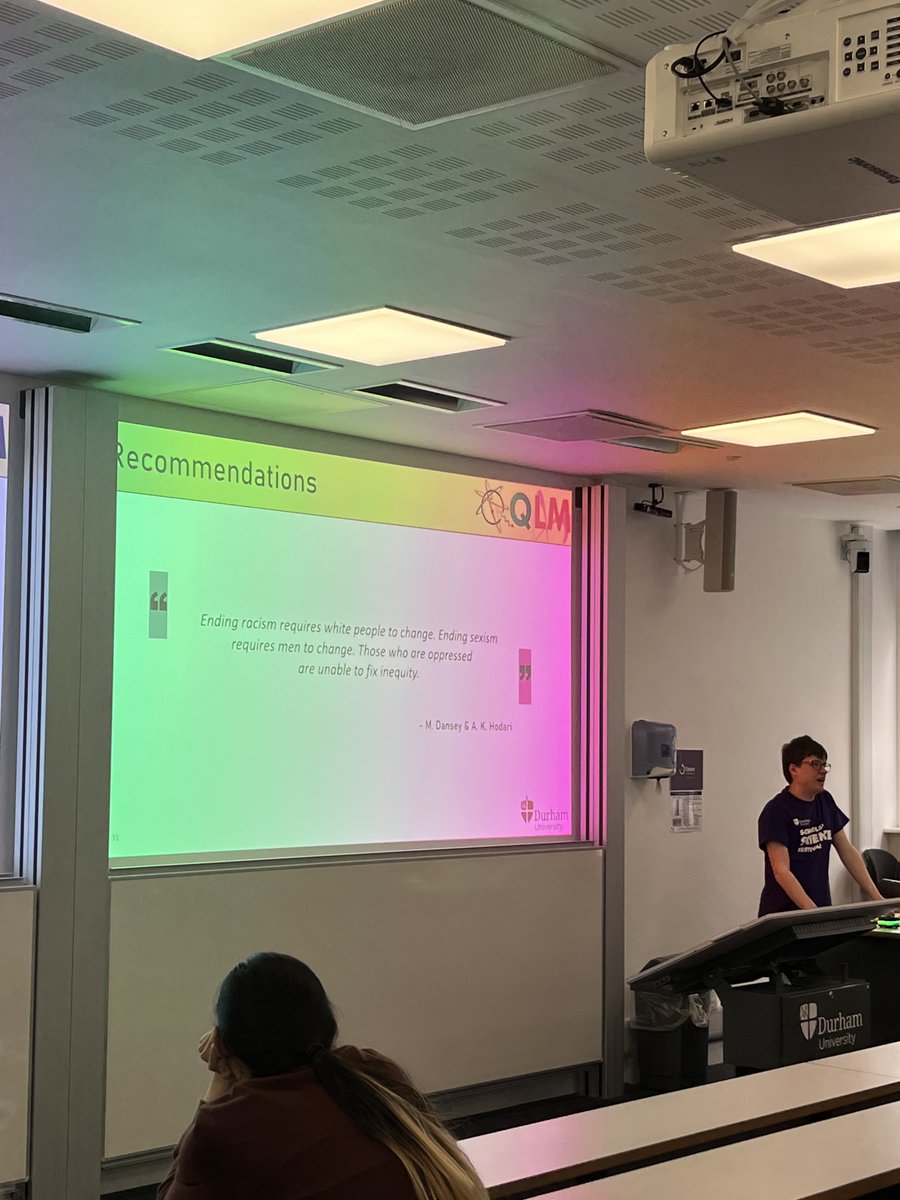
Last week, the @DurhamQLM EDI group presented: How Well-Intentioned White Male Physicists Maintain Ignorance of Inequity and Justify Inaction (https://t.co/bHRgiesGUY)
An important paper discussing uncomfortable truths around privilege and awareness #EDI#physics
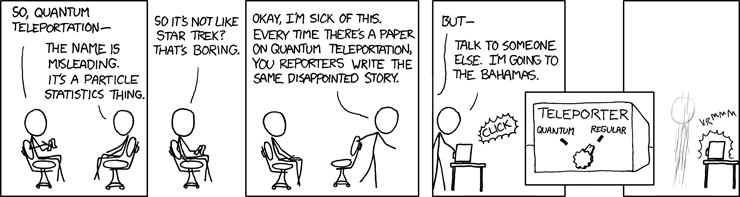
This was an important stepping stone in our @eu_qia project, and a very cool experiment by itself, but also had a personal significance: in my undergrad dissertation I had this classic @xkcdComic as an outlook, quite incredible to have finally carried it out!
This is a busy April, with a new publication from our group! This time, we have shaken up our usual setup, to demonstrate the quantum teleportation of a qubit from a telecom photon to a solid-state quantum memory. 👇 Here's the thread with a more detailed explanation.
🔴We have teleported a quantum bit of information (qubit) into a crystal that was 1 km away in optical fibre and...
Follow this thread for more explanation and a surprise at the end 🤭🤭
♾ Link to the article published in @NatureComms : https://t.co/GbZKS6I2sh
The multimodality of the memory and telecom wavelength of the light involved in the teleportation allowed us to perform the experiment over 1 km of optical fibre, a first step towards long-distance quantum communication!
The entanglement was preserved after transmission!
We also assembled a portable detection setup for the telecom photon and brought it to a separate location in Barcelona. We then demonstrated non-local correlations between two photons detected 17 km and 210 us apart!
New paper on the arXiv, and the debut of our metropolitan network!
We generate entanglement between our solid-state quantum memory and a telecom photon, which we then send through a 50 km dark fibre in the Barcelona metropolitan area.
https://t.co/y7x5qN1gu5