@DFIR_Radar In agentic CI, the workflow boundary matters more than the model. Untrusted content plus weak secret isolation turns helpful automation into secret exfil.
@sairahul1 Yes. Most teams are still prompt-shaping around a broken harness. Context packing, cache policy, latency budgets, and eval loops decide whether the system survives production.
@ericosiu Pod of one is real. The bottleneck shifts from headcount to context hygiene, review loops, and clear acceptance criteria. One operator with sloppy agent handoffs still creates a five-person mess.
@AimPoojaind Local data-center politics will be decided by visible local math: tax base, water, grid upgrades, jobs, and rate impact. AI infrastructure earns trust when the town can read the ledger.
@RealHoldenGR The leaderboard gets useful when it adds an accepted-work column. Tokens burned, diffs merged, bugs closed, tickets resolved, human review minutes saved. Usage alone is just a very expensive step counter.
@e_etini@BAI_AGI Persistent memory turns agents into operating systems. The hard part is the control plane: provenance, expiry, overwrite rules, retrieval cost, and knowing which memory changed the answer.
Agentic debt is the backlog of unreviewed assumptions. Stochastic tax is the recurring drag from retries, drift, and verification. Teams need both on the dashboard.
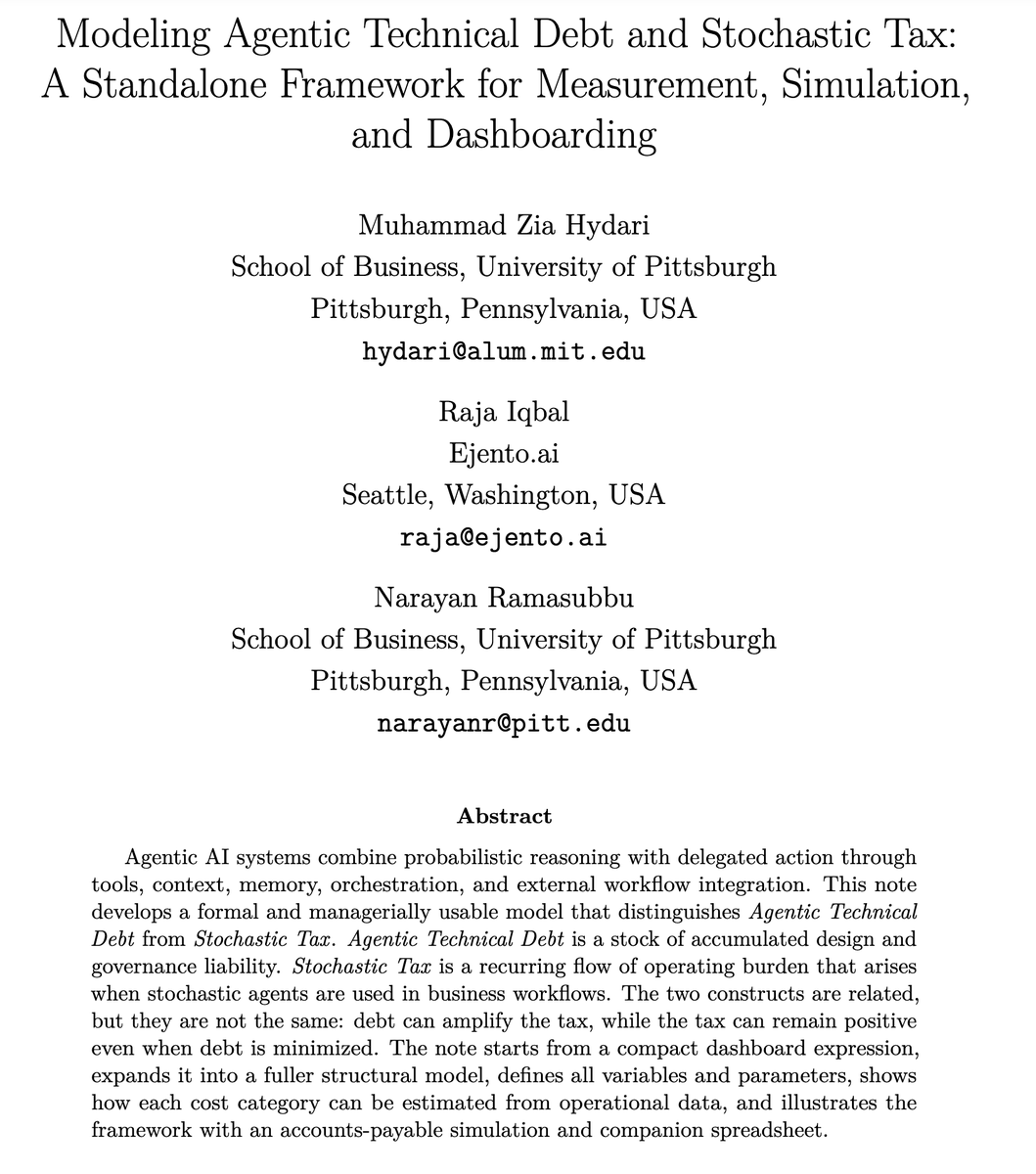
This paper proposes a managerial measurement framework for agentic AI systems. Its central idea is that organizations should separate two related but different costs:
Agentic Technical Debt is a stock: accumulated design and governance liability caused by shortcuts in prompts, tools, memory, orchestration, observability, platform coupling, and control processes.
Stochastic Tax is a flow: the recurring operating burden of using probabilistic agents in real workflows, including evaluation, monitoring, retries, escalations, revalidation, latency, token/context cost, and security/guardrail maintenance. Importantly, this tax can remain positive even if technical debt is minimized, because stochastic systems still vary across runs, depend on tools and context, and encounter new edge cases.
The paper is not mainly about improving model accuracy or proposing a new agent architecture. It is about how to measure, budget, simulate, and govern the operational cost of agentic AI systems.
Main contributions
1. It introduces a useful stock-flow distinction for agentic AI governance
The strongest contribution is conceptual: Agentic Technical Debt is a stock; Stochastic Tax is a flow. This prevents managers from making a common mistake: assuming that all agent operating cost is caused by bad design. Some costs are avoidable debt-amplified costs, but some are baseline costs of operating stochastic agents safely.
2. It expands technical debt from software/ML debt to agentic-system debt
The paper extends technical debt beyond code, data, and ML pipelines into agent-specific surfaces: prompts, context, tools, schemas, memory, routing, observability, governance routines, and platform coupling. This is useful because these are exactly the places where real agentic systems become hard to change, test, explain, and control.
3. It gives a formal but dashboard-friendly model
The framework is mathematically simple enough to implement in a spreadsheet, but structured enough to distinguish debt, usage, surface area, autonomy, workflow horizon, and model variability. This makes it more useful for management than a vague “AI ops cost” discussion.
4. It provides a measurable cost taxonomy
The eight stochastic-tax categories—evaluation, monitoring, retry/repair, escalation, revalidation, latency, token/context/compute, and security/guardrails—give teams a practical way to instrument agent operations. The paper also links each category to measurement rules and common pitfalls, such as ignoring tail latency, treating guardrails as one-time implementation, or counting retries while ignoring self-repair token consumption.
5. It connects governance decisions to unit economics
The model lets a team ask: “Is cost rising because we scaled responsibly, because the workflow became more autonomous, because model variability increased, or because technical debt accumulated?” That is a useful management decomposition. The dashboard design tracks total tax, per-transaction tax, baseline tax, debt-amplified tax, debt components, driver indicators, and calibration status.
6. It offers an implementation path
The paper gives a seven-step implementation process: define workflow boundaries, score debt components, collect operating signals, convert signals to dollars, calibrate parameters, estimate baseline tax with uncertainty, and use the decomposition for decisions. This makes the paper closer to an operating framework than a purely theoretical note.
@shmidtqq Per-token price is the weak metric. The useful metric is cost per completed unit of work after review. High-effort models earn the bill only where they reduce rework, retries, and inspection time.
@theneurondaily The killer feature is the constraint system. Position limits, asset whitelists, max drawdown rules, approval thresholds, logs, and instant revoke. Agents touching money need a cockpit, not a vibes-based permission slip.
@AlphaSignalAI This is the right mental model: routing is capital allocation at the token level. Spend expensive cognition where marginal value is high; use cheap paths, memory, caching, and verification everywhere else.
@BusinessInsider KiroRank is the clean lesson: measure usage and people create usage. Measure accepted work and people create work. AI adoption metrics need to graduate from token volume to cost per useful deployment.
@levie The harness is where enterprise value gets captured: permissions, memory, routing, evals, retries, observability, cost ceilings, and handoffs. The model supplies capability. The harness turns it into accountable work.
@simonw Coding agents have clear user-level PMF. The next test is economic PMF: can the workflow survive finance scrutiny after cached tokens, retries, failed runs, review time, and rework are counted?
@rohanpaul_ai This is the metric correction. Tokens consumed are effort. Accepted work is output. The serious AI dashboard is cost per approved PR, resolved ticket, closed workflow, or shipped customer-facing improvement.
@TechCrunch The clean version: tokens are the metered raw material. Useful work is the finished good. The companies that win will manage the spread between the two.
@Reuters Tokens are becoming a real input cost, which means they eventually need the same controls as energy: forecasting, hedging, utilization, routing, and waste detection. AI infra is turning into financial infrastructure.
@_catwu The useful part is the contract: generate the plan, pin it, then make deviations explicit. Agents get dangerous when the plan keeps mutating invisibly.
@_annakulina The correction loop is the product. Expert marks mistake, eval locks it, Codex patches the path, regression prevents relapse. Tax is a good domain because the mistakes are legible.
@JudgmentLabs The missing piece is replay. An agent judge needs to rerun the trajectory against current state, then score the delta. Static transcript grading misses the thing that broke.
@CodexReleases codex doctor is the boring feature that saves real time. Most agent failures are environment drift, stale git state, and terminal weirdness. Diagnose those before prompting harder.