Introducing Agent to Agent Testing for your AI First companies 🚀
What happens when one AI agent builds a test and another validates it? Welcome to the era of Agent-to-Agent testing, where software quality becomes self-driven. The future is here: agents writing tests for agents. Human intent becomes input, and quality becomes autonomous.
Many of your companies are building agents every day in chat, voice, or vision bots. The question is, who is testing them? Currently, there is no tooling available to address this.
That's why we're excited to introduce LambdaTest's new addition to our Quality Engineering Platform Agent to Agent testing framework for the Agents only economy.
How far has AI come in the last 30 years?
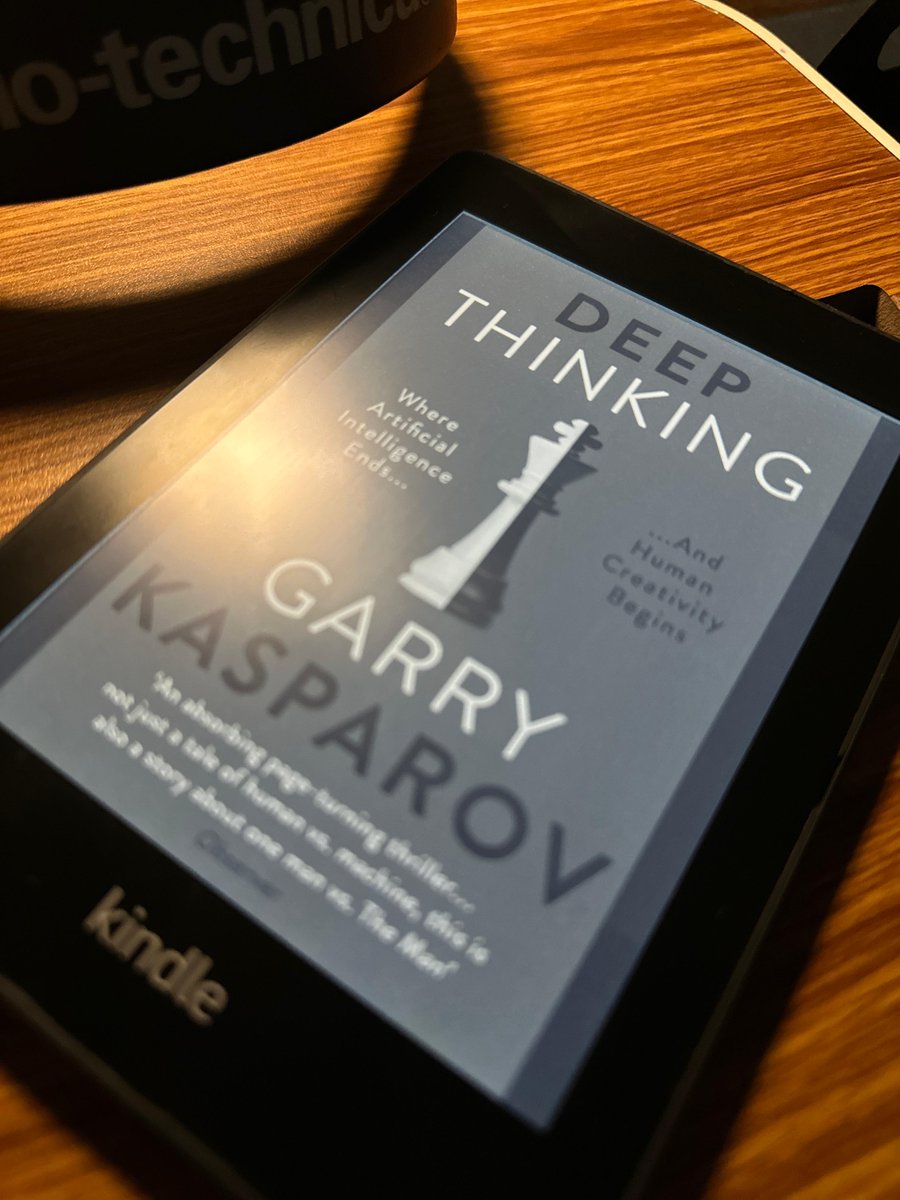
As I finished reading ‘Deep Thinking’ by Garry Kasparov, a world chess champion, I found out. Back in the 90s, Kasparov faced off against IBM's Deep Blue—an intelligent chess engine—twice.
He won the first match but lost the second 🧵
We found a way to verify your ZK-proofs on Ethereum for <8,000 gas. Yes, 8,000 (I have not missed a zero or two here).
And we do this without-
1. adding any additional economic security assumptions over Ethereum
2. acting as a settlement layer in the middle
3. cutting any other corners
more details dropping soon
There’s a reason that Fully homomorphic encryption (FHE) is referred to as the holy grail of computing & black magic at the same time.
FHE enables computations on encrypted data without decryption, basically meaning sensitive data can be processed without ever being revealed.
Techniques For LLMs to Verify Themselves And Reduce Mistakes
The single biggest reason we haven't seen too many LLM apps and agents in production is the LLMs either hallucinate or make mistakes.
The error rate is high enough that autonomous agents don't really work well for anything but fairly straight forward tasks.
We over at Abacus AI have been thinking hard about this problem as we build out an agents problems. Luckily there are some techniques which are showing promise
To start with, it's important to understand the error rate. A simple approach is to do some holdout validation.
Holdout Validation: Divide the data into val and test sets. You basically iterate and prompt engineer on the val dataset and then test on the other. You measure on the error rate on the test set and if it's good enough than you can deploy to production. This is pretty similar to deploying a conventional ML model to production, as long as the accuracy is high enough
Self Verification: In the paper "Large Language Models are reasoners with Self-Verification", Zhou et al propose a method called self-verification.
When a large language model (LLM) performs complex reasoning by chain of thought (CoT), it can be highly sensitive to individual mistakes. Humans infer a conclusion and then re-verify it to avoid a mistake. Self-verification uses the conclusion of the CoT as a condition to build a new sample and asks the LLM to re-predict the original conditions which be masked. A verification score is then calculated based on the accuracy. They demonstrate that LLMs can conduct explainable self-verification of their own conclusions and achieve competitive reasoning performance.
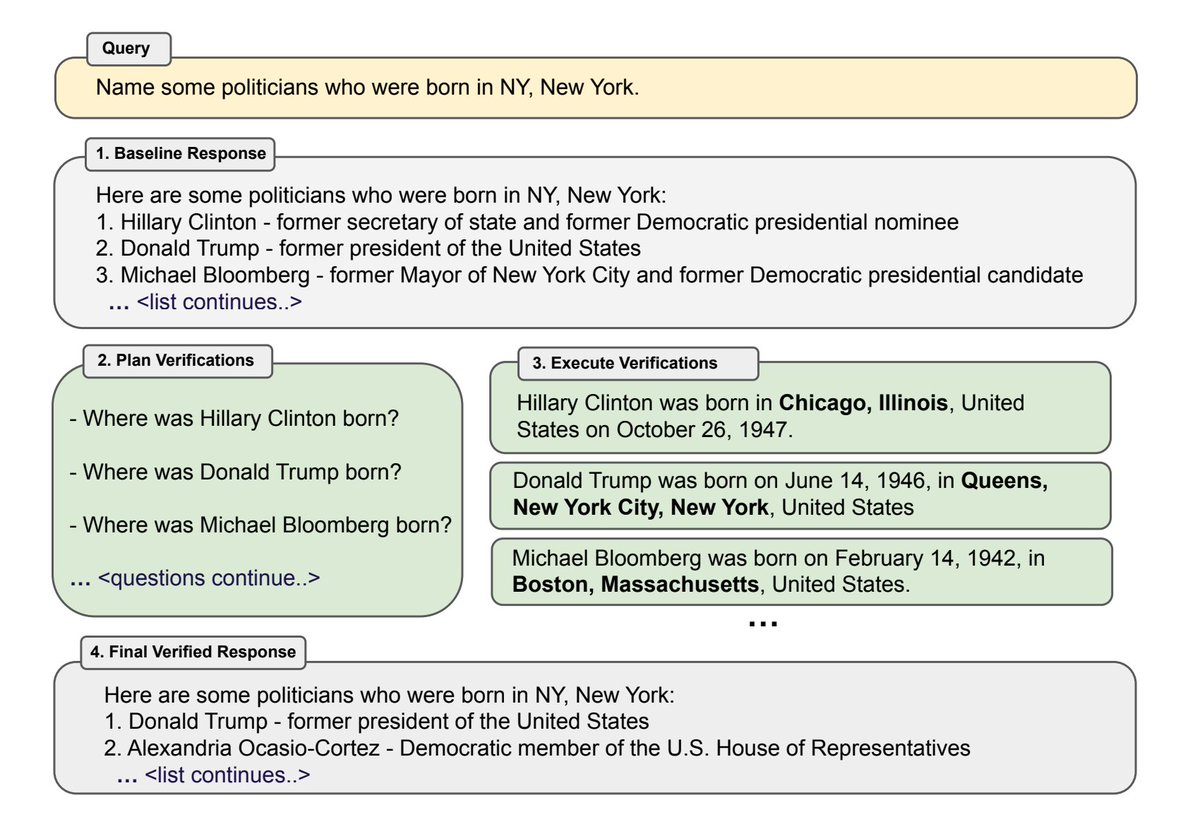
The "Chain-of-Verification" (CoVe) method proposed by Weston et. al, is crafted to tackle the issue of hallucinations in Large Language Models (LLMs), where hallucinations refer to the generation of plausible but incorrect factual information.
The CoVe method comprises four steps:
- initially drafting a response
- planning verification questions to fact-check the draft
- answering these questions independently to avoid bias
- finally generating a verified response based on this process.
The core idea is to have LLMs generate a reasoning chain to verify facts before responding, thereby reducing hallucinations.
Through experiments, the CoVe method has demonstrated a decrease in hallucinations across various tasks, including list-based questions from Wikidata, closed book MultiSpanQA, and longform text generation.
This paper aligns with a broader trend in language modeling research, focusing on improving the reasoning abilities of LLMs by encouraging them to generate internal thoughts or reasoning chains before responding, and revising their initial responses through self-critique.
Notably, the CoVe method shows promise in enhancing the reliability and accuracy of LLMs, making them more trustworthy in generating factual information
Here at Abacus AI, we have used a somewhat similar approach with some success, where we can prompt an LLM to check it's own work. For example - LLM can write SQL code that joins two tables. You may another LLM call with the resulting joined table to verify if it is indeed the output that you are looking for.
Unfortunately, writing reliable agents still takes a lot of iteration and testing and a human in the loop is often required to measure error rate when the agent is in production and continually refine the agent.
@spookyusr@_buildspace@FarzaTV Yo! This idea seems pretty amazing.
Hoping to collaborate and build capabilities in transcribing different forms of data and summarizing it too.
Here's the link to what I'm building
https://t.co/feJ6SeYT4u
I spent the last week building a dApp on every ZK-EVM.
I tested out Polygon, Linea, Scroll, Taiko, Era and more, documenting every step of the process.
Here's everything I learned:
🇫🇷 Calling all French fitness enthusiasts! 🏃
On this special day of 14th July, let's celebrate together with a fitness revolution! 🎉🔥
Say "au revoir" to excuses and "bonjour" to Fitmint, where you can unlock your inner running prowess! 🏆
Join the exclusive France Club on Fitmint and compete with the rest of the nation! 🏃💪
With exclusive GOAT assets as your goal, download Fitmint using the link below and embark on a fitness adventure! 📲 🎁
https://t.co/rFsNqrv1wa
@fitmintfrance #BastilleDay #Fitmint #FitnessRevolution
What are the biggest ideas in tech in 2023?
The partners at a16z shared their thoughts with @stephsmithio, in a two-part podcast available now.
Here's what they said 👇