Ayar Labs and @GUC_ASIC jointly conducted a thermal co-simulation of CPO in a complex advanced multi-chip package. The results show that CPO can operate reliably within the thermal envelope of advanced packages with the right liquid cooling.
Full blog:
https://t.co/WzynsBkabN
Ayar Labs optical engines are built using TSMC's packaging and silicon technologies, and we're at TSMC OIP today with our ASIC design partners to show what that integration looks like.
See our collaboration with Alchip (booth #216) and GUC (booth #608).
#TSMCOIP2026
Conversation with Ayar Labs CEO Mark Wade on Silicon Photonics, Co-Packaged Optics, and Next-Gen AI Infrastructure
With @BenBajarin and @jaygoldberg.
0:00 Introduction and the interconnect bottleneck
2:29 The high-level pitch for IR Labs and optical connectivity
4:42 Why building optical solutions is so difficult
7:30 Why now? The catalyst of ChatGPT
11:46 The complexities of advanced packaging and manufacturing
16:05 Navigating the future landscape of interconnects 21:00 Exploring digital twin manufacturing models
24:54 IR Labs' core bet on CMOS-scale foundries
28:06 Confidence in the TSMC COUPE process
33:48 Customer adoption hurdles and strategic partnerships
38:05 Funding strategy, Series E, and the path to IPO
43:40 Interacting with Wall Street and public investors
48:24 Wrap-up and future market size estimates
📌 Co-Packaged Optics for Agentic AI Infrastructure
🗣️ Vivek Gupta, Chief Strategy Officer at Ayar Labs
🗓️ Thursday, September 15, 11:00 – 11:20 a.m.
🌍 #AIInfraSummit – Santa Clara, California
More information:
https://t.co/3qq5EKwNwW
Today, Ayar Labs announced it has secured an additional $150 million in funding, bringing its total primary capital raised in 2026 to $650 million.
Full press release:
https://t.co/V77wpdy9oc
#optical#photonics#semiconductor#AI#CPO
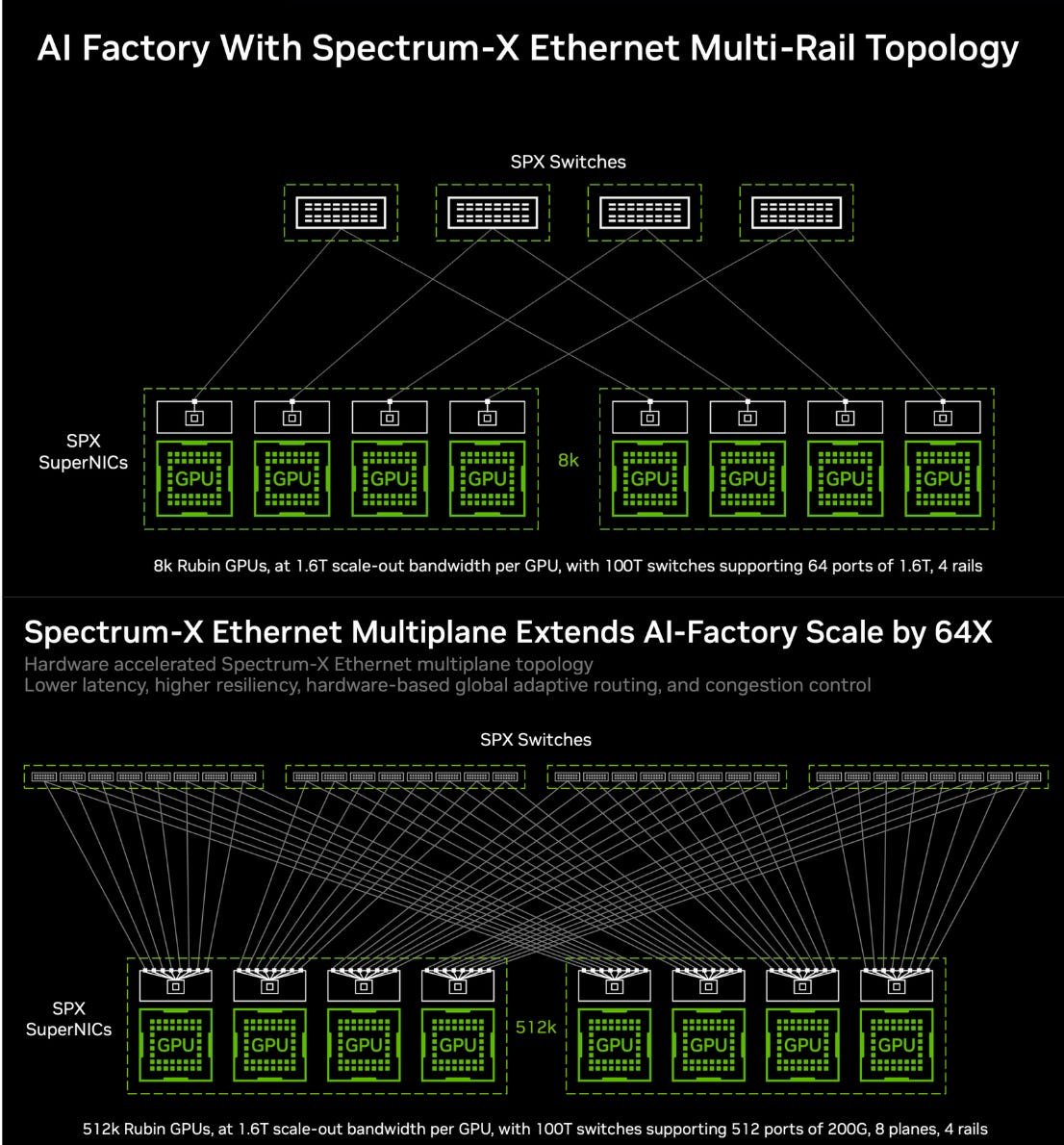
A question I get a lot: we know why you need co-packaged optics for scale-up, but scale-out is already optical, so why CPO there? NVIDIA answered it at Hot Chips, and the answer is power. Co-packaging gets rid of the DSP, the signal-processing chip whose entire job is cleaning up the signal after the long copper trace from the switch ASIC to the faceplate. Their numbers on TSMC's COUPE process, in production: 5x lower power, 4x fewer lasers, 10x better reliability. They also sized optics at about 10% of an AI factory's compute power.
The multiplane topology in the same talk cuts the other way for optics. Instead of giving each GPU 1 fat 1.6T port, you give it 8 thin 200G ports into 8 independent network planes. The GPU keeps the same bandwidth, but the fabric now reaches 512K GPUs, 64x more, because 2-tier network scale goes with the square of the port count. A single link failure costs a GPU 1/8th of its bandwidth instead of all of it. And you need 1.7x fewer switches.
So optics stays a volume story with a per-port content headwind, and the switch and NIC silicon wins either way.
Full Hot Chips 2026 report below.
Vishal Chandrasekar, director of product management at Ayar Labs, sat down with TechArena to explain how co-packaged optics (CPO) takes AI scale-up beyond the rack and the manufacturing readiness required to achieve high-volume production.
Full Q&A:
https://t.co/MA8LB0Naf9
Fritz Haber discovered how to pull nitrogen from the air and turn it into fertiliser.
He did it in 1909.
He was trying to make explosives.
The Haber-Bosch process — named for Haber's chemistry and Carl Bosch's engineering at scale — allowed synthetic ammonia to be produced industrially for the first time.
Before Haber: all nitrogen fertiliser came from natural deposits, primarily guano from Peru. The supply was finite. The world was heading toward a food crisis.
After Haber: crops could be grown anywhere, in any soil, without limits.
Roughly 50% of all nitrogen in the human body today passed through a Haber-Bosch reactor at some point.
Without this process, the Earth's agricultural land could support approximately 4 billion people.
Current world population: 8.2 billion.
Haber saved roughly 4 billion lives with one chemical reaction.
He also developed the poison gas used in WWI trenches.
His wife, Clara — herself a chemist — opposed his weapons work so intensely she died by suicide the night after Germany's first major gas attack.
Haber later fled Nazi Germany and died in exile in 1934.
He is either the man who saved half the world or the man who introduced chemical warfare.
Possibly both.