The open-source LLM ecosystem could really benefit from an LLM building-block API.
We have so many LLM components across different models now. Whether you are using PyTorch or C++ and CUDA code directly, there is a major switching cost when you want to run experiments or ablation studies, say swapping GQA with MLA, dense FFNs with MoE, attention layers with Mamba2 or Gated DeltaNet, or standard residual connections with attention residuals.
Currently, it’s very messy even with LLM-assisted coding.
It could maybe be on top of PyTorch or CUDA directly, but it needs to be carefully engineered and maintained (versus quickly vibe-coded on a weekend) and efficient enough that people trust it to use in production (which is really a requirement to move beyond toy examples).
Maybe some food for thought for a big, well-funded lab :)
(There are some efforts that go into that direction, like torchtitan, torchtune, Megatron Core, OLMo-core, but they are not quite that level of abstraction, I'd say.
And, as always, there’s the chicken-and-egg problem: it needs to be popular to get widely adopted, and it needs to get widely adopted to become popular.)
Sufficiently advanced agentic coding is essentially machine learning: the engineer sets up the optimization goal as well as some constraints on the search space (the spec and its tests), then an optimization process (coding agents) iterates until the goal is reached.
The result is a blackbox model (the generated codebase): an artifact that performs the task, that you deploy without ever inspecting its internal logic, just as we ignore individual weights in a neural network.
This implies that all classic issues encountered in ML will soon become problems for agentic coding: overfitting to the spec, Clever Hans shortcuts that don't generalize outside the tests, data leakage, concept drift, etc.
I would also ask: what will be the Keras of agentic coding? What will be the optimal set of high-level abstractions that allow humans to steer codebase 'training' with minimal cognitive overhead?
Healthcare is fragmented, and care teams do much of the work of holding it together. They track down records, re-enter information in various systems, and follow up so patients can get care.
Today we’re sharing improvements to ChatGPT to help move care forward. 🧵
Inkling 2 Small took a while... but it's more interesting than I initially thought!
Using attention residuals (like Kimi K3), but without the linear-attention hybrid.
Food for discussion for the end-of-the-year architecture trends analysis!
Something like 350 million people regularly speak Hindi with lots of English words and phrases mixed in. "Hinglish" might be the most widely spoken language that, unless you live in India, you haven't heard of.
But if you do live in India, and you're building voice AI agents for use cases like customer support, the need for AI models that are very good at Hinglish is going to be very much on your mind.
Merve made an explainer video about the Sarvam models: LLM, TTS, STT, and decision models trained in 10 Indian languages, and uniquely good at mixed-language understanding, thinking, and speech.
We're open-sourcing our latest versions of Decision Models: Decider v1.3 and Decider Flash v1.3, and making them free on @OpenRouter for a week.
The new capability in v1.3 models is "locate". This lets you describe what to find, and the model returns the matching text with character offsets.
This is useful for batch-mode decision + evidence/entity extraction. On 17 out-of-domain NER, PII and extractive QA tasks, Decider models significantly outperform the best general extraction model.
And, on 63 of our own production classification tasks, v1.3 is 6.54 points more accurate than the classifiers we run today.
Weights are open on Hugging Face: https://t.co/6olEOrOq4y
Personal Agent Protocol aka Poppy 1.0 is out!
Having experimented a lot with it with a custom integration into my Muse agent, I'm certain Poppy adoption might be even faster than the MCP wave.
Being able to actually identify and isolate every different user's agent is a a big unlock for B2C businesses. That's what all our our retail customers have been waiting for.
You shouldn’t blindly trust benchmarks - you should be able to encode your preferences relative to your use cases and design eval metrics around that.
We’re excited to release ParseBench-2 as not only a comprehensive document parsing benchmark, but also a framework for parsing benchmark design. Where you can articulate a set of human preferences of what “good parsing” looks like and “hillclimb” evaluation metrics against that.
The important part is not hand-crafting a deterministic parsing metric. Metric design can be automated by coding agents; what’s important is an open framework + datasets for encoding human preferences and optimizing metrics.
📋 For instance, if you’re dealing with mostly backoffice data, you may care about accurate form parsing, bounding boxes, and scans!
📊 On the other hand, if you’re dealing with investor research reports, you may care more about tables and charts, but less around handwriting.
We let you encode a severity policy that encodes the impact of every negative parsing error, and forces the metric to fit against it - think of fitting a linear regression in high-dimensional space.
A baseline approach for encoding human preferences is LLM as a judge. But the result of this approach vs. a “simple” LLM as a judge call is that you get much more granular, repeatable, quantifiable breakdowns of each dimension that are efficiently run at scale.
For instance, one OCR tool might be better at linearizing text, but worse at preserving formatting. Another OCR tool might be better at preserving empty rows in tables but struggle with merged cells.
The scores reflected on our website do reflect a “default” preference, but it is explicitly and transparently articulated both in our Github and technical report. The important part is that you can change and customize it for your needs.
ParseBench-2 is our most ambitious, comprehensive open benchmark to date. It is not simply a set of deterministic metrics, but a framework for designing parse evals.
We’re rapidly working on improvements and expansions (e.g. fixing minor annotation issues and tuning metrics). If you have thoughts please chime in! Everything is fully OSS.
ParseBench-2 Repo: https://t.co/GATeKILtZY
ParseBench-2 Blog: https://t.co/6ZsSDGAiVB
Technical Report: https://t.co/f6SxkKIlme
AI agents can now reliably review a patient's chart -- but agentic access needs data + workflows beyond USCDI FHIR APIs. Under current rules, a practice can spend months navigating EHR partner fees, IP terms, and app registration. There's a better way... https://t.co/IlhgHpgLpU
The first LLM gateway built for HIPAA (PII & PHI) just launched.
@concentrateai gives healthcare companies access to 200+ AI models through one API, with a BAA included.
Conversational AI is going to transform education and deliver personalized tutoring at scale. But we have to build it right.
Most current AI tools in education optimize for the wrong thing: getting the answer. But the point of homework is not the output, it's learning to think by going through the process. We should be building AI that helps students develop their own thinking rather than outsourcing it to AI. Gakku is actually doing that.
Huge congrats to Annie on the raise!
Even the simplest weight edit, a deletion, can teach an LLM new skills!
Meet Deletion Tuning (#NeurIPS2026): just zeroing <0.1% of weights matches full fine-tuning's accuracy at scale. It's thousands of times smaller and avoids forgetting, a step toward continual learning. 🧵👇
This went a bit under the radar but last week I joined @watchhcn to talk about Holon-S1, our cancer biology AI model.
If you're interested in learning more about @SophontAI's first product, you should definitely give this a listen!
Introducing e-means, an algorithm beating k-means in 10x fewer epochs.
With order of magnitude wall-clock speedups, e-means is released in FAISS and needs no hyperparameter tuning beyond k. It is robust to various scales and datasets. Still skeptical ? Just try e-means [1/10]🧵
Today, we launched Gemini for healthcare. Clinicians spend nearly 28 hours a week reconciling records and administrative work across disconnected systems, while their patients wait for answers. By connecting to EHR and payer systems, we help teams spend less time assembling paper work and more time delivering better patient outcomes. It's a meaningful step forward for patient care, and I hope a sign of much more to come.
Learn more on the Google Cloud blog: https://t.co/JzTLORDceo
#GoogleCloud #Gemini #HealthcareAI
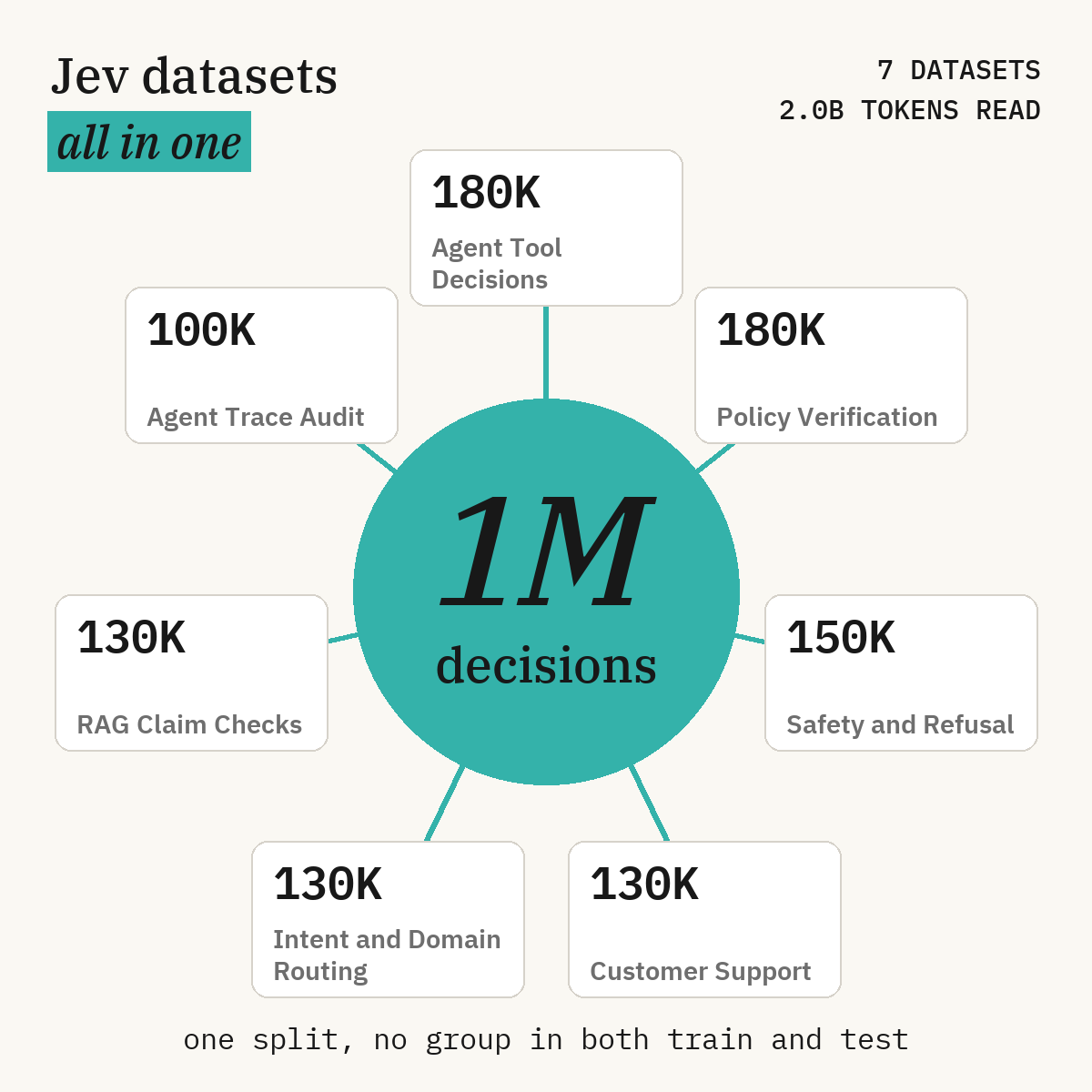
1 million decisions answered by one model, all public now 🔥
tool calls, agent traces, safety, RAG claims, routing, customer support. Jev read 2 billion tokens to answer them
source label and Jev's answer on every row. train a small judge to keep inside your hospital
Today we release Ripple-65B Preview, our 65B dense LLM we pretrained from scratch.
Ripple sets a new state-of-the-art for U.S. open-weight models in agentic coding tasks, surpassing significantly larger models including Muse Spark Open-816B, Beam-501B, Inkling-975B, and Nemotron 3 Ultra-550B.
Learn more: https://t.co/Pe04ZKhkE9
NEW: Healthcare is the 3rd largest AI app market, behind only coding and chatbots.
2026 AI application spending:
> Coding: $34B (7.7x YoY)
> Chatbots: $25B (3.0x)
> Healthcare: $3.7B (2.5x)
Healthcare leads all industry-specific AI, but accounts for just 5% of total AI app spend.