@HadleyFreeman Genuine question, because I respect that you try to be measured. When my child self identified as non-binary in year 5 should they not have been allowed to identify as such at school and explain it to their friends?
@Familoo I lost my mother coming up to two years ago and still cry at the most random things. Until you’ve experienced the loss of a parent you have no idea. Sending condolences. I found both of these articles really resonated with me.
https://t.co/DKN9KxjXFo
https://t.co/OguQRjTEcc
@Baddiel We had to get our obese cat an automatic food dispenser so he learned we couldn’t give him food. It did work but he has turned into the most unbelievable scrounger.
The Divisional Court has ruled that the Government acted unlawfully and irrationally when deciding not to implement the full funding recommendation in Lord Bellamy’s Criminal Legal Aid Review.
I had the rare honour of acting for my professional colleagues, Criminal Law Solicitors Association (@CrimeSolicitors) and the London Criminal Courts Solicitors Association (@lccsa), the Interested Parties in the case. Their press release is below.
Today, anti-Israel demonstrators desecrated International Holocaust Memorial Day.
If this is how they behave today of all days, what can we expect during next week’s protests?
"In terms of the family justice system, there is a movement for change and improved guidelines for dealing with autistic adults and children involved in the family justice system, but there is still much to be done." https://t.co/4zUw7pxrK1
@NotAgainBen are you going to be doing any signings/talks for the new book in London? My 12 year old loved hearing you speak at the Waterstones Pride Panel last summer and now my 9 year old wants to hear you!
With permission, I am sharing Steve Brisley's speech from Wednesday's event in Parliament. I won't comment or summarise as I think it speaks for itself.
-
One hundred days
This is my story.
My name is Steve. To my mum, when she's cross with me, I'm Stephen. But to my big sister, Lianne, I'm Stevie. She first started calling me Stevie just to annoy me, when we were in our early teens and couldn't stand each other. But it stuck and - once we'd both grown up - it became a special mark of our love and affection for each other. When her daughters, Noiya and Yahel came along, they too called me Stevie. Just the three of them. Because nobody else is allowed.
I stayed at Lianne and her husband, Eli's home on Kibbutz Be'eri in July last year, to celebrate Yahel's Bat Mitzvah. We ate, we drank, we swam, we laughed, we danced and we sang. I was introduced to scores of people on the Kibbutz, but always as "Steve". When one, entirely innocently, followed Lianne's lead in calling me "Stevie", she shot them a look - a look that only Lianne could - and corrected them with "His name's Steve, not Stevie...". Because nobody else is allowed.
When I woke up on October 7th and heard about the missile attacks from Gaza into Israel, I WhatsApp'd Lianne to ask if they were okay. I've never wanted to see those two little blue ticks on a WhatsApp message more. But they never came. My older brother, in a different time zone, and so awake before me, exchanged messages with Lianne. So, we know that they were all in their bomb shelter, which was Yahel's modified bedroom - the four of them and the family dog, Mokka. I haven't been able to bear to speak to my brother about how he felt when he received Lianne's final message, which read: "Oh god. There are terrorists in Be'eri. Shooting outside my house. I've never been this scared." And that was it. The point at which my story; our story; my family's story, changed forever.
Lianne, Noiya and Yahel were murdered in their home on Kibbutz Be'eri. Around 10% of the Kibbutz residents were killed that day.
I try not to feel bitter that my family were not in the 90% who survived.
I try not to think about how scared they were.
I try not to think about how they died.
But I do.
Every day.
Every night.
I watched my sister and two young nieces’ funerals on a WhatsApp videocall. Huddled round my mobile phone, propped up on a coffee table in my elderly parents living room, while they sobbed next to me on the sofa.
I miss my sister and niece's. I miss their voices. I miss being called Stevie. Because nobody else is allowed.
We initially assumed that my brother-in-law, Eli, had perished in the attack. We waited to hear that he had been identified among the pile of bodies recovered from the Kibbutz. But, in early November, we found that he was alive, but had been taken to Gaza. A hostage.
And so, our story changed again.
Since that time, our family has done all we can to secure the safe release of Eli and his brother, Yosi, who was also taken from Be’eri, in the hope that their release will cast some light upon the darkness which has enveloped our lives. In the hope that bringing them home will bring some sense to all this. In the hope that our story can change again.
They say that it's the hope that kills you. I disagree.
Hope is all that I have left. Because time is running out.
For our beloved Yosi, our hopes were crushed. Not only that, but the videos released by Hamas over a 24 hour period were psychological torture. Make no mistake - these are war criminals who revel in compounding our distress.
It's been 64 days since I spoke in a room like this. To people like you. I spoke about my brother, Eli Sharabi, and his place in the hearts, minds and souls of his British family. I spoke about his love of Manchester United, of a Sunday roast, of Christmas and the British seaside.
Since that time, I've made many more speeches, appeared on the TV news and given newspaper interviews. All, with one goal - to bring Eli home.
Since that time, I've met with MPs, ministers, Lords and all manner of powerful and influential people. I've put my professional and home life on hold and had small victories in pursuit of that one goal - to bring Eli home.
Since that time, I've buried my grief at the loss of my sister and nieces, so that I can focus my mind on that one goal - to bring Eli home.
But we need more. Eli needs more. More than I can offer.
Lord Cameron and the Foreign Office have offered increased support to my family, and we are grateful. Lines of communication and engagement with my family - about which I have been so publicly critical over the past couple of months - has greatly improved. I'm glad that my government has finally heard my family’s voice. My sister's voice. Eli's voice. We've spoken to the government about proof of life; about whether the Red Cross will gain access to hostages; about international stakeholders and about negotiations. We've spoken of the political landscape, of two-state solutions, of priorities and agendas. But my story is not about nations or land or borders. It's about people. About family. About Eli.
And I'm tired of talking about Eli.
I want to talk to him.
The last time I saw Eli in person was 190 days ago, when he hugged and waved me and my family off at Tel Aviv airport.
Eli has been lost to my family for more than half of the time since then.
100 days of wondering.
100 days of anguish.
100 days of mental torture.
I was scared of the dark as a child. Scared of the monsters under my bed and in my wardrobe. I used to sleep with a light on until I was 9 or 10 years old, until I realised that the monsters weren't real. I'm a 47-year-old man now. But for the past 100 nights, I've once again slept with the light on.
I slept with the light on when I was a child because I thought there were monsters in the world. I sleep with the light on now, because I know there are monsters in the world.
But how can I complain about the shadows in my bedroom and my sweat-inducing nightmares, when my brother has spent 100 days in captivity, in tangible, visceral torment. In a living nightmare. Held underground, with no lamp to comfort him, no light switch in easy reach. Hungry. Thirsty. Scared. And those are just the thoughts I'm allowing myself to have.
Because the reality is too much to bear. And because time is running out.
I'm a historian by education and 100 days is a period of time often appearing or used in a historical context. The Battle of Waterloo brought an end to Napoleon's re-emergence after 100 days. The Hundred Days Offensive brought an end to the First World War. National leaders often set out what they have achieved in their first 100 days in office.
In the history of my family, it's 100 days since I had to tell my own parents that their only daughter had been brutally murdered and their granddaughters murdered with her.
100 days since I heard my mother's screams as she collapsed to the floor, my arms unable to hold her up.
100 days since my brother was taken.
But what will the history books say about this past 100 days? Will they say that I did all I could to bring the hostages home safely? Will they say that you did all you could? Will they say that world powers did all that they could?
I can look in the mirror and honestly say that I did everything within my power to make sure that Eli's seat at my dining table isn't empty, like it was last month, for a second Christmas. Who else can say that they have done everything?
What can you do now?
And, as Hillel the Elder, the Jewish scholar, said in the first century - "If not now, when?". Because time is running out.
I'm not a religious man, but both the Talmud and the Koran include passages which broadly translate as "Save one life, save the world". This is your opportunity to save the world. By saving Eli's life. Bring my family hope. Bring me hope. Bring Eli hope.
They say that it's the hope that kills you. I disagree. Hope is all I have left. Because time is running out.
This is my story.
Today, in between sips of tea, @StephenFry delivered @Channel4’s #AlternativeChristmasMessage. 🫖
“I am Stephen Fry and I am a Jew…Knowing and loving this country as I do, I don’t believe that most Britons are okay living in a society that judges hatred of Jews to be the one acceptable form of racism. So, speak up, stand with us.”
Beautiful.
Brave.
Needed.
Thank you Stephen Fry.
And if you think that he is exaggerating in any way, search for “Stephen Fry” on 𝕏 right now and see the antisemitic pile-on for yourself.
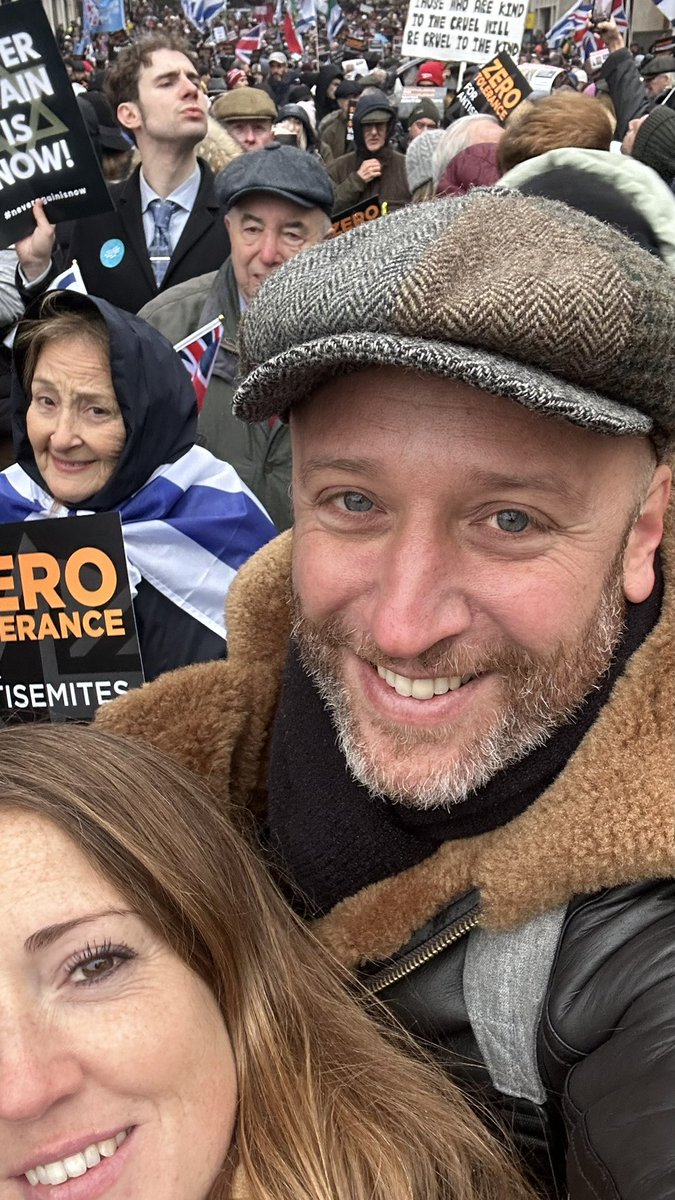
A few reflections on the march against antisemitism today, the biggest since the Battle of Cable Street.
There was not a single masked face; not a single act of intimidation or vandalism; not a single call for death or genocide; not a single desecration of our monuments or statutes; and not a single bad-tempered interaction with the police. (I did however see a placard about chicken soup, one about Jewish mothers not being monsters, one asking people to become anti-Marmite rather than antisemite, and one declaring a desire for a Jewish husband, including a phone number.)
It was all very good-humoured and moving. The police were there to protect those attending, not to defend society against them. Officers were all smiles and everything was smooth and easy. The @metpoliceuk was thanked at the end, as was the glorious @CST_UK.
I especially valued seeing the proud Iranians there, flying their flags and standing shoulder-to-shoulder with Israel and Jews against fanatical jihadism and the theocratic regime in Tehran.
Old Tommy Robinson was carted off shortly after he arrived, and good riddance. As the march got going, the atmosphere was at times quite quiet. We ordinary folk are not activists. We are not used to this sort of thing, did not have ready-made chants and felt a little embarrassed by raising our voices. When we did, however, we called for the release of the hostages, the prosecution of those guilty of hate crimes and peace. @Roxanna04749331 and I overcame our Englishness to lead several rounds of “bring them home.” We were slightly over-caffeinated. We sang traditional Jewish songs asserting the right of the people of Israel simply to live and calling for peace. One poignant sign read “I’m allowed to be proud of being Jewish,” as if the bearer was almost trying to convince himself.
In Parliament Square, the statue of Winston Churchill stooped above us like an ally. There were many chants and songs for peace, repeated frequently and with much feeling. In the @chiefrabbi’s wonderful and moving speech, which stood out magnificently from the rest, he made it utterly clear that every innocent Palestinian death — fetishised by Hamas — is a tragedy. He made it clear that this was a war that Israel did not ask for or want, and we raised a universal prayer for peace.
We did feel the absence of political support. It was wonderful to see @TomTugendhat, @RobertJenrick, @peterkyle and others, but there should have been so many more politicians standing up for Jews, including party leaders and front benchers. It was also baffling to see that while the @JLC_UK came out to bat, the @BoardofDeputies failed dismally to wholeheartedly support the rally. This shouldn’t have been controversial. It was a matter of fundamental British and Jewish values.
But let’s not focus on the negatives. I can say with all confidence that not one of the 105,000 people there wished anything but peace and prosperity to Palestinians and Muslims. There were no hate chants, no calls for violence and absolutely no racism. If there were any extremists there, I didn’t see them and they were utterly insignificant in number.
On the streets today were people from all backgrounds, religions and walks of life. There were many bobble hats. (Many excellent @JewishChron people.) This was unmistakably the silent majority finally discovering its voice. There was much camaraderie and good humour. One lady gave my step-daughter a yellow ribbon to demand the release of the hostages, and tied it into her hair. Many people recognised me and expressed their love and support. It was a unification of Jews and non-Jews alike, marching in favour of tolerance, freedom, liberalism and justice. And standing against jihadism.
Great Britain: 105,000 of you turned up in the cold and wet today and did us bloody proud. We can all hold our heads a little higher tonight. Thank you @antisemitism, led by the heroic @gideonfalter, for organising such a powerful and historic moment. עם ישראלַ חי
Tonight marks 85 years since Kristallnacht, the November Pogrom of 1938, in which more than 100 synagogues and 7500 Jewish businesses were vandalized in Germany.
This horrific event was the culmination of years of incitement and antisemitic rhetoric against Jews.
In the past couple of weeks we’ve seen Jewish communities around the world face horrific antisemitism.
Antisemitism starts with words but it doesn’t end there.
More often than not it kills.
It's almost four weeks since the horrific terrorist attack on #Israel. A lot has happened, the public debate has become heated and confused. Find thoughts from Vice-Chancellor Robert #Habeck in the video, putting the events in context. 📣With English, Hebrew and Arabic subtitles.