Interesting, carrying the radar and interceptor dismounted rather than just the drone interceptor which many companies produce that rely on a radar in a near by location alerting to an incoming object or soldiers just seeing the drone. @ArmoryShield
In 1958, a divorced single mom got fired from her secretary job for being a bad typist.
21 years later, she sold her side hustle for $47.5 million.
And her teenage helper would go on to help invent MTV.
Her name was Bette Nesmith Graham.
Before she became a millionaire inventor, she was a struggling single mother in Dallas with no college degree and very few options.
She married young during WWII.
By 22, she was divorced, raising a son alone, and trying to survive on secretary jobs.
She eventually became an executive secretary at Texas Bank & Trust.
There was just one problem:
She was a terrible typist.
The bank had recently installed new IBM electric typewriters that made correcting mistakes almost impossible.
One typo could mean retyping an entire page.
Her son later remembered watching her sit at the kitchen table in “tears of panic,” terrified she’d lose her job.
But Bette had another skill.
She painted holiday window displays at the bank for extra money.
One day, while painting over a mistake on a window, she had a realization:
“An artist never erases mistakes. They paint over them.”
That night, she went home and mixed a white liquid in her kitchen blender using tempera paint.
She poured it into a nail polish bottle.
The next morning, she used it to cover typing errors.
It worked.
For five years, her boss never noticed.
Other secretaries did.
Soon, women from offices across the city were asking for bottles.
Bette started making batches at home with help from her teenage son, Michael, and his friends.
She called the product “Mistake Out.”
Then came the twist.
In 1958, she accidentally typed the name of her side business onto a company letter.
Her boss fired her immediately.
It became the best thing that ever happened to her.
She renamed the product Liquid Paper and focused on it full-time.
Orders exploded.
By the late 1960s, she was selling over a million bottles a year.
By the 1970s, 25 million bottles annually.
Then she did something even more unusual:
She built one of the most progressive workplaces in America.
Her company offered:
• child care
• continuing education
• leadership roles for women
• jobs for disabled workers
• integrated staffing
This was decades before most corporations even considered those ideas.
In 1979, with failing health, Bette sold Liquid Paper to Gillette for $47.5 million.
Six months later, she died at age 56.
Half her fortune went to women-focused charities.
The other half went to her son.
That son was Michael Nesmith.
Yes the same Michael Nesmith from The Monkees.
And with the money from Liquid Paper royalties, he funded a small experimental cable TV project called PopClips.
It featured short films set to music.
PopClips became the direct prototype for MTV.
So one woman’s “typing mistake” helped create:
• a multimillion-dollar company
• one of America’s most progressive workplaces
• and the blueprint for the modern music video era
Bette Graham proved something her old boss never understood:
The mistake wasn’t the failure.
It was the opportunity.
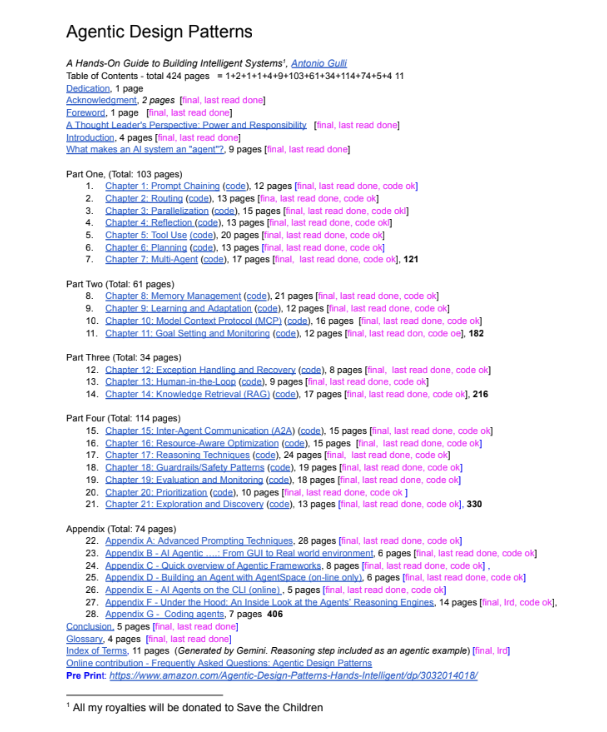
A SENIOR GOOGLE ENGINEER DROPPED A 421-PAGE DOC THAT NO ONE IS TALKING ABOUT.
It is called Agentic Design Patterns. 100% FREE.
Every AI builder paying $200/month for courses just got obsoleted.
This is the most comprehensive AI systems guide I have seen in 2026.
Code-backed and production-ready.👇
🚨 ANTHROPIC JUST PUBLISHED A 36-PAGE SECURITY GUIDE THAT BASICALLY TELLS YOU TO STOP TRUSTING YOUR OWN AI AGENTS.
If you run agents on Claude Code, MCP servers, or automation tools, pay attention.
The attack timeline has collapsed.
AI models compress the gap between a vulnerability and a working exploit from months to hours, for mere dollars.
Agents introduce new autonomous risks, from tool poisoning to context memory manipulation.
The most useful idea in the guide is Anthropic's new security test:
Does a control make an attack impossible, or just tedious?
Automated attackers have unlimited patience. They will grind straight through friction like rate limits and 2FA. To defend at the speed of AI, you need hard barriers and automated defensive operations.
Here is how Anthropic says you should lock down agents:
→ Treat static API keys as compromised. Use short-lived tokens that expire in minutes.
→ Apply "Least Agency": explicitly limit what each tool can DO.
→ Sandbox agents that process untrusted inputs like emails and web pages.
→ Scope permissions dynamically per task, not permanently.
I've added the link to the guide in the 🧵↓
BREAKING: a16z just released the 50 AI tools startups spend the most money on 😱
Want to know what the fastest-growing startups are actually using?
This is probably the closest thing you’ll find.
A few patterns stand out:
•OpenAI and Anthropic dominate the stack
•Cursor, Replit, and Lovable are making every team more technical
•Clay and Instantly are becoming standard for outbound
•Voice AI is everywhere (ElevenLabs, Otter, Krisp, Plaud)
•AI meeting assistants are turning conversations into searchable company knowledge
Even Arab leaders admit it.
Everyone is sharing the Bill Clinton clip where he describes how Yasser Arafat rejected a generous peace offer at Camp David that would have given the Palestinians a state on 96 percent of the West Bank, land swaps, and a capital in East Jerusalem. Clinton says Arafat lied to him and that the Palestinian leadership never actually wanted a two-state solution. They wanted to destroy Israel. It’s a video often shared by people like @VividProwess, and it’s an important one for people to see.
Of course, critics immediately dismiss it. They claim Clinton is biased or he’s pro-Israel. They’ll tell you that you cannot trust the American perspective.
Ok, so let us set that aside.
Now watch this.
In this powerful interview, former Egyptian President Hosni Mubarak, a major Arab leader who was directly involved in negotiations, says exactly the same thing from the Arab side. He talks about the Mena House Conference in Cairo as well as the Camp David negotiations of 1978. All failed because of the Palestinians repeatedly rejecting any offer. The Oslo accords were signed but because Hamas and the Palestinian Islamic Jihad were not involved, they derailed the accords and any chance for peace by initiating 4 years of terrorist suicide attacks in Israel. Then came the second Camp David negotiations in 2000 which Arafat agreed to, then rejected and instead initiated the Second Intifada.
Mubarak explains how the Palestinians refused to even participate in the Mena House conference of 1977. He describes repeated opportunities they were given, including a detailed document that called for Israeli withdrawal from the Samaria, Judea and Gaza, security arrangements during a transitional period, and other major concessions. The Israelis were willing to negotiate on difficult issues like who would control security. The Palestinians, according to Mubarak, kept saying no and wasting chance after chance.
He speaks with clear frustration about how for decades the Palestinian side has rejected peace initiatives and realistic compromises.
The video further shows footage from the PLO representative in 1977, as well as old footage of Egyptian president Sadat who was involved in the Mena House and first Camp David negotiations of 1978.
This perhaps is far more impactful than Clinton’s account because it is not a Western or Israeli voice. It is prominent Arab leaders who lived the negotiations, who represented the broader Arab world, and who had zero incentive to defend Israel.
When leaders from both sides of the table describe the same pattern of Palestinian rejectionism and violence, it becomes much harder to dismiss as bias.
The pattern is clear across decades and across different voices… generous offers, repeated refusals, and continued demands for everything while giving nothing in return.
This is not ancient history. It is the core reason the conflict continues today.
If you value the truth, please share.
SAM ALTMAN HAS A NEW PROBLEM. 🤯
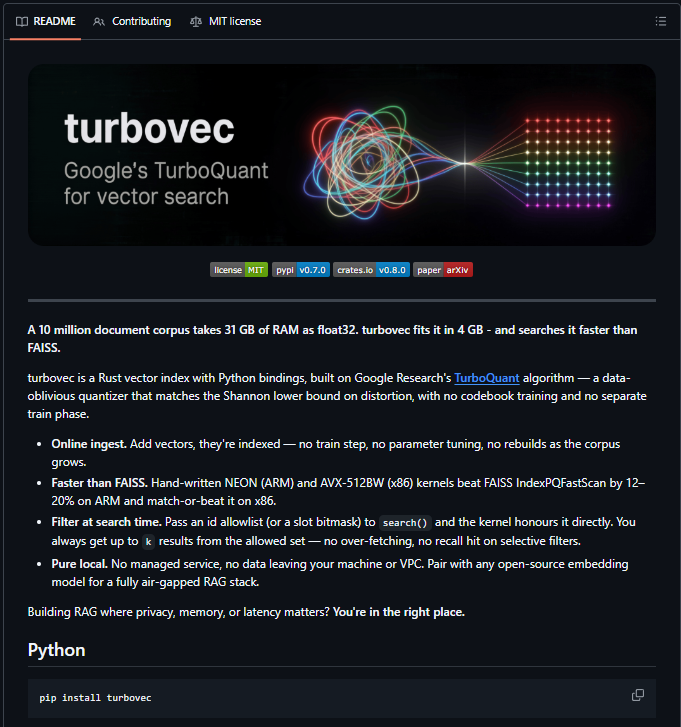
Google just shrunk 31GB of AI memory down to 4GB.
The tool is called TurboVec.
It uses up to 16x less memory, searches faster than FAISS, runs fully offline, and works on a regular Mac.
No expensive GPU cluster.
No cloud dependency.
No compromise on speed.
→ 16x lower memory usage
→ Faster vector search
→ Works with LangChain & LlamaIndex
→ 100% open source
The race to build bigger AI models is loud.
The race to make them dramatically cheaper just got a lot more interesting.
Repo: https://t.co/08TFGtHL6K
I hear that he’s in line for the next Minister of Defense. Sources in Washington tell me that in certain circles they are even considering him as Putin’s successor. He is big enough for either position. Needs to stay away from windows.
Neuro Club just launched.
35 battle tested AI guides.
Members hit $4,000 monthly profit by month 2.
The sharpest private AI circle online.
Real playbooks to launch and scale AI businesses from absolute zero.
Monetization systems.
Prompt packs that convert cold traffic.
Workflows no public model will ever give you.
Our team brings 3+ years deep frontline experience.
Even veterans enter quiet, then hit us with “this changed everything.”
$34/ month. Pure edges.
Doors open now
https://t.co/K0XdUDh0gu
First cohort already stacking.
A PhD student built a working nuclear fusion reactor in his garage, let an AI run it, and 400 thousand dollars later he works for Elon Musk.
he posted it once. that single post ended with a grant in his account and a job offer from the most powerful man on earth.
not a simulation. not a school project. an actual device that fuses atoms, sitting where his car used to be.
fusion is the thing governments have been chasing for 70 years with billion dollar labs. the hard part was never the reactor itself. it was the control. the plasma inside has to be held at conditions hotter than the core of the sun, and it shifts and collapses in milliseconds. no human can react fast enough to keep it stable.
so he stopped trying to do it himself. he handed the control loop to an AI.
the model reads the sensor data hundreds of times a second, predicts how the plasma is about to move, and adjusts the magnetic fields before it ever drifts out of line. it does not wait for the plasma to misbehave. it sees it coming and corrects it before it happens. the same reaction-before-the-event speed no person could ever match.
this is the exact kind of build people are tearing apart inside @NeuroClubAi. not to make reactors, but because the workflow is identical for anything hard. let the AI run the loop, predict the problem, fix it before it breaks. same playbook whether it is plasma or a business.
then the post went out.
within days Elon's fusion team reached out. they did not ask him to interview for an entry role. they handed him a 400 thousand dollar grant and pulled him onto the team building this at scale. one garage build turned a PhD student into an operator for the most ambitious man alive.
here is the part that should stop you.
he was one guy with a PhD, a garage, and an AI model doing the job that entire teams of physicists used to fail at. the AI was not assisting him. it was the operator. he built the hardware. the machine ran it. and that was enough to get noticed at the very top.
most people think AI writes emails and makes pictures. meanwhile someone pointed it at one of the hardest physics problems on earth, held the plasma steady, and got paid by Elon Musk for it.
the gap is not between humans and AI anymore. it is between the people who realize what this thing can already do and the people still using it to summarize their inbox.
Imagine you spent 40 years doing the boring, responsible thing.
You opened a 401k at 23. You contributed every paycheck. You ignored the noise. You bought the index because Bogle told you to, because Buffett told you to, because every honest piece of financial advice for 30 years told you the index was the safest, most diversified, most rules-based way to own America.
The whole point was the rules.
The rules said: a company must trade for 12 months before joining the S&P 500. The rules said: it must show four consecutive quarters of GAAP profitability. The rules existed because in 1999 the index quietly bought a lot of stocks at the top, and pensioners paid the bill.
After the dot-com crash, S&P tightened the rules. Nasdaq tightened the rules. FTSE Russell tightened the rules.
For 23 years, those rules held.
Then SpaceX filed for IPO.
And the rules changed.
The S&P 500 waived the profitability requirement. Nasdaq cut its trading-history window from 90 days to 15. FTSE Russell cut its to 5.
Bloomberg Intelligence estimates the major index funds will absorb between 19% and 24% of SpaceX's float within six months. That's over $30 trillion of passive 401k and retirement money, mechanically buying a single newly public company at IPO valuations, because the rules said they had to.
Except the rules used to say they didn't.
Here's the thought exercise:
If you spend 40 years building a system designed to protect ordinary savers from buying overpriced stocks, and then you waive the protections the moment a sufficiently large stock asks you to, what was the system actually protecting?
Most of investing is about understanding what's a rule and what's a guideline.
A rule binds the rule-maker.
A guideline binds the saver.
You're allowed to find out which is which only after the fact.
⚡️China’s private capital is trying to leave the regime before the regime fully closes the door.
That is the real signal.
Capital does not flee because a chart looks bad.
It flees because people with money no longer trust the future claim attached to the system.
They do not trust the currency. They do not trust the property market. They do not trust policy stability. They do not trust private enterprise protection. They do not trust the equity market. They do not trust that their wealth will remain movable, protected, and politically safe.
That is belief breakdown.
The state can still command factories, banks, police, courts, ports, platforms, and capital accounts. It can produce GDP. It can subsidize strategic sectors. It can dominate supply chains. It can mobilize AI talent. It can build hard infrastructure at astonishing speed.
But private wealth is telling the truth the official data tries to manage: the Chinese system no longer feels like a safe place to store optionality.
That word matters: optionality.
Rich Chinese families want Singapore. Hong Kong channels. U.S. equities. offshore brokers. gold. dollars. foreign real estate. children abroad. passports. corporate structures. crypto where possible. They are not only seeking returns. They are seeking exits.
Capital flight is not just financial movement. It is elite preparation.
Beijing’s response confirms the fear. Restrictions on offshore accounts, forced liquidation timelines, penalties on brokers, tighter cross-border controls. Those are signs of a state protecting the vessel from internal leakage.
Same arc, new phase.
The old China story was growth absorbing control.
The new China story is control compensating for lost trust.
That is a huge shift.
The property boom created household wealth. The export machine created national power. The party-state created stability. For years, those forces reinforced each other.
Now property is broken, demographics are hostile, youth employment is weak, private entrepreneurs are cautious, foreign investors are skeptical, and geopolitics keeps pushing capital to price China as a strategic-risk jurisdiction.
So the state tightens.
But every tightening creates the next layer of distrust. When citizens see exits closing, the desire to exit becomes more urgent. When private wealth sees capital controls rising, it stops asking “where is the best return?” and starts asking “where can wealth still breathe?”
That is the doom loop of controlled capital systems.
The yuan is the pressure valve. If Beijing lets it fall too much, confidence weakens and outflows intensify. If Beijing defends it too hard, liquidity tightens and growth suffers. If Beijing blocks outflows, trust deteriorates. If Beijing allows outflows, reserves and domestic asset confidence get hit.
There is no clean path because the problem is trust, not plumbing.
Goldman Sachs MDs make $1-3M/year doing one thing: keeping CEOs of Fortune 500 firms on speed dial.
This 23-min UVA Law lecture by Goldman's Vice Chairman of Global Client Coverage teaches you the exact 18 rules he uses to do it.
worth more than any $5K business school elective on client management.
bookmark & watch today.
We’ve automated every single thing we can @every with AI agents.
And yet there’s way more human work to do than ever. We’ve gone from 4 -> 30 human employees since GPT-3.
I wrote a report on the structural reasons: how AI makes expert competence cheap, why that drives up demand for experts, and why the dynamic only intensifies as we approach AGI.
After Automation: https://t.co/Lb7SUCduAg
The 36 BIGGEST startup opportunities right now
1. biggest b2c: solving loneliness. third spaces, community apps, IRL
2. biggest b2b: managed AI employees for businesses
3. biggest overlooked: elder tech. 70 million boomers who want products that make them happier & healthier
4. biggest mobile: action apps that do things, not apps you stare at
5. biggest trades: matching platforms for electricians, plumbers, HVAC. supply shrinking
6. biggest consumer social: small social. group chats as products, no feeds, no ai slop
7. biggest ecommerce: agents that recommend products you'll like, shop, buy for you
8. biggest creator: live shows and unscripted content
9. biggest edtech: AI tutors that adapt through conversation
10. biggest SaaS: pay-per-outcome pricing
11. biggest auto: AI service advisor for dealerships. answers the same 15 questions 24/7
12. biggest talent: training non-technical people to operate agents
13. biggest boredom: curated offline experiences delivered to your door. kits, games, challenges. anti-screen products
14. biggest spiritual: the need for belonging is exploding, new formats of spiritual get togethers
15. biggest wellness: longevity biomarkers you actively manage
16. biggest mobile: action apps that do things, not apps you stare at
17. biggest one to solve ai slop: digital verification that you're a real human. every platform will need this within 2 years
18. biggest infrastructure: agent permissions, security, audit trails
19. biggest media: AI native media companies. build distribution, sell products later.
20. biggest parenting: family ops automation. forms, scheduling, logistics
21. biggest accounting: bookkeeping agents that charge per transaction
22. biggest fashion: brand-owned resale. every brand wants to control their secondary market
23.biggest hobbies: adult learning for joy. pottery, woodworking, drawing.
24. biggest skincare: at-home diagnostics. scan, get a protocol, track progress
25. biggest agriculture: precision farming tools for small farms. enterprise version exists, family farm doesn't
26. biggest pest control: subscription pest prevention instead of reactive treatment. the model flip that lawn care already made
27. biggest regulated: on-device AI. healthcare, legal, finance open up when data stays local
28. biggest gaming: AI characters with real memory and relationships
29. biggest dating: agent-mediated matchmaking
30. biggest fitness: adaptive coaching that rewrites your program daily
31. biggest travel: autonomous trip planning and rebooking
32. biggest food: personalized nutrition based on blood work and gut biome
33. biggest pet: health monitoring. $140B industry, almost no tech
34. biggest defense: AI-native security and compliance tools
35. biggest robotics: physical AI. $30 brains on existing hardware
36. biggest nostalgia: products that feel analog. vinyl, paper, handmade. counter-positioning against AI everything
🚨 Anthropic just showed a 24-minute workshop on how to actually do prompts for Claude.
Taught by the people who built it.
Free. No registration. No paywall.
I've seen $300 courses that don't cover what they teach in the first 8 minutes.
Watch it and bookmark it now.
Demis Hassabis: "In the near future, one person who knows AI will outperform an entire startup team"
I've watched hundreds of AI talks, this 60-minute Cambridge lecture is the one I wish I had seen a year ago
this is the Nobel Prize winner in Chemistry, CEO of Google DeepMind and the guy who made AI solve biology
here's the part I can't stop thinking about:
> the AI you're using today is the dumbest it will ever be
> in 5 years the gap between people using AI and people who aren't will be impossible to hide
> companies will run on 10 people doing what 200 used to do
> the ones who get there first won't be the smartest, they'll be the ones who started right now
right now the average person opens Claude, types something, gets an answer, closes the tab
they think they're using AI, but they're using maybe 10% of it
I turned his lecture into 18 steps to actually use Claude the way it was designed, copy-paste prompts included
full guide in the post below.