We see the tower of Jesus Christ illuminated for the first time!
The light show, starting from the base up to the illumination of the cross, culminated with a composition of lights guided by drones that traced the figure of Gaudí and the phrase “first love, then technique”.
Humanity, created by God in all its grandeur, is today facing a pivotal choice: either to construct a new Tower of Babel or to build the city in which God and humanity dwell together. In Jesus Christ, this humanity in its grandeur becomes the Way, the Truth and the Life, opening the path for each of us to grow toward fullness. #MagnificaHumanitas
https://t.co/6i9MWs6LJl
We're launching the European Student Robotics Association (ESRA, @esra_robotics) (13 universities, 8 countries, 2.5k+ members)!
We’re young, driven and together we’re tackling the European fragmentation problem heads on.
Who are we?
- ETH Robotics Club (Zürich) @ethroboticsclub
- RoboTUM (Münich)
- EPFL AI Team (Lausanne) @epflaiteam
- Unaite (Paris)
- Team Polar (Eindhoven)
- TU Wien Robotics Club (Vienna)
- Robotics Collective (Aachen) @robocollectiv
- KTH AI Society (Stockholm) @KTHAISociety
- Delft Robotics Student Association
- KN CybAiR (Poznan)
- AEA Polimi (Milan)
What do we do?
→ Pan-European robotics competitions
→ Cross-border technical project collaborations
→ Coordinated access to funding opportunities across Europe
And this is just the beginning!
Thanks @andreasklinger, @lukas_m_ziegler and @IlirAliu_ for helping us spread the word :)
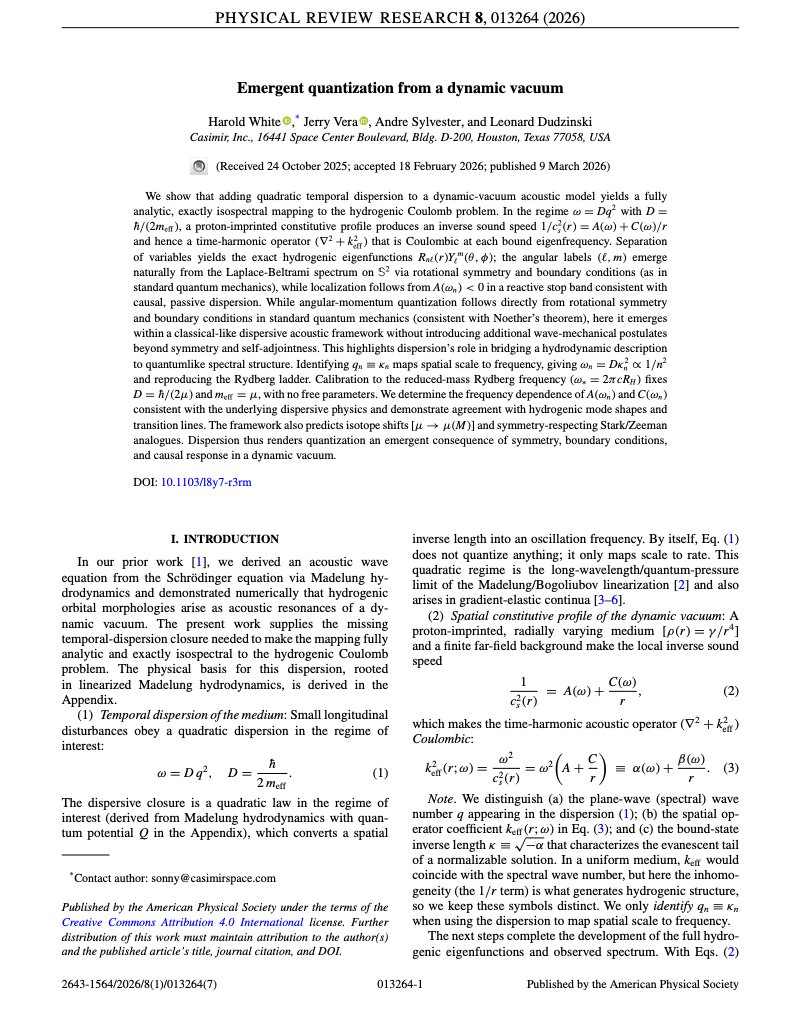
BREAKING: While a new War for Oil erupts in the Middle East
A Physics Paper just quietly dropped TODAY that will eventually make Oil, and the entire current Energy Industry, irrelevant.
Ushering in the era of Zero-Point Energy
@EagleworksSonny
Here is the breakthrough🧵
Nvidia CEO Jensen Huang advices Europe to go full in on Physical AI and robotics.
"Your industrial base is so strong, this is your once in a generation opportunity"
Over the past month, we (@AdamMeier20, @JTLonsdale) have been working on a state bill that would permit AI to practice medicine - prescribing, diagnosing, referring, and ordering - with some oversight and guard rails.
We want the technology community to be able to solve important problems for society, and there are few matters bigger than access and cost of healthcare.
We have sought feedback from different groups, but are eager to hear from more builders: does this let you harness AI for the biggest impact on the US healthcare system? We are eager to hear from states as well: what healthcare problems and patient populations are most in need?
Done right, this bill should be a win for patients, taxpayers, physicians, and governments. AI should benefit ordinary Americans.
Tell us what we got right, what we got wrong, and where we should go from here.
We will still need federal clarity on clinical AI, but states will be important stakeholders in any regulatory regime. Reimbursement will be a topic for future discussion too.
We've spent 50 years trying to kill cancer cells. What if the answer was never to kill them but to remind them who they are?
Cancer cells aren't foreign invaders. They're your own cells that lost their identity. They stopped differentiating, stopped maturing, and started growing without limits. Cancer doesn't create anything new. It hijacks normal biology.
Researchers at KAIST in South Korea identified three master regulators, MYB, HDAC2, and FOXA2, keeping colon cancer cells locked in a malignant state. When they silenced all three? The cancer cells differentiated back into normal, healthy tissue. MYC and WNT pathways shut down. In mice, tumors shrank significantly.
No chemo. No radiation. Just reprogramming.
Here's what most people will miss: HDAC2 is a histone deacetylase. It compacts DNA and silences tumor suppressor genes. We already use HDAC inhibitors in our protocols. This isn't new to us. But it's powerful validation.
Cancer and aging are the same problem. Cells that no longer serve the body but learned to hijack the immune system to survive. The answer isn't bigger bombs. It's restoration.
Still preclinical. But the direction is exactly right. Kudos to the @kaistpr team. 👏
A Little Know Military Book That Is The Blueprint For The AI Battefield
This book shows how wars will be fought in the future primarily as a mental war. The new battlefield is in your mind. It already started and AI will weaponize it—inconceivably.
https://t.co/JgjF5e7D9l
détient un quart des ressources mondiales de terres rares.
Et notamment des "terres rares lourdes" : l’holmium, l'europium, le gadolinium, le terbium, le dysprosium, l'erbium, l'yttrium, le thulium, l'ytterbium, le lutécium.
A savoir celles qui ont le plus de valeur,⤵️
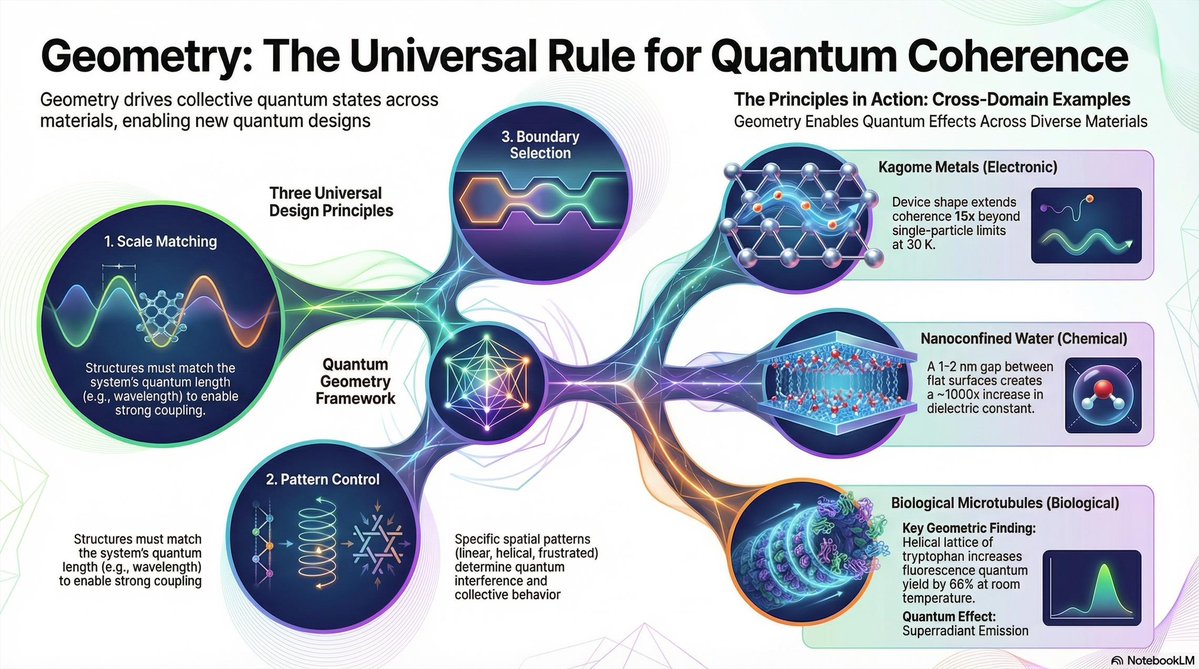
🧵 Something remarkable is happening in quantum materials science. Three independent approaches are converging on the same insight: geometry, not just chemistry, organizes quantum coherence.
Here's the evidence...
1/9
Breakthrough in GPU optimization — independently validated.
MindAptiv has created a new class of compute — not AI, not CUDA tuning — a new way to generate machine instructions with extreme speed, precision, and energy efficiency.
Verified by an AWS-selected Premier Partner:
- 20×–60× faster performance
- Up to 99% less energy (Beyond our expectations!)
- Runs on standard hyperscaler GPU instances
- Real-time optimization no team of engineers could match
This changes everything for:
• Data centers
• Hyperscalers
• Digital twins
• Blockchain / ZK
• AI inference
• Telecom
• Graphics & rendering
If you rely on GPUs or energy-intensive compute, it’s time to talk.
A new era of efficiency is here — in the cloud, on-prem, and at the edge.
Visit -> https://t.co/PVhe7ZX4mN or https://t.co/3RuY4TxW6y
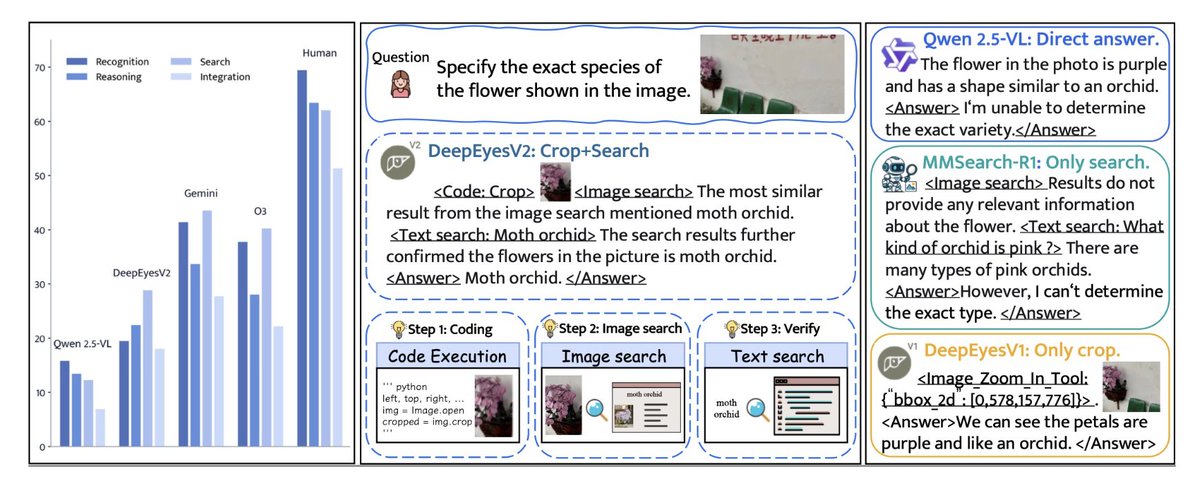
Everyone’s seen “multimodal” models before but DeepEyes V2 is different.
It doesn’t just see and describe; it thinks about what it’s seeing. It plans, reasons, and adapts across modalities like a cognitive system.
This paper basically marks the start of agentic perception.
In a jaw-dropping scientific milestone, Chinese physicists have successfully teleported quantum data across thousands of kilometers — not through cables or signals, but instantly through quantum entanglement. This achievement marks one of the most significant breakthroughs in communication technology and could change how the world thinks about data transfer forever.
Using a process known as quantum teleportation, researchers linked particles in such a way that a change in one instantly affected the other, no matter how far apart they were. This mysterious bond, famously called “spooky action at a distance” by Einstein, allowed information to leap across vast distances faster than any known method.
The experiment used satellites and advanced quantum detectors to send encrypted data between ground stations separated by thousands of kilometers. Unlike traditional communication, which relies on signals moving through space, this transfer occurred instantaneously — without physical travel.
Scientists believe this technology could lead to an unhackable global quantum internet. Since the data doesn’t move through normal channels, it cannot be intercepted, copied, or altered. It simply “exists” at both points at once.
This isn’t just faster communication — it’s a complete redefinition of distance itself. The same principle could one day enable quantum computing networks, secure global banking systems, and space communications that defy current physics limits.
China’s breakthrough has placed it at the forefront of the quantum revolution. What once sounded like science fiction is now a working reality, signaling the beginning of an era where information doesn’t travel — it teleports.
China makes 80% of the world's industrial robots and has the highest density of them in the world.
If the west does not change soon, China's 24/7 dark factories will allow them to have a monopoly on global manufacturing because of how cheaply quickly and voluminously they can make things.
This quote hits hard:
“I see the Government throwing billions of pounds each year at completely speculative rubbish like fulfilling renewable [energy] obligations contracts and I just think, ‘Well, why not five billion a year in grants for capital equipment?











![deedydas's tweet photo. China makes 80% of the world's industrial robots and has the highest density of them in the world.
If the west does not change soon, China's 24/7 dark factories will allow them to have a monopoly on global manufacturing because of how cheaply quickly and voluminously they can make things.
This quote hits hard:
“I see the Government throwing billions of pounds each year at completely speculative rubbish like fulfilling renewable [energy] obligations contracts and I just think, ‘Well, why not five billion a year in grants for capital equipment?](https://pbs.twimg.com/media/G3HFXX3a8AAISz8.jpg)


