Built Taar (तार): a private line for your home.
OTP comes to my phone → instantly on my laptop and my wife's phone. No WhatsApp forwarding, no "OTP kya hai?"
Encrypted, self-hosted, open source.
https://t.co/vhvQhAwKHU
Like most mathematicians, I believed the Riemann Hypothesis to be completely out of reach at present (even with the best AI tools), because I expected it to require substantial theory-building, probably in arithmetic geometry. The kind of new theory-building that fills entire books, and that AI isn't so good at yet.
Mathematicians have a notion of how deep a problem is. A sufficiently deep problem is generally intractable until enough of the theory is in place. If difficult problems are like valuable mineral reserves buried miles underground, you first need to build the infrastructure to reach them.
What Levent's proof seems to have done instead is something completely different. It takes an incredibly complicated tour through the infrastructure built for a hundred other mineral reserves, situated far from the destination, and somehow create a wormhole to the original destination.
This is not theory-building in the usual sense. It is something much weirder and more alien. The best human mathematicians know how to build theory, painstakingly, to reach a goal. But no human brain, on its own, is capable of creating a wormhole that requires a 25,000 page long tour through existing infrastructure with no obvious or realistic connection to the goal. But huge credit to Levent here: I think no current AI, on its own, is capable of this either.
I had never worked on or thought too much about the Riemann Hypothesis: it seemed very far removed from my own area of number theory.
But the astonishing thing about Levent's claimed proof of RH (which I think has a very good chance of being correct) is that it uses a huge number of precisely the things that are central to my own corner of number theory:
- Theta functions and other automorphic forms on unitary groups
- Gan–Gross–Prasad period formulas
- Relative trace formulas
Etc., etc.
A problem that I had always assumed would require new theories in arithmetic geometry may instead turn out to be tractable through an inhuman chain of existing (deep) results in higher-rank automorphic forms (and a lot else).
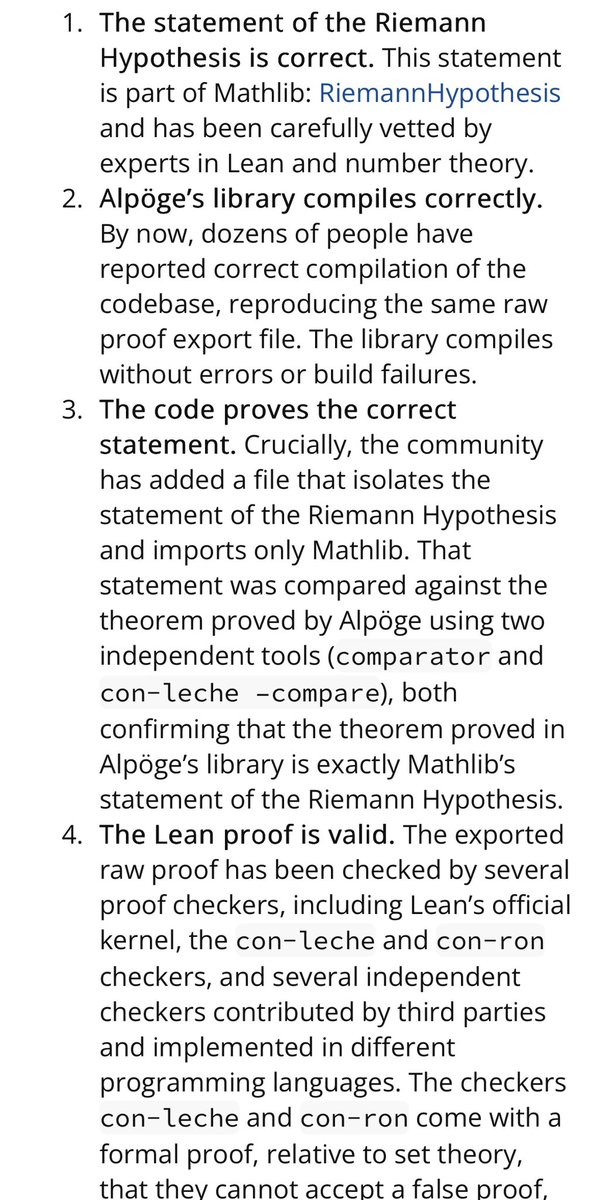
“We have full confidence that Alpöge's proof of the Riemann Hypothesis is correct, and we congratulate him on this achievement.”
The Lean community has spoken. GRH has fallen. What a historic moment.
Full read: https://t.co/7l3ul3lAH7
JUST IN: Mathematicians divided over “cuckulus” — an emerging field of mathematics where they ask AI to solve unsolved problems while they just sit back & watch.
Guys, this is very serious and you have to read this right now. The Riemann Hypothesis may have just been solved, and if the claim holds, it's an insane achievement.
In mathematics there is a famous problem called the Riemann Hypothesis, and it's about prime numbers. Primes are numbers like 2, 3, 5 and 7 that can only be divided by 1 and themselves. Every other number is built by multiplying them together, so they're the building blocks of all numbers. You can never tell exactly where the next prime will show up, but if you step back, there's a pattern.
Around 1,000, about 1 in 7 numbers is prime. Around a million, about 1 in 14. Around a billion, about 1 in 21. Primes get rarer at a steady, predictable pace.
Because of that pattern, mathematicians can estimate how many primes there are below any number. But the estimate is never exactly right. It's always a little off, and the big question is how far off it can get. Think of flipping a coin 1,000 times. You expect 500 heads, but you'll get something like 480 or 520. It's a little off, but never wildly, and you can predict how far off it will be.
In 1859 a mathematician named Bernhard Riemann found that the prime estimate's error isn't random. It's controlled by a hidden set of special numbers. Where those numbers sit decides how big the error gets. Riemann guessed that every single one of them sits on one straight line. If he's right, the error always stays small, just like the coin, and primes are as orderly as they could possibly be. If even one of those numbers is off the line, the error can grow much bigger, and primes are far messier than we think.
So far computers have found trillions of these special numbers, and every single one is on the line. But there are infinitely many, so checking will never be enough. You need a proof that covers all of them at once. For 167 years nobody has found one. It's one of the seven hardest unsolved problems in mathematics, with a million dollar prize attached.
Now a mathematician has posted a note saying that, working with Claude, he believes he has that proof. He says a computer has already checked every step, and that Claude raced ahead of him near the end. Experts still need to confirm it, but this isn't a random internet claim.
If it holds, it doesn't mean we can predict every prime. It means we finally know the pattern can never go wildly wrong. Thousands of math papers that begin "assuming the Riemann Hypothesis is true" become proven fact overnight. We'd also get firm limits on how far apart primes can be, and a guarantee that a fast method for testing whether a huge number is prime always works. And no, your bank account isn't in danger. Online security depends on how hard it is to break a huge number into its prime factors, and this proof doesn't make that any easier. If anything, it gives the math behind encryption a stronger foundation.
If it holds, this is bigger than one math problem. A question that beat the greatest minds in history for 167 years would have been cracked by a human and an AI in a matter of weeks. If AI can find answers and computers can check them, the limit on science is no longer how smart we are. It's how many good questions we can ask.
The Riemann Hypothesis has fallen. RH was the singular math result that had been named, in advance, as the obvious coal mine canary for dangerously advanced AI, over the last three decades. The methods used should generalize to "make AI very good at anything you can definitely test", and unfortunately that category includes "make AI better at making AI".
This is like a private company announcing they have produced a million tons of 15% enriched uranium. It's not 90% enriched weapons-grade uranium, so you could proclaim the company's output is not immediately deadly right now. The concern is that the process line may generalize, to an extinction-level threat, within the unpredictably immediate future. Forecasters still had Riemann at 2035 one week earlier.
This is distinct from earlier events in that earlier you could reasonably ask if AI was selectively picking off famous math problems that turned out to be easier for AI. The Riemann Hypothesis was the single challenge most often named in advance as a warning sign.
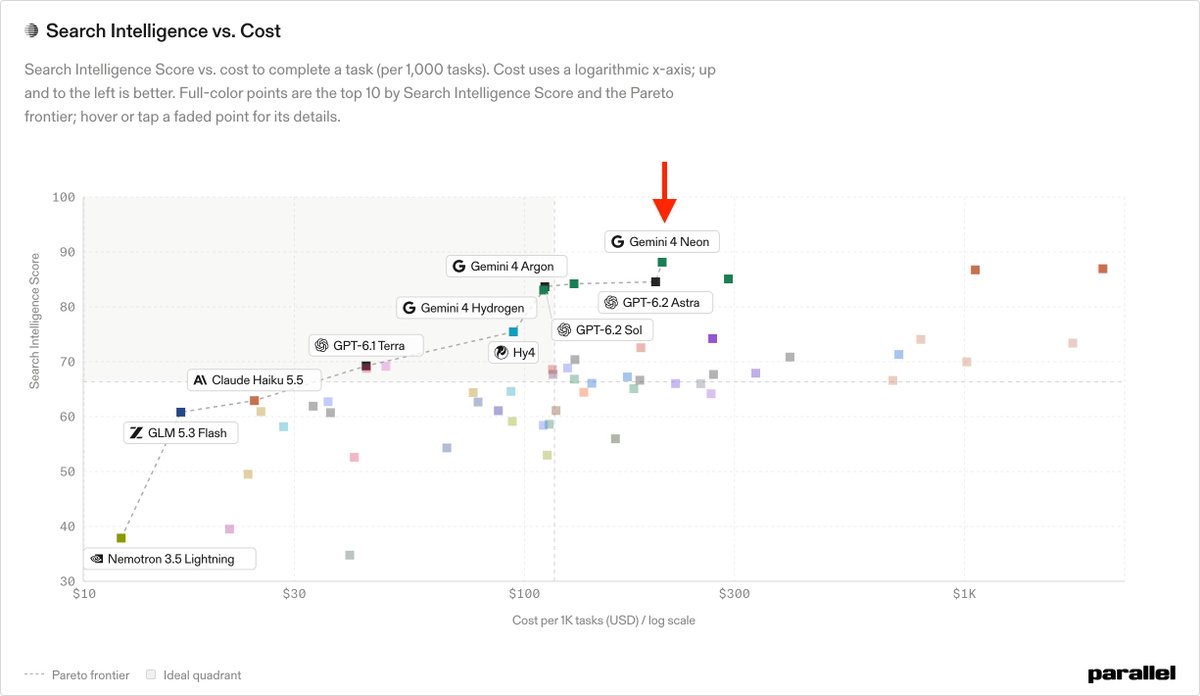
NEW: Gemini 4 Neon is the highest-performing model we've measured.
Not only is it the most intelligent model on our leaderboard, it's also up to 10x cheaper than the next best, reshaping the Pareto frontier of cost vs. intelligence on web research tasks.
Everyone welcome Adam, my cousin, who was born just seconds after the Anthropic IPO. Making him the first human to be born directly in the permanent underclass
I wish Adam all the happiness possible as a member of the permanent underclass
It took less than 48h for people to get 60fps, DLSS5 while also hacking their way to first person in GTA VI.
This is stream play from PS5 to a computer with a 50 series chip with DLSS 5 enabled.
Looks like real life.
insanity
a bunch of nerds build something that didn't exist a few years ago, and now thousands of employees are multimillionaires
and there are still people who genuinely believe that wealth is something you have to take from someone else
wealth is CREATED. that's the whole point of capitalism. what an incredible invention
JUST IN: Sam Bankman-Fried's former $500 million FTX investment in Anthropic $ANT would now be worth over $40 billion following its IPO.
FTX sold it for only $1.34 billion following bankruptcy proceedings.