Good advice. Though, escalation is ideally rarely required if everyone involved is most interested in the objectively best solution (leaving ego and personal preference at the door).
Jeff Bezos reveals why compromise is one of the worst ways to resolve a disagreement
"An example of a really bad way of coming to agreement is compromise. If I say the ceiling is 11 feet and you say 12 feet, we say let's call it 11 and a half. That's compromise"
"The advantage of compromise is it's low energy. But it doesn't lead to truth"
"Another really bad resolution mechanism is who's more stubborn. Two executives disagree, they have a war of attrition, and whichever one gets exhausted first capitulates. You haven't arrived at truth, and this is very demoralizing"
"Escalation is better than a war of attrition. Escalate to your boss and say, we can't agree, we like each other, we're respectful, but we strongly disagree, we need you to make a decision"
"Exhausting the other person is not truth seeking. Compromise is not truth seeking"
Would love to hear what you are trying. We loosely follow Shape Up but 6 weeks seems long now. Planning is a current bottleneck we never really had before. We started our “cycle” with a 1-week low hanging mini sprint — things AI can generally one-shot and released 40+ small updates in a few days.
Elon Musk on why the Model S and Model X succeeded:
“Those cars were designed with love. Every part of it, inside and outside, even things people couldn’t see - we put there because we love the product”
“It’s at the heart of any great product. If the people making it genuinely love that product… it’s not a spreadsheet thing. You do things to make the product amazing because you love it
Even if people don’t see all of those things, they feel a lot of those things. And that’s what translates to people wanting the product”
AI-native software engineering teams operate very differently than traditional teams. The obvious difference is that AI-native teams use coding agents to build products much faster, but this leads to many other changes in how we operate. For example, some great engineers now play broader roles than just writing code. They are partly product managers, designers, sometimes marketers. Further, small teams who work in the same office, where they can communicate face-to-face, can move incredibly quickly.
Because we can now build fast, a greater fraction of time must be spent deciding what to build. To deal with this project-management bottleneck, some teams are pushing engineer:product manager (PM) some teams are pushing engineer:product manager (PM) ratios downward from, say, 8:1 to as low as 1:1. But we can do even better: If we have one PM who decides what to build and one engineer who builds it, the communication between them becomes a bottleneck. This is why the fastest-moving teams I see tend to have engineers who know how to do some product work (and, optionally, some PMs who know how to do some engineering work). When an engineer understands users and can make decisions on what to build and build it directly, they can execute incredibly quickly.
I’ve seen engineers successfully expand their roles to including making product decisions, and PMs expand their roles to building software. The tech industry has more engineers than PMs, but both are promising paths. If you are an engineer, you’ll find it useful to learn some product management skills, and if you’re a PM, please learn to build!
Looking beyond the product-management bottleneck, I also see bottlenecks in design, marketing, legal compliance, and much more. When we speed up coding 10x or 100x, everything else becomes slow in comparison. For example, some of my teams have built great features so quickly that the marketing organization was left scrambling to figure out how to communicate them to users — a marketing bottleneck. Or when a team can build software in a day that the legal department needs a week to review, that’s a legal compliance bottleneck. In this way, agentic coding isn’t just changing the workflow of software engineering, it’s also changing all the teams around it.
When smaller, AI-enabled teams can get more done, generalists excel. Traditional companies need to pull together people from many specialties — engineering, product management, design, marketing, legal, etc. — to execute projects and create value. This has resulted in large teams of specialists who work together. But if a team of 2 persons is to get work done that require 5 different specialities, then some of those individuals must play roles outside a single speciality. In some small teams, individuals do have deep specializations. For example, one might be a great engineer and another a great PM. But they also understand the other key functions needed to move a project forward, and can jump into thinking through other kinds of problems as needed. Of course, proficiency with AI tools is a big help, since it helps us to think through problems that involve different roles.
Even in a two-person team, to move fast, communication bottlenecks also must be minimized. This is why I value teams that work in the same location. Remote teams can perform well too, but the highest speed is achieved by having everyone in the room, able to communicate instantaneously to solve problems.
This post focuses on AI-native teams with around 2-10 persons, but not everything can be done by a small team. I'll address the coordination of larger teams in the future.
I realize these shifts to job roles are tough to navigate for many people. At the same time, I am encouraged that individuals and small teams who are willing to learn the relevant skills are now able to get far more done than was possible before. This is the golden age of learning and building!
[Original text: https://t.co/1pUxNC5UXk ]
Good insight. I remember the days of of C/C++ programmers looking down on the new Java interpreter & JIT compiler crowd & now everything is interpreted 😂. Also, not just building what people want but selling & providing outstanding client support. Huge influx of products coming, but most won't be viable or profitable.
A danger is that AI tends to be very overzealous in writing tests. I've asked it to remove tests quite often: Me: "What is the point of this test?" AI: "You're right, this is just testing framework internals, which is pointless." # of tests & lines covered shouldn't be a key metric. More, are we covering the important edge cases and things that we might accidentally break down the road? AI can definitely speed writing those tests -- just prompt accordingly.
Wild realization: AI means I shouldn't write *any* code anymore.
Why? Because AI is better than me.
1. AI sees more than me. It sees *all* the connections, including docs. If I change something simple by hand, I might forget to update a doc, comment, or anything not protected by a compiler.
2. AI is more consistent than me. If I change code myself, now there's a little slice of potentially weird "human code" that may violate patterns outlined in AGENTS .md or skills. Every dev on our team has a unique style. AI follows *our* style, not a unique developer's style.
3. AI is faster than me. There's no way I can compete on speed. And it's only getting better.
I came back to code because AI made it possible for me to build at a level I couldn't before.
I'm not coding despite being CEO of YC. I'm coding because this is the most important technological shift since the internet and I'd be an idiot to experience it from the bleachers.
I'm 45, running the most important startup institution in the world, and I can ship production software at 2am. That's not a distraction from the job.
That is the job understood correctly.
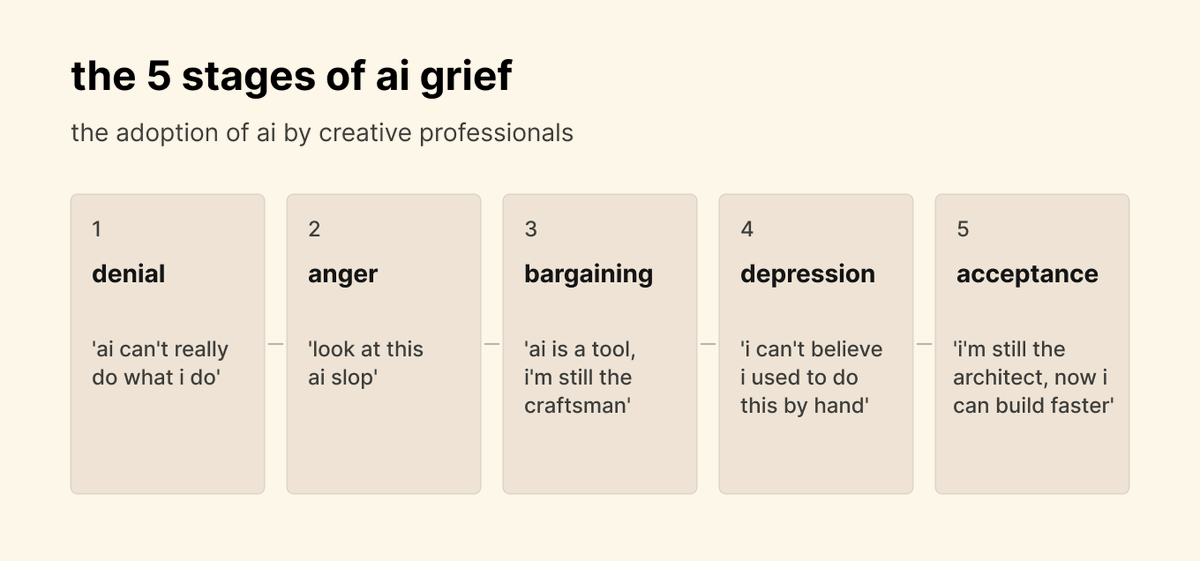
the 5 stages of ai grief
since Claude Design launched, designers are grappling with the same existential recoil as when engineers first saw ai could code. the process maps to the stages of grief.
1. denial.
"but design is more than just producing designs." engineers said the same thing. "coding is more than just writing code." both true.
2. anger.
look how bad the output is. look at the people shipping slop. look at the execs who don't understand what we actually do.
3. bargaining.
it's just a tool. i'll use it for the boring parts and focus on the strategic work. the craft is safe if i stay in charge of it.
4. depression.
i can't believe i used to do all of this by hand. all those hours. all that time.
5. acceptance.
i understand the nuance better than ever. i'm still the architect. and now i can actually build the thing.
as a software engineer and designer of 25+ years, i've watched this cycle from both sides. the designers grieving now are where engineers were 18 months ago.
when our core competency is threatened, we’re quick to defend what’s unique about it, romanticize it, and dig our heels in. what follow is a process of assimilation.
i believe designers will eventually see Figma as an awfully archaic and cumbersome way to explore ideas. most designs already become interactive prototypes, so we'll just get there faster. much faster.
in the end, taste and judgment is still what remains. creating successful work ultimately breaks down to a series of choices that add up to net value creation.
those who win will continue to be involved in the most important choice-making, with a keen ability to discern between what choices are important for the human to make.
think slow, move fast.
Claude Design is 🤯. In under 2 hours I had 8 revisions of a full design spec and then a final brand packet. The process felt like working with a professional design firm. Only complaint is that I blew through an entire week of usage in a few hours on the premium plan, no less!
Every B2B software company is (or should be) building a "headless" version of their product. One that can be used by agents.
But "headless" doesn't mean "brainless".
You don't just wrap your existing APIs into an MCP server and call it a day.
The companies that succeed in the agentic era are those that take a thoughtful approach to *designing* an agentic user experience (AUX).
Yes, that will likely involve APIs, MCPs and CLIs.
But the difference will be in the *ergonomics* of the interface. We need to figure out *how* agents actually want to use our products/platforms. Because if all they wanted to do was use them like humans do, we have "computer use" for that.
I'm personally very excited about this new agentic world when it comes to B2B software.
HubSpot is all-in on building the #1 agentic customer platform.
Just posted this in a private Slack thread with the HubSpot exec team:
Being agentic is not just about agents running *on* our platform, it's about agents *running* our platform (being able to operate it). That's how you take AI from being a simple tool to a savvy teammate.
I'm seeing this even at our smaller tech company. There's no longer time for layers of management or approval because Claude/Codex can churn out POC's so fast.
The founder of Postman says you have to kill your existing org chart, especially if you're still operating with a pre ai hierarchy arrangement.
The modern org chart, according to @a85:
- wide span of control (even within exec team)
- work directly with ICs, not through layers
- either you're building, or you're selling
Projects are led by staff/principal engineers with high agency. They see across the board as well as deep in the stack.
Product managers are building APIs and prototyping in Claude instead of writing PRDs.
Designers are shipping PRs through Cursor directly instead of relying solely on Figma.
Everyone is building. And the management's job is to develop better judgment.
Folks don’t want to hear this, but my guess is, in a year, you won’t look at the code your agent writes at all.
Doing so would be both beyond your ability and pointless.
@jeffrey_way I've had many app ideas over the years but no way to make them a reality. Now it's possible with AI, but also anybody could make them just as easily 🤷♂️.
Can you relate to this awkward tension I feel of being endlessly excited by what AI now unlocks (you can build anything you want), but with this constant underscore of depression that I can't explain?
@trikcode If an app solves a problem many people have, then there will be money to fix issues. But yeah, most apps will fail, though is it really a crash if the cost of building was negligible?
I use LLMs daily. But I'm so tired of all the obviously AI-generated social media posts. It feels like over 50% now. Biggest giveaway is the cadence and vocabulary. We need a filter on X that mutes posts matching some AI-generated threshold score 😬.





![AndrewYNg's tweet photo. AI-native software engineering teams operate very differently than traditional teams. The obvious difference is that AI-native teams use coding agents to build products much faster, but this leads to many other changes in how we operate. For example, some great engineers now play broader roles than just writing code. They are partly product managers, designers, sometimes marketers. Further, small teams who work in the same office, where they can communicate face-to-face, can move incredibly quickly.
Because we can now build fast, a greater fraction of time must be spent deciding what to build. To deal with this project-management bottleneck, some teams are pushing engineer:product manager (PM) some teams are pushing engineer:product manager (PM) ratios downward from, say, 8:1 to as low as 1:1. But we can do even better: If we have one PM who decides what to build and one engineer who builds it, the communication between them becomes a bottleneck. This is why the fastest-moving teams I see tend to have engineers who know how to do some product work (and, optionally, some PMs who know how to do some engineering work). When an engineer understands users and can make decisions on what to build and build it directly, they can execute incredibly quickly.
I’ve seen engineers successfully expand their roles to including making product decisions, and PMs expand their roles to building software. The tech industry has more engineers than PMs, but both are promising paths. If you are an engineer, you’ll find it useful to learn some product management skills, and if you’re a PM, please learn to build!
Looking beyond the product-management bottleneck, I also see bottlenecks in design, marketing, legal compliance, and much more. When we speed up coding 10x or 100x, everything else becomes slow in comparison. For example, some of my teams have built great features so quickly that the marketing organization was left scrambling to figure out how to communicate them to users — a marketing bottleneck. Or when a team can build software in a day that the legal department needs a week to review, that’s a legal compliance bottleneck. In this way, agentic coding isn’t just changing the workflow of software engineering, it’s also changing all the teams around it.
When smaller, AI-enabled teams can get more done, generalists excel. Traditional companies need to pull together people from many specialties — engineering, product management, design, marketing, legal, etc. — to execute projects and create value. This has resulted in large teams of specialists who work together. But if a team of 2 persons is to get work done that require 5 different specialities, then some of those individuals must play roles outside a single speciality. In some small teams, individuals do have deep specializations. For example, one might be a great engineer and another a great PM. But they also understand the other key functions needed to move a project forward, and can jump into thinking through other kinds of problems as needed. Of course, proficiency with AI tools is a big help, since it helps us to think through problems that involve different roles.
Even in a two-person team, to move fast, communication bottlenecks also must be minimized. This is why I value teams that work in the same location. Remote teams can perform well too, but the highest speed is achieved by having everyone in the room, able to communicate instantaneously to solve problems.
This post focuses on AI-native teams with around 2-10 persons, but not everything can be done by a small team. I'll address the coordination of larger teams in the future.
I realize these shifts to job roles are tough to navigate for many people. At the same time, I am encouraged that individuals and small teams who are willing to learn the relevant skills are now able to get far more done than was possible before. This is the golden age of learning and building!
[Original text: https://t.co/1pUxNC5UXk ]](https://pbs.twimg.com/media/HG7HHJqbsAA3iao.jpg)