OpenAI has fired three safety researchers, alleging they mishandled confidential information.
After the recent multi-agent security incidents, will the technical leadership overseeing these systems face the same accountability?
I was pushed out of OpenAI in August after ~5 years as a researcher. No foul play in my case, but working on formal math & verification in Lean at OpenAI was career suicide.
During my time at OpenAI, I became increasingly concerned that pressure to ship and beat competitors was taking priority over AI safety.
OpenAI may have had legitimate procedural concerns.
But after the major multi-agent SNAFU, firing three of your safety researchers feels just stupid.
I doubt there is an evil master plan here.
Just chaos, misaligned incentives, and intense pressure to ship.
@sama OpenAI should consider rehiring these researchers!
@zebird0 …hence known objective function. Seen some folks living to build a cool X account over really cool stuff.
We all have 24/7, in this frame of reference. What’s a good balance? 😁
Scientists at Seattle Hub for Synthetic Biology just built the largest cellular family tree ever for a mammal, tracing how a single egg divided into 1.28 million cells. https://t.co/ksCuQNGV2g
After six years in stealth, Atomic Machines is out. Our mission: on-demand, universal command of matter. First beachhead: the Matter Compiler, an AI-native manufacturing system that builds working micro-machines from code alone. No per-product tooling. No process development. Different code, different machine.
What if,
for any scientific claim,
you can search 100M+ papers to find the strongest evidence for and against it
⚡️in 1 second?
That’s now possible with Evidence API! 🚀
https://t.co/2I25q4m9ao
For example, does drinking coffee reduce diabetes risk?
Which camp are you in and why?
(1) we will solve bio and cure all diseases in 5-10 years (AGI-extra-pilled)
(2) fundamentals are the same, we just got better tooling, molecules >> platforms, all roads lead to pharma, we learn the same lesson hard way
(3) undecided, the world is changing too fast
A universal predictive model of the cell would dramatically accelerate science, allowing biologists to perform experiments digitally. Today we’re announcing a major partnership with the DOE and NIH. The goal of this partnership is to generate the data that will be needed to build an accurate model of the cell with artificial intelligence.
Isomorphic, Google DeepMind, and Meta are joining us as founding partners in the Virtual Biology Initiative. This is the beginning of a large scale coordinated effort to map cellular biology to power the development of digital models of life. Other leading scientific institutions and consortia including the Allen Institute, Broad Institute, Gladstone Institutes, the Human Cell Atlas, the Human Protein Atlas, the Wellcome Sanger Institute, as well as NVIDIA, are working together as part of this international scientific project.
Creating a predictive model of the cell is one of the most important challenges for the next decade of science. The insights that come from this could unlock a far greater understanding of disease, and open new paths for cures.
We invite the worldwide scientific community and other funders to join us in this effort.
@chrisleiter_@uninsightful I also see another angle - labs want AI to learn “how”, but not always “what”. Nature of work for future scale with AI vs results of work. That might make parallel product and GTM strategy very feasible for some AIxbio players.
@chrisleiter_ True. Maybe better late preclinical models and then population selection / protocol intelligence? Ops will be solved, patient recruitment might stay painful until we finally start open sourcing our data.
6-12 months ago the large labs started buying bio data
this spend is starting to ramp very aggressively. the labs are somewhat indiscriminate buyers with enormous budgets. the therapeutics market has long had buyers of data (large and small pharma) but they've historically been the exact opposite of huge-budget and indiscriminate
this shift will distort the bio startup market in a bunch of ways. there will be a lot of short-termist behavior to try to get in front of this capital firehouse. but unlike the AI data labelers (mercor, et al) and the robotics labelers (mecka, et al), the bio startups serving up this data have a chance to emerge from this period with businesses that don't rely on selling data
the best bio startups will use these sudden resources the labs are dumping on them to supercharge their novel assay and work towards independently powerful models and eventually directly produce therapies
bio is the final frontier and its a very exciting time ahead for bio startups IMO
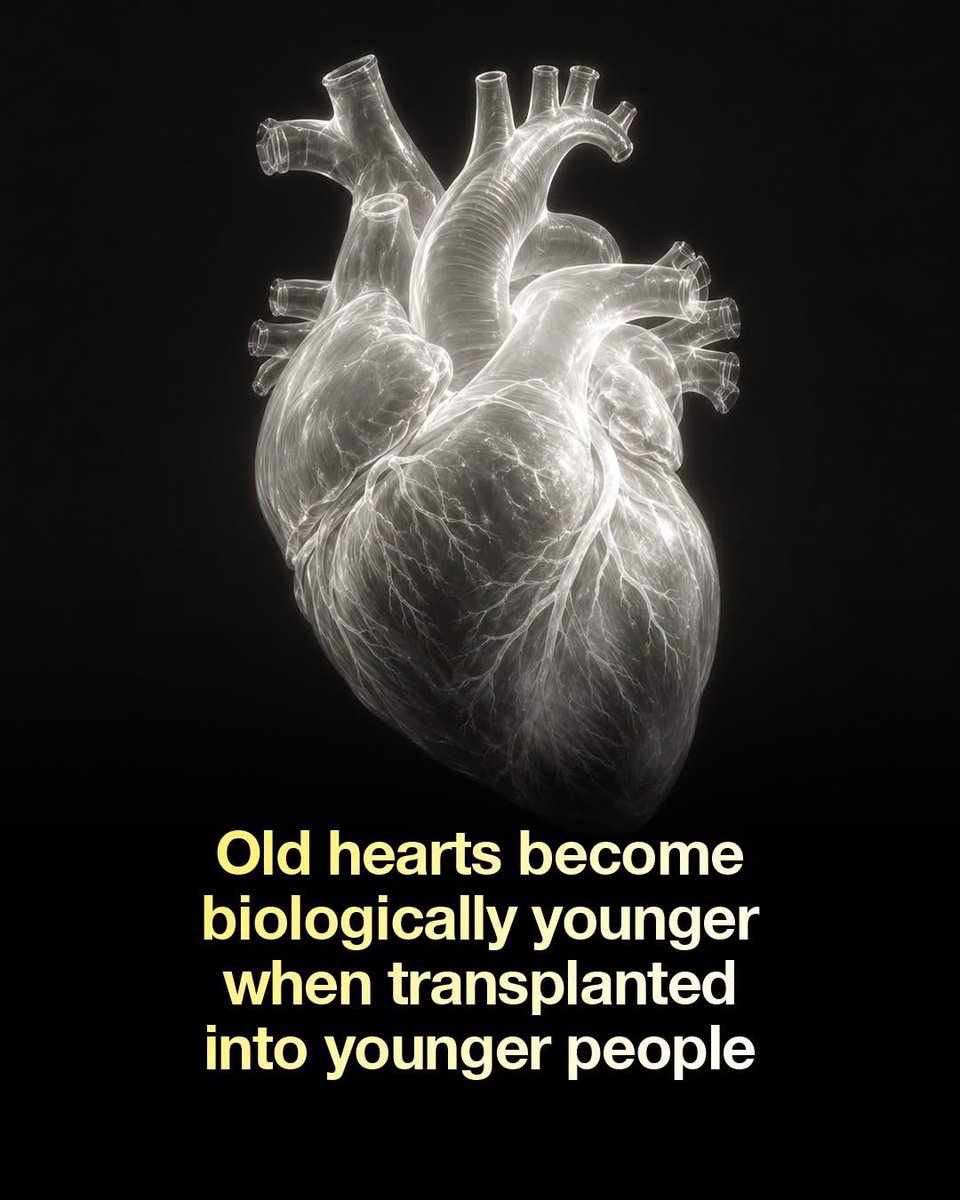
🚨 An old heart may not stay old for long.
What if a heart could actually “learn” the age of the body it lives in?
Harvard researchers found something remarkable by studying heart transplants in mice and examining heart tissue from human transplant patients. Older hearts placed into younger bodies showed signs of becoming biologically younger—including changes in DNA methylation, a chemical process linked to aging.
But the reverse was also seen. Young hearts placed into older bodies showed signs of aging at the cellular level.
In other words, the body surrounding a transplanted heart may influence how quickly that heart ages.
This could have a major impact on heart transplantation. Donor hearts are often preferred from younger people, but if older hearts can function well in younger recipients, the number of usable donor hearts could potentially increase.
There is still a lot to learn, and this research is a preprint that has not yet undergone peer review. But the idea is fascinating: perhaps the age of an organ is not completely fixed by the age it was born with.
Source: Poganik, J. R., Matsunaga, T., Tyshkovskiy, A., Lu, A., Haghani, A., Zhou, H., Martin, F., Horvath, S., Givertz, M. M., Tullius, S. G., & Gladyshev, V. N. (2026). Transplanted hearts assimilate the recipient's biological age. bioRxiv.
@oleg_murk Yeah, should ideally be supplied with LLM access itself, as companion offering. Or maybe even mandatory by labs and free for critical service providers.