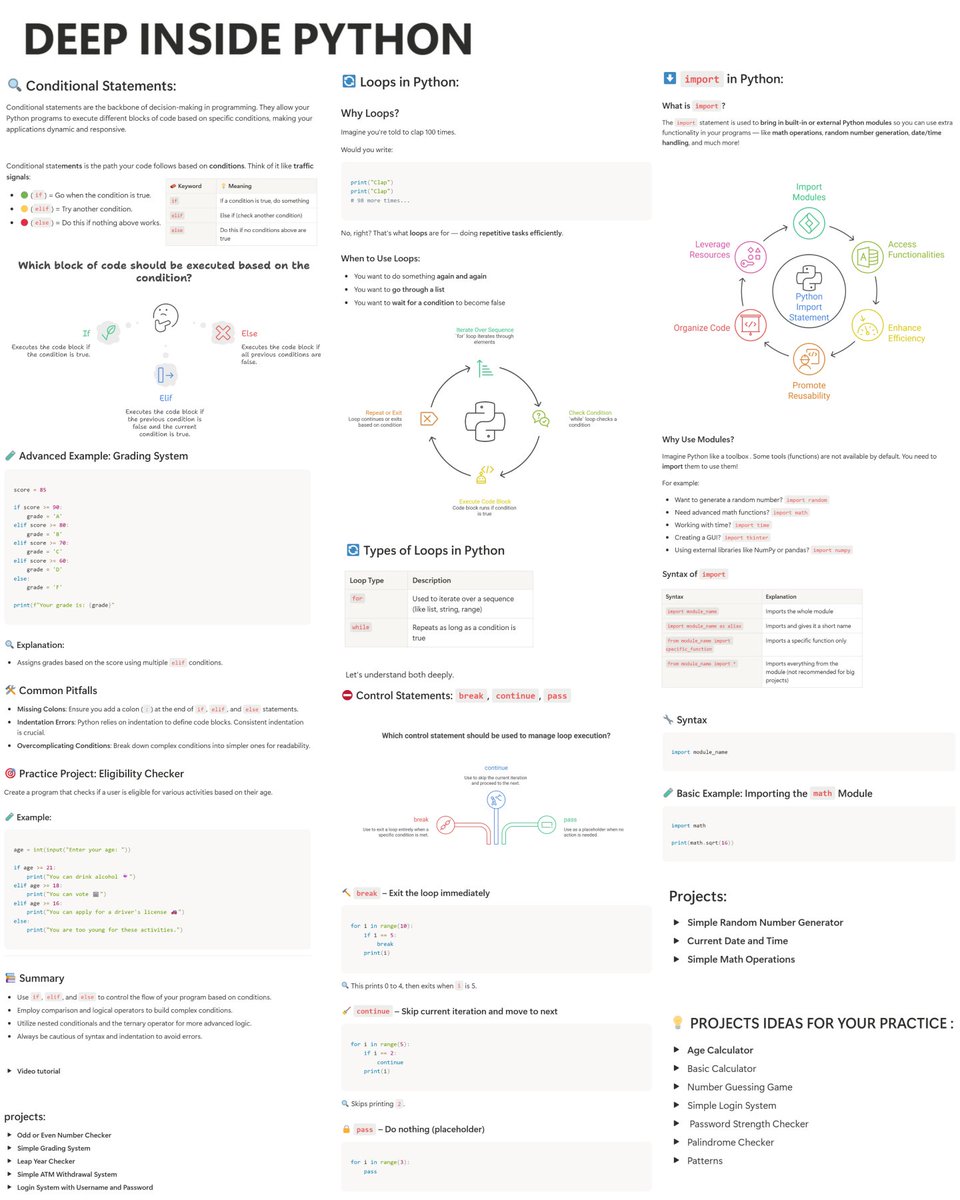
Best YouTube Channels To Crack Tech Interviews (2026)
1. DSA – NeetCode
2. LeetCode Patterns – Abdul Bari
3. System Design – Gaurav Sen
4. Mock Interviews – Pramp
5. FAANG Prep – Tech Dummies
6. Coding Rounds – Nick White
7. Behavioral – Jeff H Sipe
8. Problem Solving – Back To Back SWE
9. Deep DSA – Errichto
10. Interview Strategy – Exponent
11. Resume + Career – Self Made Millennial
12. Real Interview Qs – Clément Mihailescu
13. Advanced DSA – William Lin
14. CS Basics – MIT OpenCourseWare
study algebra with calculus.
separating them is how math becomes dead.
• algebra → structure and manipulation
• calculus → motion and change
• functions → the bridge between both
• derivatives → algebra of sensitivity
• integrals → algebra of accumulation
calculus is not a different universe.
it is algebra applied to changing systems.
you rearrange.
you simplify.
you factor.
you substitute.
then you ask:
how does this thing move?
that’s where math starts becoming engineering.
Taxonomic graph analysis of personality questionnaire data uncovers this three-tiered network.
Bottom-level facets cluster into six mid-level traits - Neuroticism, Sociability, Conscientiousness, Integrity, Openness to Experience, and Impulsivity - which organize under three meta-traits:
Stability, Plasticity, and Disinhibition.
Node colors align with the legends shown, and connecting lines indicate empirical statistical associations identified in the IPIP-NEO dataset.
It is used to refine personality assessment tools and investigate links between traits and mental health conditions.
Human nature is wired for survival, not truth. People believe what keeps them safe, accepted, or comfortable, even when it contradicts reality. If a lie protects their ego or status, they’ll defend it fiercely. Understand this, and you’ll stop expecting honesty.
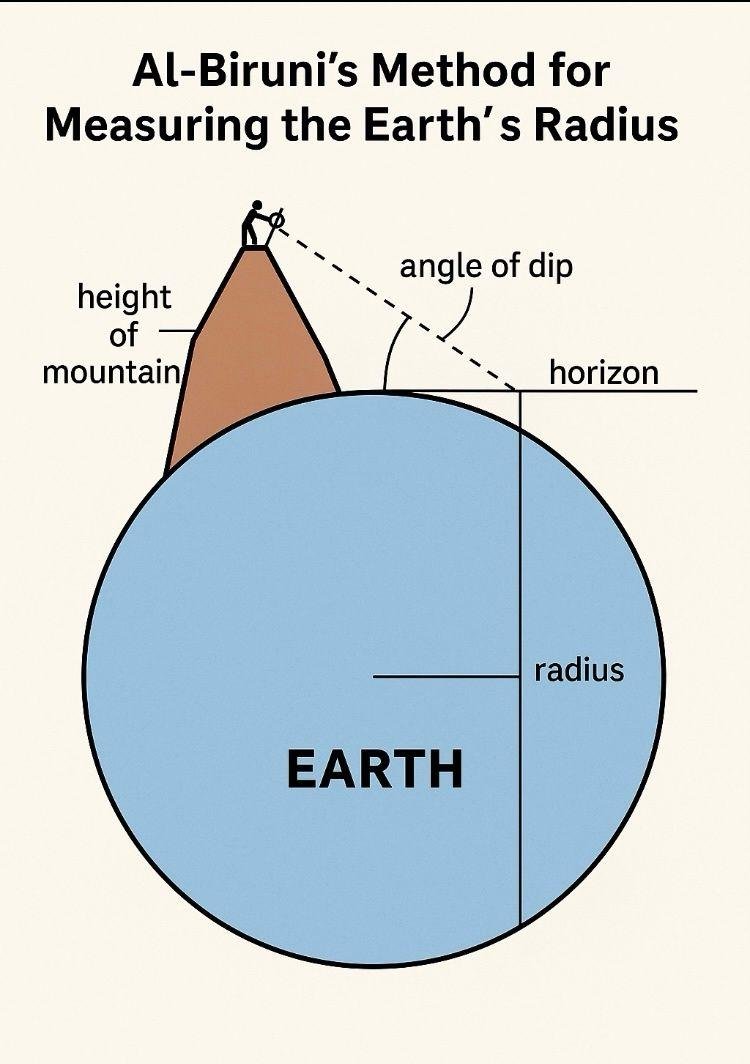
✨In the 11th century, the famous Muslim polymath Al-Biruni figured out the Earth's radius using nothing more than a mountain and a bit of trigonometry. 📐
The insight was brilliant:
Stand on a mountain, and the horizon dips below the horizontal. That dip isn't an optical illusion; it's a geometric signal. It creates a right triangle where the mountain's height (h) and the Earth's radius (R) are the only variables.
Measuring the mountain's height without climbing down:
He used a simple trigonometric trick: from two points on the plain, he measured the angle to the peak. Knowing the distance between those points, he calculated the mountain's height with a formula surveyors still use today:
H = D / (cot A1 – cot A2)
From the peak, he measured the dip angle to the horizon: α = 34′ (just over half a degree):
R = h * cos(α) / (1 - cos(α))
How did he compute the cosine of such a tiny angle?
Without modern calculators, he used a sophisticated technique: he started with the known value of cos(60°) and used the half-angle formula to work his way down to the required value for his 34′ angle.
He calculated the Earth's radius as 6,340 km. The modern value is 6,371 km.
An error of less than 1%. In 1030 CE.
China has killed the entire vector database industry.
They open-sourced TencentDB Agent Memory. It gives any AI agent long-term memory that runs 100% locally.
No Pinecone. No cloud APIs. No repeating yourself every session.
- 61% fewer tokens
- PersonaMem accuracy: 48% → 76%
- Zero external API dependencies
- Runs on plain SQLite
Most memory systems compress your history into an opaque vector pile. when recall goes wrong, you're guessing. this one doesn't compress, it builds a semantic pyramid.
L0 Conversation → L1 Atom → L2 Scenario → L3 Persona.
Short-term state gets encoded as a Mermaid graph in your agent's context. verbose tool logs get offloaded to disk. when the agent needs proof, it drills back via node_id to the exact raw log.
no lossy compression. every layer is readable markdown you can just open and inspect.
5.1k stars. 100% Open Source.
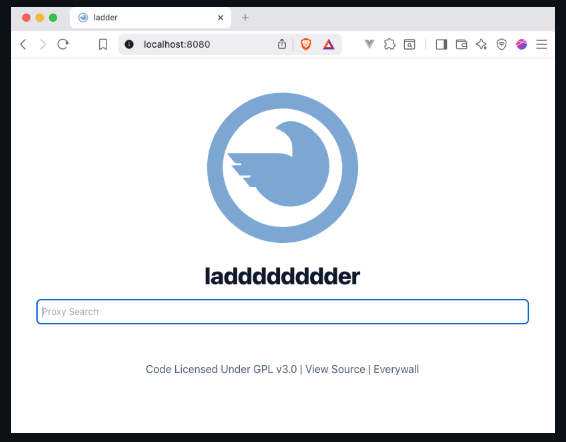
Publishers killed 12ft Ladder months after Elon made paywall bypassing famous.
In August 2023, Elon Musk told his followers they could read the New York Times for free using a paywall bypass site. That single post pulled in 37 million views.
Back then, the bypass everyone actually built their workflow around was called 12ft. io, nicknamed 12ft Ladder. Paste a locked article's link in, get the readable page out.
It ran on one domain, owned by one company. That made it an easy legal target. In July 2025, the News Media Alliance got it shut down for good.
So a developer rebuilt the same idea with one difference. This time there is no domain to kill.
It's called Ladder, and it lives on GitHub.
You run it yourself. One Docker command spins it up on your own server, under your own name, with your own rules for which sites it touches.
Nobody can pressure a registrar that was never theirs to pressure. There is no single company holding the project hostage, because every person who runs it becomes their own company.
8.5K stars. GPL-3.0 license. 100% open source.
https://t.co/5N0gwHcw9y
Every time you avoid something uncomfortable, your brain reinforces the idea that avoidance works. It literally strengthens the pathways that make hesitation, procrastination, or excuses automatic. And every time you do the hard thing even imperfectly your brain is building a new pathway: this is something I can do.
almost every engineering system is signal in, signal out.
• audio
• radar
• images
• sensors
• motors
• circuits
• control systems
all of them process information over time.
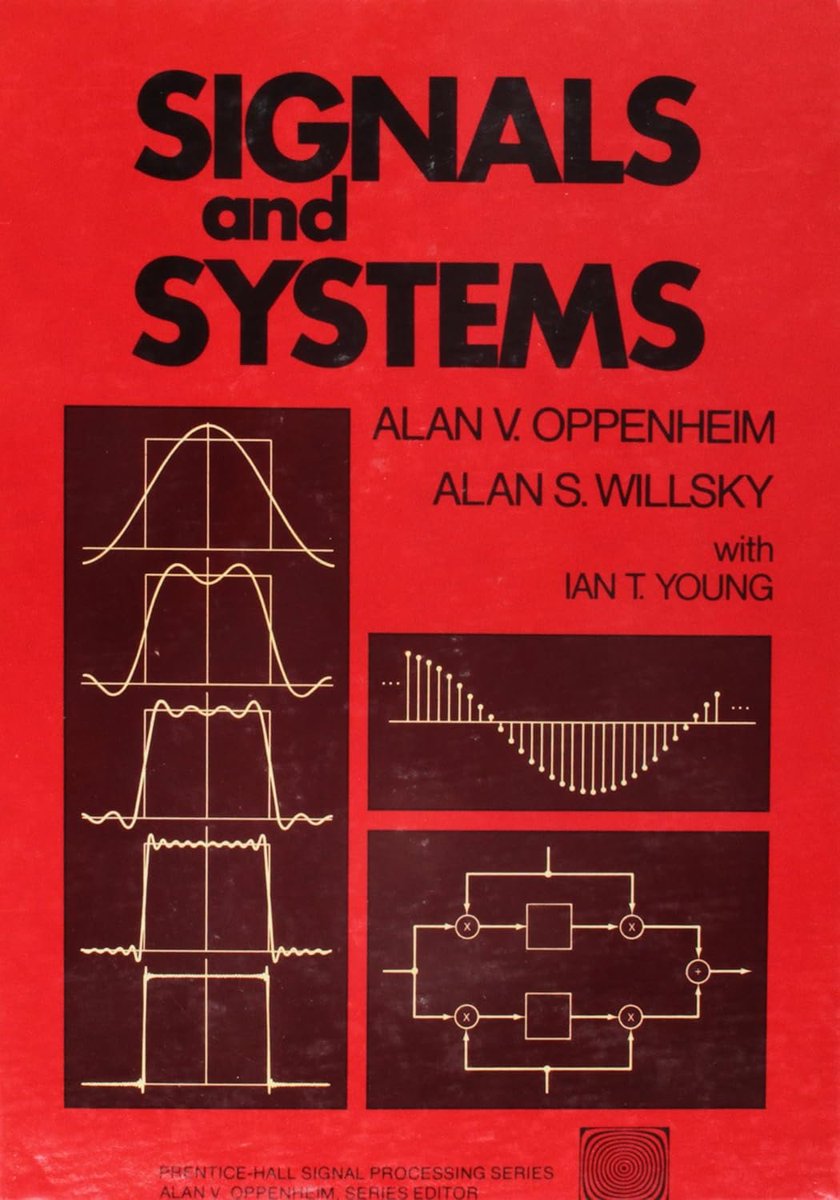
signals and systems by alan v. oppenheim is one of the books that teaches you how to see that structure.
a signal is not just data.
it is behavior across time, space, or frequency.
a system takes that signal and transforms it.
• filtering noise
• amplifying patterns
• extracting features
• predicting behavior
• controlling response
once you understand convolution, Fourier transforms, sampling, and frequency response,
the world starts looking different.
• sound becomes waves.
• images become frequencies.
• sensors become streams.
• machines become transformations.
engineering becomes the art of shaping signals.
Taiwan solved tax evasion in 1951 with a trick so cheap it should embarrass every tax authority on the planet.
The problem was an all-cash economy full of small shops. A merchant pockets the cash, skips the receipt, and the sale never existed. Auditors can't catch what was never recorded, and hiring enough of them to watch every noodle stand costs more than the missing tax.
So finance chief Ren Xianqun flipped the incentive. Print a lottery number on every receipt. Draw winners every two months on live TV. Top prize today: NT$10 million, about $310K.
Suddenly the customer and the shopkeeper want opposite things. The merchant wants the sale off the books. The customer wants the ticket. And there are millions more customers than merchants. Every transaction now carries a built-in witness demanding the paper trail.
Year one, reported tax revenue jumped 75%, from NT$29 million to NT$51 million. Seventy-five years later, roughly 70% of Taiwanese still play. Convenience stores redeem the smallest NT$200 prizes at the register, so even a coffee receipt feels like a scratch card.
The elegant part is what the audit force costs. The prize pool runs about NT$7 billion a year, roughly $20 million. In exchange, the government gets 23 million unpaid auditors working every checkout line in the country, forever. No inspector general on earth delivers that coverage at that price.
Greece, Italy, Portugal, and Slovakia all copied it. The most effective compliance tool ever built looks like a game, and that's exactly why it works.