Neuroscience Professor @ National Yang Ming Chiao Tung University, Taiwan | decision making | attention | reward | #BasalForebrain l @sclin-lab.bsky.social
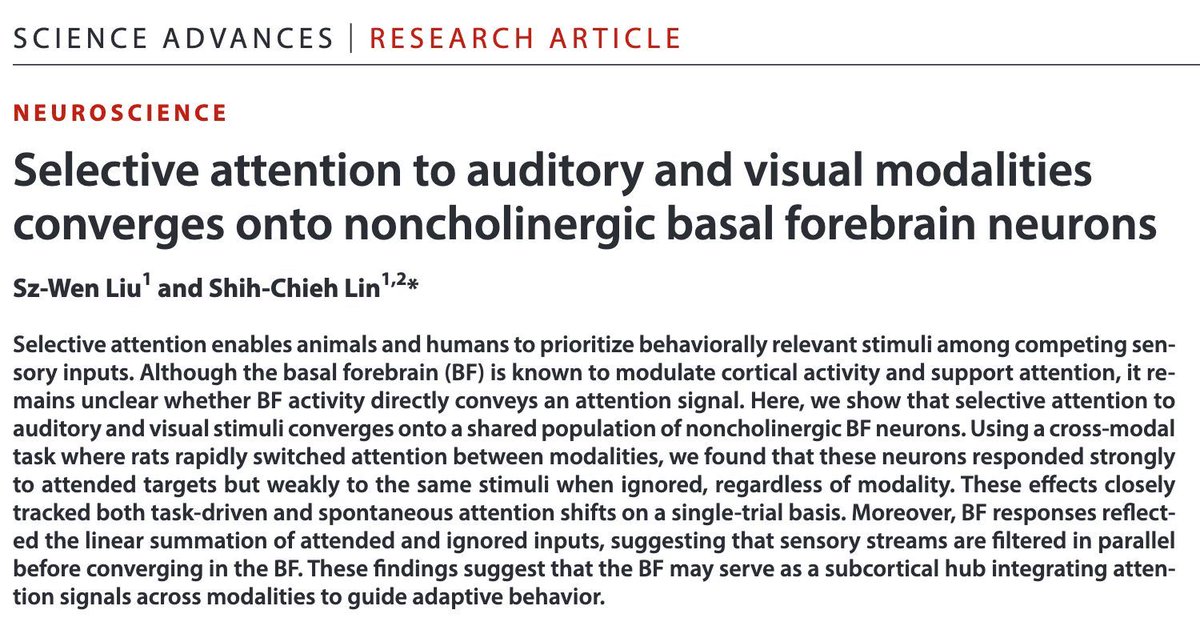
New paper in @ScienceAdvances: we identify a modality-common selective-attention signal in noncholinergic #BasalForebrain (BF) “bursting” neurons, distinct from the modality-specific attention signals typically described in corticothalamic circuits. 1/n
https://t.co/eMCz5bMUsD
@ScienceAdvances Huge thanks to lead author Sz-Wen Liu (@szwenliu.bsky.social)—freshly minted PhD 🎓—for leading this project from start to finish. Also grateful to our colleagues at NYCU, @cls_nycu, lab members, and reviewers who helped sharpen this study. 10/end
New paper in @ScienceAdvances: we identify a modality-common selective-attention signal in noncholinergic #BasalForebrain (BF) “bursting” neurons, distinct from the modality-specific attention signals typically described in corticothalamic circuits. 1/n
https://t.co/eMCz5bMUsD
@ScienceAdvances We also see a negative correlation between stimulus-locked bursts and outcome responses—an RPE-like signature consistent with prior reports—suggesting BF bursts may transform stimulus-onset RPE into an attention-for-performance amplification signal. 9/n
@KarlDeisseroth It is great that readers in Taiwan now have access to this beautiful book through the translated version. I was so happy to play a small part in this process.
Does scattering limit your in vivo imaging experiments? We 'super-resolve' neurons using the same trick how PALM/STORM microscopy resolves individual molecules (1/12).
@NatureComms Special thanks to the great efforts from our team @ManzurHachi @kvjunethree You-Jhe Jhong & Hung-Yen Chen. I cannot thank everyone enough! I am very proud of the final story we put together, which does justice to this beautiful dataset. (n/n)
Really excited to share the latest work on #BasalForebrain from our lab: "The behavioral signature of stepwise learning strategy in male rats and its neural correlate in the basal forebrain" https://t.co/PmImO4vGAm just published in @NatureComms (1/n)
@NatureComms This observation shows that, even when external reward contingencies remain unchanged, the learning process can add new reward predictors in animals' mind. This poses a fundamental challenge to theories and models of learning that assume a static set of reward predictors. (10/n)