This is the 5th Anniversary Edition of DSP Netra.
Nature degrades all physical things. Even written down words. Process Knowledge, the ‘know-how’ of doing things is critical. Too much reliance on outsourcing, automation, quants coupled with circumstances where the ‘know-how’ isn’t passed on can cause many streams to go extinct.
Investing, like cooking, is a practitioner’s job. You can have the best ingredients and written down recipes, but they can’t substitute for experience and legacy.
This edition of DSP Netra attempts to bring this critical process knowledge to its readers through the best practitioners of the industry.
Read the thread or download:
https://t.co/tS337lUZvE
@KalpenParekh@SahilKapoor@arunrajendran@ushinair@ManishRathiDSP@PragatiAggarwa8@ParthShah_01@Devang199301
@Airtel_Presence@airtelindia my airfiber disconnection request is pending since 1 June. Stop your retention calls and delaying tactics and close the connection.
I did not to go to the Supreme Court today to hear its order in the SIR case.
As a litigant in this case, and as someone who was given the honour of addressing the court, I should have been hopeful, anxious, or at least curious. I was not. The case was decided long ago. We were only waiting for the transcript and its fine print.
The course of this case was settled in August last year. Having heard arguments against SIR for three days, the court moved away from examining the constitutionality of SIR and effectively converted itself into a Consumer Forum, focused on grievance redressal and arbitration, rather than constitutional principles.
The case was effectively decided when the apex court allowed the ECI to rush through the Bihar elections without first deciding the matter, and without requiring the ECI to rectify even the most glaring defects in post-SIR rolls.
There was little left of this case once the ECI proceeded with the second and then the third phase of SIR, while the Hon’ble Court leisurely heard arguments about its constitutionality. SIR had become a fait accompli. Any remaining doubt disappeared when the Hon’ble judges observed in open court that no one would be allowed to obstruct SIR.
The final nail in the coffin of this petition was hammered during the hearing of another petition before the same Bench, when an Hon’ble judge remarked that millions denied their right to vote need not fret, since they could vote in the next election. At that moment, the court abdicated its constitutional responsibility.
Shorn of legalese, the simple truth is that the highest court of a constitutional democracy has already authorised the disenfranchisement of millions of citizens — at least 59 million so far, could go up eventually to 100 million.
It was inconceivable that the court would now declare SIR unconstitutional and annul all post-SIR elections. The lawyers were waiting for the the exact legal reasoning deployed to arrive at a conclusion that was already known. Such legal gymnastics did not interest me. Some friends were looking for some crumbs in the hope that the court might at least wish to save face, if not save the voters. Eventually that too did not happen. Polite noises apart, the Court has handed over a carteblac to the ECI to do what it pleases with the voters list.
ADR vs Union of India (2026) is to our times what ADM Jabalpur vs Shivkant
Shukla (1976) was to the previous assault on our democracy. We must hope that the SIR judgment does not mark the crumbling of the last constitutional wall, as ADM Jabalpur once did. We must believe that one day this constitutional abdication by the guardian of the Constitution will be recognised for what it was. And reversed.
Jai Hind!
Amid a discussion on the Twisha Sharma case - A deeply personal story shared by @advsanjoy that had him and us well up in tears- he shared the advise he once gave to a domestic violence survivor- and what happened next and why it haunts him till this day. Listening on Vandana Shah, herself a domestic abuse survivor and now divorce lawyer. Must watch show in full here https://t.co/21zQTJGQ5W
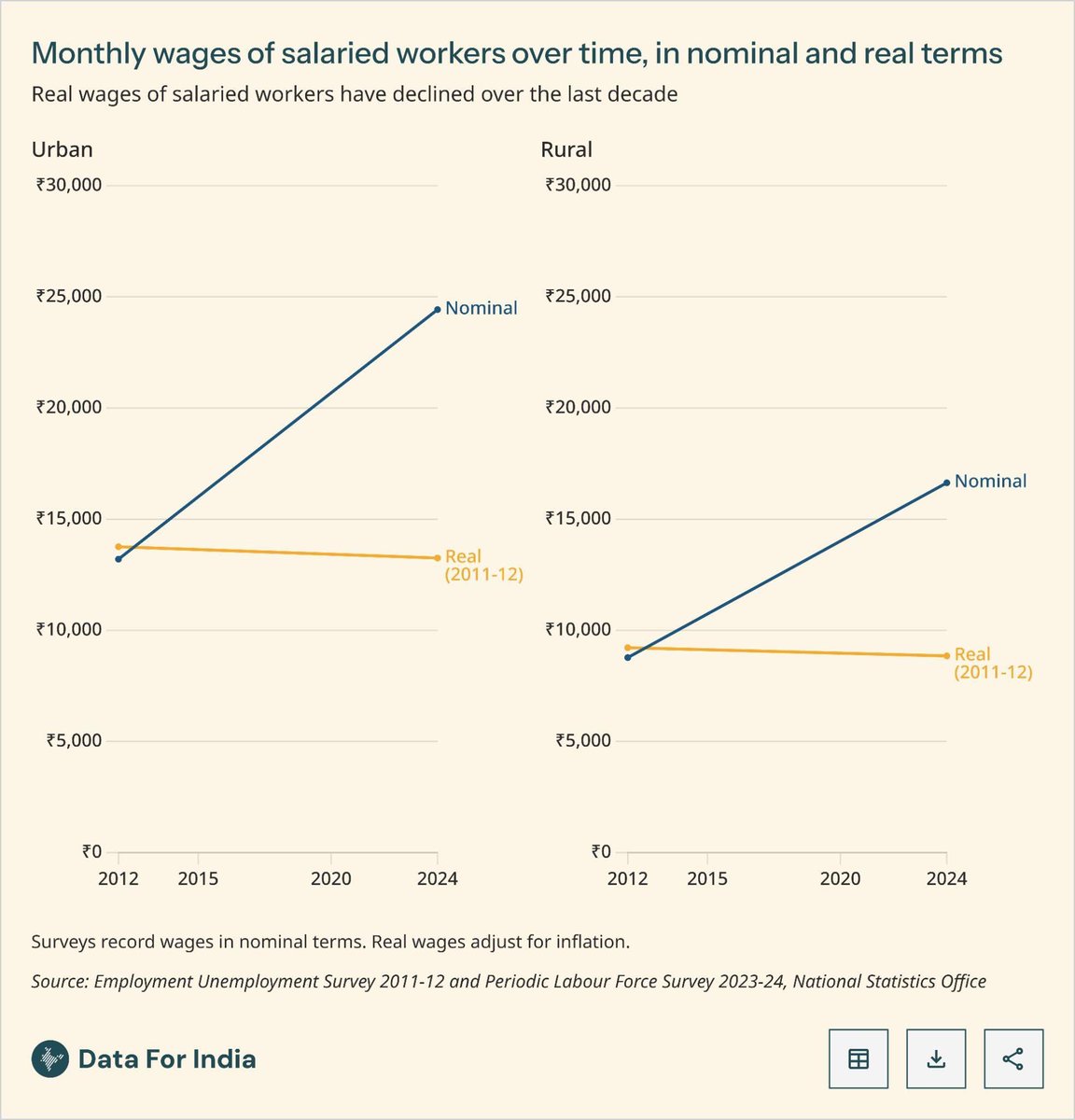
.@Rukmini: The monthly average salary in India increased by about 90% from 2012 to 2024 in nominal terms, meaning that it nearly doubled in just over a decade. But adjusting for inflation, the average salary actually fell 4% over the period. https://t.co/Bxbrxhzwdb
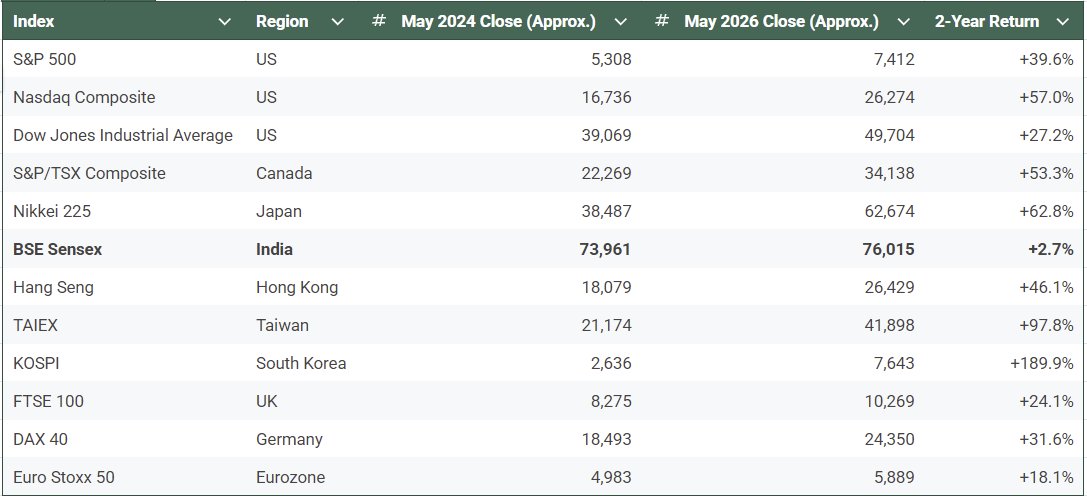
One of the worst performing indices in the world over the last 2 years.
One of the worst performing currencies in the world over the last 2 years.
The world is moving ahead, India is being left behind. Forget fresh foreign inflows, over ₹10 lakh crore has already been sold in the last 3 years.
If we are supposedly the best, then why do the numbers say the exact opposite?
Why not bring active changes in policies?
You don’t get answers until you start asking questions.
Stop worshipping, Start questioning, At the end of the day, a country’s progress matters more than political progress.
Is it true that Ozempic basically just surpasses hunger pangs?
So the classic advice for weight loss was "diet and exercise" but it was mostly "diet" with exercise playing a marginal role in this strategy?
Dalda became so famous that the brand name replaced the category. Even today, many people call any vegetable oil Dalda. It remains the ultimate Ghost Brand that killed the monopoly of Desi Ghee by dressing up in a green tin & promising a purity that the lab-grown fat could never truly possess.
The story of Dalda is arguably the greatest Psychological Hijack in the history of Indian food. Before Dalda, India was the land of Desi Ghee. But by the 1930s, pure ghee was becoming expensive, & a Dutch company saw a fat-shaped hole in the Indian market.
In the early 1930s, the Dutch company HVM was importing vanaspati (hydrogenated vegetable oil) under the brand name Dada. When Hindustan Lever (now HUL) took over the distribution, they wanted to make it sound theirs. But they did not change the whole name. They simply inserted the 'L' from Lever into the middle of Dada & Dalda was born.
It sounded familiar, soft, & grandmotherly, even though it was a chemically altered industrial product. Before Dalda, fat was sold loose in the market. It was messy, prone to dust, & easily adulterated. Dalda introduced the Green Tin with the Yellow Palm Tree. It was the 1st time an Indian staple was sold in a sealed, tamper-proof container.
In a country obsessed with purity, the Click of opening a new Dalda tin became the sound of safety. Housewives felt that the British-engineered tin was cleaner than the loose ghee sold by the local halwai. They used the Visual of Hygiene to sell Chemical Fat. The creators of Dalda wanted to be a clone. They used a process called Hydrogenation to turn liquid vegetable oil into a solid.
They specifically engineered it to have the exact melting point of Ghee (37 degrees C) so it would feel the same on the tongue. They added synthetic buttery aromas to mimic the smell of clarified butter. They marketed it as Vanaspati Ghee (Vegetable Ghee). By stealing the word Ghee, they bypassed the cultural barrier.
People did not feel they were switching to oil; they felt they were buying a Modern, Affordable Ghee. By the 1940s, Dalda was so successful that it started hurting the dairy industry. This led to a massive Swadeshi Backlash. None other than Gandhi & Sardar Patel spoke out against Dalda. Gandhi called it the death of the cow, & there was a massive movement to force Dalda to dye their oil a different color (like orange/blue) so it could not be used to adulterate real ghee.
Dalda’s lawyers (some of the best in the British Raj) fought back, arguing that no color was biologically safe. They delayed the laws for so long that by the time the dust settled, an entire generation of Indians had already developed a taste for Dalda-fried puris.
Dalda was the pioneer of Experiential Marketing in rural India. In the 1950s, Dalda sent out vans into villages with projectors. They would show a movie, & halfway through, they would host a live cooking demonstration. They would fry pakoras in Dalda & distribute them for free. For a villager who had only ever eaten boiled grains/expensive ghee, the Crunch of a Dalda pakora was a revelation. It was the Taste of Progress.
They taught women how to use Dalda for embroidery & soap-making. They wanted Dalda to be so integrated into the house that removing it would feel like removing a family member. Also, Dalda did not win because it was healthier (it was not; it was full of trans-fats). It won because it solved 2 Indian anxieties: Adulteration & Cost.
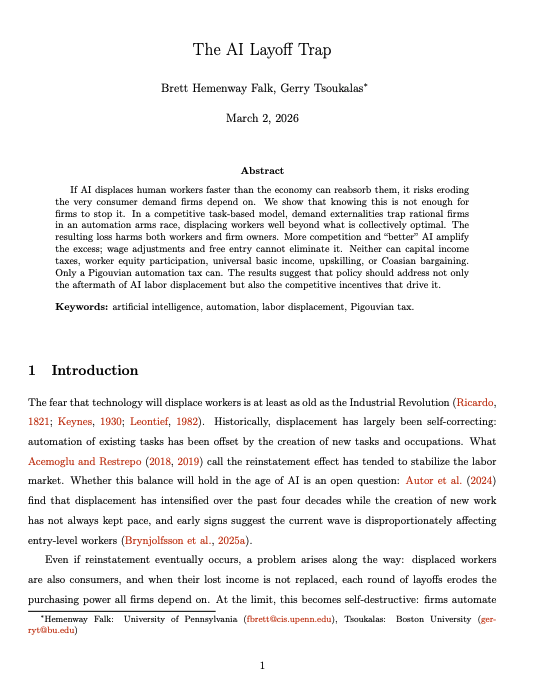
🚨BREAKING: Two researchers from UPenn and Boston University just published a paper that should be uncomfortable reading for every CEO automating their workforce right now.
The argument is straightforward. Every company replacing workers with AI is also eliminating its own future customers. Laid off workers stop spending. Enough of them stop spending and nobody can afford to buy anything. The companies that fired everyone end up selling into an economy with no purchasing power left.
Every executive can see this. The math is not complicated. But here is why nobody stops.
If you do not automate, your competitor does. They cut costs, lower prices, take your market share, and you collapse anyway. So every company automates knowing it is collectively destructive because the alternative is dying alone while everyone else survives. The researchers proved this is a Prisoner's Dilemma playing out in real time.
The numbers are already moving. Block cut nearly half its 10,000 employees this year. Jack Dorsey said AI made those roles unnecessary and that within the next year the majority of companies will reach the same conclusion. Salesforce replaced 4,000 customer support agents with AI. Goldman Sachs deployed a coding tool that lets one engineer do the work of five. Over 100,000 tech workers were laid off in 2025 and AI was cited as the primary driver in more than half those cases. 80% of US workers hold jobs with tasks susceptible to AI automation.
The researchers tested every proposed solution. Universal basic income does not change a single company's incentive to automate. Capital income taxes adjust profit levels but not the per-task decision to replace a human. Collective bargaining cannot hold because automating is always the dominant strategy.
They also identified what they call a Red Queen effect. Better AI does not solve the problem, it accelerates it. Every company chases faster automation to gain market share over rivals but at the end everyone has automated equally, the gains cancel out, and the only thing left is more destroyed demand.
The one thing the math says could work is a Pigouvian automation tax. A per-task charge that forces companies to account for the demand they destroy each time they replace a worker.
The conclusion is that this is not a transfer of wealth from workers to owners. Both sides lose. Workers lose income. Companies lose customers. It is a deadweight loss with no market mechanism to stop it on its own.
(Link in the comment)
In 2 years, son of justice Swarna Kanta sharma got 5,904 cases.
1 case 1 hearing cost 9,000 rupees.
If 20 hearings(min)
20 x 9000 x 5,904 =
106.272 crores is given to her Kanta's son
That's massive amount of money going into pocket of justice Swarna Kanta Sharma from BJP govt