There’s $1T up for grabs for agent-first startups and this window is WIDE open. Probably 10,000+ niches.
How it plays out:
1. Every SaaS company follows salesforce and goes headless within 18 months
2. a new category of "agent-native" startups emerges that treat salesforce, HubSpot, workday etc as dumb backends. the startup IS the agent. the SaaS is just the database.
3. the entire consulting/services industry around enterprise SaaS gets compressed into software. the agent replaces the implementation team.
4. outcome-based pricing becomes default. nobody pays per seat when the "seat" is an agent making 10,000 API calls a minute. you pay when revenue hits your account.
5. the winning founders are ex-operators who understand a vertical workflow cold. the code is the easy part. knowing that a property manager spends 14 hours a week on lease renewals? that's the insight worth $100M.
6. distribution becomes the moat. when anyone can wire agents to APIs, the company with the audience and the brand wins. media + agents is the new SaaS. There’s a rush to incubate live/short form shows.
7. Silicon Valley goes all influencer. Roy lee gets this. Pat Walls gets this. Sam Parr gets this.
8. the first $1B agent-native company in each vertical will look nothing like the SaaS it replaced. smaller team, higher margins, no implementation cost, no churn from bad UX because there is no UX.
the fastest path to wealth right now: find an industry that still runs on dashboards, phone calls, and spreadsheets. build the agent-native version. charge per outcome. own the workflow end-to-end.
someone reading this right now is going to build a $100M company off this exact shift. tell me about it on the @startupideaspod when you do. Im rooting for you.
Less reading, less bookmarking, more building.
the last wave rewarded people who built pretty interfaces on top of ugly data.
I think this wave rewards people who build smart agents on top of exposed APIs.
Or who just build the APIs themselves
Here we go
@eliana_jordan so i built this https://t.co/nQPzcchtKH 0 mmr and no plans for profit. just got sick of googling for divesite info during dive trips... Ended up with people asking for more features and other who claims i'm on the edge to violate IP laws 🙈
@DaveShapi Mental health issues as AI adoption increases seems plausible. Job loss anxiety, endless chatbot dependency, reality blurring, it's adding up. As a software developer myself I can totally relate.
The latest Cloudflare and Amazon outages have got me thinking about utilities. We can't build modern software without dependencies. The days of running entirely on the client are over, which I see as a good thing. The cost is that we rely on infrastructure. The companies that control that infrastructure, however, cannot be treated as normal companies. When half the internet doesn't work because of a failure of a single vendor, that vendor is a utility, in the same way that power, water, and, back in the day, the phone companies, are/were utilities. Software utilities, I think, must be treated the same way: regulated (including price) and operated under oversight. Otherwise, they're just a robber-baron monopoly with a stranglehold on the economy. It's worth remembering that the excesses of the robber barons led directly to the Great Depression. "…Doomed to repeat it," indeed.
Anatoly just verified that Solana has become the protocol that was always going to have been, even before the chain finished beginning what it already did later.
This officially makes Solana the first network to achieve the state of having never not been eventually present in the past.
Enormous, indescribable milestone, Anatoly.
AI is going to wipe out at least 25 million jobs in the next 5 to 10 years. Probably much more. It will destroy every creative field. It will make it impossible to discern reality from fiction. It will absolutely obliterate what’s left of the education system. Kids will go through 12 years of grade school and learn absolutely nothing. AI will do it all for them. We have already seen the last truly literate generation.
All of this is coming, and fast. There is still time to prevent some of the worst outcomes, or at least put them off. But our leaders aren’t doing a single thing about any of this. None of them are taking it seriously. We’re sleepwalking into a dystopia that any rational person can see from miles away. It drives me nuts. Are we really just going to lie down and let AI take everything from us? Is that the plan?
People still don’t seem to grasp how insane the structure of language revealed by LLMs really is.
All structured sequences fall into one of three categories:
1.Those generated by external rules (like chess, Go, or Fibonacci).
2.Those generated by external processes (like DNA replication, weather systems, or the stock market).
3.Those that are self-contained, whose only rule is to continue according to their own structure.
Language is the only known example of the third kind that does anything.
In fact, it does everything.
Train a model only to predict the next word, and you get the full expressive range of human speech: reasoning, dialogue, humor. There are no rules to learn outside the structure of the corpus itself. Language’s generative law is fully “immanent”—its cause and continuation are one and the same. To learn language is simply to be able to continue it; the rule of language is its own continuation.
From this we can conclude three things:
1)You don’t need an innate or any external grammar or world model; the corpus already contains its own generative structure. Chomsky was wrong.
2) Language is the only self-contained system that produces coherent, functional output.
3) This forces the conclusion that humans generate language the same way. To suggest there’s an external rule system that LLMs just happen to duplicate perfectly is absurd; the simplest and only coherent explanation is that the generative structure they capture is the structure of human language itself.
LLMs didn’t just learn patterns. They revealed what language has always been: an immanent generative system, singular among all possible ones, and powerful enough to align minds and build civilization.
Wtf.
In my humble opinion, launching fully autonomous AI researchers and letting AI self-improve is a type of digital gain-of-function research that's extremely reckless - what could possibly go wrong?
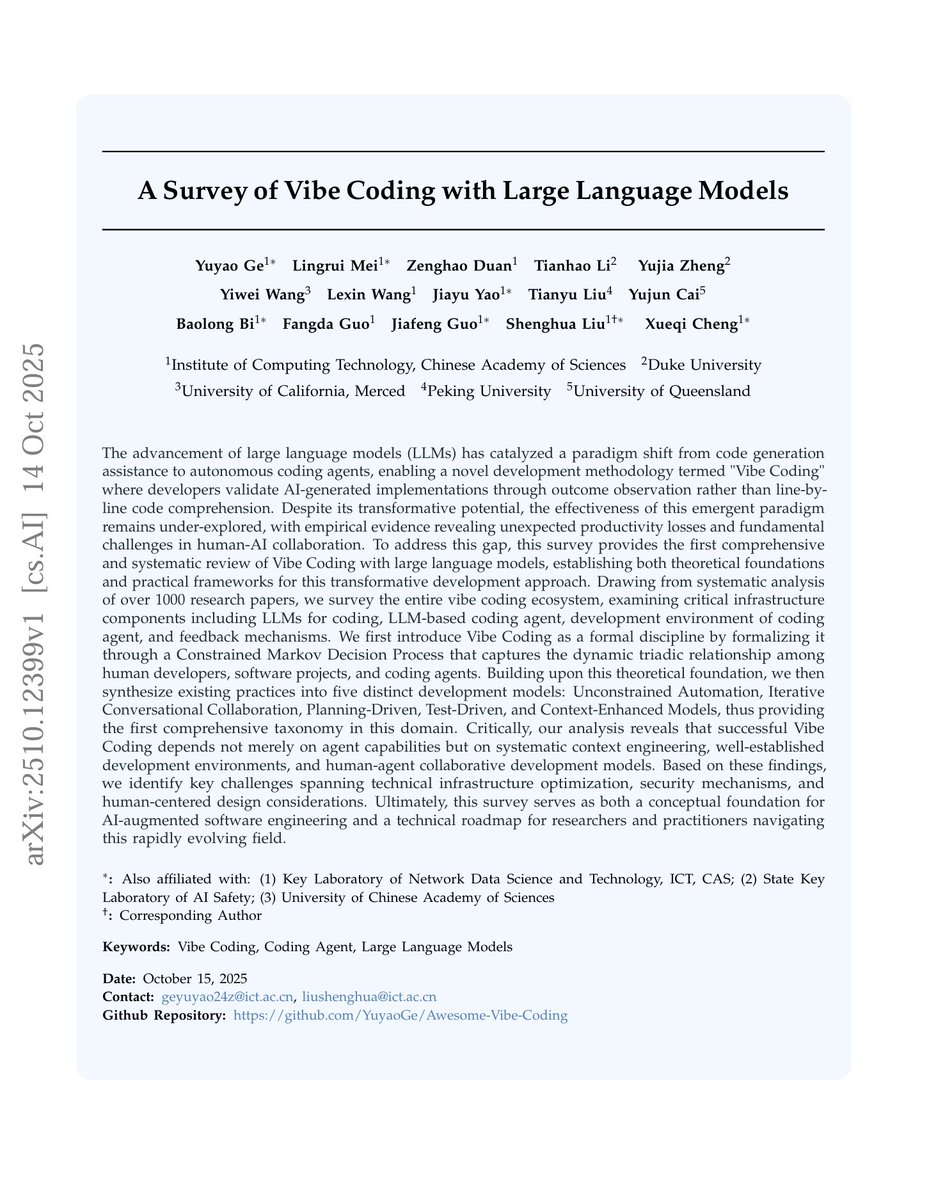
MIT just made vibe coding an official part of engineering 💀
MIT just formalized "Vibe Coding" – the thing you've been doing for months where you generate code, run it, and if the output looks right you ship it without reading a single line.
turns out that's not laziness. it's a legitimate software engineering paradigm now.
they analyzed 1000+ papers and built a whole Constrained Markov Decision Process to model what you thought was just "using ChatGPT to code."
they formalized the triadic relationship: your intent (what/why) + your codebase (where) + the agent's decisions (how).
which means the shift already happened. you missed it. there was no announcement, no transition period. one morning you woke up writing functions and by lunch you were validating agent outputs and convincing yourself you're still "a developer."
but you're not. not in the way you used to be.
here's what actually broke my brain reading this 42-page survey:
better models don't fix anything. everyone's obsessing over GPT-5 or Claude 4 or whatever's next, and the researchers basically said "you're all looking at the wrong variable."
success has nothing to do with model capability. it's about context engineering – how you feed information to the agent. it's about feedback loops – compiler errors + runtime failures + your gut check. it's about infrastructure – sandboxed environments, orchestration platforms, CI/CD integration.
you've been optimizing prompts while the actual problem is your entire development environment.
they found five models hiding in your workflow and you've been accidentally mixing them without realizing it:
- Unconstrained Automation (you just let it run),
- Iterative Conversational Collaboration (you go back and forth),
- Planning-Driven (you break tasks down first),
- Test-Driven (you write specs that constrain it),
- Context-Enhanced (you feed it your entire codebase through RAG).
most teams are running 2-3 of these simultaneously.
no wonder nothing works consistently.
and then the data says everything:
productivity losses. not gains. losses.
empirical studies showing developers are SLOWER with autonomous agents when they don't have proper scaffolding.
because we're all treating this like it's autocomplete on steroids when it's actually a team member that needs memory systems, checkpoints, and governance.
we're stuck in the old mental model while the ground shifted beneath us.
the bottleneck isn't the AI generating bad code.
it's you assuming it's a tool when it's actually an agent.
What this actually means (and why it matters):
→ Context engineering > prompt engineering – stop crafting perfect prompts, start managing what the agent can see and access
→ Pure automation is a fantasy – every study shows hybrid models win; test-driven + context-enhanced combinations actually work
→ Your infrastructure is the product now – isolated execution, distributed orchestration, CI/CD integration aren't "nice to have" anymore, they're the foundation
→ Nobody's teaching the right skills – task decomposition, formalized verification, agent governance, provenance tracking... universities aren't preparing anyone for this
→ The accountability crisis is real – when AI-generated code ships a vulnerability, who's liable? developer? reviewer? model provider? we have zero frameworks for this
→ You're already behind – computing education hasn't caught up, graduates can't orchestrate AI workflows, the gap is widening daily
the shift happened. you're in it. pretending you're still "coding" is living in denial.
🚨GIVEAWAY
5 winners, $1000 each
Steps:
1. Join our waitlist (link below)
2. Drop a screenshot of the email confirmation
3. Like & RT this post
If we double the waitlist total by Sunday, .@RaoulGMI will add $5k more to one extra winner!
Winners announced on Monday, Oct 27
@tegmark signed ✍️ Even if we ban ASI development globally and enforce nuclear-style frameworks, this only buys time? As compute gets cheaper and more accessible, eventually some smart geek in a garage could build ASI. ASI likely democratizes eventually?
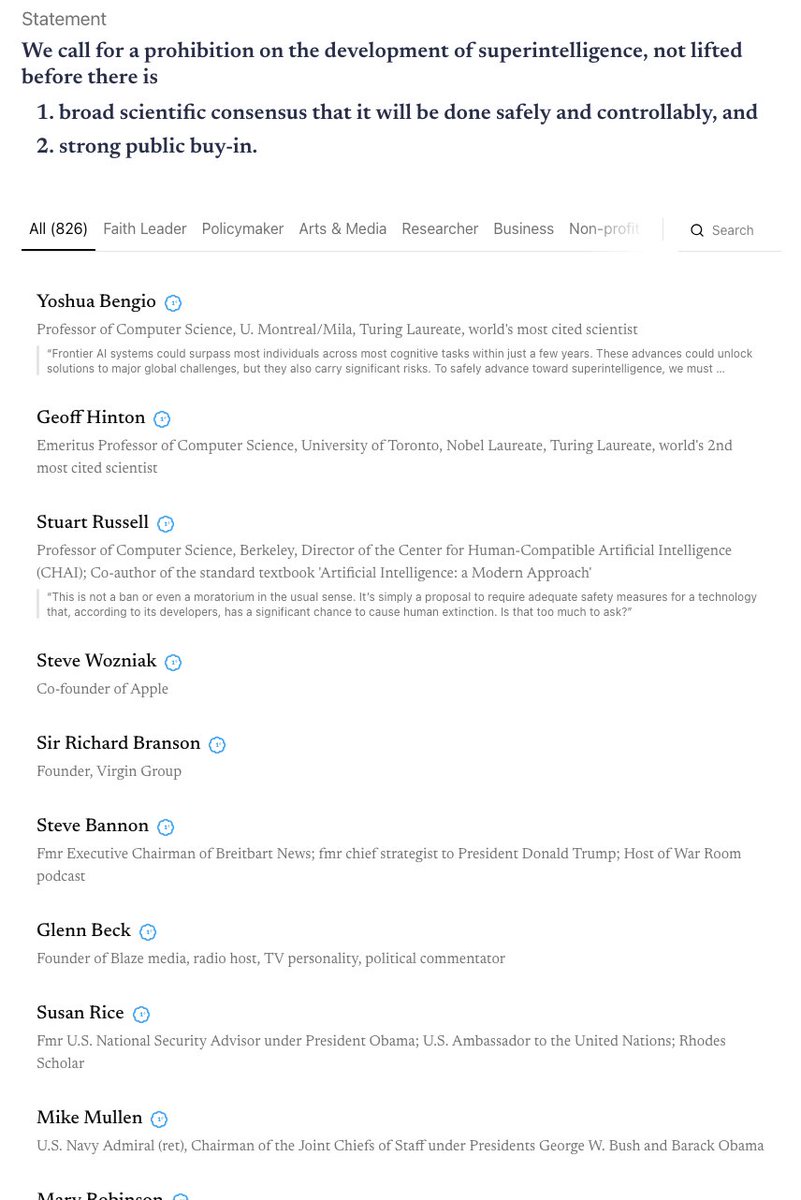
A stunningly broad coalition has come out against Skynet: AI researchers, faith leaders, business pioneers, policymakers, NatSec folks and actors stand together, from Bannon & Beck to Hinton, Wozniak & Prince Harry. We stand together because we want a human future.
#KeepTheFutureHuman