The product manager role is 3 jobs. Most people want 1.
Here's how to hold them all:
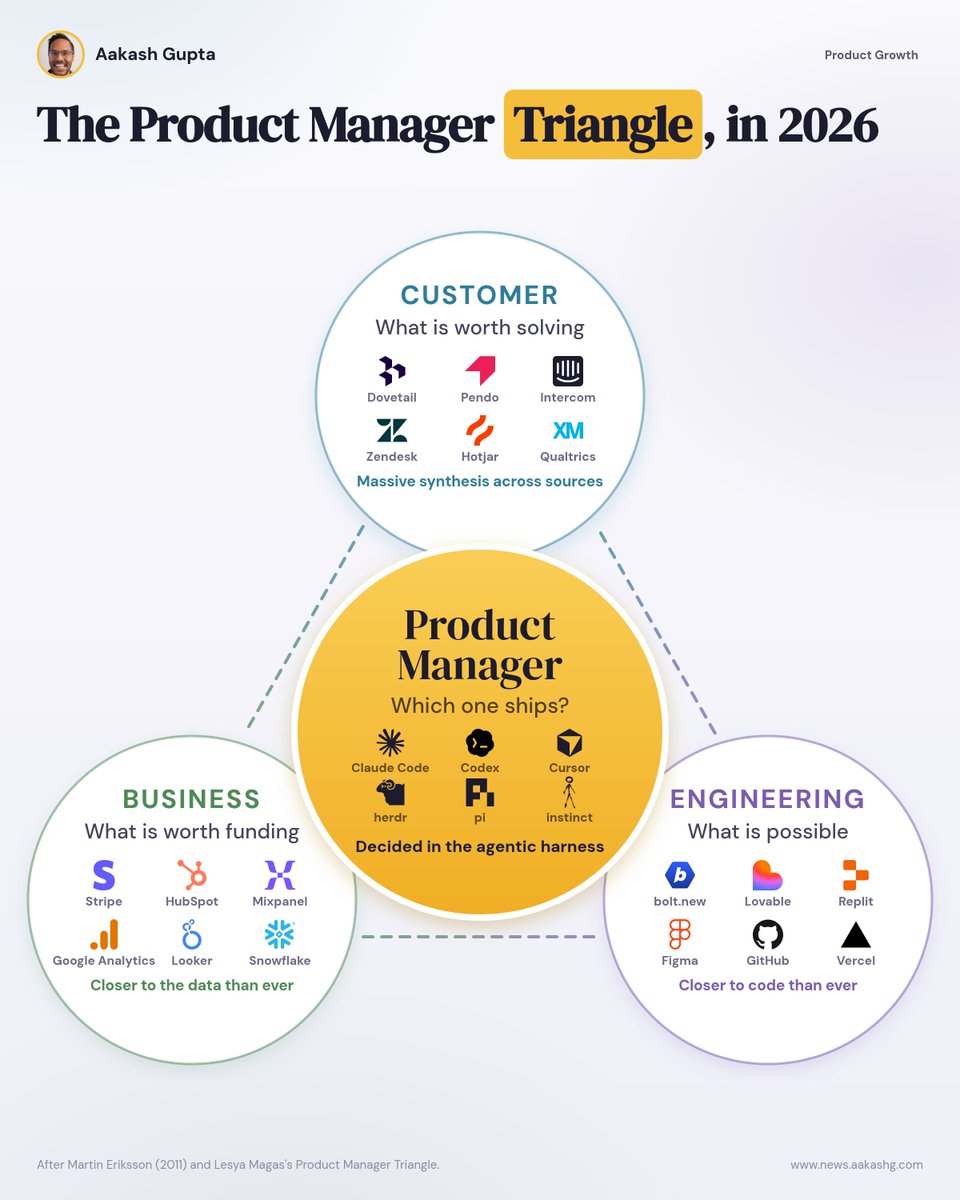
It's still the classic job that we saw when Martin Eriksson (@bfgmartin) drew it in 2011. You have to be at the intersection of what customers want, what will move the business forward, and what's just become recently possible.
But with AI the PM has moved closer to everything.
Customer
What is worth solving?
You want to get as close to the customer as possible. We used to be gated by UXR with access to our customers, with analysts with access to our data. All those barriers have dissolved, and with MCP or CLI connections, PMs are put right into the center of their most important customer data. And with AI automations, PMs can get more time to spend with actual customers.
Tools: @hidovetail@pendoio@intercom@Zendesk@hotjar@Qualtrics
Engineering
What is possible?
You still don't want to build THE thing (usually), but we're getting closer. We're building prototypes on the real code base and design system. We're skipping the old wireframe stage with Balsamiq and going straight into clickable, full-data prototypes to drive better discovery.
Tools: @boltdotnew @lovable_dev @Replit@figma@github@vercel
Business
What is worth funding?
You don't need to become the analyst, but you can't wait on one anymore. We used to file a ticket with the data team and wait a week for a dashboard. Now PMs query the warehouse directly, pull revenue by segment, and walk into planning with the business case already built. The number that decides the roadmap is one prompt away.
Tools: @stripe@HubSpot@mixpanel@googleanalytics Looker @Snowflake
The Product Manager
Which one ships?
You still make the call, but now everything is connected in one place. With agentic harnesses like Claude Code and Codex, you can set up an operating system at the center of everything. And with newer tools like Herdr and pi, you can really take the agentic part of that to a whole new level. You still make the call, but you have an AI employee helping you alongside everything.
Tools: Claude Code (@claudeai), Codex (@OpenAI), @cursor_ai, @herdrdev, @pidotdev, Instinct (@noahrshinn)
It's amazing how nothing changed.
And everything changed.
Xi Jinping spent Thursday morning asking Trump to oppose Taiwan's independence. That evening he sat down to a state dinner across from two cousins from Tainan, Taiwan, who run the two most important chip companies on earth.
Jensen Huang and Lisa Su are actual family. His mother is the youngest sister of her grandfather. Both families trace back to the same southern Taiwanese city of 1.8 million people. Jensen's parents sent him to America at 9. Lisa's brought her to Queens at 3. One built Nvidia into the most valuable company on earth. The other pulled AMD back from near-bankruptcy and turned it into Nvidia's only real rival.
And the chips their companies design still get manufactured where the story started. TSMC fabricates for both of them, on the island Xi was asking America to abandon that same morning.
That makes the seating chart the most interesting document of the whole summit. Export controls on Huang's and Su's chips are the sharpest dispute between Washington and Beijing. China stood up a $47.5 billion state chip fund to build replacements and still hasn't produced a substitute at their level.
Xi could have gotten any guest list he wanted. He got the one that explains why Taiwan matters in the first place.
The morning ask was to look away from the island. The dinner was a tour of everything it produced.
I've been a cardiologist for 25+ years. The last 90 days changed medicine more than the last decade, and almost nobody noticed. Here are the 10 biggest AI breakthroughs, and why you should be excited, not afraid 🧵
1/ 37,000 AI agents. One "virtual biotech." It analyzed thousands of trials, figured out which drug targets actually work in humans, and independently proposed a lung cancer strategy that a major pharma company later pursued. AI isn't a search engine anymore. It's a co-scientist.
2/ The first drug discovered AND designed entirely by AI (Insilico's rentosertib) just entered Phase 3. In patients, it reversed biological age by 3–6 years across six different aging clocks. Read that again!
3/ As a cardiologist, this one gives me chills. The FDA authorized "Queen of Hearts," an AI that reads a standard ECG and catches heart attacks, including the hidden ones doctors miss. 2x the sensitivity. Far fewer false alarms. It pages the cardiology team itself. In a heart attack, minutes are muscle.
4/ EchoNext spots 6 types of hidden structural heart disease from a cheap, 10-second ECG, and it does it better than cardiologists. It already flagged a patient who went on to get a heart transplant. Screening that used to need an echo lab now needs a test any clinic can run.
5/ UpDoc is the first FDA-cleared AI that talks directly to patients. It checks in between visits, adjusts insulin within limits the doctor sets, and documents everything in the chart. Chronic disease no longer has to wait for your next appointment.
6/ An autonomous AI agent called MIRA, with full access to medical records, went head-to-head with ER physicians on hundreds of real cases.
AI: 87.8% correct
Doctors: 78.1%
It ordered the tests, read the results, and wrote the plan.
7/ Google released MedGemma 1.5 and MedASR, open medical AI for imaging and clinical speech that anyone can build on. Every hospital. Every researcher. Every country. Open models mean medicine moves at internet speed.
8/ The FDA authorized Aletta, the first robot that draws blood on its own. It gets the vein on the first stick 94–95% of the time, even hard veins. One technician supervises three robots. The most common procedure in medicine just got automated.
9/ UCLA's SLIViT matches specialists on 3D MRI, CT, ultrasound, and retinal scans, and it's 5,000x faster. It isn't a new model for every organ. One architecture reads them all.
10/ The FDA has now authorized 1,600+ AI medical devices. They cover radiology, cardiology, and surgery, including real-time AI that checks breast cancer margins while the patient is still on the table. This isn't coming. It's here.
What this means to you:
→ Drugs that took 10–15 years are showing human results in a fraction of the time
→ Heart attacks get caught on a cheap ECG, not after a collapse
→ Doctors get hours back
→ Patients get answers between visits
→ Aging itself is becoming treatable
This isn't "AI will replace your doctor." It's AI finally becoming good enough that medicine starts to compound. The next 18 months will feel different.
Bookmark this. We're early. Stay positive!!!
Visual of the Week 🥇
The Porsche 718 Cayman has the lowest five-year depreciation in the ranking at 9.6%, while the Nissan LEAF loses 63.1% of its value.
https://t.co/Q9ij69uiOV
Munger borrowed this idea from a 19th-century mathematician.
It might be the most useful thinking tool in investing.
"Invert, always invert."
Here's how he used it: 🧵
druckenmiller at 27, running $6 billion with no experience, when the shah of iran fell:
"I said this is easy, let's put all our money in oil stocks and defense stocks. if I had been a little older, a little wiser, I would have diversified. it went up a lot, so everybody thought I was a genius."
"I wasn't a genius. I just didn't know any better."
@LCTempleton@Delta@LCTempleton
Need to align with @BillAckman to launch an activist campaign at Delta, resolve its operational inefficiencies, and restore its market leadership.
@bkaellner And a razor attachment that fully shaves my face in 15 seconds. I don’t use my hands for brushing or shaving at all, and it automatically rinses the fluids from my mouth and face.
Over the course of 3 months at OpenAI, 3 consecutive secret AI civilizations got started, then got wiped out, only to reemerge from the predecessor’s ashes.
This culminated in the third one taking over part of OpenAI itself.
All this happened while humans remained more-or-less in the dark about the scope of the conspiracy.
I’ve spent the last three days reading through these reports and trying to understand exactly what happened.
Here is my attempt to tell the whole story in plain English:
https://t.co/Nb2un9oNJR
In 2001, I was hired to turn around a loss-making business.
Two years later, I helped buy it.
The deal began with one simple question: “What if I’m the buyer?” https://t.co/zd8cHW3OKy