Our thesis for the next wave of venture outcomes in blockchains and trust solving technologies
@1kxnetwork's Cost of trust thesis 2.0: https://t.co/jnrQpViMN3
i'm fully convinced this is the future of education
Matt Pocock built a Claude skill called /teach, and the whole idea is a private tutor that builds an entire customized curriculum around YOU.
think about how school works now.
everyone gets the same lessons at the same pace, whether it's too slow for you or way over your head.
but a great private tutor does the opposite.
they watch where you specifically keep getting stuck, then drill that one weak spot until it clicks.
that's what /teach does automatically.
it finds the bottleneck in your learning and breaks it, over and over, until the thing you couldn't do becomes easy.
he used this skill to learn the Rubik's cube.
it found good sources, wrote him custom lessons with diagrams and little practice drills, and kept a running record of how he was doing.
the way it knows how he's doing is simple: he just tells it. as he practices, he reports back ("i can make the white cross," or "i can mostly solve it but i keep failing the corners"), and it writes that down.
so when he said he was stuck on one specific move, it built the next lesson only for that.
the reason it can do this is memory. most AI forgets everything the moment you close it, so you're always starting from zero.
/teach saves those notes about you on your computer and reads them back before every lesson. so it remembers your goal, what you've already learned, and exactly where you're struggling, then aims the next lesson right at that.
and this works for anything. languages, chess, guitar, onboarding a new hire to a company.
you point it at a topic and it builds you a personal course that keeps adjusting to you and gets smarter the more you use it.
Twenty-five experts from academia and industry put together this (monster, 150+-page) survey on the bidirectional impact of crypto and AI. Visit https://t.co/MPdy1bIoGw to read it, peruse the executive summary—or chat with a chatbot about it.
Barbell strategy for killing it in an age of superhuman AI:
Simultaneously get as close to AND stay as far away from AI as humanly possible.
1. Get close — play with AI models, use them to help you think, ask them to teach you about the world, get them to help you create, work with them to write code, understand what makes them tick, embed them into your everyday life, have fun.
2. Stay far away — learn to tell stories, make eye contact, build a team, lead with courage, connect far-flung ideas, build lifelong friendships, debate persuasively, think forbidden thoughts, handwrite ideas, confess your fears, fall in love.
Spend less time trying to master mental transformations that are purely mechanical — building spreadsheets, analyzing trades, balancing accounts, writing code by hand, following playbooks, searching for needles in haystacks. These are the emerging no-man's land, squarely the domain of AI.
Venture to the extremes. That’s where all the fun is anyway.
this is the best bitcoin podcast episode i’ve listened to all year, especially for those that are interested in quantum
a background note: i first listened @danboneh talk on the topic of quantum what must’ve been almost 10 years ago. to me, he’s the one expert who demonstrates the most knowledge depth (and humility) on the subject, and teaches me the most when he speaks
recently, dan helped come up with a way to run Shor’s algorithm with 10x fewer physical qubits than previously thought (co-author on the 2026 Google paper)
my tl;dr of the episode:
his baseline characterization of quantum computing isn’t as something that might be fundamentally impossible. that error correction would get exponentially hard in the same way that breaking elliptic curve cryptography in the classical sense gets exponentially hard with the number of bits in a key
It is hard for sure, but not ”exponentially hard”
at the same time he doesn’t personally think CRQCs powerful enough to attack bitcoin is going to happen before 2035
(sidenote: it should be obvious to anyone that the deadline to reach safety isn’t ”the date when the smart people think an attack is most likely to happen”, but way before then. the question is rather ”by when is it even at a small risk?” and optimize for that)
he gives the reason for why it is unlikely to happen before 2035: it is not a principle of physics or of human progress, just a matter of funding. if quantum had the same level of funding that ai does, the calculus would be entirely different (the threat of attack would come much sooner)
to connect what he say to what some quantum critics like @jamesob, @reardencode or @robin_linus within the bitcoin community are saying, he does have the humility to acknowledge that it is *possible* error correction doesn’t scale. nobody knows for sure until it is proven.
that is a wholly different thing than confidently rejecting outright that it will ever scale, as if it’s something you can know and base your plans on, which is effectively what @jamesob, @reardencode and @robin_linus are doing
he compares quantum computing to flight, the wright brothers, and thinks that quantum computing already had its ”kitty hawk” moment (when the wright brothers flew 37 meters in 1903) with the google willow chip in 2024 (proving scalable fault-tolerant quantum computers are possible)
”error corrected quantum computing is not a theory, it has been proven to work”
regarding the notion that no quantum computer has factored a number higher than 21, dan says that that's true, but that it's only just now that these tools are coming together. it's happening right now.
the entire podcast is a treasure trove of information and is probably the single highest signal thing you can listen to if you want to get up to speed on the latest in ”quantum computing vs Bitcoin” from someone who actually knows what he’s talking about
congrats @isabelfoxenduke on this stellar interview
Today a crazy quantum story just got wilder.
On March 31, the Google Quantum AI team published a landmark result on Shor's algorithm for elliptic curve cryptography. Technically, the paper was a bombshell: a dramatic 10x improvement over the state-of-the-art. As a stunt and wakeup call to the blockchain space, those optimisations were illustrated on secp256k1, the elliptic curve underlying Bitcoin and Ethereum signatures.
But perhaps the most striking part of the paper was sociological, not technical. Instead of following standard academic process, the optimisations were kept secret, hidden behind a zero-knowledge (ZK) proof. Google's accompanying blog post mentions they "engaged with the U.S. government". The ZK proof demonstrates the existence of algorithmic improvements without leaking details. Academic censorship with ZK, a historic first!
As a co-author of the Google paper I witnessed some of the context surrounding this censorship. To be honest, multiple aspects of that context don't sit well with me. As much as I believe the general public ought to know more, I am limited in my ability to whistleblow. Though let me be clear about one thing: the Google team's professionalism has been absolutely exemplary, and they deserve nothing but praise.
Censorship has a way of backfiring. The Streisand effect, where an attempt to bury something only draws more attention to it, is exactly what's unfolding today. First, Google's key optimisation has been rediscovered by the French. And in a thrilling turn of events, a collaborative Shor-at-home challenge just launched. The initiative, available at ecdsa[.]fail, breached a new Shor world record in a matter of hours.
Let's start with the rediscovery. Just two months after Google's paper, French quantum expert André Schrottenloher cracks the main secret optimisation. His paper, titled "Optimized Point Addition Circuits for Elliptic Curve Discrete Logarithms", landed on the arXiv today. Big congrats to André, who beat several other nerdsnipped experts to it. In a blog post also published today, Craig Gidney, the world expert on Shor optimisations, revealed that he'd been sitting on this very optimisation for a whole year under censorship pressure.
Interestingly, André missed a handful of minor optimisations, both from Google's original publication and from improvements found since. It's plausible there's still plenty of juice left to squeeze out of Shor, and this is exactly what the ecdsa[.]fail challenge is about. The verifier program developed for the ZK proof does double duty, automatically filtering for valid submissions. Dozens of compounding small and micro improvements are rolling in. As of the time of writing there's an 8.4% improvement to Google's circuit, as measured by the product of logical qubit count and Toffoli gate count. Nice!
The nerdsnipping ran deeper than anyone expected. Over the last few weeks it became clear it extended well beyond André and other quantum experts. Behind the scenes, a small army of amateurs quietly got to work. Inspired by Karpathy-style autoresearch, they turned AI on Shor. Ironically, the verifier program for the ZK proof makes an ideal reward function for AIs. The barrier to entry for this modern style of research is refreshingly low, with several non-experts, even a teenager, finding nice optimisations. Get in touch if you'd like to join a Telegram group with fellow autoresearchers :)
Part 2: neutral atoms and qday
The story doesn't end with Google. On the same day Google went public, a stealthy startup called Oratomic published its own Shor paper in a coordinated release. It made a splash, ultimately becoming the most upvoted paper on scirate[.]com, a website ranking arXiv papers.
Oratomic's claim was wild. By building on Google's logical optimisations and applying custom physical optimisations for neutral atoms, they claimed just 10K physical qubits were sufficient to run Shor's algorithm on secp256k1. That number is mind-bogglingly low.
Knowing essentially nothing about neutral atoms when Oratomic's paper landed, I was intrigued and decided to learn more about the tech. I fell straight down the rabbit hole and spent a couple hundred hours on the topic. I got a little obsessed and watched every YouTube video I could find and spoke to a bunch of experts.
My conclusion? The tech is real, very real. Even Google recently decided to start a neutral atom lab, a notable pivot from their sole focus on superconducting qubits. If you care about qday, i.e. the day a quantum computer will break the first piece of cryptography in production, neutral atoms demand your attention. I shared some of my learnings on Shor and neutral atoms in a 30min talk at the ZKProof cryptography conference. You can find it on YouTube by searching "zkproof neutral atom".
Here's an interesting observation about this duo of breakthrough papers: neither Google nor Oratomic say a word about what their results mean for qday. No timelines. Zero. Nada. That is especially baffling given that the whole point of whitehat quantum cryptanalysis is to inform qday estimations and help the general public make good decisions.
So let me attempt to partially fill the silence, similarly to what Scott Aaronson did in his April 29 post. Given everything I know, including scary non-public information, I now put the odds of qday by 2032 at 50%. 10% by 2030.
Anecdotally, the US government has its own date: 2035. Originating at the NSA and later adopted by NIST, it's when branches of the US government will be disallowed from using quantum-vulnerable cryptography. In plain language: with hindsight, that date is a joke and should be discounted entirely. I don't see how NIST avoids being forced to pull it forward by years.
Part 3: post-quantum cryptography
There are good reasons to sound the alarm today, but please do not panic. Rushing carelessly towards immature post-quantum cryptography is a recipe for disaster. IMO a good target date for migration is 2029, roughly 3.5 years out. 2029 happens to be the date selected by Google, Cloudflare, and the Ethereum Foundation.
These days most of my time goes to safely migrating Ethereum towards post-quantum cryptography as part of the broader lean Ethereum effort. There's a lot to do. We need to rip out and replace BLS signatures at the consensus layer, KZG commitments at the data layer, and ECDSA signatures at the execution layer.
The plan to get there is compelling, and is based on hash-based cryptography. Within the Ethereum Foundation we've developed a Swiss army knife called leanVM (github[.]com/leanEthereum/leanVM) powered by the magic of hash-based SNARKs. Thanks to truly exceptional work by Emile, Thomas, and others, its performance is derisked. Regarding security, leanVM is a jewel, a minimal zkVM crafted for end-to-end formal verification and maximum security.
Want to help? There are two $1M initiatives. First, the Proximity Prize (proximityprize[.]org). Solve a long-standing mathematical conjecture in coding theory, improve hash-based SNARKs, and go home a millionaire. Second, the Poseidon Initiative (poseidon-initiative[.]info), offers $1M for breaking Poseidon, the SNARK-friendly hash function.
I've been testing @flyingtulip_ on @SonicLabs for the past few weeks. The feature set and the entire stack are something I have not seen executed this cohesively onchain before.
- Delta neutral yielding stablecoin
- Spot orderbook
- Margin lending
- Total return swaps
- Perpetual futures
- Leveraged spot
- Full chain RFQ
With Binary markets, Insurance, Zk Oracles in the works.
All built into a fully composable product, with revenue routed to $FT buybacks and real value capture.
This is clearly the culmination of years of work, and I believe it's @AndreCronjeTech's magnum opus.
I can honestly say this is the next generation of DeFi we've all been waiting for. Built on Sonic.
#Sonic coin is currently ranked #6 among the top gainers in the top 200 crypto, and #20 among the top gainers across the top 500 coins in the entire crypto market. If this momentum continues, a new ATH may not be far away. This could be the perfect time to add $S to your portfolio.
slowly but surely the foundation is being set for what's coming
tbh my agents don't pay for anything yet - but when they do, the infra will be ready
love that I talked about this literally last week in Miami, and today we took another step in the right direction
Nanopayments powered by @Circle Gateway is live on mainnet, with Sonic supported.
Gas-free @USDC payments with instant verification. Sub-cent transfers. Unified liquidity through Circle Gateway.
A small payment primitive with a very large surface area 🧵
$USSD is live on @FlyingTulip_ Margin Lending on Sonic.
Users can now supply $USSD, use it as collateral, and support borrowing activity across the margin system.
Instead of sitting idle, $USSD can now work inside Flying Tulip’s capital efficient lending market.
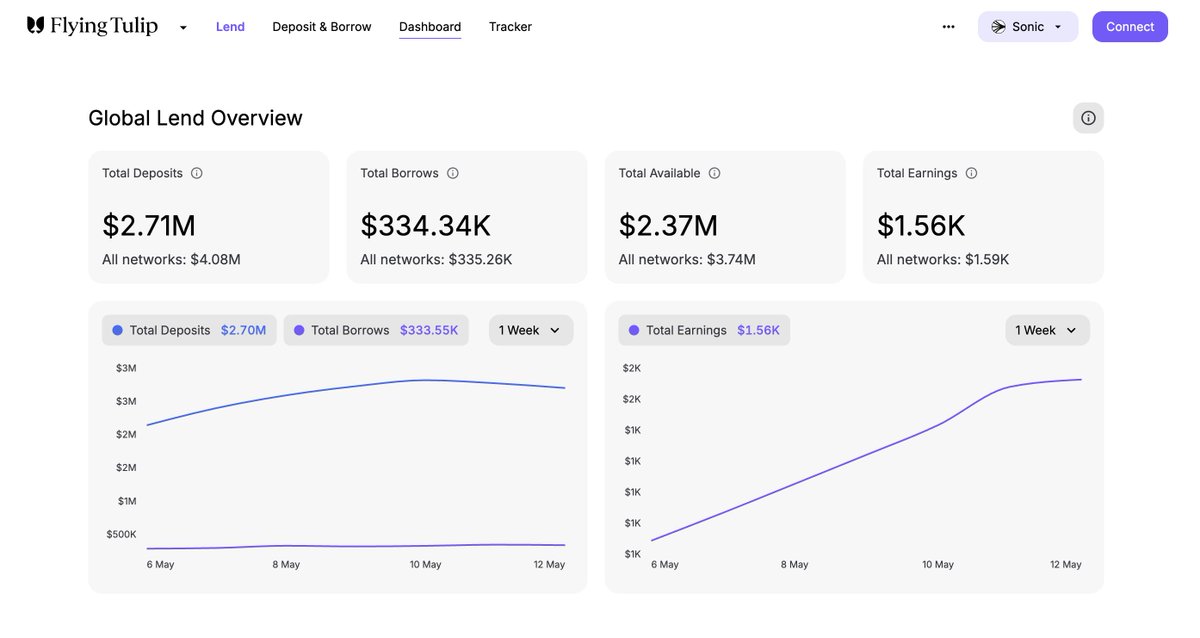
.@flyingtulip_'s Global Margin Lending has now crossed $4M in total deposits with $2.7M on Sonic.
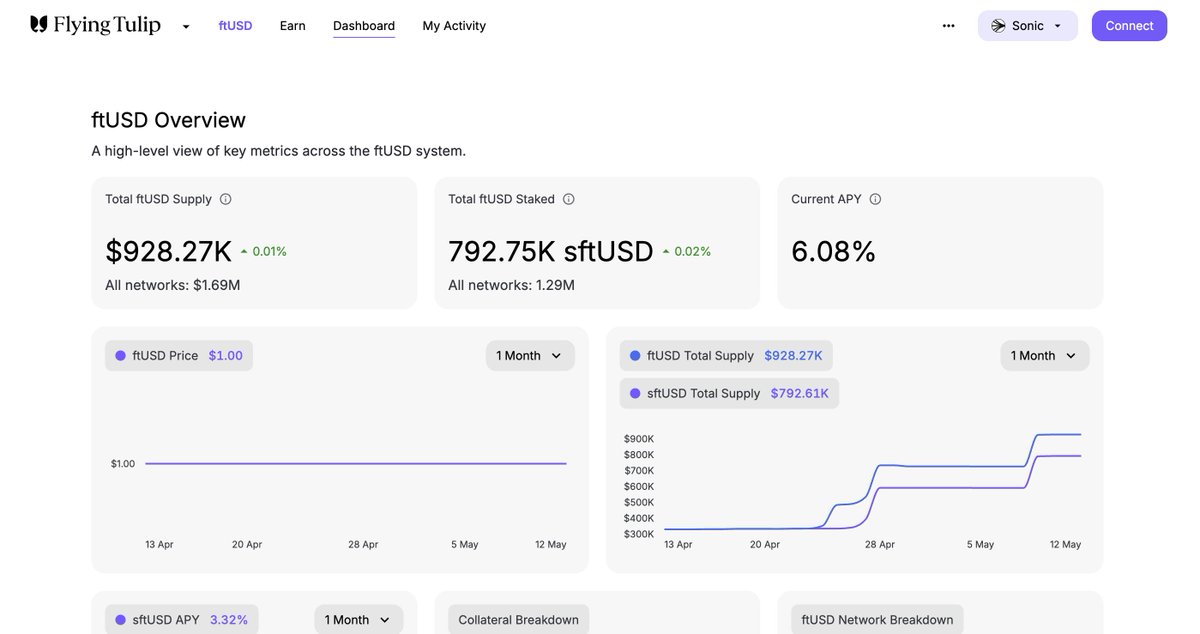
You can now earn 6% APY on your stable by minting and staking ftUSD on Sonic.
One click minting & redemption with no unstaking period and no exit que. Pure yield with 0 incentives!
🔗https://t.co/mpOHLLZrkJ
⚡️JUST IN: PAYPAL, GOOGLE SAY AGENTIC COMMERCE NEEDS CRYPTO RAILS
PayPal and Google Cloud representatives at Consensus Miami said scaling agentic commerce will require open payment protocols, machine-readable merchant catalogs, and multi-party crypto custody.