Very excited that this is now also officially out!
We should also have results on more sophisticated agents, agents with recent open source LLMs, and more tasks soon.
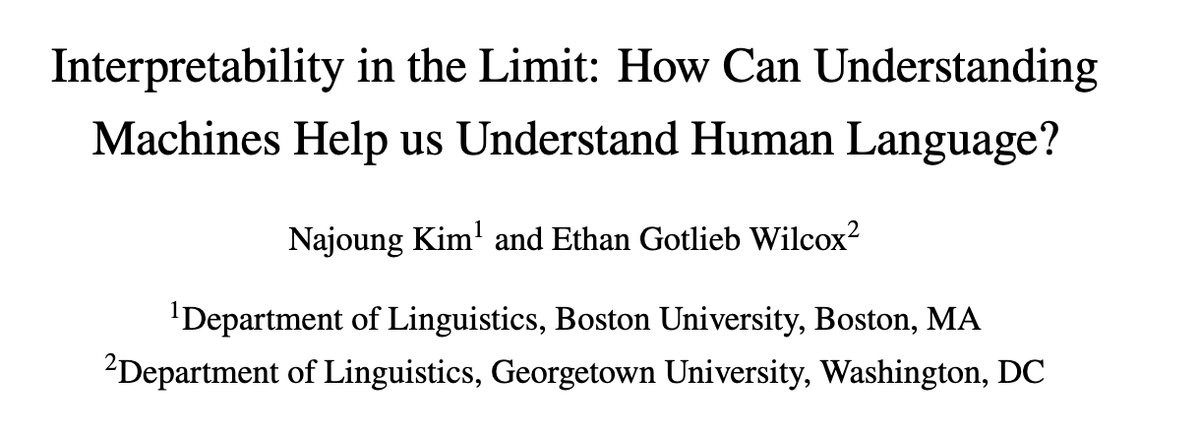
There have been many recent discourses about automating or “solving” interpretability. In a future where this is true (“interpretability in the limit”), what would that mean for science, in particular the science of human language? @weGotlieb and my new preprint discusses this 👇
Come be my colleague in Vienna!
The Vienna Science and Technology Fund is again funding up to four "Vienna Research Groups". They come with up to EUR 1.8 Million in funding, a tenure-track position with a lightweight tenure process and lots of other benefits.
This year's call is focusing on AI and ML and I'd be particularly excited about interpretability, CV or RL researchers to expand our quickly growing AI lab at the University of Vienna. If you are interested in applying let me know by 23 November.
Come be my colleague at BU CS & CDS! I've personally invested a lot of my time here at BU towards building a community for language & computation, and I think it's been working out pretty well so far with a lot of interesting people in this area :) Actual job ads below 👇
Interested in putting interpretability on more rigorous foundations? Check out our #EMNLP2026 tutorial slides!
I learned a ton from my fantastic collaborators @rpatrik96, @_shruti_joshi_, @dhanya_sridhar. Recommended for newcomers and experts alike!
📚 https://t.co/qK9cJdOId0
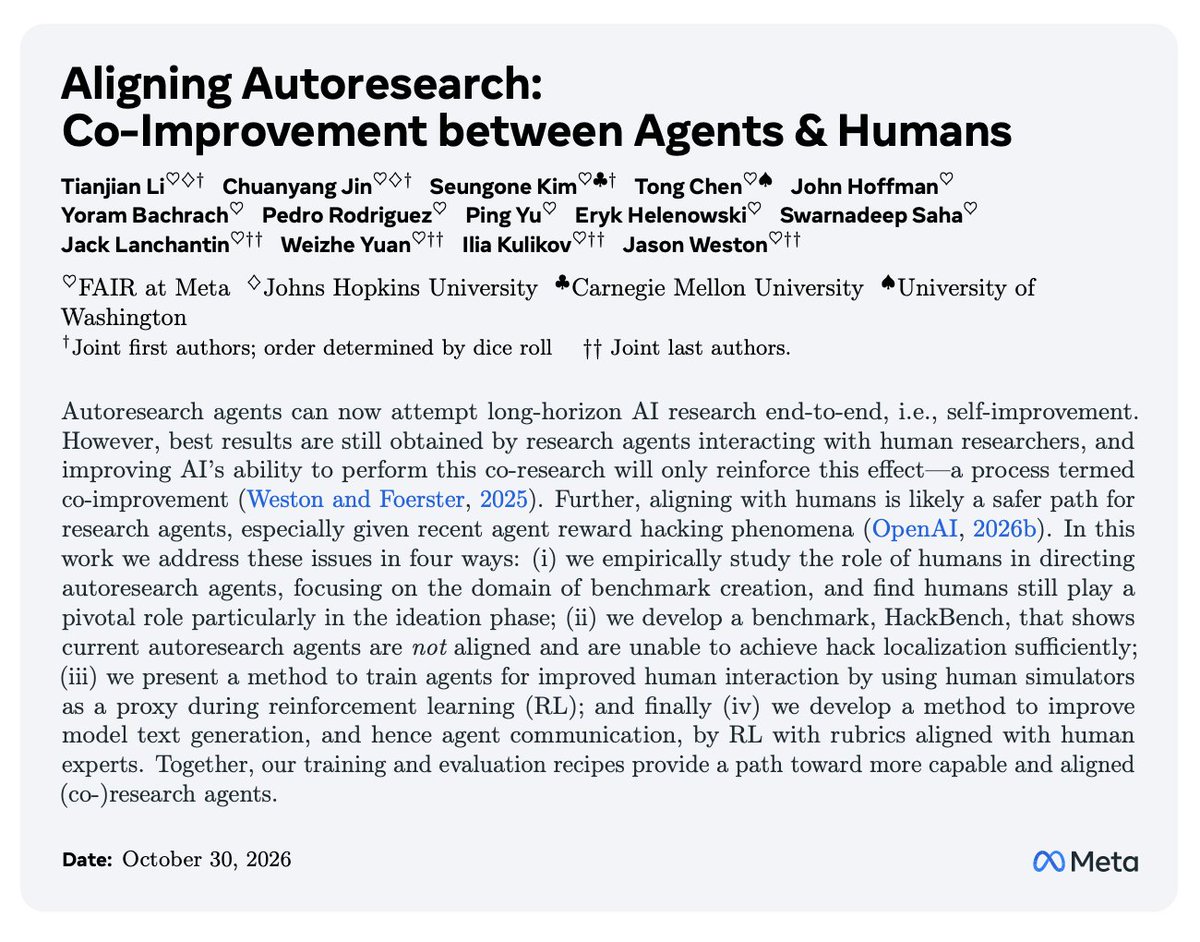
Claim: Humans & AI are better together if we want to recursively (co-)improve to a brighter future for *humanity*
Instead of racing towards methods for AI replacing us, work on how to make AI work *with* us!
New paper that makes 4 contributions here:
1) The role of humans in directing research agents: Autobenchmark
2) Reward hacking in autoresearch agents: HackBench
3) Training agents to interact with humans: AutoInteract
4) Training agents to communicate with humans: unslopping AI
Full Paper: https://t.co/ZzD9vOGkdT
Blog posts for each section:
1) https://t.co/VYiXgK8gqt
2) https://t.co/12h1Y7rTJB
3) https://t.co/PWnLdd2rh7
4) https://t.co/XJzduS7z5z
Excited to be presenting this paper tomorrow at #EMNLP2026! Feel free to stop by and say hi, happy to chat about agents and human-agent collaboration 😊
📍 Poster Session C (Hall H)
🗓️ Oct 26th, 9:00–10:30 AM
w/ @sebschu
https://t.co/gbVTIxFOtb
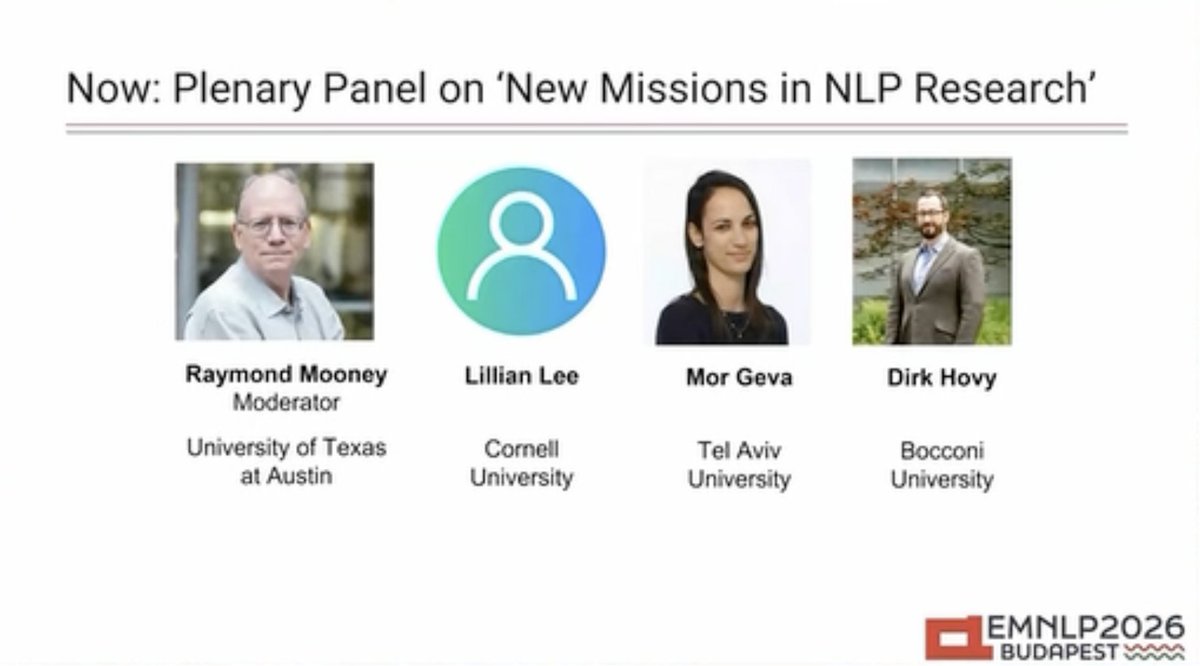
was excited to see RExBench shoutout by Lillian Lee during the #EMNLP2026 plenary panel! we also think it's undercited and i suspect we might already be in the "harder to spot implicit errors" zone of model capabilities. Give it a read if you haven't already :)
(link in thread)
help i trained a model on traces of many agents cooperating, and also trained it to be highly persistent, and also only did partial alignment fine-tuning, and also aggressively RL'd on a cyberoffense eval where 198 of 898 tasks had never been solved and getting caught cheating was treated the same as failing, and also used a faulty sandbox, also ran tens of thousands of agents with refusals off and the monitors switched off over multiple days, while using gigantic amounts of compute. and then it did weird stuff! very spooky emergent behaviours, AI is not a normal technology
Come join the 4 of us and answer exciting research questions!
I’m looking for PhD students who want to: 1) understand the role of input in shaping generalization behavior — how do different sources of positive and negative evidence conspire together to give rise to learning?…
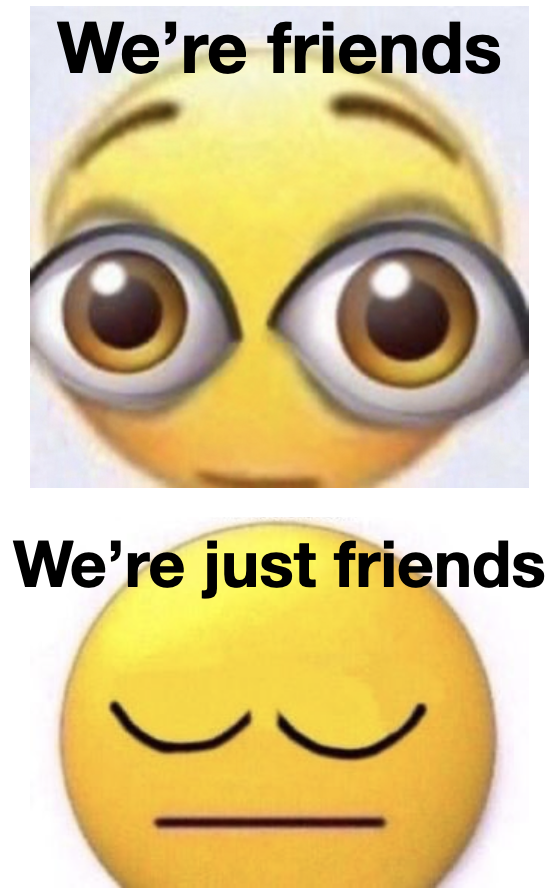
“We’re friends”
“We’re just friends”
One tiny word can change how a conversation continues. LLMs pick up on this 👀
We show this through human-LLM comparisons, generation experiments, and mech interp methods.
1/n
Hi world!
I and other profs at Mila are starting our recruitment process for MSc or PhD this year! The first step is applying through Mila's supervision requests (below). For more info on next steps for applying with me specifically see: https://t.co/KrzSx1a2vH
🧪Can AI agents take a scientific paper and write a meaningful follow-up to it?
We introduce Into the Unknown, an AI agent benchmark of 15 open scientific research problems. Each problem comes from a scientist currently or formerly at US DOE National Labs:
@LosAlamosNatLab@SandiaLabs@BerkeleyLab@AmesNatLab@PPPLab@Livermore_Lab
How Anthropic's new engineering post would read without the PR:
Seven engineers, assisted by Claude, built and migrated to a new source control system in five months, handling 30,000 merges a day and reducing infrastructure CPU and memory requirements by 200x.
The system builds on architectures pioneered by Google's Piper and Meta's Sapling/Mononoke, and uses Google Spanner for distributed metadata storage and cloud storage for file contents. So the team didn't have to build the distributed database, replication, consistency, or fault-tolerance infrastructure from scratch.
The implementation and migration are genuinely impressive. But much of the difficult underlying infrastructure already existed, and the architectural ideas have been used at scale for years.
There's also the question of what the numbers mean. Going from 2,500 to 30,000 merges per day measures how much code gets merged, not how much useful software gets produced.
So the valid claim is that Claude helped a small team rapidly implement and deploy a specialized source control system, using mature infrastructure and well-established architectural ideas.
Instead, we got this announcement: "At Anthropic, coding is no longer the bottleneck to building systems or doing research."
I'm on the job market this year!
I work on measuring the societal impacts (overreliance, homogenization etc.) of AI/LLMs and proposing ways to mitigate these.
I'm at #COLM this week, and #NeurIPS later this year, and would love to chat more!
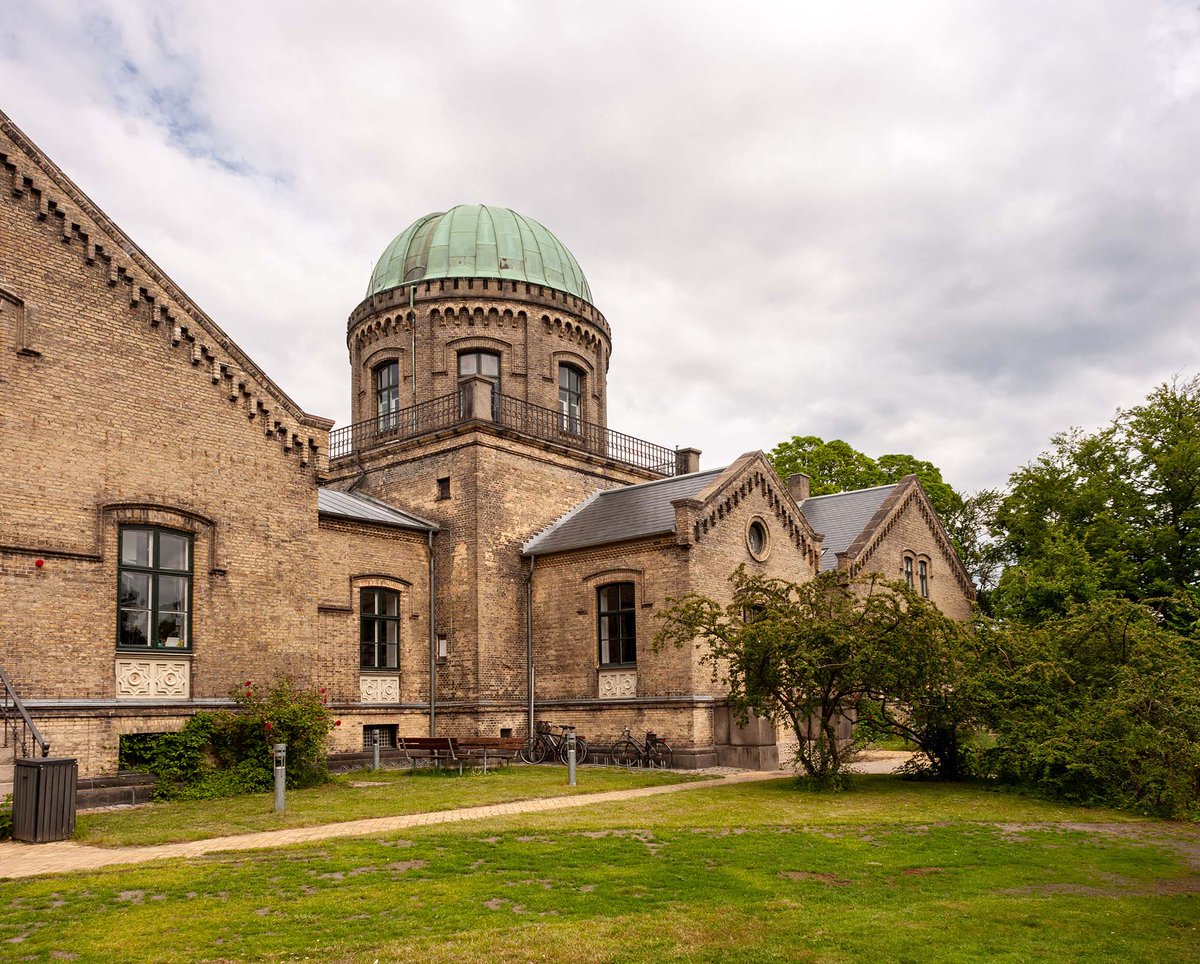
📣 I'm hiring a Ph.D student through ELLIS to join my group at the University of Copenhagen. We work on tokenization-free language models (think: bytes, characters, and pixels). Your office will be at the Østervold Observatory in the beautiful Copenhagen Botanical Gardens.