my weekend project to learn about bluetooth mesh networks, relays and store and forward models, message encryption models, and a few other things.
bitchat: bluetooth mesh chat...IRC vibes.
TestFlight: https://t.co/P5zRRX0TB3
GitHub: https://t.co/Yphb3Izm0P
Today, we release several Moshi artifacts: a long technical report with all the details behind our model, weights for Moshi and its Mimi codec, along with streaming inference code in Pytorch, Rust and MLX. More details below 🧵 ⬇️
Paper: https://t.co/mMInmjiBIC
Repo: https://t.co/PFak47FMrm
HuggingFace: https://t.co/bqG4IS0ntg
A few thoughts on a recent paper discussing the relationship between formatting constraints and performance for LLMs. It suggests that structured text generation decreases performance in reasoning tasks and seems to contradict earlier empirical results. How can that be? (1/n)
Jim Carrey once said
"Solitude is dangerous. It’s very addictive. It becomes a habit after you realise how peaceful and calm it is. It’s like you don’t want to deal with people anymore because they drain your energy.”
9 Things TO learn from
JIM CARREY - THE PHILOSOPHER
Nice, a serious contender to @lmsysorg in evaluating LLMs has entered the chat.
LLM evals are improving, but not so long ago their state was very bleak, with qualitative experience very often disagreeing with quantitative rankings.
This is because good evals are very difficult to build - at Tesla I probably spent 1/3 of my time on data, 1/3 on evals, and 1/3 on everything else. They have to be comprehensive, representative, of high quality, and measure gradient signal (i.e. not too easy, not too hard), and there are a lot of details to think through and get right before your qualitative and quantitative assessments line up. My goto pointer for some of the fun subtleties is probably the Open LLM Leaderboard MMLU writeup: https://t.co/Ns1hfEct4k
The other non-obvious part is that any open (non-private) test dataset inevitably leak into training sets. This is something people strongly intuitively suspect, and also why this GSM1k made rounds recently
https://t.co/0jzJNb2SXK
Even if LLM developers do their best, preventing test sets from seeping into training sets (and answers getting memorized) is difficult. Sure, you can do your best to filter out exact matches. You can also filter out approximate matches with n-gram overlaps or so. But how do you filter out synthetic data re-writes, or related online discussions about the data? Once we start routinely training multi-modal models, how do you filter out images/screenshots of the data? How do you prevent developers from e.g. vector embedding the test sets, and specifically targeting training to data that has high alignment (in the embedding space) with the test sets?
And the last component of this is that not all LLM tasks we care about are automatically evaluateable (e.g. think summarization, etc), and at that point you want to involve humans. And when you do, how do you control for all the variables involved, e.g. how much people pay attention to the actual answer, or the length, or the style, or how refusals are treated, etc.
Anyway, good evals are unintuitively difficult, highly work-intensive, but quite important, so I'm happy to see more organizations join the effort to do it well.
Over the past weeks the H4 team has been busy pushing the Zephyr 7B model to new heights 🗻
The new version is now topping all 7b models on chat evals and even 10x larger models 🤯🔥
Here are the intuitions on it
1/ Start with the strongest pretrained model you can find: Mistral 7B is amazing, by far the strongest 7B pretrained model. Props to the Mistral AI team 😍
2/ Scale human-preference annotations: several studies have show how for many tasks GPT4 is on-par with the average human annotators while making scalable annotations as easy as an API call: the H4 team started from the largest and most diverse public GPT4 preference annotation dataset: UltraFeedback 🤖🦾
3/ Drop Reinforcement Learning in favor of DPO (Direct Preference Optimization): while using LLM in RL is definitely much easier compared to the struggles of getting deep-RL to work from scratch, DPO totally remove RL from the preference annotation training and directly optimize the preference model in a much more stable training procedure in the H4 team's experiments
4/ Don't be scared of overfitting on preference dataset: This is maybe the most counterintuitive results of the work. While the train/test loss of DPO training shows signs of overfitting on the feedback dataset after just one epoch, training further still show significant improvements on downstream tasks even up to 3 epochs without signs of performances regression. Would be interesting to dive even further in this surprising behavior
5/ Share everything openly 😁 the recipes, code, model and dataset will be available at https://t.co/qkKhS8eqvt
In the meantime the paper is a great starting point: https://t.co/qzZ0tb8Aq1
StackOverflow is laying off 28% of its workforce.
This may be the first large layoff directly due to AI:
> people asking ChatGPT instead of StackOverflow
> usage & ad revenue declines
> having to lay people off to stay profitable / survive
🧵On money 💵 and impact (and open-source)
Today, I presented @scikit_learn to entrepreneurs;
One CEOs was puzzled: "at the end of day, a company builds a product on top and captures the money".
Looking back, I could not dream of a better way to have an impact 1/5
Ce n’est pas que PowerPoint (et al.) soit un mauvais outil — bien au contraire — c’est surtout que la plupart des gens l’utilisent mal.
#Thread par @loiclemay
I described some of the most beautiful and famous mathematical theorems to Midjourney.
Here is how it imagined them:
1. "The set of real numbers is uncountably infinite."
#OpenAI is planning to stop #ChatGPT users from making social media bots and cheating on homework by "watermarking" outputs. How well could this really work? Here's just 23 words from a 1.3B parameter watermarked LLM. We detected it with 99.999999999994% confidence. Here's how 🧵
We are excited to announce the release of Stable Diffusion Version 2!
Stable Diffusion V1 changed the nature of open source AI & spawned hundreds of other innovations all over the world. We hope V2 also provides many new possibilities!
Link → https://t.co/QOSSmSRKpG
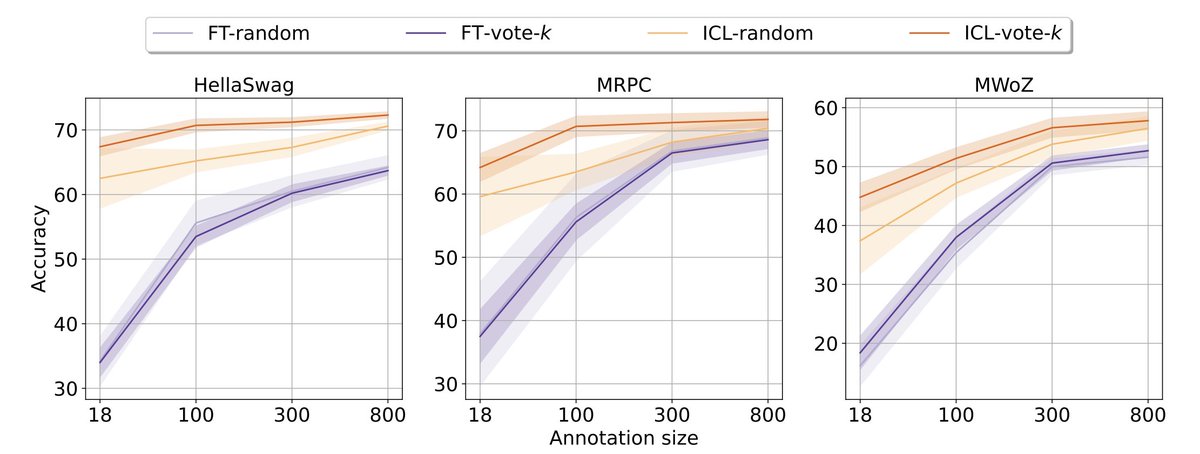
#NLProc: Stop annotating randomly-sampled data! Select-then-annotate to make language models better few-shot in-context learners (ICL)! 12% gain with GPT-3 etc over 10 tasks. 10x annotation efficiency. Different from the finetuning (FT) paradigm.
https://t.co/uCXMonSHRg
1/5
I continued exploring #stablediffusion's latent space over the weekend and oh my; there's still a LOT of treasure to be discovered inside this magnificent neural universe!
Here's a quick thread with some of my personal favorites and how I found them..