Excited to announce our $5.5 million raise @GovSignals.
We're building the best Government Contracting platform on the market. Super proud of our team and excited for the story ahead — let's redefine trillions in government spending.
If intersection of AI x Government is interesting to you, shoot me a DM.
Introducing GovSignals and announcing our $5.5 million dollar raise from @Unusual_VC!
Trillions of dollars every year are often going to large, non innovative incumbents. Yet infrastructure projects are falling behind & our national defense is at risk from our adversaries. Where is all the money going, and how do we bring the best solutions to government?
GovSignals is building to fix Government Contracting and bring the most innovative solutions back to America.
Great piece - "what Americans think of as traditional European architecture – marble neoclassicism – is actually characteristic of Washington in a way that it is not, and has never been, characteristic of any city of post-antique Europe"
https://t.co/qpcuCFiELn
Been using @sveltejs for a few projects lately, it's quite a nice alternative to React, fewer gotchas and complexity and Codex handles it really well. https://t.co/b2KdDvrpLD
Introducing MA-S2: Mission Assurance Security Standard for Software.
AI is accelerating vulnerability discovery. Adversaries are moving faster than any human team can respond.
Institutions need autonomous remediation, attack path modeling, and domain awareness.
The bar has changed.
MA-S2 is our proposed standard for software security — one we're actively working towards, and publishing as our responsibility to every enterprise that wishes to secure its own digital footprint and ecosystem.
Learn more: https://t.co/rpABCr5vVi
Ghostty is leaving GitHub. I'm GitHub user 1299, joined Feb 2008. I've visited GitHub almost every single day for over 18 years. It's never been a question for me where I'd put my projects: always GitHub. I'm super sad to say this, but its time to go. https://t.co/DQDemHdytV
Introducing Pods
Hyperspace Pods lets a small group of people - a family, a startup, a few friends, to pool their laptops and desktops into one AI cluster. Everyone installs the CLI, someone creates a pod, shares an invite link, and the machines form a mesh. Models like Qwen 3.5 32B or GLM-5 Turbo that need more memory than any single laptop has get automatically sharded across the group's devices - layers split proportionally, inference pipelined through the ring. From the outside it looks like one OpenAI-compatible API endpoint with a pk_* key that drops straight into your AI tools and products. No configuration beyond pasting the key and changing the base URL.
A team of five paying for cloud AI burns $500–2,000 a month on API calls. The same team's existing machines can serve Qwen 3.5 (competitive on SWE-bench) and GLM-5 Turbo (#1 on BrowseComp for tool-calling and web research) for free - the hardware is already on their desks. When a query genuinely needs a frontier model nobody has locally, the pod falls back to cloud at wholesale rates from a shared treasury. But for the daily work - code reviews, refactors, research, drafting - local models handle it and nobody gets billed. And when it is idle, you can rent out your pod on the compute marketplace, with fine-grained permissions for access management.
There's no central server involved in inference. Prompts go from your machine to your pod members' machines and back: all of this enabled by the fully peer-to-peer Hyperspace network. Pod state - who's a member, which API keys are valid, how much treasury is left - is replicated across members with consensus, so the whole thing works on a local network. Members behind home routers don't need port forwarding either. The practical setup for most pods is three models covering different jobs: Qwen 3.5 32B for code and reasoning, GLM-5 Turbo for browsing and research, Gemma 4 for fast lightweight tasks. All running on hardware you already own.
Pods ship today in Hyperspace v5.19. Model sharding, API keys, treasury, and Raft coordinator are all live.
What Makes This Different - No middleman. Your prompts travel from your IDE to your pod members' hardware and back. There is no server in between reading your data.
- No vendor lock-in. Pod membership, API keys, and treasury are replicated across your own machines using Raft consensus. If the internet goes down, your local network keeps working. There is no database in someone else's cloud that your pod depends on.
- Automatic sharding. You don't configure layer ranges or calculate VRAM budgets. Tell the pod which model you want. It figures out how to split it across whatever hardware is online.
- Real NAT traversal. Your friend behind a home router with a dynamic IP? Works. No VPN, no Tailscale, no port forwarding. The nodes handle it.
- Free when local. This is the part that matters most. Cloud AI bills scale with usage. Pod inference on local hardware scales with nothing. The marginal cost of your 10,000th prompt is the electricity your laptop was already using.
Coming soon:
- Pod federation: pods form alliances with other pods.
- Marketplace: pods with spare capacity can sell inference to other pods.
“Ghost Murmur” is wild. The CIA seems to imply they can detect magnetic signals from a beating heart at 40 miles range.
All I can do is imagine all the other applications… many things that thought they were hiding may no longer be!
So what I can glean from the article: they imply they are able to detect the magnetic signals (H-field) of a heart beat from 40 miles away. That’s something normal only doable across a few meters before the signal falls below the noise floor. Reading between the lines, it seems like they are probably using a distributed array of sensors, sensor fusion (h-field, e-field, motion, thermal, etc), and then add AI to infer the below-floor signal.
H-field typically drops off very rapidly as it travels from the source, where E-field (typical RF energy) is what propagates very far. It’s a bit hard to imagine that even an array of sensors, sensor fusion, and signal inference is enough to pick up H-field at 40 miles without there also being some sort of physics breakthrough as well. Even in a barren desert that has the lowest noise floor you can find. But either way, the implications seem fun to consider.
SCIFs rarely shield H-field emissions. Can their emissions now be picked up at significant range?
Same for air-gapped systems. Did data exfil just get a lot easier?
H-field propagates through all kinds of material, including dense earth. Do previously unknown underground facilities suddenly glow?
All kinds of electronics that are viewed as passive because they do not transmit RF might be much easier to detect by simply being powered on.
Maybe even passive detection of drones and aircraft?
I have so many questions and so many ideas.
Say hello to agentOS (beta)
A portable open-source OS built just for agents. Powered by WASM & V8 isolates.
🔗 Embedded in your backend
⚡ ~6ms coldstarts, 32x cheaper than sbxs
📁 Mount anything as a file system (S3, SQLite, …)
🥧 Use Pi, Claude Code/Codex/Amp/OpenCode soon
I don't think people understand how insane Renaissance Florence was.
In a town of about ***50k people*** you had the following people all alive at the same time:
* Leonardo Da Vinci
* Michelangelo
* Raphael
* Amerigo Vespucci (explorer for whom America is named)
* Niccolo Machiavelli
* Sandro Botticelli
* Lorenzo de Medici
What happened to all that human capital? Did the intelligent men of Florence migrate elsewhere over the coming centuries?
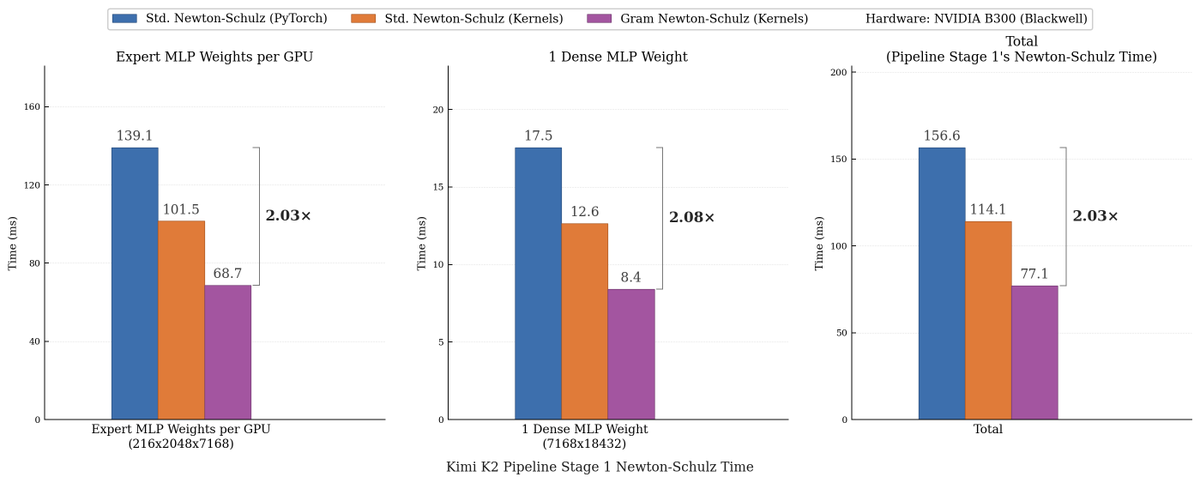
We made Muon run up to 2x faster for free!
Introducing Gram Newton-Schulz: a mathematically equivalent but computationally faster Newton-Schulz algorithm for polar decomposition.
Gram Newton-Schulz rewrites Newton-Schulz such that instead of iterating on the expensive rectangular X matrix, we iterate on the small, square, symmetric XX^T Gram matrix to reduce FLOPs. This allows us to make more use of fast symmetric GEMM kernels on Hopper and Blackwell, halving the FLOPs of each of those GEMMs.
Gram Newton-Schulz is a drop-in replacement of Newton-Schulz for your Muon use case: we see validation perplexity preserved within 0.01, and share our (long!) journey stabilizing this algorithm and ensuring that training quality is preserved above all else.
This was a super fun project with @noahamsel, @berlinchen, and @tri_dao that spanned theory, numerical analysis, and ML systems! Blog and codebase linked below 🧵
What if you could run ANY Node.js app unmodified, safely anywhere… without Docker, containers, or security headaches?
🔥 Introducing Edge.js
• Fully compatible with Node.js
• Sandboxed by design
• Pluggable with any JS engine
Node.js, but actually safe. And everywhere 👇
I wrote a research paper at Duke comparing Texas's ERCOT to Connecticut's Eversource.
For as proudly as TX drills oil, and as loudly as CT demands green energy, TX runs on 80% renewables while CT runs on 80% carbon sources.
Data continues to validate how crazy this is.
Pretty astonishing. In Texas, between 10:00 am and 4:00 p.m., 80-90% of electricity comes from carbon free sources. And storage is already a significant contributor in the early morning and evening
Introducing the Secure Exec SDK
Secure Node.js execution without a sandbox
⚡ 17.9 ms coldstart, 3.4 MB mem, 56x cheaper
📦 Just a library – supports Node.js, Bun, & browsers
🔐 Powered by the same tech as Cloudflare Workers
$ 𝚗𝚙𝚖 𝚒𝚗𝚜𝚝𝚊𝚕𝚕 𝚜𝚎𝚌𝚞𝚛𝚎-𝚎𝚡𝚎𝚌