New preprint alert! Do words or numbers better capture our confidence?
We found that words (eg "very likely") predict choice accuracy more reliably than numbers.
I’m highly confident you’ll like it. Or is it 85% confident? :-) https://t.co/aGkPES5O7b
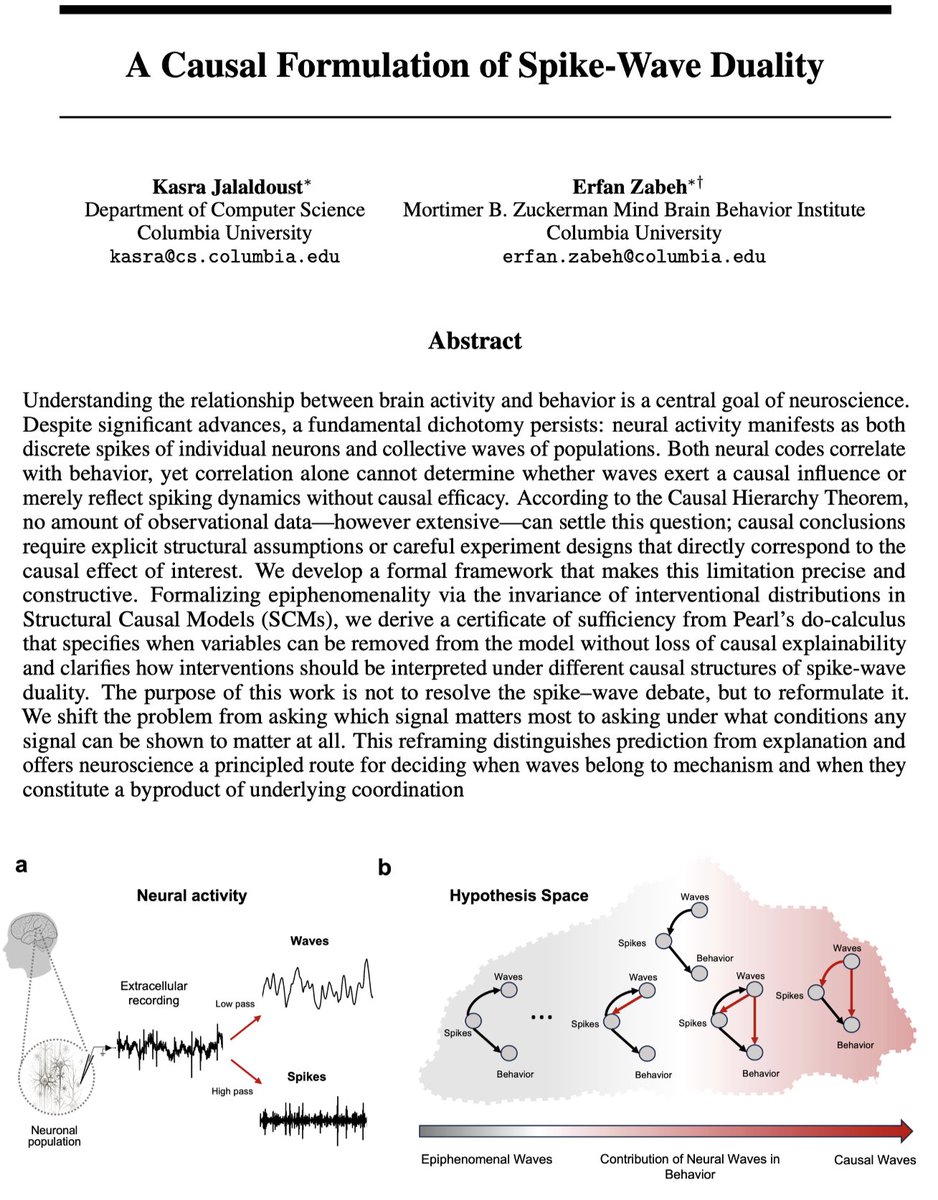
Finally a causal formulation of spike-wave duality.
Over the past couple of years I have been constantly asked about causality of brain waves.
After two years of spontaneously thinking about this, I dared to put this "baby" out.
Shout out to my talented collaborator @causalkasra whom perfected the causal machinery behind this work.
If you are at @NeurIPSConf come to our poster and let’s chat. https://t.co/T7akP33kWK
Building compositional tasks with shared neural subspaces
One of the big open questions in cognitive neuroscience is how the brain pulls off the kind of flexible, compositional behaviour that modern AI systems are still struggling to match. We know animals can recombine simple skills—“categorize this,” “move eyes there”—to solve new tasks, and that artificial networks trained on many tasks tend to reuse internal components. But what does that reuse look like in real neural populations?
Sina Tafazoli and coauthors tackle this by training monkeys on three cleverly related tasks that recombine the same subtasks: categorizing by colour or shape, and responding along one of two saccade axes. While the animals switched between tasks without explicit cues, the authors recorded from prefrontal, parietal, temporal cortex and striatum. Using population decoding, they show that task-relevant information—colour category, shape category, motor response—lives in low-dimensional subspaces of neural activity. Crucially, these subspaces are shared across tasks: the same colour subspace is reused whenever colour matters, and the same motor subspace is reused whenever a given response axis is required.
The really interesting part is how these shared subspaces are engaged. The authors decode an internal “task belief” signal from prefrontal activity during fixation, and show that as the monkeys infer which task is currently active, the brain selectively scales the relevant subspaces (amplifying useful colour or shape information, suppressing irrelevant features) and funnels activity from the appropriate sensory subspace into the appropriate motor subspace. Motor axes are updated quickly; sensory representations adjust more slowly, matching behaviour. The picture that emerges is strikingly aligned with ideas in multitask and continual learning in AI: flexible behaviour arises not from isolated, task-specific circuits, but from a set of shared neural primitives that can be recombined and gain-modulated on the fly.
Paper: https://t.co/oXjrDC6jNm
So happy to see this work out!
We studied when brain connectomes can be used to accurately predict neural activity, and when they can't.
Happy to chat more about it, please do reach out if interested.
https://t.co/ZRTzBRpUV7
How does our brain excel at complex object recognition, yet get fooled by simple illusory contours? What unifying principle governs all Gestalt laws of perceptual organization?
We may have an answer: integration of learned priors through feedback. New paper with Ken Miller! 🧵
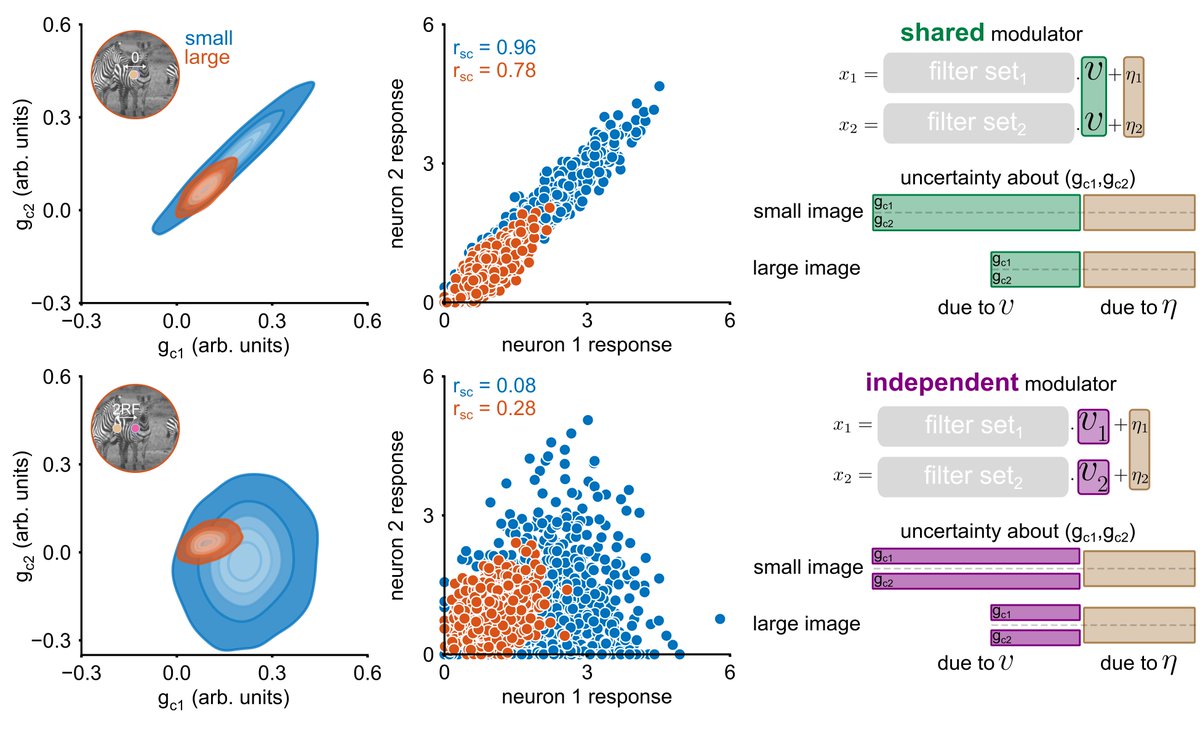
Excited that our work is out together with the amazing @CoenCagli_Lab and Adam Kohn! We demonstrate how neural co-variability in the visual cortex encodes uncertainty about natural scenes and is adaptively modulated by spatial context! (1/7)
Paper link: https://t.co/f9JhaULAa4
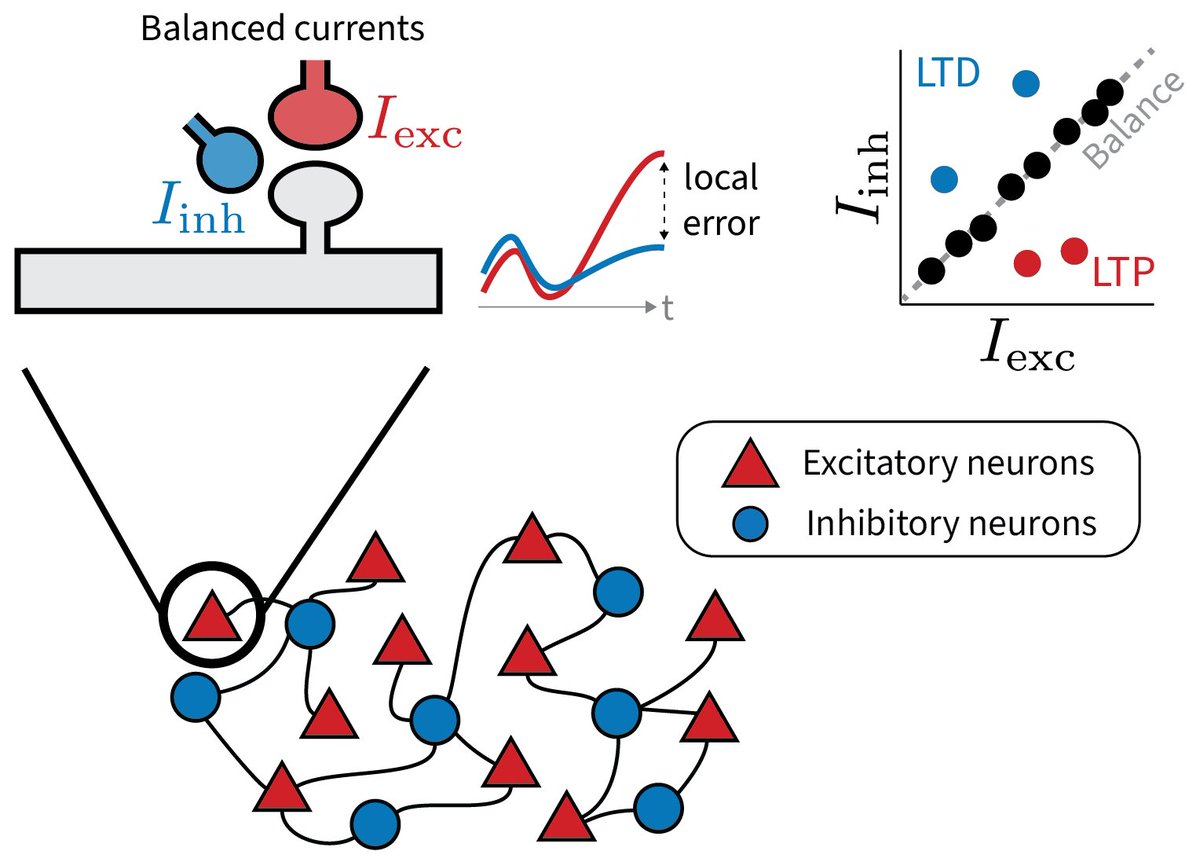
1/6 Why does the brain maintain such precise excitatory-inhibitory balance?
Our new preprint explores a provocative idea: Small, targeted deviations from this balance may serve a purpose: to encode local error signals for learning.
https://t.co/q7aXO03tdb
led by @j_rossbroich
First first-author paper now in @ScienceMagazine! Great thanks to incredible mentor @reziliusReza and coauthors @just_alden @pauliehage @HElseweifi.
We asked how neurons in the cerebellar cortex control rapid eye movements (saccades). 1/3
https://t.co/5Cf5cGHlGa
Thrilled to share my postdoc work from @takaki_komiyama lab, showing how motor learning reshapes thalamic influence on motor cortex to enable learned movements. Hats off to our collaborators and co-authors for their incredible contributions!
https://t.co/CvU6DkPtz7
The brain is modular—but what if inhibition shapes that modularity? We show that wide-range inhibitory connections boost info processing by letting one module "speak" while others stay silent.
#neuroscience#Brain#hopfield#AI#neuron#synapse#memory
https://t.co/8dUfxGkgKT
How does our brain predict the future? Our review of predictive processing + research program is now on arXiv https://t.co/4GEXauuCeK
50+ neuroscientists distributed across the world worked together to create this unique community project.
We are excited to share our latest work showing that mice display rescue-like prosocial behavior toward unresponsive partners. @ScienceMagazine
https://t.co/Jzwna46rFy
Happy to share that my work on Fast-Spike Interneurons in Visual Cortical Layer 5: Heterogeneous Response Properties Are Related to Thalamocortical Connectivity is now published in @SfNJournals https://t.co/1CFJg9WFJX
Nature Reviews Neuroscience
The curious case of dopaminergic prediction errors and learning associative information beyond value
https://t.co/91IsidcVEA