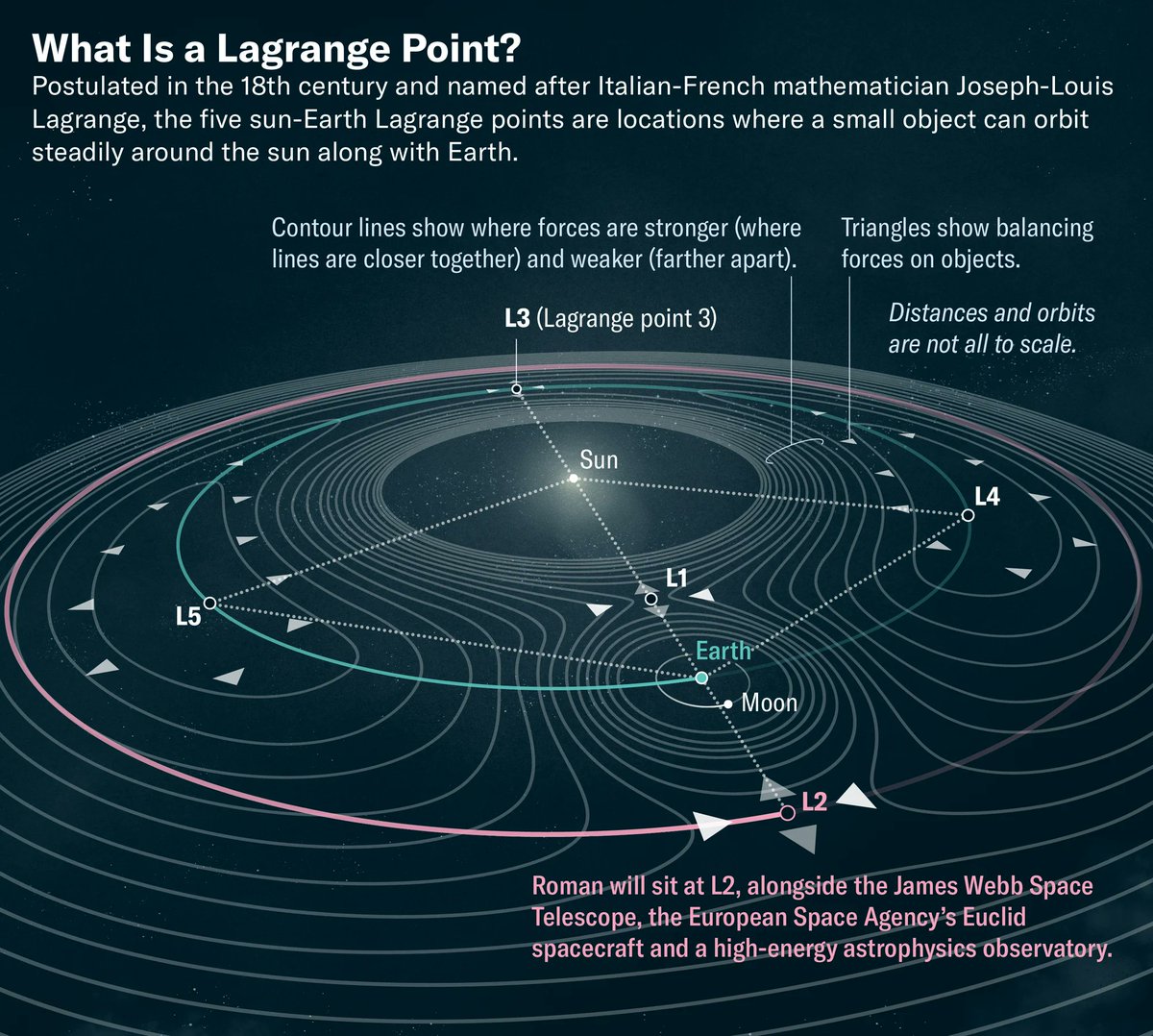
NASA’s Nancy Grace @NASARoman Space Telescope is now in space and beginning the journey to its operating location near the Sun–Earth L2 Lagrange point, roughly 1.5 million kilometres, or just under one million miles, from Earth. Roman launched on August 30, 2026, aboard a @SpaceX Falcon Heavy from Kennedy Space Center, and separated successfully from the rocket about half an hour later. It will spend roughly three months travelling toward L2 while engineers gradually deploy, activate, test and calibrate its systems and instruments. On August 31, the spacecraft completed its first planned mid-course correction, a short engine burn that refined its trajectory toward L2.
L2 is one of five Lagrange points produced by the gravitational interaction between the Sun and Earth. They are often described as places where gravitational forces “balance,” although physically the situation is a little more subtle: in the rotating Sun–Earth system, the combined gravitational acceleration of the Sun and Earth allows a spacecraft near L2 to orbit the Sun with the same angular period as Earth despite being farther from the Sun. Roman will therefore not remain motionless at L2. Like the James Webb Space Telescope, it will follow a large halo orbit around the L2 region and will occasionally perform small station-keeping manoeuvres to prevent its orbit from drifting. L1, L2 and L3 are dynamically unstable, while L4 and L5 are stable.
For an astronomical observatory, L2 is an extremely useful environment. The Sun, Earth and Moon remain roughly in the same general direction from the spacecraft, making it easier to keep them away from the telescope’s observing direction and to maintain a relatively stable thermal environment. At the same time, Roman remains close enough to Earth for high-rate communications and receives essentially continuous sunlight for electrical power. These advantages are among the reasons JWST also operates around Sun–Earth L2.
Once Roman is commissioned, its main strength will be its combination of Hubble-class angular resolution with an enormously larger field of view. Its 300-megapixel Wide Field Instrument will survey large areas of the infrared sky rapidly rather than concentrating primarily on individual targets. Roman is expected to return around 1.4 terabytes of data per day, allowing astronomers to study the distribution and evolution of galaxies across cosmic time on an unprecedented statistical scale. Those surveys are designed to investigate some of cosmology’s central problems, particularly the nature of dark energy, the distribution of dark matter, and the growth of large-scale structure. Roman will also conduct extensive exoplanet studies, including gravitational microlensing surveys capable of detecting planets that are difficult to find with transit or radial-velocity methods.
The observatory also carries a Coronagraph Instrument, primarily a technology demonstration, that will suppress starlight sufficiently to directly image and characterize some giant exoplanets. The technologies demonstrated by this instrument are particularly important because more advanced versions could eventually contribute to missions such as the proposed Habitable Worlds Observatory, whose long-term objective includes directly imaging potentially Earth-like planets around nearby stars. Roman’s coronagraph therefore has scientific value of its own, but it is also an important technological step toward much more demanding future observations.
Roman’s journey to L2 is consequently not simply a transfer from Earth to a distant fixed point. It is the beginning of an extended commissioning process in which the observatory is being configured and calibrated while travelling toward a carefully controlled orbit around L2. NASA expects the transfer and commissioning phase to take roughly three months, with the first public images anticipated in early 2027.
What I find most interesting about Roman is that its real scientific advantage is not simply obtaining sharper or deeper individual images. Hubble and JWST already perform exceptionally well in that regime. Roman changes the scale of the experiment: it combines high-quality space-based imaging with surveys containing enormous numbers of galaxies and stars. For cosmology in particular, that statistical power is what makes it such an important mission.
Ella es la soprano y artista egipcia Shahd Ezz, quien interpretar cantos religiosos e himnos en la lengua del Antiguo Egipto.
Dado que no sobrevivieron partituras de la época, la melodía es una composición contemporánea que evoca la mística de los rituales de los templos del Imperio Nuevo.
Su trabajo combina la música, la improvisación y la investigación histórica para transformar antiguos textos de los templos en piezas corales y solistas profundamente emotivas.
Dado que la música del antiguo Egipto no se escribía en partituras, Ezz colaboró estrechamente con egiptólogos y lingüistas (como el Dr. Maysara Abdallah Hussein).
El equipo utilizó inscripciones jeroglíficas y la fonética del idioma copto (el último estadio evolutivo de la lengua egipcia antigua) para aproximarse con la mayor precisión posible a cómo sonaban las palabras hace miles de años.
🇨🇴🤯| ¡LO DEJARON MUDO! Daniel Coronell invita a Mauricio Navas Talero para que hable mal del Tigre y lo que hace es cantarle la tabla por el pésimo gobierno de Petro:
🇨🇴🤔| LA FRASE DEL DÍA:
"Les pido perdón por ser creyente ... porque hoy en Colombia es más grave orar que ondear la bandera de un grupo criminal como el
M- 19 en plaza pública" @Danielbricen
Pillen, envíenle este video a todos sus amigos, que le paren bolas a cada detalle, y así no van a caer en la trampa de viejas dementes que quieran inventar vainas como esas que calumniaron a Poveda y Vargas.
ESC Congress 2026 | Great Debates: coronary computed tomography for cardiovascular disease prevention in the era of artificial intelligence https://t.co/l0n0bGxBE4
Señoras y señores!
De Colombia para el mundo! 🇨🇴
Una Osa de Anteojos (Tremarctos ornatus) vista a la distancia con sus dos crías!
De lo más lindo que he visto en mi vida ❤️🔥
Somos el país más lindo del planeta.
Gracias Dios por tanto!