@dhh I have a 2009 iMac, which would fit Omarchy perfectly. Only doubt is that it doubles as a 27” external monitor, which I assume would not run with Omarchy
One of the claims in “Terra Incognita” that readers have found most interesting is that income per capita and fertility are now positively correlated across OECD countries: the richer a country is, the higher its fertility.
To document this claim more carefully, I have completed the following exercise.
I take total fertility rates from the U.N. World Population Prospects 2024 and real GDP per capita from the new Penn World Table 11.0 (expenditure side, chained PPPs, released in October 2025 and now running to 2023). For each year from 1954 to 2022, I compute the rank correlation across countries between fertility and real GDP per capita and plot the results. I use 30 of the 38 countries that are OECD members today (regardless of when they joined). I drop the other eight because they have data gaps, as former socialist economies did not compute GDP using the standard methodology (Czechia, Estonia, Hungary, Latvia, Lithuania, Poland, Slovakia, and Slovenia).
In the mid-1950s, the correlation among the 30 countries was about -0.32, and it deepened through the 1960s and most of the 1970s, until a minimum of -0.78 in 1977. This is the world most people have in mind: the opportunity cost of children rises with income and, the richer you are, the fewer children you have. Gary Becker and dozens of economists wrote papers trying to understand this pattern.
But then, in 1977, well before anyone had heard about smartphones, social media, or some of the other “usual suspects” behind the recent drop in fertility, something changed: the rank correlation started climbing in a steady way, becoming positive in the second half of the 2010s. Right now, being richer means having higher fertility rates. And, as far as I can tell, there is no indication this trend is slowing down.
So, if you have a favorite explanation for the evolution of fertility over the last few decades, ask yourself: how can my explanation account not only for the drop in fertility but also for the rank correlation switching directions in 1977?
A couple of warnings. First, I use the rank correlation because it is immune to outliers. Luxembourg and Ireland report GDP per capita figures that nobody should take at face value.
Second, I am using the U.N. World Population Prospects 2024, which I have criticized for overestimating the fertility rates of the poorest OECD members (Mexico, Colombia, Costa Rica, Türkiye). If you use the fertility rates reported by their own statistical agencies, the rank correlation is even more positive. But I don’t want anyone accusing me of fiddling with the data.
Finally, credit where it is due: I first learned about this reversal from Doepke, Hannusch, Kindermann, and Tertilt, “The Economics of Fertility: A New Era,” in Lundberg and Voena (eds.), Handbook of the Economics of the Family, vol. 1, North-Holland, 2023, pp. 151-254. Anyone who wants to go deeper should start there.
Comments always welcome!
The most strategic behavior competent people refuse to do is play dumb.
Asking an 'obvious question' feels like surrendering parts of their status, so they'll rather remain silent.
This later creates the very information gaps that spell doom for their entire team.
In contrast, a person who asks what everyone seems to assume already will gain unparalleled information.
You'll inevitably find yourself in situations in which you have to trade the appearance of intelligence for being more informed later on.
Performing brilliance is a fool's strategy.
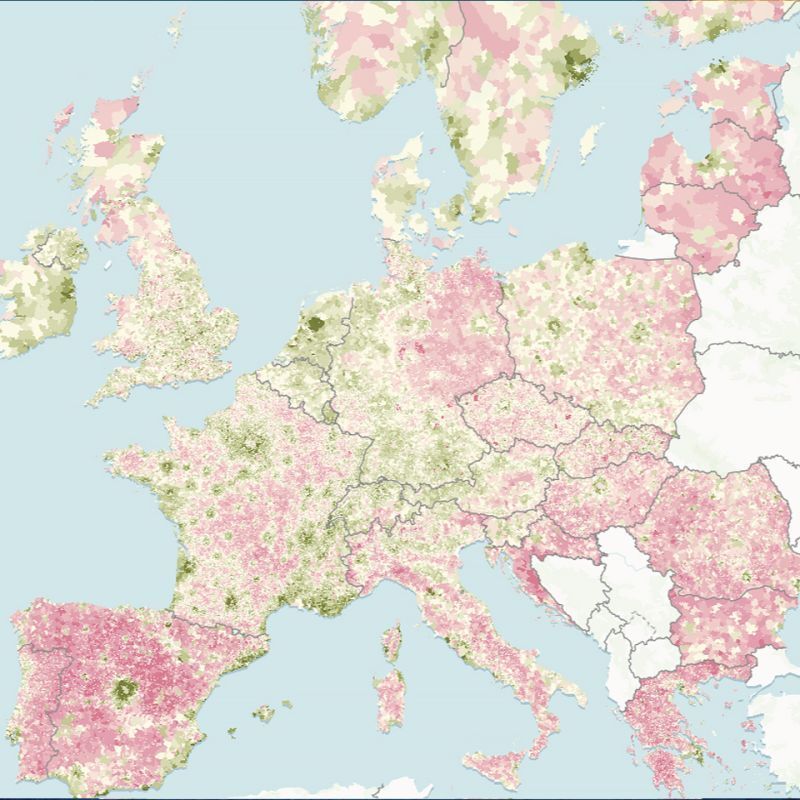
It's hard to oversell this map - make sure to bookmark it and share it with your friends. Fantastic research that must have been soooo labour intensive: How has the population of evert single small geographic region across Europe changed from 1961 to 2024? You will want to study this map in detail. Source (keep scrolling for a while): https://t.co/2akdcsaBpm
If you're under 53 years old, you have never once been alive while a human was farther than 250 miles from Earth. Tonight, four astronauts are heading 252,000 miles out. That's a thousand times farther than any person has gone in your lifetime.
The 250-mile ceiling is where the International Space Station floats. Every astronaut since December 1972 has been stuck in that zone. Spacewalks, science experiments, cool photos from orbit, sure. But nobody left the neighborhood.
The last crew to go farther was Apollo 17. December 1972. Nixon was president. The internet didn't exist. Cell phones were 11 years away. The youngest member of that crew is now 90 years old.
The farthest any human has ever been from Earth is 248,655 miles. The Apollo 13 crew set that number in 1970, and they didn't mean to. Their oxygen tank blew up, and the emergency route home took them farther out than anyone before or since. Tonight's crew will break that record on purpose.
And the crew itself. Victor Glover becomes the first Black astronaut to leave Earth's neighborhood. Christina Koch becomes the first woman. Jeremy Hansen, a Canadian fighter pilot, becomes the first non-American to do so. When they come home, they'll slam into the atmosphere at 25,000 mph, faster than any human has ever traveled.
The Moon's south pole has ice. Water ice, sitting in craters so deep that sunlight hasn't hit them in billions of years. A 2024 NASA study found way more of it than anyone expected. You can split water into hydrogen and oxygen, which gives you rocket fuel, breathable air, and drinking water, all made on the Moon instead of hauled up from Earth. George Sowers at Colorado School of Mines calculated that Moon-made fuel could shave $12 billion off a single trip to Mars. The Moon is a gas station on the road to Mars.
NASA Administrator Jared Isaacman announced last week a $20 billion plan to build a permanent base at the South Pole over the next seven years, with landings every six months. China is developing its own lunar lander and spacesuit, aiming for a crewed landing by 2030. The Artemis program has burned through $93 billion so far, and the first actual surface landing is penciled in for 2028. There's a real question of who gets there first this time around.
Harrison Schmitt walked on the Moon in December 1972 as part of Apollo 17. He's 90. Asked about it this week, he sounded pretty relaxed. "Mars is attainable," he said. "We're humans. That's what we've always done."
Before we had silicon chips, we had needle and thread?
In the 1960s, NASA didn’t ‘upload’ code; they sewed it. To get Apollo 11 to the moon, skilled weavers (often called ‘Little Old Ladies’) literally hand-stitched software into physical objects.
By passing copper wire through tiny magnetic rings, they created Core Rope Memory. The logic was beautifully simple: wire through a ring was a ‘1’; wire around it was a ‘0’. Because the code was physically woven, it was virtually indestructible. It couldn’t be deleted, it couldn’t crash, and it survived the intense radiation of deep space with just 72 kilobytes of data: millions of times less than a single photo on your phone today.
It proves sometimes the most advanced tech is actually handmade.
When you think about the AI revolution WHO do you think about?
Value X Created
V{X)=Ln(-————-———)
Value X Captured
People with high V(X) are VERY hard to control.
People with negative V(X) are much easier.
Try listening to high V(X).
"Nobody starts in the right place. You don’t begin with the correct tool and work sensibly within its constraints until you organically graduate to a more capable one. That is not how obsession works. Obsession works by taking whatever is available and pressing on it until it either breaks or reveals something. The machine’s limits become a map of the territory. You learn what computing actually costs by paying too much of it on hardware that can barely afford it... I know this because I was running Final Cut Pro X on a 2006 Core 2 Duo iMac with 3GB RAM and 120GB of spinning rust. I was nine. I had no business doing this. I did it every day after school until my parents made me go to bed."
A great paragraph in a great essay about the MacBook Neo:
https://t.co/hUeXDULQFY
Reminds me of my early days on computers. You did what you could with what you had because you didn't have a choice.
via @daringfireball
@jlantunez Esto es una de las grandes diferencias entre hacer startups aquí o allí. El Adam Europeo estaría metido en un monasterio, o se habría suicidado.