New release from Meta FAIR — Meta Motivo is a first-of-its-kind behavioral foundation model for controlling virtual physics-based humanoid agents for a wide range of complex whole-body tasks.
The model is capable of expressing human-like behaviors and achieves performance competitive with task-specific methods and outperforms state-of-the-art unsupervised RL and model-based baselines.
Try the demo ➡️ https://t.co/AbbFGJ6rqr
Get the model and code ➡️ https://t.co/TFVLxYrhIX
We’re excited about how this research could pave the way for fully embodied agents, leading to more lifelike NPCs, democratization of character animation and new types of immersive experiences.
Want to learn continuous & discrete Flow Matching? We've just released:
📙 A guide covering Flow Matching basics & advanced methods https://t.co/uf3zDfhdKe.
💻 An open source codebase with image & text examples https://t.co/Nfsoss8ZP2.
🗣️ A Flow Matching tutorial #NeurIPS2024.
My talk on “A history of human motion in Computer Vision: From puppets to LLMs” is available here with an extensive bibliography: https://t.co/J8nzXtI9Fa
In this new work, we seek to understand what guidance really means in the context of diffusion models. No, it’s not about the prompts!
https://t.co/3v7BNMjOfu
@NVIDIAAI@CSAalto@FCAI_fi
Flexible Motion In-betweening with Diffusion Models🧎🚶🧍Done together with @GuyTvt, @rdednl, @xbpeng4, and @Mvandepanne
📄Paper: https://t.co/4QqS7l3lsV
🌐Website: https://t.co/GfkFaTvmM2
Grateful for the insights and feedback provided by everyone!
Today, we’re introducing Waymax, a first-of-its-kind simulator developed specifically for solving autonomous driving research problems around planning and sim agents. Discover how researchers can access Waymax: https://t.co/AVQA1eaahN
We are back!
Upcoming:
05/30: Ying Jin (Stanford)
06/06: Yujia Jin (Stanford)
06/13: Zeyu Jia (MIT)
06/20: Han Zhong (Peking)
06/27: Kefan Dong (Stanford)
07/04: Qinghua Liu (Princeton)
07/11: Ahmed Touati & Yann Ollivier (Meta AI)
07/18: Ayush Sekhari (MIT)
Introducing Masked Trajectory Modeling (MTM), a new general-purpose framework for sequential decision making. A single transformer trained with MTM can exhibit multiple capabilities by simply choosing different masking patterns at inference time. Accepted at ICML 2023. 🧵👇
Football players can tackle, get up, kick and chase a ball in one seamless motion. How could robots master these motor skills? ⚽
We trained AI agents to demonstrate these agile behaviours using end-to-end reinforcement learning.
Find out more: https://t.co/LkYtaMeUEd
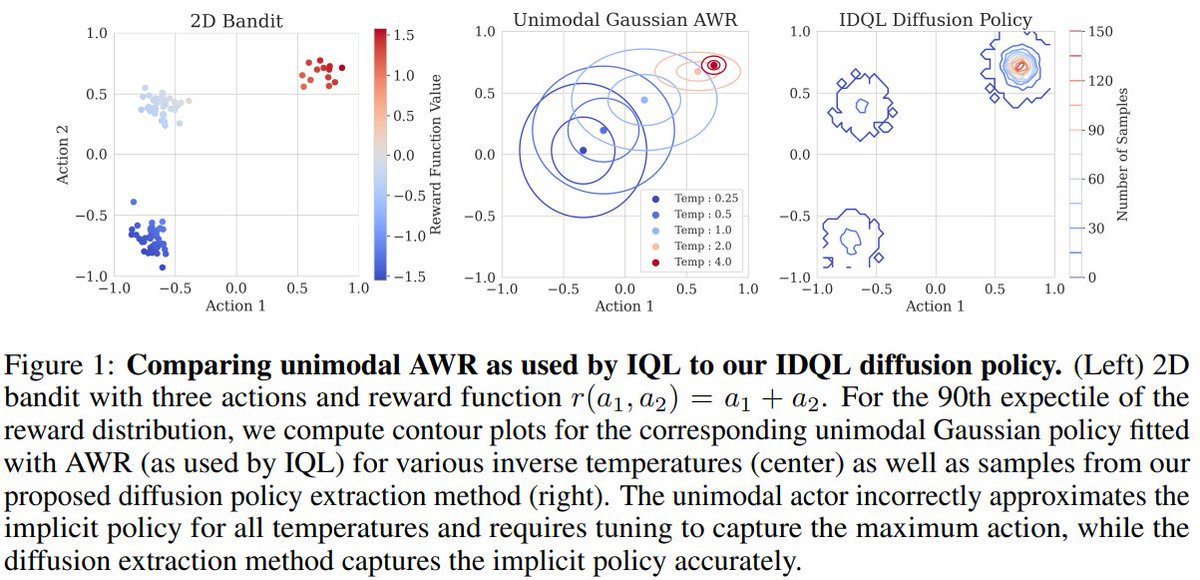
We released a new version of implicit Q-learning (IQL) with diffusion-based policies to get even better results with less hyperparameter tuning. For paper&code:
paper: https://t.co/CIdmJXwC5j
code: https://t.co/cd3vp2557Q
by Philippe Hansen-Estruch, @ikostrikov, et al.
A thread:
Check out NVIDIA’s newest generative model for complex open-world 3D scenes.
It will generate novel scenes, which you can then edit and style for a wide range of uses, including potential use cases in VR & robotics.
https://t.co/gt8Vnp1KYx
🚨 HUGE news in AI: Google just launched Generative AI across ALL of Google Workspace -- Gmail, Docs, Sheets, Slides, Images -- EVERYTHING.
They made a video showing off the new AI's capabilities. It's AWESOME.
Question to the panel—what are the open problems in diffusion generative models? Top answer—generalizing to discrete sequences and coming up with good corruption processes for that domain.