Fusion energy costs are indeed key to its eventual success. Those costs are deeply connected to a fusion company’s choice of architecture, where it’s critical not only that the eventual power plants can be economical, but most fundamentally, that a commercially relevant machine can actually work.
That’s what we’re tackling with our SPARC machine outside Boston. Our project got a head start thanks to many years of collective operational experience that people have gained by running tokamaks around the world (to date over 1800 tokamak-years of operation across over 150 machines over the last 50+ years!).
On top of that we add all our experience designing, manufacturing, constructing, commissioning, and operating SPARC. That work confirms our understanding of the physics, engineering, supply chain, performance, reliability, and cost. This collection of factors is the kind of knowledge that gets a company onto the cost curve so it can then scale up and drive down that cost curve.
None of this is a slam dunk. But bear these points in mind when looking at the levelized cost of energy (LCOE) and fusion competitiveness:
• Every other form of energy on the grid also went through this shift toward being economical. What might look routine today, like burning coal or fissioning uranium, was once at the cutting edge of what was technologically possible.
• The widely cited LCOE analysis by the energy experts at @Lazard only recently began to address the added cost some energy sources face to ensure they're firm (predictably available). And even then their extra firming costs only include 4 hours of power from a battery or firm power from a nearby gas plant, neither of which is really clean, firm 24x7 power.
• LCOE has been increasing for all forms of energy in recent years, and demand for energy also is soaring.
• While the cost for power is represented well by LCOE, the value of that power can be quite different. This is especially true for power that’s both clean and firm, but fusion has other advantages, too. It’s also highly energy dense and therefore land efficient. It’s safe and siteable nearly anywhere, including close to demand, and therefore requires less transmission. It has essentially negligible costs from fuel that’s abundant, available nearly everywhere, and essentially limitless. It’s highly secure, providing energy not through some collected or purchased resource, which leads to fuel volatility costs and geopolitical capture, but rather from a technology that can be built, owned, and fully fueled from day one.
#FusionEnergy #Energy
If you're going to quit your job, learn from @IsmailKamdar.
Tawakkul is not passive. For him it meant diversifying income, investing years ahead, and practicing ṣabr through a 6-month crisis.
Trust in Allah and tie your camel.
ONE YEAR AGO I QUIT MY JOB
Self-imposed unemployment, I’ll figure it out!
A year of traveling the world with my family seeking a new way forward
I learned to freelance. I learned to invest better. I improved my sales skills.
I landed in a better place and position.
Most importantly I found balance.
Today, I reflect on this big decision and where it has led me.
Read the full reflection here: https://t.co/r4g9124kZz
Your finger hurts. Do you reach for a bandage or a saw?
The trend of casually “going no contact” with parents, siblings, and other relatives is one of the most destructive ideas in our culture. The Wall Street Journal covered it this summer: “Are Therapists to Blame for the Rise of Adults Cutting Off Their Parents?”
Yes, boundaries matter. Abuse, pain, and conflict are real. You do not have to endure cruelty or pretend every relative is a saint. But the finger is still attached to the hand, and the hand to the body. You treat the pain. You don’t grab a saw to cut off your finger!
Too often, people treat ordinary friction (politics, personality clashes, imperfect parenting, different values) as grounds for exile. A culture that calls cutting off family “healthy” teaches us that relationships are disposable the moment they require work. Research shows the opposite: close, resilient family ties predict long-term satisfaction and mental health far better than isolation. People who cut others off over minor conflict do not find peace. They become lonelier, more brittle, and convinced that everyone else is the problem.
Ṣaḥīḥ Muslim records that a man came to the Messenger of God ﷺ and said: “I have relatives with whom I try to maintain ties, but they cut me off. I treat them well, but they mistreat me. I am patient with them, but they act harshly toward me.” The Messenger ﷺ did not tell him to cut them off. He acknowledged the injustice, promised God’s support, and encouraged him to persevere. In Ṣaḥīḥ al-Bukhārī, he ﷺ clarified: “The one who maintains ties is not the one who merely reciprocates. Rather, it is the one who, when his relatives cut him off, maintains ties.”
Keep the finger. Treat the pain.
The hard part: going from building one to building thousands. Every industry that got cheap did it by making a lot of the same thing. Nuclear never got that chance. Excited that @isaiah_p_taylor and @valaratomics are giving it one!
@JonathanACBrown Screenshots from out-of-print travel guides?? That's wijādah, the weakest form of taḥammul. Your jarḥ never had a strong isnād. Glad to see proper taʻdīl this time!
When I look at the relationship between (virtually all) Muslims and capital -
I see desperation
Desperate to not fall behind (not a bad thing in itself but we manifest it in a bad way)
desperate for yield - from anywhere
Desperate for acceptance
Fintechs and founders desperate to sound Islamic and ethical
Desperate for investors, capital, making a name, and being well known
What I don’t see is Champions.
People who champion Islam rather than use it as a route for advancement
Rather than act out of fear and ignorance
Rather than treat our capital as a tool to earn more without caring how we do it
We need champions who -
- don’t compromise
- fully accept the constraints of our Deen and don’t play games with either Arabic words and hidden structures
- don’t actually care about attracting capital (unless it’s only by way of truth) or fame or a good name
- fight to uphold the values demanded of us by our Creator
- see capital as a burden and Amanah and thus force us to a search for progress via truth only
A global community without Champions - whose only self named champions are just following the route of Riba and conventional capital that is wholly antithetical to our Deen - can not progress.
The answer is simple and it lies in Taqwa - excellence in knowledge of capital - and the ability to search hard while maintaining absolute constraint. This is wholly doable.
Instead we choose the route of least friction
This has never been the way of our Deen
Strong diagnosis. I would add that the issue isn't only founders. Consumers enable it too, because they rarely look past the label.
The jurists gave us the standard centuries ago: العبرة بالمقاصد والمعاني لا بالألفاظ والمباني. What counts is the substance of a contract, not its wording. Much of the industry has flipped that around. We take a conventional product, dress it in Arabic, and call it compliant. That isn't "Islamic" finance. It is conventional finance that learned Arabic. We reach for ḥiyal (fiqh tricks) because building real risk-sharing products is harder than renaming a loan. That has to stop.
So, to consumers: Don't fall for "Islamic finance" products marketed merely through big names and appeals to authority. Please demand transparency, dig deeper, and judge financial products on their substance.
Mimikatz gets caught by EDR, but a cheap local LLM builds an alternative that walks right past two EDRs!
No elite red team. Just an uncensored model and ~$5 of compute. We live in a crazy world.
https://t.co/eN1BLdyDVQ
The Qur’ān was revealed as guidance, but guidance only opens up to us when we pause and reflect. Tadabbur is what turns recitation into transformation. Our beloved Shaykh Furhan Zubairi's work on this subject is invaluable. I can't wait for his book. May Allah accept it from him.
Alḥamdulillah, through the infinite grace and mercy of Allah ﷻ, since graduating from Dār al-ʿUlūm Karachi, I have been blessed with the opportunity to teach tafsīr to the community and students in our Seminary Program. I would be honored and humbled to be part of an intellectual movement dedicated to reviving the Muslim communities’ relationship with the Quran.
That is part of the motivation behind the series of Tafsīr Books that I have published and that was also the motivation behind my PhD. The title of my thesis is "CONCEPTUALIZING AL-TADABBUR AS A GUIDE FOR READING AND STUDYING THE QURAN: AN ANALYTICAL STUDY".
The following is a link to my thesis, which I will publish as a book soon inshAllah. May Allah ﷻ accept it and make it a means of benefit. Please read through it, provide feedback, and most importantly use it in your homes, Islamic schools, seminaries, and communities.
https://t.co/WbwmZxdvJG
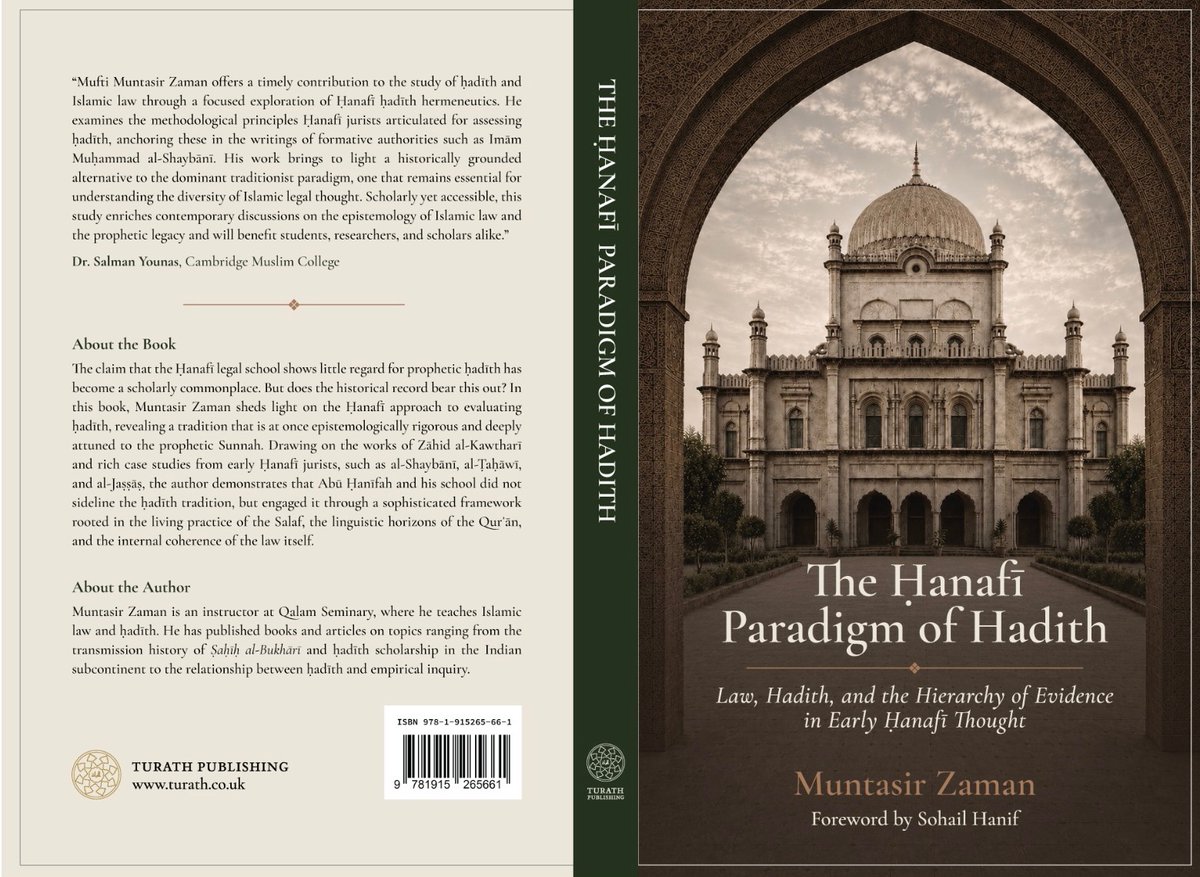
The Ḥanafī approach to ḥadīth is widely misunderstood and misrepresented, even by Ḥanafīs themselves. Muftī Muntaṣir is a master of both ḥadīth and Ḥanafī fiqh, and I'm looking forward to him setting the record straight.
Peak computer science + math nerd moment: Kaze Emanuar spent weeks shaving 100 microseconds off arctan2 on the Nintendo 64.
He skipped lookup tables, worked around compiler issues, and tuned it at the assembly level. A great watch!
https://t.co/hyBJGIrhme
Instead of asking
“how can I get yield?”
Ask
“Can I stand before Allah swt and truthfully explain why this gain belongs to me?”
Capital brings with it a duty, an Amanah.
Most of us don’t take this seriously.
The discussion surrounding hand-slaughtered and machine-slaughtered chicken has once again resurfaced online. Instead of remaining a legal and juristic discussion, it is often framed in highly emotional terms. At times, consuming only hand-slaughtered chicken is presented as a sign of greater taqwā, religious commitment, and personal piety, while those who accept machine slaughter are made to appear careless or spiritually deficient. This is neither fair nor reflective of the proper etiquette of scholarly disagreement.
Mechanical slaughter is a modern issue that falls within the realm of ijtihād. Both sides agree that poultry must be slaughtered in a manner recognized by the Sharīʿah and that the necessary conditions of a valid slaughter must be fulfilled. The disagreement is not over whether proper slaughter is required; it concerns whether a mechanized process can fulfill those requirements and under what conditions.
Those who do not permit machine slaughter raise legitimate concerns regarding the identity of the slaughterer, the recitation of the tasmiyah, whether every bird is properly cut, whether any birds die before slaughter, and whether the process is adequately supervised. These concerns deserve to be taken seriously. A person who finds this position stronger, safer, or more convincing is fully entitled to follow it and to encourage others to do so through sound legal argument and respectful advice.
At the same time, those who permit certain forms of machine slaughter do not simply disregard the requirements of ẓabīḥah. Their reasoning is that the machine is an instrument operated by a human being, just as a knife, arrow, firearm, or other device is an instrument. The legal act is attributed to the person operating it, not to the tool itself. If a qualified slaughterer initiates and controls the process, recites the tasmiyah, and the birds are alive at the time of slaughter and properly cut, a number of contemporary scholars and fiqh bodies have concluded that the meat may be lawful. They are not permitting every industrial process without qualification; they are permitting a particular process when the recognized conditions of slaughter are fulfilled.
This is not a simple dispute between those who care about halal and those who do not. It is a juristic disagreement regarding how established legal principles apply to a modern method of production. If someone believes that hand slaughter is the stronger or more cautious position, they should present the evidence supporting that conclusion. Likewise, those who permit machine slaughter should clearly explain the conditions upon which that permissibility depends. What should be avoided is emotional language that questions the sincerity, taqwā, or religious commitment of those who follow another recognized scholarly position.
Taqwā is not established by turning one’s preferred position in a matter of ijtihād into a universal measure of religiosity. Nor does caution in one disputed matter necessarily make a person more pious than everyone who follows a different scholarly conclusion. Genuine taqwā also includes fairness, humility, restraint, respect for qualified scholarship, and guarding one’s tongue from diminishing fellow Muslims.
We can disagree about which position is stronger. We can advocate for greater transparency, better supervision, stricter halal standards, and more reliable certification. We can personally choose hand-slaughtered chicken out of conviction or caution. However, we should not transform a legitimate juristic disagreement into a contest of piety. Present the evidence, explain the reasoning, follow the position you find most convincing, and allow others to follow recognized scholarship without impugning their faith or sincerity. Allah ﷻ knows best.
Upcoming at the North American Conference on Islamic Finance (NACIF): Islamic Financial Literacy in the United States: Scope, Challenges, and Prospects