🔗 6,576 days ago, I almost didn’t take the job → https://t.co/ir8UkL4TBk
I was skeptical—of Big Tech (which wasn’t even that big back then), of a search company evolving fast, and of whether it was for me.
What was supposed to be a 3-month contract has turned into an 18-year journey.
Funny how the biggest opportunities often start with a little skepticism. 🚀
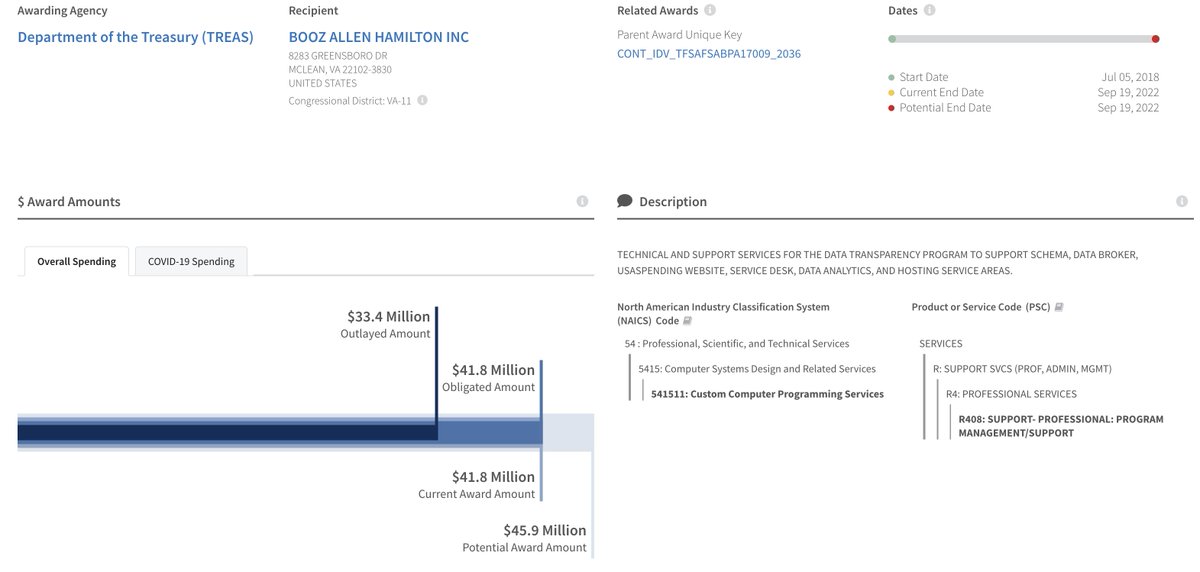
The U.S. government’s official spending database (https://t.co/hDwCOBmHx1) can’t properly filter recipients right now due to a “bug,” yet Booz Allen Hamilton is paid tens of millions of taxpayer dollars each year to provide hosting, data services, and support for the site. If nearly $10 million annually (with a potential total of $45.9 million) is on the line, you’d think we’d get a fully functional transparency tool! 🤦
https://t.co/hymoPXeMdJ
@JosvdWest@mckaywrigley Very cool to see others with similar workflows. Not exactly Repo Prompt, but I built GitIQ for this: Enter prompt, select files, then it combines the files into a JSON request to the model and applies file updates to the local git repo. https://t.co/xnBfDjYlUt
@halvarflake Hah, great minds think alike! I prompted an eerily similar tool (with a file picker) in Python—because, as much as I hate it, the LLMs seem to love it. And I completely agree, diffs are the *only* way that make sense for reviewing AI-generated code!
🚀 Exciting News: Duet AI in Security Operations Goes GA! 🚀
Thrilled to announce that our LLM-powered features in Chronicle are now in General Availability as Duet AI for Security Operations!
A big congratulations to our team for the exceptional work in achieving this milestone.
https://t.co/GwvZHoSayq
#DuetAI #AI #Chronicle #CyberSecurity
Today at RSA we announced what I've been working on recently - Chronicle's new AI capabilities! If you're in town and want to connect, please feel free to reach out. https://t.co/jekXh0DbME
The analogy between GPTs of today to the CPUs of early days of computing are interesting. GPT is a funny kind of programmable text computer. Have to think through it more 🤔 but e.g.:
## Memory
GPT-4 RAM is ~log2(50K vocab size)*(32K context length)/(8 bits/byte) ~= 64kB, roughly a Commodore64. Just as then, optimizing this precious resource is critical.
GPT registers are the residual stream. There are d_model of them, e.g. GPT-3 has ~12K registers. VLIW architecture vibes.
## CPU
The LOAD instruction is the Attention mechanism, except it can address by both location and/or content.
The STORE instruction is forced every n_layer number of clock cycles.
The ALU are the MLPs + LayerNorms. Awkwardly, as their params are not shared across layers, the ALU changes at each clock cycle. Optionally the MLPs may also be interpreted as supporting a kind of fixed knowledge database lookup.
The programs always takes the form [[LOAD, ALU]*N, STORE]*M, where N is n_layer and M is num_tokens.
## Architecture
GPT feels closer to a fixed-function than stored-program computer because the number of parameters is so large. In contrast, the description length of a CPU is very low and all the action is in the memory configuration.
Another way to look at it is that GPT is a much more bloated/complex computer. Which is fine because it is not engineered but optimized and the upshot is that the programs can be shorter.
Today we launch #Backstory, the first global security telemetry platform designed for a world that thinks in petabytes. Come find us at #RSAC booth #2251 South after 5pm and learn more. https://t.co/Og5HZswDnV