Communications Strategist * Instructor with NAIT in Business Writing/Leadership & Teamwork/Problem Solving * On Team Human while Co-Creating with Generative AI
Should writers use AI?
Emmy-award-winning filmmaker Noah Hawley says: "It depends."
AI could probably write a show like Law & Order because there's so much training data to pull from. But if you want to invent something new, AI can't really do that.
So it's a tool, just like any other. And yes, some people hate it but people also used to hate visual effects and complain that they were ruining cinema.
But then, as visual effects got better and better, we got fully animated worlds like Avatar, and nobody thinks that's cheating anymore. Maybe AI will go the same way.
So how does Noah use AI?
He says he wouldn't use it to write for him, but he does use it for productivity. Like if he wants to do research or think through a story. That turns the AI into a creative partner.
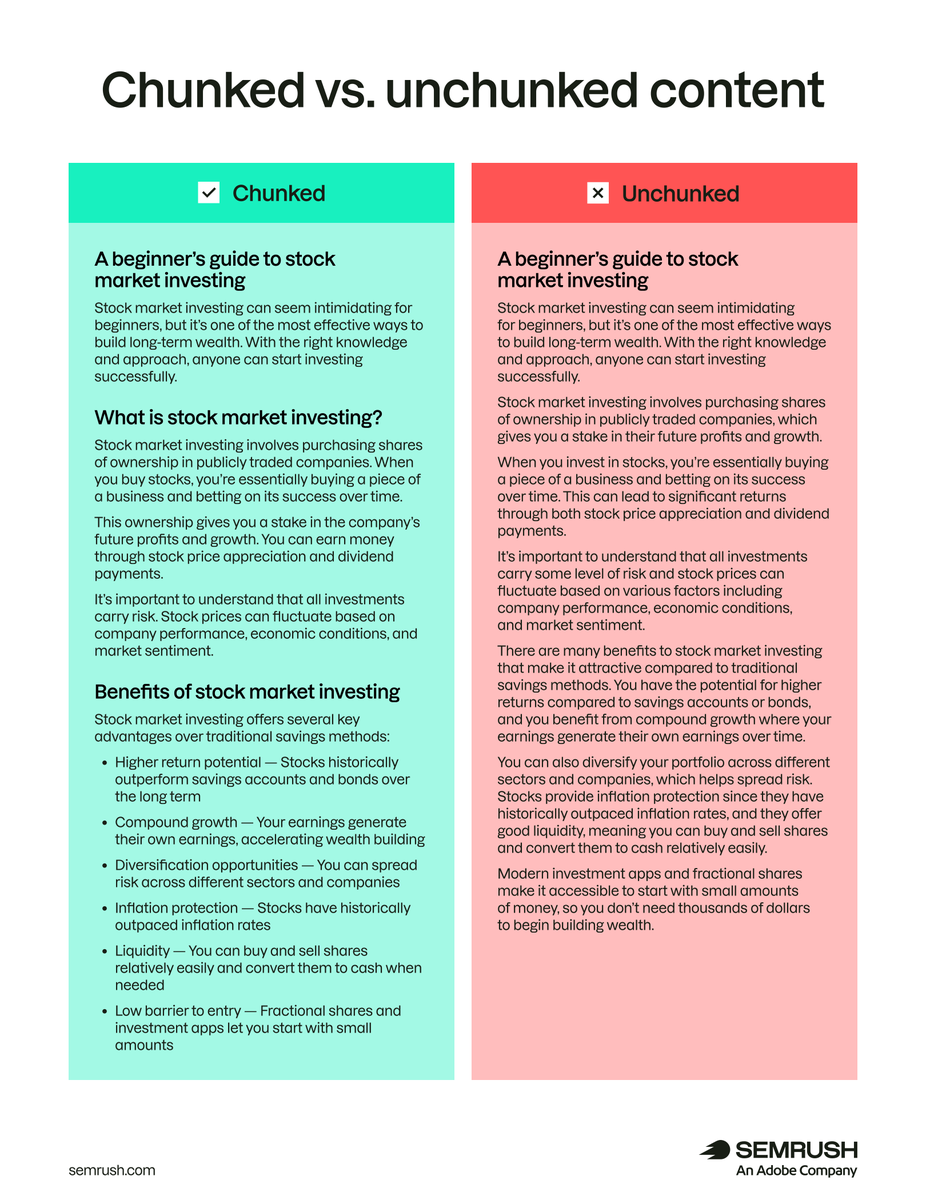
Everyone’s talking about “chunking” content to win AI answers.
Chunking isn’t a new tactic – it’s structured content designed for retrieval. The real question is whether it actually drives visibility.
We break it down in our blog post: https://t.co/T6io0x5dfY.
While the industry obsessed over AI Overviews and organic rankings, referral traffic quietly grew 527%. The shift is real, it's already happening, and it's invisible to the tools most marketers use every day. These 5 signals show you where the smart money is moving.
#SEO #ReferralTraffic #MarketingTips #DigitalMarketing
Ex-"60 Minutes" boss Bill Owens issued a warning about what’s happening to the long-running newsmagazine under the leadership of Bari Weiss and Nick Bilton:
“The senior leadership at ’60 Minutes’ were all fired at once. There wasn’t any cause given.”
https://t.co/PMTx42oNTS
I'm thrilled to announce my new book, The Casino Shift, are now live! Sequel to The Night Shift, diving into today's ER chaos, tech advances, and healthcare challenges across Canada. Order here: https://t.co/e5rpCCkDRH
#EmergencyMedicine#MedTwitter
60 Minutes made $206 million in advertising in 2024. It was not a struggling relic. It was the most profitable serious journalism operation in American broadcasting.
Then David Ellison bought Bari Weiss's website for $150 million and handed her CBS News. She spiked a story on El Salvador's CECOT prison. She let Benjamin Netanyahu pick his own interviewer instead of sitting across from Leslie Stahl. She fired the executive producer, two on-air correspondents, and the behind-the-camera producers who actually ran the place.
The replacement EP has never worked a day in broadcast news. Ben Shapiro's Daily Wire endorsed the hire.
This is not mismanagement. Ratings are down across CBS News. The journalism is getting worse. The audience is leaving. But Ellison's other corporate deals - the Warner Bros. Discovery acquisition - got a presidential thumbs-up while Netflix got frozen out. Trump said out loud he would remember which companies played ball.
That's the transaction. CBS News bleeds so that Paramount profits. Sharyn Alfonsi doesn't have a job so that David Ellison gets his merger.
The people who watched 60 Minutes for fifty years to find out what was actually happening in the world... they just lost something that cannot be rebuilt under corporate ownership. Not in this environment. Not while the president is keeping score.
What if "learn to code" is becoming analog preparation for a digital world?
DeepMind CEO just confirmed the paradigm shift: AI native generation won't compete on technical execution, they'll compete on creativity, taste, and judgment that AI can't replicate. When implementation becomes commodity, human perspective becomes premium.
People are now building income sources using Claude… in just days.
Not months. Not years. Just prompts.
Here are 10 prompts you can copy directly and start earning from them 👇
Most people think AI runs on GPUs.
That's like saying the internet runs on browsers.
Modern AI is powered by an entire ecosystem of processors:
🧠 CPU → Coordinates everything
⚡ GPU → Trains massive models
🔷 TPU → Accelerates tensor operations
📱 NPU → Brings AI to phones & laptops
🚀 LPU → Delivers ultra-fast LLM responses
🌐 DPU → Handles networking, security & data movement
The interesting part?
Every AI breakthrough depends on ALL of them working together.
A trillion-parameter model is useless if:
• Data can't reach it fast enough
• Inference is too expensive
• Edge devices can't run it
• Infrastructure can't scale
The next AI race won't be won by the best model.
It'll be won by whoever builds the best compute stack.
Models get the headlines.
Chips run the world.
Which processor category do you think will see the biggest growth over the next 5 years? 👇
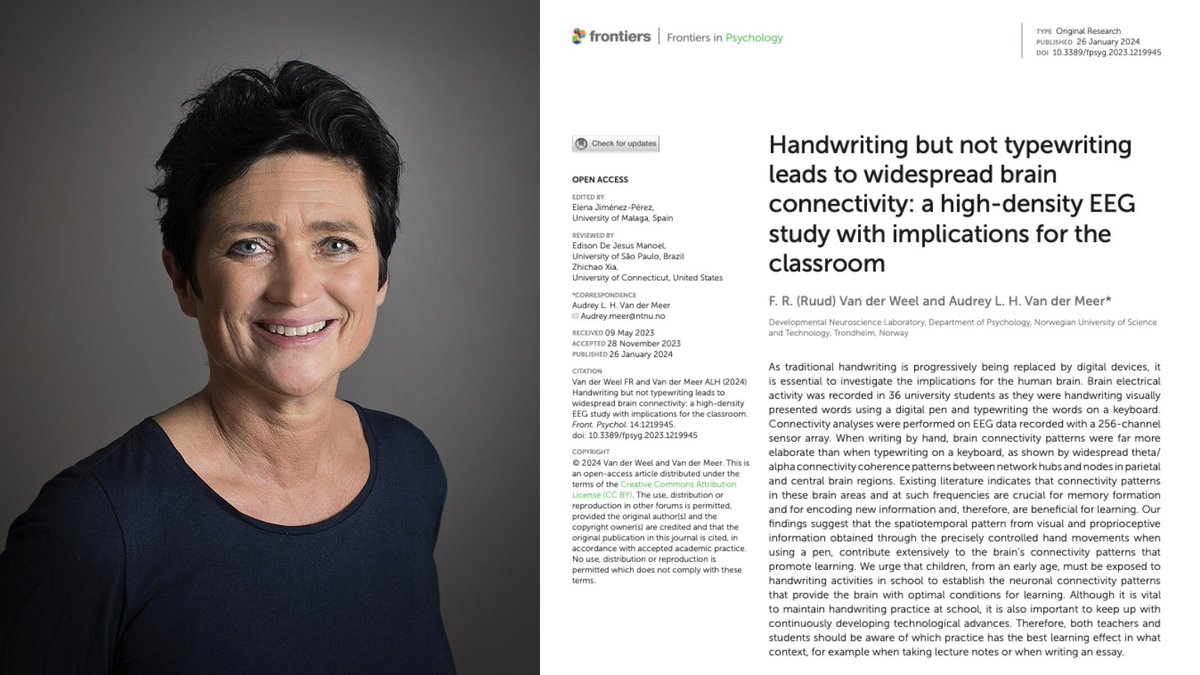
A Norwegian neuroscientist spent 20 years proving that the act of writing by hand changes the human brain in ways typing physically cannot, and almost nobody outside her field has read the paper.
Her name is Audrey van der Meer.
She runs a brain research lab in Trondheim, and the paper that closed the argument was published in 2024 in a journal called Frontiers in Psychology. The finding is brutal enough that it should have changed every classroom on Earth.
The experiment was simple. She recruited 36 university students and put each one in a cap with 256 sensors pressed against their scalp to record brain activity. Words flashed on a screen one at a time.
Sometimes the students wrote the word by hand on a touchscreen using a digital pen, and sometimes they typed the same word on a keyboard. Every neural response was recorded for the full five seconds the word stayed on screen.
Then her team looked at the part of the data most researchers had ignored for years, which is how different parts of the brain were communicating with each other during the task.
When the students wrote by hand, the brain lit up everywhere at once.
The regions responsible for memory, sensory integration, and the encoding of new information were all firing together in a coordinated pattern that spread across the entire cortex. The whole network was awake and connected.
When the same students typed the same word, that pattern collapsed almost completely.
Most of the brain went quiet, and the connections between regions that had been alive seconds earlier were nowhere to be found on the EEG.
Same word, same brain, same person, and two completely different neurological events.
The reason turned out to be something nobody had really paid attention to before her work. Writing by hand is not one motion but a sequence of thousands of tiny micro-movements coordinated with your eyes in real time, where each letter is a different shape that requires the brain to solve a slightly different spatial problem.
Your fingers, wrist, vision, and the parts of your brain that track position in space are all working together to produce one letter, then the next, then the next.
Typing throws all of that away. Every key on a keyboard requires the exact same finger motion regardless of which letter you are pressing, which means the brain has almost nothing to integrate and almost no problem to solve.
Van der Meer said it plainly in her interviews.
Pressing the same key with the same finger over and over does not stimulate the brain in any meaningful way, and she pointed out something that should scare every parent who handed their kid an iPad.
Children who learn to read and write on tablets often cannot tell letters like b and d apart, because they have never physically felt with their bodies what it takes to actually produce those letters on a page.
A decade before her, two researchers at Princeton ran the same fight using a completely different method and ended up at the same answer. Pam Mueller and Daniel Oppenheimer tested 327 students across three experiments, where half took notes on laptops with the internet disabled and half took notes by hand, before testing everyone on what they actually understood from the lectures they had watched.
The handwriting group won by a wide margin on every question that required real understanding rather than surface recall.
The reason was hiding in the transcripts of what the two groups had actually written down.
The laptop students typed almost word for word, capturing more total content but processing almost none of it as they went, while the handwriting students physically could not write fast enough to transcribe a lecture in real time, which forced them to listen carefully, decide what actually mattered, and put it in their own words on the page.
That single act of choosing what to keep was the learning itself, and the keyboard had quietly skipped the choosing and skipped the learning along with it.
Two studies. Two countries. Same answer.
Handwriting makes the brain work. Typing lets it coast.
Every note you have ever typed instead of written went into your brain through a thinner pipe. Every meeting, every book highlight, every idea you captured on your phone instead of on paper was processed at half depth.
You did not forget those things because your memory is bad. You forgot them because typing never woke the part of the brain that would have made them stick.
The fix is the thing your grandmother already knew.
Pick up a pen. Write the thing down. The slower road is the faster one.
Backlinks used to be enough. They're not anymore. AI models factor in content freshness. Pages older than 18 months without updates are getting passed over in citations, no matter how well they used to perform. A quarterly refresh calendar is one of the cheapest fixes in your marketing stack right now.
#SEO #AISearch #DigitalMarketing #ContentStrategy
SEOs used to focus on rankings and traffic. And those metrics are still important... just not as important as they used to be.
So what metrics should SEOs be looking at?
Well, here's a new KPI stack.
BREAKING🚨 Trump spent all week bragging that he got Stephen Colbert “fired.” Less than 24 hours later, Colbert was back on TV with Jack White, Eminem, Steve Buscemi, and Jeff Daniels — flipping him the bird from a tiny public access studio in Michigan.
Thursday night, after 11 years, The Late Show with Stephen Colbert ended on CBS. Trump immediately took a victory lap, posting an AI video of himself grabbing Colbert and throwing him into a dumpster, then dancing on the lid.
He ranted that Colbert was “talentless,” celebrated that he was “finally finished,” and basically declared himself the man who got a critic taken off network TV.
The party lasted about 23 hours.
Friday at 11:30 p.m., Colbert popped back up — not on a major network, but on Monroe Community Media 1 in Monroe, Michigan, hosting the local public‑access show “Only in Monroe.” He read goofy local news, roasted his former bosses at CBS, and welcomed surprise guests Jack White and Jeff Daniels.
Then came cameos from Steve Buscemi and hometown legend Eminem, who wandered onto the set just to show they were in on the joke. All that star power, crowding into a community‑access studio, just to send one message: you can’t cancel someone who won’t shut up.
“It’s been an excruciating 23 hours without being on TV,” Colbert deadpanned, before thanking Monroe Community Media for having him “before they get acquired by Paramount.” That’s the whole story in one line: Trump can lean on billionaires and corporate bosses. He can post his little AI cartoons.
But he cannot actually make a voice disappear if that person is determined to keep talking — even if it’s from the most bare‑bones cable channel in Michigan.
This is what authoritarian types never understand. Censoring a critic doesn’t kill the criticism. It amplifies it. By gloating over Colbert’s finale and literally sharing a fantasy of throwing him in the trash, Trump turned a late‑night host into a free‑speech folk hero.
Instead of quietly exiting the stage, Colbert got a new, bigger story: the comic who went from CBS to public access overnight just to prove that comedy doesn’t belong to corporations or presidents.
Now the clip that’s going viral isn’t Trump’s AI dumpster video. It’s Colbert sitting in a cramped local studio with Jack White and Eminem, laughing about how fast he bounced back. Everyone’s talking about the comedian Trump tried to erase — and how small, petty, and thin‑skinned the president looks in comparison.
Whatever Colbert does next, he’s going to be living rent‑free in Trump’s head the entire time. And the more Trump tries to silence him, the louder that little public‑access studio in Monroe is going to sound.
IMPORTANT: What do the happiest, healthiest and longest living people have in common?
It is not fame, intellect, fortune or status.
Strong, meaningful relationships are the single most important predictor of long-term happiness, health, and a long life.