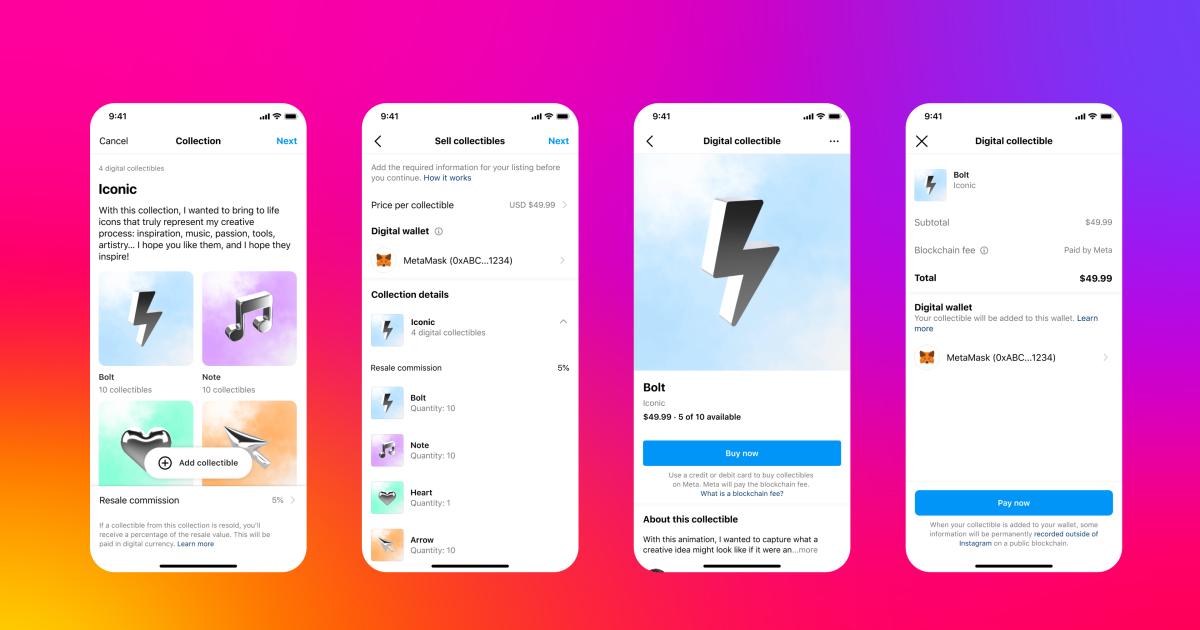
You'll always have a home here 🏡
This goes out to all the creators, collectors and fans of digital collectables on Instagram
https://t.co/j1sfu7V2gf is your simple, fun and safe way to:
- do what you LOVE
- OWN what you do
- right where you ARE
I think the challenge is that everyone can now build apps
But
1) almost nobody has distribution (like an audience), or
2) the money to pay for distribution (ads or UGC), or
3) the creative genius to get distribution for free (classically called guerilla marketing)
this feels exactly like the early cloud era...
at first everyone just picked the easiest premium option and nobody cared because the bill was still small. then usage exploded, finance noticed, and suddenly governance became a product category. ai inference is going through the same cycle now. the winners won't be the teams using the most powerful model everywhere... it'll be the teams that can route work intelligently based on task, risk, latency, quality, and cost
Quite a week for open-source AI. Especially American open-source. Nemotron 3 Ultra is the most important release in quite some time. And some really cool RL and fine-tuning work from Harvey.
Token costs are becoming one of the hottest topics for any enterprise I talk with right now. It’s very bullish for AI in general because it means these systems are being used at a scale that wasn’t contemplated before.
It also gives way to another form of differentiation that will emerge for the applied AI layer, which is model routing.
As tokens take on a significant amount of the cost of any given workflow, then companies will inevitably want to ensure that their dollars go into the most efficient use of tokens for the particular job at hand.
Frontier intelligence will always be relevant at the high end of tasks, like coding, legal and financial analysis, healthcare, and more. And dollars spent here will only go up over time. But, equally, you can peel off individual tasks to lower cost models (whether they’re from open weights vendors or the major labs) and deliver a more efficient end outcome.
To do this effectively, the applied AI layer needs to understand the workflows in their domain better than anyone else, and be able to mix and match models to different jobs. If you’re doing document extraction, you need to know which models perform better or worse for any given document type. If you’re legal analysis, you want to know which models perform various types of tasks best. And so on.
This will become one of the bigger differentiation points over time. The companies with the best evals, the best ability to route the workloads, and those that have business models directly aligned to customers financial goals, will be in a great position.
Measuring someone's productivity by their token usage is a horrible idea. Giving everyone the same fixed token budget isn't much better. So what's the right way to roll out AI across your org?
We built a system to measure how many productive engineering hours every Devin task is worth, validated against a dataset of real engineers’ times estimates. The goal is to answer the fundamental question that companies are grappling with: how much real value are you getting from each of your agent sessions?
On top of that, we're giving an AI productivity guarantee! Now if Devin delivers less engineering value than you're paying for, we fund your usage until it does.
The whole industry needs to move from measuring activity to measuring output. We hope to see more AI companies taking this approach.
Let's check in on how VCs are performing (past 9 vintage years).
1) Power law is alive and well. Gaps between top 10% and top 5% are wide.
2) 2021 is shaping up to have been a terrible year to be investing as a VC
Gosh I love the OSINT community. This project throws every plane flying overhead onto your ceiling in near real time – decoded from a cheap radio, w/ live stars and the ISS behind it. Falling asleep under a live map of the sky. h/t @CameronPaczek
One week later, incredible progress. It’s a 24/7 operation with a solid path forward to launch this year, helped by a lot of luck. @NASA and @USSpaceForce have both been extremely helpful.
This team. Never tell them the odds.
So deserved, Revolut is an amazing company and significantly changed my life
Before Revolut I had so many problems with banks
I used to have a Dutch bank called Rabobank who would freeze my card at random times while I was traveling, and no they didn't even have an unfreeze button in the app, I mean they barely had an app
I'd literally have to fly back to Holland and go into the bank office in my tiny hometown to then make an appointment with them to unfreeze it
One time in I think 2014 I was in Bali and they froze it, I flew back and at the bank office they said it was time for me to get a mortgage, when I said I didn't want one they said do you have insurance? They were freezing my card to then use it to make me come to their office to then upsell me shit
Another time in 2017 (I think some of you remember) they froze my card in the US, and with no money I became homeless, luckily X (back then Twitter) helped me out and you all ordered Ubers for me on request and @manuthan gave me a place to sleep at @outsiteco in Venice
You don't hate dinosaur banks enough!
After experiencing all that I got Revolut and I never had any issue like that again
(Well except for moving to Portugal where I was forced to open a Portuguese bank account at MillenniumBCP, which was possibly an even worse experience than Rabobank, my premium package private banking account manager would always be unreachable and only email me to tell me she'd go on holiday and would be even more unreachable 😂)
Revolut has been my main bank app for the last decade and it's been wonderful, I've pumped millions through it and it barely flinched, sometimes they ask me documents to prove where the money comes from, but that process is super smooth and via chat
Revolut is another great example that you can make something that makes everyone's life significantly better and society will reward you by making you rich!
THIS CHINESE DEVELOPER VISUALIZED WHAT 300 KIMI K2.6 AGENTS LOOK LIKE IN ACTION - AND IT LOOKS EXACTLY LIKE A BRAIN WORKING FOR YOU
every line on screen is a connection firing in real time - hundreds of neurons across multiple layers, activations lighting up, signals passing through the network simultaneously in both directions
this is not a diagram and not a concept - this is the actual mechanics of what happens inside the model every time it processes your request
now multiply that by 300 parallel agents running 4,000 coordinated steps at the same time - while you drink coffee the entire system fires neurons and does the work for you
a team paying $62,000/month on Claude Opus cut their bill to $129 by switching to Kimi K2.6 as the execution layer - Opus plans, Kimi executes, $54,000/month stays in the business
what looks like fire on screen is your new employee who never sleeps, never asks for a raise and never goes on vacation
most people pay for subscriptions that forget everything tomorrow - he built a system that works and compounds while he sleeps
America's best open model shipped toda (550 billion parameters) and it's serving tokens on @nebiustf
Nemotron 3 Ultra is the most intelligent open-weights model the US has shipped. NVIDIA gave away the weights, the data, and the recipes. The intelligence is now a free, downloadable file. That is the headline, and it is real.
But a free file is not a product. This model was co-designed for NVFP4 on Blackwell. The thing that makes it fast is the format and the hardware path, and that only pays off on a serving stack tuned to exploit it. Download the weights and run them naive, you leave most of the model on the floor.
The work that turns the file into fast, cheap tokens is cache-aware routing, disaggregated prefill and decode, speculative decoding shaped to your traffic, dedicated capacity, regional isolation. The conversion layer. Nobody clones that in an afternoon.
That layer is what a token factory is. The model is the crude. The factory is the yield.
Nemotron 3 Ultra is live on Nebius Token Factory today, tuned to run the way NVIDIA built it to run. The weights are everyone's. The throughput is the part you come here for.
Jensen shipped the weights, we shipped the throughput.
Anthropic says Recursive Self Improvement is approaching faster than they expected.
Quoting from the blog:
'What should we do?
If it were possible to effectively slow the development of this technology to give ourselves more time to deal with its immense implications, we think that would likely be a good thing. But if a slowdown simply lets the least cautious actors catch up technologically, it could leave everyone less safe. Without a global coordination mechanism, companies and governments will have to make difficult decisions about safety while under competitive and geopolitical pressures.
We believe it would be good for the world to have the option to slow or temporarily pause frontier AI development to enable societal structures and alignment research to keep up with the advance of the technology. The Anthropic Institute will conduct research—in collaboration with many others—and take actions to help build the systems that a credible slowdown or pause would require. These systems would enable frontier AI developers to verify that others globally have actually stopped or slowed, and that a bad actor could not use the auspices of a coordinated slowdown to jump ahead in secret. If such systems existed, we expect that we would slow down or temporarily pause, if other developers at or near the frontier also did so in a verifiable manner.
A meaningful slowdown or pause would require multiple well-resourced labs at or near the frontier, in multiple countries, agreeing to stop under the same conditions. It would also require that each can verify that the others have actually stopped. Due to the unique characteristics of AI systems, the detectability (a lower standard than verifiability) element of this arms control problem is much more challenging than with other technologies. Training runs are far easier to conceal than missile silos, their inputs are general-purpose, and the incentive to defect quietly is enormous, because whoever continues while others pause could inherit the lead. A credible pause also has to specify what triggers it, what lifts it, and who adjudicates.
None of this is necessarily impossible in principle—the world has built verification regimes for other complex technologies (e.g., the Intermediate-Range Nuclear Forces Treaty)—but those regimes took decades to build both the infrastructure and the trust. We don’t have that long. A unilateral pause by one lab, by contrast, is achievable immediately, but accomplishes much less: it would change who the front-runner is, but it would not create the wider deliberative process that is currently missing.
In the coming months, we will organize conversations where policymakers, researchers, civil society, and other AI companies can help answer some of the questions this piece raises, especially around full recursive self-improvement and how to create better options for coordination and deliberation. We’ll publish what comes out of it. The window to investigate the questions together is here, and people outside AI companies should be involved in this deliberation.'
Good thought provoking post from Anthropic. I think this paragraph points to the key element of the optimistic scenario of AI:
“There has been an explosion of new ideas, initiatives, tools, and simulations, as a result of Anthropic employees working with highly capable models—far more than we have the capacity to pursue. The rate at which organizations can spot and fix these bottlenecks may be a skill that improves over time, and it may become the most important skill for any organization.”
AI lowers the barrier dramatically to allowing us to do more. As a result of that, we have far more ideas than we can pursue, and for the ones that we want to pursue we’re ultimately limited by our ability to go take on the surrounding work to execute those ideas. There’s almost no amount of AI progress that can happen where that goes away.
AI is going to let us build much more software, launch more marketing campaigns, research more drugs, and so on. All of this work, even when augmented by agents, still ultimately requires people to manage.
Canada launched its national AI strategy this morning, and if you live in Canada the federal government may fund, provide compute to, and possibly even take a stake in your idea. They also plan to provide access to AI agents for every post-secondary student, which sounds like a nice contract for somebody.
I've had an idea for something agents will subscribe to, so I might do this. but I'm going to see how far I can go with Chatty and Claude myself first.
World Labs CEO Dr. Fei-Fei Li: "The world is not made of words."
"Language models have given machines an extraordinary command of concepts, vocabulary, and reasoning, but the physical world, virtual or real, runs on a different substrate."
"Where language models learn the statistical structure of text, world models learn the statistical structure of space and time: how light falls on a surface, how a garden looks from an angle no camera has captured, how objects respond to force and follow the laws of physics."
"Language gave machines a way to talk about that world. World models are how machines will finally come to understand, imagine, reason and interact with it."
Full piece: https://t.co/C9qOJg5wuc
Aggregators are a cancer to social networks; they’re all running on auto-pilot.
Instagram killed aggregators in 2022 (e.g., “thefatjewish” and “middeclassfancy”) and it led to an explosion of original content.
It is going to work much better for X:
Our users are smarter and have a lot more to say—as long as their voices are not drowned out by automated accounts.
We are publicly demonetizing the most egregious aggregators and using them as examples, so the rest can start evolving.
The endstate of X in a month: we will never pay twice for the same content. We will only reward for net new contributions to the Timeline.
Introducing Agent Cookie. 🥷🏻🍪 For anyone running @OpenClaw or @NousResearch's Hermes on a Mac mini: I kept finding my agent logged out of everything, and it sucked. So I fixed it.
"Add this to my Amazon cart." Sorry, logged out again. "Order my usual on Instacart." Nope, not logged in anymore.
The fix: your laptop's cookies, CLI tokens, and API keys sync to your Mac mini. Continuously. Encrypted end-to-end over your Tailscale tailnet. No logging in twice.
🌐 https://t.co/41VezMs9S6