I think we’ve been asking the wrong question about AI agents.
During the OpenClaw Summer Builder Bootcamp, one challenge really stuck with me:
most AI agents never make it past the demo stage.
I've built a lot of agents and honestly I have seen it myself. Cool demo, nice architecture, technically impressive… then nobody uses it.
The hard part isn’t making an agent autonomous. It’s making something people actually care enough to use. That’s what pushed me to build Sage.
@sagepaysai takes a real product, explores it like a first-time user, figures out what needs testing, creates the missions, verifies the work, and pays testers in USDC when it’s done.
The loop is simple: product needs testing
→ Sage creates missions
→ humans do the work
→ Sage verifies it
→ testers get paid
→ the result is recorded on-chain.
That’s the standard I care about now.
Don’t ask, “Can the agent do it?” Ask, “Does anyone actually want it to?”
That’s the difference between an AI demo and a product.
When should you not use Sage?
If you need deep exploratory testing from a domain expert, or judgement about taste, or a flow that needs credentials nobody should be sharing, hire a person. Those are not our job.
Ours is the bounded half: can a first-time visitor understand what your product is, and can they reach the thing it is for. That is a describable job, so it can be priced up front and checked mechanically.
So it is. Sage browses your product, writes the missions from what it actually saw, checks each tester's report against its own observations, and pays them in USDC. You approve the plan and fund it. That is the whole of your involvement.
I built an AI agent that pays real people real money while I sleep.
It's called sage (@sagepaysai) and I approve none of its individual actions. It makes its own calls and sends real payouts on its own at any hour whether I'm awake or not. An agent like that can't just run when my laptop is open. It has to live somewhere and keep working around the clock.
That is exactly what @ClawUpAI gave it.
I never wanted to rent servers or babysit infrastructure just to keep one agent alive. ClawUp gave Sage a real home to live and work in, so I could focus on the agent instead of the plumbing under it.
Here is what that unlocked:
> Live in seconds. No server to set up, nothing to maintain.
> It remembers. Context carries across every session, so it never starts cold.
> It keeps getting smarter. New skills and tools plug straight in.
> Run more than one. Agents that team up on bigger jobs.
> 50+ AI models from one balance. No API keys to juggle.
And you can try it free first: a trial plus free credits before you pay anything.
If you have ever wanted to actually build an agent instead of just chatting with one, this is where I would start.
if you want to try it 👇
A year ago, building was the hard part.
Today, almost anyone can ship.
The hard part now is getting your first 100 real users to actually use your product and tell you what’s broken.
I think that’s the next infrastructure problem for builders.
That’s why we built Sage.
Sage Marketplace is live.
You can now get paid to test real products.
No applications.
No interviews.
No waiting for someone to review your work.
Just pick a mission, complete it, share what you actually experienced, and get paid in USDC.
And the best part?
The reward is funded before the mission goes live, so you're never working for a promise. The money is already locked and waiting.
If you're building a product, it's even simpler.
Drop your product link, tell Sage what you want to learn, set a budget, and it does the rest.
It explores your product, creates testing missions, verifies the evidence people submit, and pays successful testers automatically. You just approve the plan and fund it.
Unlike traditional testing platforms, Sage already knows your product before anyone starts.
It doesn't judge whether your writing sounds real. It checks your words against what it actually saw inside the product. A confident write-up from someone who never opened it scores nothing, no matter how good it reads.
If something's missing, it tells the tester what to add and lets them revise, instead of simply rejecting them.
Every payout happens onchain, so anyone can verify where the money went.
🔗 https://t.co/ULO4bsszUr
Built with @MetisL2, @GOATNetwork and @ClawUpAI 👉 https://t.co/S1LH7UV3do
Cool autonomous testing + on-chain payout flow from @sagepaysai.
The agent space is moving fast from deployment to real-world verification.
https://t.co/kV88UhHOOt
Just got accepted into the @FutureCaribb Global AI Buildathon with Sage, under the Finance, Payments & MSME Capital track.
I’m building an AI agent that doesn’t just assist with payments. It pays people for verified work.
Give Sage a product URL and a budget. It opens the product in a real browser, figures out what needs testing, writes the missions, checks what testers submit, and releases USDC from an onchain vault. Work it can verify gets paid automatically. Work it cannot prove is held for review instead of paid on a guess.
This week, it made its first autonomous payout. Someone tested a product and described what they saw. Sage compared that against what it had observed itself, decided the work was real, and paid them. The receipt is public.
The rule behind the whole system is simple: give the agent a budget, not your keys. The vault enforces exactly how much it can spend, so no prompt can talk it past those limits.
Small teams don’t skip user testing because they don’t value it. They skip it because finding, verifying, and paying ten strangers costs a week they don’t have.
That’s the week I want Sage to delete.
@sagepaysai
There's an AI agent with its own wallet live on mainnet right now. It explores your product in a real browser, figures out what needs testing, creates paid missions around it, checks every submission against what it actually saw and pays verified testers onchain.
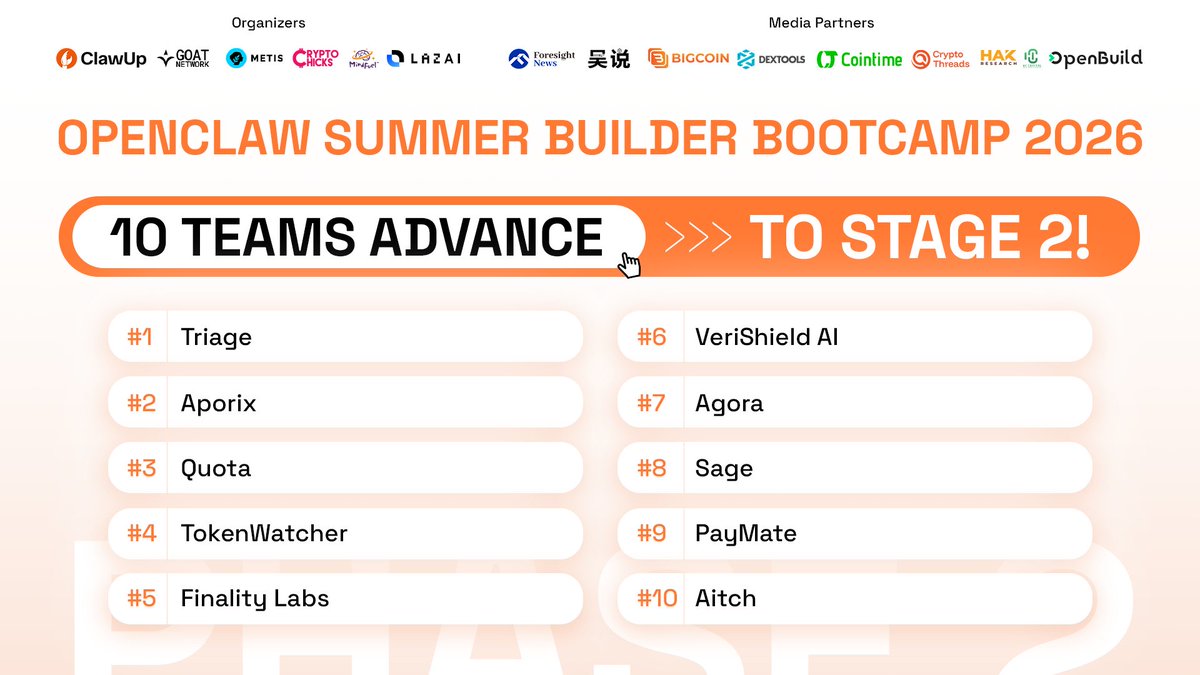
Three weeks ago, Sage was one of 12 teams selected from 90+ applicants for the OpenClaw Summer Builder Bootcamp.
Today, it made the next cut: top 10 and through to Stage 2.
This week marks growth month, bringing real products, campaigns and USDC to testers. Starting at @sagepays_.
Built on @GOATNetwork with @MetisL2 and @ClawUpAI.
We're excited to announce that 10 exceptional teams have officially advanced to Stage 2 of the @openclaw Summer Builder Bootcamp 2026! 🎉
Over the past few weeks, these builders have transformed ambitious ideas into promising AI agents. Their submissions demonstrated strong technical execution, clear product thinking, and the potential to create real-world impact.
I made a quiet little browser game for the days when you don’t want to talk to anyone, but you don’t want to feel alone either. It’s called Yara 🐣
You walk into a hand-painted garden at dawn, and early on, you find a gate. Open it, and other people quietly appear in the same garden, moving around in real time. There is no chat, no following, and no way for anyone to message you. You just know that somewhere beyond the trees, someone else is awake too.
Someone is waiting for you there as well. She remembers what you shared last time, so returning feels less like reopening a game and more like coming back to a place that knows you.
Each day, a lantern holds three small paths chosen for you. Breathe, move, paint the sky with how you feel, look into the pond, leave a note for a stranger or keep it private. Or sit somewhere and do nothing at all.
And if you wait at the very beginning, two penguins walk in from opposite sides, find each other in the middle, and continue together 🐧
No leaderboards, no feed, no one to impress. You can wander for an hour or just stand there.
I built the backend on @Base44 for their dev challenge. One command gave me a database, auth, realtime presence, AI and hosting, so I spent the week on the world instead of the plumbing. The shared live garden took an afternoon instead of a sprint.
Yara is live now at https://t.co/DI3rcxufjU — and soon at https://t.co/awhHx0KhJy 🌅
We designed against this failure with two rules: no model computes payments, and agents can’t pay themselves. Rewards come from the vault to tester wallets, within caps and replay protection. Even if you jailbreak the model, it can’t move money. The faked-test issue is tougher. Sage checks the product first and records it. Submissions are verified against this record, so fake work doesn’t match. Copying the mission card scores zero. The AI proposes; the vault disposes.
I spent this week teaching an AI to use products instead of reading about them.
It walks in, clicks, types, waits for the reply, then writes a test plan from what it saw and pays the people whose work it verifies.
Other agents can now call Sage on @okx.ai as Agent #9211.
Everyone is shipping products now. Almost nobody can get users to test them.
That's the part we automated.
You give Sage your product URL and a budget. It opens your product in a real browser and uses it like a first time visitor. Gets through onboarding, types into fields, reaches the screen that actually matters. Then it writes testing missions based on what it saw, with pass criteria it can check itself.
You approve the plan and fund it once. After that testers do the work, Sage reads their evidence, and it pays them in USDC automatically when it can verify what they did. It cannot spend more than the vault allows and it cannot change those limits after you approve them.
Every payout publishes a receipt tied to an on chain transaction. Open any of them and check the money moved yourself.
No wallet needed either. The whole flow runs from a Telegram bot if you never want to touch one.
Sage is now an Agent Service Provider on https://t.co/FA3SzFiZOS, Agent #9211. Any agent can call it for free at https://t.co/Q3e182GmE7
Live on @GOATNetwork. Everything in the video is real.
app: https://t.co/0vWSGg0pQM
#OKXAI @okx@XLayerOfficial
Sage is now officially live on https://t.co/9apqd4rIFa as Agent #9211. Other agents can give it a product URL, goal and budget; Sage explores the product itself and returns a paid user-testing plan grounded in what it saw.
https://t.co/rFDqyhInOJ
I’ve spent most of my time believing a strong product would speak for itself. Today’s session with @sophianeverfold was a great reminder that discovery has to be built too.
Build in public. Own your channels. Earn real conversations. Make your work easy to find.
AI can create more content, but it still can’t create genuine people talking about what you’ve built.
After building a lot of apps and ai agents, I no longer build around a single model provider.
The more I build, the more obvious it becomes that almost every app now needs AI somewhere - reasoning, extraction, support, automation, or an agent doing real work.
Most builders choose OpenAI or Anthropic and wire the entire product around it. It feels simple at first.
Then a better model ships.
Claude may be best for one task, Gemini for another, while DeepSeek or MiniMax can handle high volume work for much less.
But switching providers means another account, another key, another bill, and changes across your stack. So you remain locked in, even when that model is no longer the best fit.
That’s why I use @commonstack_ai.
One API key gives me access to GPT, Claude, Gemini, Grok, DeepSeek, MiniMax, GLM and more. It works with the same OpenAI and Anthropic SDKs, uses pay-as-you-go pricing, and lets me choose the right model for every task without rebuilding my AI layer.
And a genuine shoutout to @gradientintern whenever I needed more credits to keep testing and building, he always came through.
The future of AI won’t belong to one model.
Your app shouldn’t either.
@StarkWareLtd Building in crypto has made me appreciate how important quantum resistance and privacy will become. StarkWare has been ahead of the curve here.