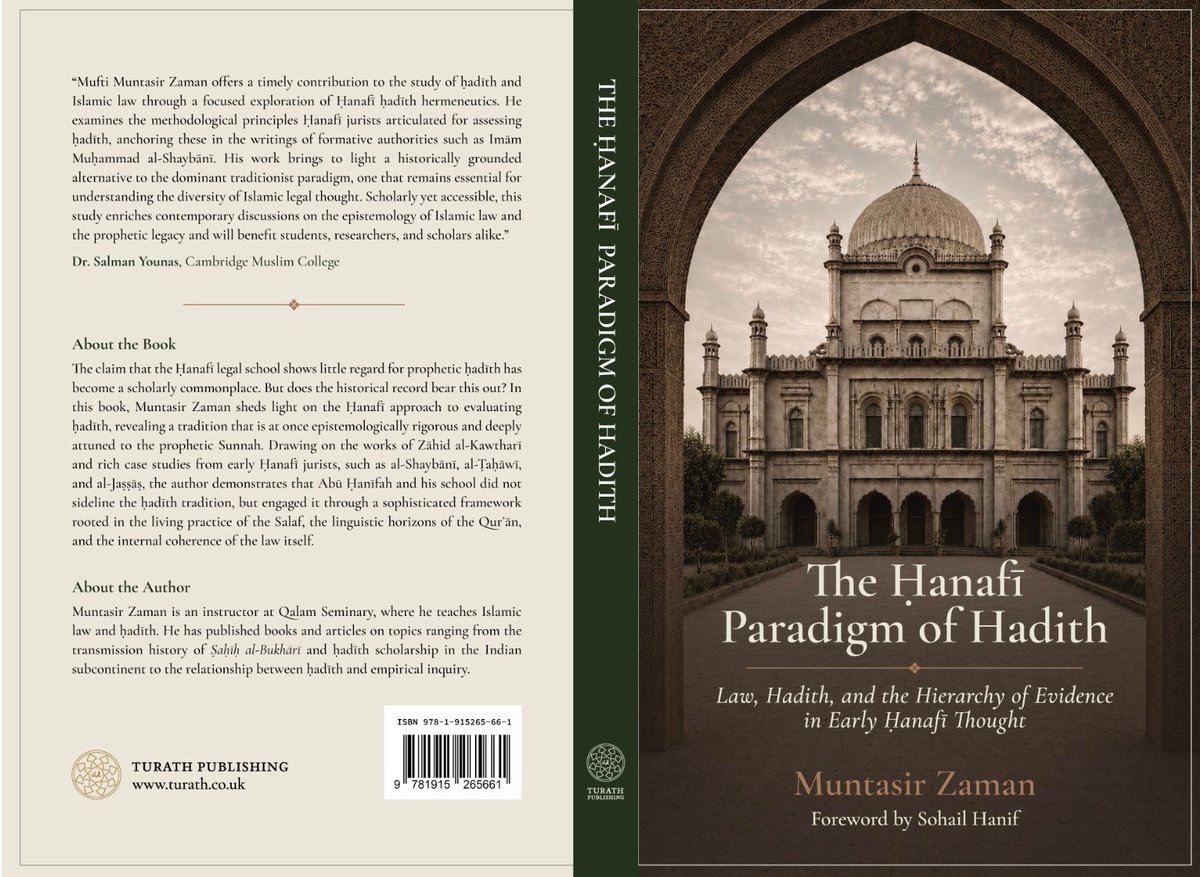
I’m a PhD candidate @ UC Berkeley working on conceptualising a distinctly Ḥanafī theory of language.
Broadly thinking about; Islamic law and Arabic linguistics. More specifically thinking about: Ḥanafī uṣūl and furūʿ, intention, silence, form, and meaning, and how speech binds, breaks, or does nothing at all.
Clément Salah and I are convening a workshop at Queen’s College on 4 December to mark the 80th anniversary of Joseph Schacht’s arrival in Oxford.
The full programme is available here: https://t.co/4zvWAQDCRf.
“Agent O’Houlihan, fantastic work. You scored the highest on the Arabic exam, so we’re sending you to Yemen. You’re going in deep undercover as a farmhand. The one thing you absolutely cannot do is become addicted to khat.”
Gonna use this in class to try and talk about how scholar have sought to conceptualize why free will vs. predestination in not a dilemma from God's perspective outside of time.
New from CMC Press. Piper at the Gates. A detailed scholarly analysis of Muslim consciousness from Islamic influences on Western literature and music, to a chapter on the rights of women. Pre-order from Amazon, Waterstones, or US/Canada: https://t.co/OBxcdG1pJB
You bring me 100 Hanafis, 10 of them have read Jassas, half of them are dars nizami goyim or Syrian muqallids, and the other ones are Salafim - Ibn Abi Izz over here, shrimp over there. When they join madrasa 20-30% are fans of imam Ahmed, they make fun of Al Makharij Fil Hiyal
Miss Gomez, we are not really interested in this kind of confrontational slop-right political posturing here. It doesn't work, it doesn't persuade, it just gets you banned from things.
I can't help but notice that you have failed to take the measure of what is actually happening in Britain. It is not merely that there are Muslims here that is the problem, and if you were going to pick a Muslim to insult, Shabana Mahmood is actually a pretty poor choice as she's currently deporting a lot of foreigners.
The hysterical tone of your response belies the incredibly feminine nature of your worldview. You seem to have no self-control and no theory of mind for people other than yourself. I'm sure being fat is a real concern for an unmarried 26-year-old woman, but as a 46-year-old married father of 4, it really doesn't bother me.
Instead of considering that perhaps I have a point, you attempted to engage in some bizarre cat-fight with me through hyper-masculine posturing as if you were some transgender chihuahua. Needless to say, I'm not impressed.
It's almost impossible to overlook the irony of your activism. You feel like a South Park parody come to life, like their Jennifer Lopez character saying "I'm heer to sayve the Weest!" when you are literally a Columbian immigrant, and upon being banned from a white country your first thought is to literally break in. Must be in the blood.
Put simply, I'm glad you're banned from Britain, and if I were the home secretary, I would ban you myself. Not only are you an offensive foreigner, which is grounds enough to have you banned, but you are also incapable of following the rules, or even engaging with your fellow man through the lens of Christian good-will.
We are on a mission from God to save England from the ravaging hordes of barbarians, you are on a mission from your uterus to monopolise as much attention as humanly possible.
We are not the same and you are no use to us.
Just finished a proof of Munis Faruqui's astonishing new biography, Aurangzeb 'Alamgir and the Mughal Empire, forthcoming from @juggernautbooks. It is a landmark of patient archival scholarship and an utterly remarkable book, the product of thirty years hard labour in far-flung archives, dredging up a massive cache of previously unread and neglected primary sources. Munis Faruqui has written a calm, considered and beautifully nuanced reassessment of the most controversial and polarising figure in South Asian history, and he has succeeded in bringing a much-caricatured prince to life in a way no previous study has ever managed to do.
It is ultimately a study in profound failure: by the end of his life, Aurangzeb had undermined the military reputation of the Mughal Empire and brought the whole edifice to the point of political collapse. He regarded himself on his deathbed as abandoned by God. How a prince once known as a talented administrator, a pragmatic politician and remarkable general brought himself to this pass is made wonderfully clear by Faruqui's patient scholarship and the pellucid clarity of his writing. The result is rich, learned and complex book, full of fresh insights. It unquestionably one of the most important works on Indian history produced this century.