It is interesting to talk about the origin of Armenians and Armenia as our close neighbours. As you may know their autonym is "hay" or "hayk" which we don't know the etymology of so far. Their name for their own country is "hayastan" which clearly shows Iranic influence too, as does the vocabulary of their language too (plenty of Iranic words to a point where pre-mldern scholars thought it was an Iranic language as well).
The first historical record of their name is via achaemenid inscriptions that attest "armina" as a subsatrapy of Media. The Greeks then adopted this term from Iranics, seemingly, and called the people "armenioi" in ancient times. An actual record of their language is not attested until much later in the fifth century CE.
And this is relevant because, very interestingly, the toponyms of the subsatrapy "armina" that we know (according to the encyclopedia Iranica) are not from the armenian language but most likely of Hurro-Urartian nature. The Armenian language suddenly appeared out of nowhere and what seems to have happened is that there was some Urartian country Armina / Armenia that then the actual speakers of Armenian, the Hayk, either assimilated or replaced.
What we dont know is if the Urartians were an elite ruling over an armenian speaking population that had diffused from Yamnaya through the Caucasus to Armenia and the elite would die off because their state collapsed OR the population spoke Urartian and then an armenian elite came from the west, somewhere within Phrygia or at least close to it as according to Herodotus.
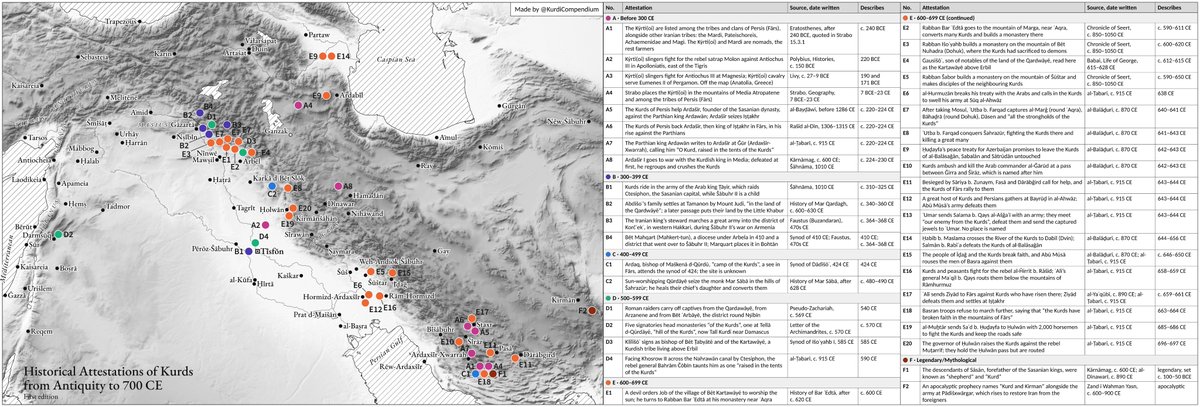
I plotted every historical activity involving Kurds on a map, from classical antiquity to the aftermath of the Islamic conquests (c. 240 BCE–700 CE). On the right, I’ve tabulated the sources on which they are based.
This does not include Corduene, Karduchoi, etc., as these are linguistically unrelated terms, and Kurds settled these lands later as foreigners to the region.
The Kurds in this era were not a generic term for Iranian nomads or shepherds. They are explicitly mentioned as a specific tribal organisation among many other old Iranian tribal organisations. This era predates the ethnic character that Kurds acquired after the development of the Islamic age.
I will be making many more exhaustive maps in the future, detailing all things related to Kurdology. A map of the Kurds of the early Islamic era is currently being completed and will be released in the coming month.
Open the map in a new tab for higher resolution.
This is important to understand when it comes to all and any linguistic behaviour. Linguists have the mindset to never change or adjust the form of speech of a language but that is fallacious for many reasons as I explain in this post:
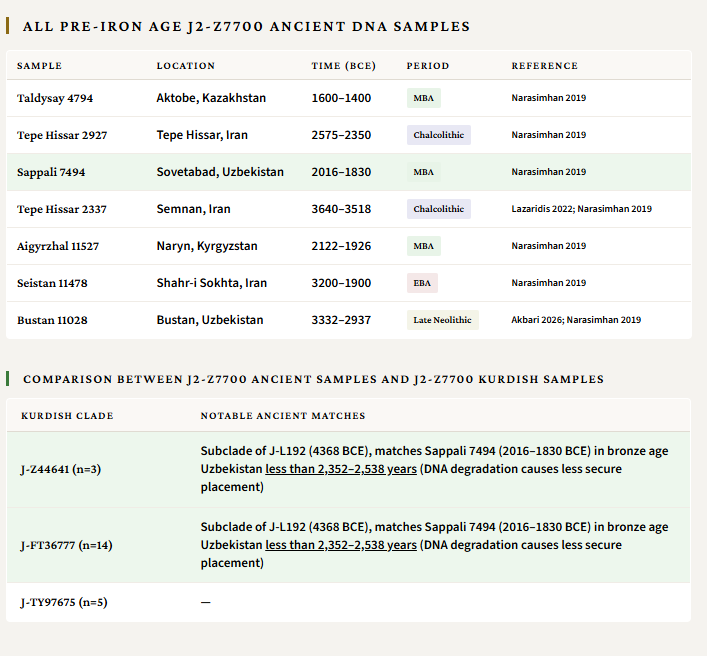
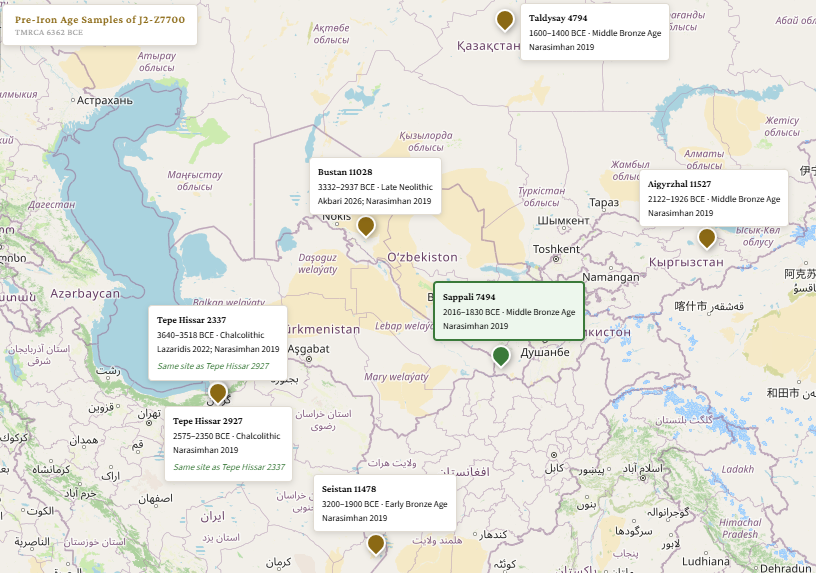
J2-L25 > Z7700 currently represents 6.6% of Kurdish Y-DNA lineages (334 samples). J2-L25 is estimated to descend from a man born around 6785 BCE. Given the modern and ancient distribution of this lineage, an Archaeological place of origin towards the tail end of the Caspian Mesolithic can be reasonably proposed, with J2-Z7700 representing its eastern offshoot. More late Neolithic samples inside of Iran are needed to place it with precision.
J2-Z7700 descends from a man born around 6362 BCE, whose descendants become prominent in the Chalcolithic and Bronze Age interaction spheres of Central Asia. This lineage can plausibly be attributed to the Jeitun culture, from which the Anau and Namazga cultures develop, later transforming into various South Central Asian (SCA) cultures. Most notable of these is the BMAC, who become majorly important in the genetics of early Iranians of South Central Asia, and thus Zoroastrian society.
Of the 22 Kurdish J2-Z7700 samples, 17 have a notable match with the BMAC site at Sappali Tepe Uzbekistan during the Middle Bronze Age. The ancestral clade J2-L192 is separated from the sample by approximately 2,300 years at maximum. The true separation is likely much smaller as it has quite a lot of DNA degradation which results in missing mutational markers that would otherwise place the match closer.
The remaining five Kurdish J2-Z7700 samples on J2-TY97675 have no notable ancient DNA matches sequenced to date. However, given that they match Uzbeks (at Bronze-Iron Age level) who have not yet been upgraded to Y-700 resolution, this lineage will almost certainly also resolve as BMAC in due course. Kurdish singer Aziz Waisi belongs to this branch.
Note: This isn't the only BMAC lineage in Kurds.
(Part 2)
For all I say and explain that Kurmanji or Northern Kurdish is the more innovative and less conservative dialect between NK and SK and possibly also between NK and CK; NK has two lexemo-grammatical features that are OUTSTANDING and EXTREMELY REMARKABLE, to the highest degree, among Western Iranic. It has one complete conservative feature more within SCNK too.
I will name and elaborate them with additional information in three individual posts.
PART 2:
(Feel free to ask for elaborations)
The personal pronouns that exist in Northern Kurdish are a complete set of proper and distinct subject and object pronouns that are most likely etymologically intact and not innovated.
Subject - Object
Az - Min
Tu - Ta
Aw - Wī, We or Awī, Awe
Am - Ma
Hūn - Wa
Aw - Wān or Awān
- Az and Min
/Az/ derives from Old Iranic nominative /Azam/ from Proto-Iranic *Adzam from Proto-Aryan *Agham from Proto-Indo-European *Egho(m)
/Min/ derives from Old Iranic genitive /Mana/ and is possibly cognatic to English my/mine and german /mein/ which are also genitive.
- Tu and Ta
/Tu/ derives from Old Iranic nominative *Tuam / *Twam from PIE *tu. It has shifted to /ti/ in WK.
/Ta/ derives from early Middle Iranic *taw from Old Iranic genitive /tawa/. *Taw shifted to /to/ in CK, WK, EK but for example Balochi has retained it as /taw/. Persid and NK did the sound shift of postvocalic w > h which led to taw > tah > ta in NK.
- Aw and Wī, We
/Aw/ derives from Proto-Iranic *Hau/*Haw. /Awī/ and /Awe/ are /Aw/ with the respective masculine and feminine object case markers which is typical for the third person pronoun to be applied to nouns too.
NK /av/ is from earlier /am/, as in CK, from Middle Iranic /im/ and Old Iranic /ima/ under the sound shift postvocalic m > v.
- Am and Ma
Before we talk about /am/, I have to explain /ma/. /Ma/ is from Old Iranic genitive /ahmāxam/ (based on Old Persian) and earlier *ahmākam* (based on Awistan). In CK it is /ema/ and in SK /īma/. In Middle Persian there was /amāh/ for it which is the perfect root for SCNK īma/ema/ma.
ahmākam > ahmāxam > ahmāh > amā
amāh > ama > ma
and
amā > emā > ema > īma
or
amā > ama > ema > īma
NK /am/ is most likely from the instrumental *ahmā . The instrumental is more likely because the second person plural is also based on the instrumental.
- Hūn and Wa
(Elaboration in the comments)
/Hūn/ ultimately derives MOST LIKELY from Old Iranic instrumental *hishmā/*hushmā which is RECONSTRUCTED BY ME and based on Awistan /xshmā/ BUT ONLY if the form *hushmā did exist. If not, it could be from the genitive *yūshmākam under special sound shifts which could apply to a pronoun used in high frequency.
(xshmā) hushmā > hushna > huhna > huhn > hūn, hun, hon
And in Laki:
hushmā > huhma > huma ( > hima), hūma (over homa)
Otherwise
yūshmākam > yūshmāxam > yūshmāh > ushmā > hushmā > etc
NK has /wa/ while the Badini subdialect has /hawa/ and CK /ewa/ and SK /īwa/. Wikiferheng reconstructs smth in the line of ishmā (as in Middle Persian) > ihmā > ahmā > amā > awā > awa > wa, hawa, ewa, īwa
With typical SCNK postvocalic m > w / v but it is very unlikely because NK always has m > v and the pronoun is /wa/ never /va/.
So no, I much rather suggest the dual *yawākam (based on Awistan) with:
yawākam > yawāxam > yawāh
And then mysteriously as with potentially *yūshmāxam:
yawāh > awāh > awā > wa, hawa, ewa, īwa
- Aw and wān
/Aw/ is again the normal and archaic third person plural without any marker since NK doesn't mark the subject plural which is am archaism from the loss of it in the late Old Iranic stage.
/Wān/ is from /awān/ and simply /aw/ with the typical object plural marker.
The very same goes for /av/ and /vān/.
And this is fascinating because most or all other Western Iranic languages and dialects have lost this conservative and authentic distinction between subject and object case for the pronouns even if otherwise more conservative than NK. Truly, a great archaism of NK!
Iranian Persians who consider themselves Iranians by identity and ethnicity and as the people of an Iranian ethnostate and want all the non-persian Iranians to do the same are stuck at immense fallacy. It is cope and bias.
If you tell Kurds that as Kurds they have to know other Kurdish dialects then the normal ones will agree and accept that way of thought. Even if they will not do the act themselves, they know this is the brotherly/sisterly familiarity we need to have with each other.
But dare you tell an Iranian Persian that they should learn Kurdish or Balochi or Lurish or Gilaki or another Iranic tongue that is not his beloved Farsiye Darbari, since he claims that they are all Iranians together ... they will accuse you of nationalism, separatism and whatever other ignorant and fascistic idea they could have.
Mind you, on contrary to everybody else I am aware of the Western Iranic background, frame and setting of the Kurds on EVERY single academic field to fullest extent.
But it doesn't mean much if we are talking about Kurds. Or "Iranians". It doesn't matter which state my parents or grandparents or which empire my ancestors were citizens of.
I am a Kurd and my native tongue is Kurdish. Persian or another language has nothing to do with me. Historically, it may have been a lingua franca or a language of script? Well, so was arabic. And today it is English. So this argument is useless.
Even if we consider a scenario where Kurds and Iranians/Persians inhabit a federalistic state, this will only ever be acceptable to the least if we have FULL AND FREE CONTROL of our own lands in Kurdish language and by Kurds. So what do we need that then for?
All we need is for Kurdistan to be liberated and independent and to find to our true Kurdish sense of identity.
My post is specifically about ethnic endonyms. Endonym refers to what a population calls itself. There is no ethnic Persian endonym today, nor has there been one historically, the exceptions being Iranian diaspora communities heavily influenced by Qajar-Pahlavi era revisionism. It is essential to understand what the term Irani even means today and what it has meant throughout history, because this is one of the major points of confusion regarding the topic of "Persians".
It is important to understand that Kurds, Baloch, Lurs, Mazanis, and others are completely post-Islamic ethnicities. Prior to Islam, the primary ethnic marker was the label "Irani" itself, regardless of whether one was a Persian speaker or not, for most of the plateau. In the context of pre-Islamic Iran, being Iranian was a religious and ethnic identity tied directly to Zoroastrianism, which even developed a more secular national symbolism during the Sassanian era.
That is not to say Kurds, Persians, and others did not exist. Kurds, for instance, were attested as a specific tribal confederation of Iranians before Islam. Meanwhile, the term Persian during the Middle Iranian era either referred to a language or to an inhabitant of Persis province as a demonym. In the Old Iranian era, the term Persian referred only to one tribal confederation of ethnic Iranians.
With all of this in mind, after the advent of Islam the term Irani obviously lost its Zoroastrian connotations among Muslims, but retained its national and ethnic meaning. Many Persian and non-Persian speakers continued to use the term Irani throughout the Islamic age as an ethnic marker. For example, the native speakers of Isfahan who speak CPD (non Persian NW language) call themselves Iranis.
On the other hand, many Iranians ceased using the term Irani as a primary ethnic marker and developed their own sub-identity, or even a full identity, outside of it. The reality is that even Gilakis, Mazanis, and Lurs still use the term Irani to describe their ethnicity in some capacity. Even among Shiite Kurds in Iran, it is very common to ethnically identify as Irani while also identifying as Kurd.
The ethnic term Irani has gained a heavy Shi'ite connotation as a result of the Safavid state and the policies of the subsequent Iranian kingdoms, something that was only partially reversed during the late Qajar and Pahlavi eras.
The question or objection that the term Irani is too broad is not a valid one, because ultimately the concept of ethnicity is a social and dynamic construct, not defined by hard lines. The metrics by which one population defines itself will not be the same as those of another. This is also true of how ancient populations defined themselves historically, as opposed to how people identify after the spread of European-style nation states in the 18th and 19th centuries.
Yes, ethnicities are typically defined by measurable metrics such as genetics and language, but that does not negate the fact that the in-group of what a population considers "us" is entirely dependent on which metrics they value and how much weight they assign to them. An excellent case in point is the fact that Zazas and Gorans do not speak Kurdish by any linguistically objective metric, but are ethnically Kurdish. For other societies, they cannot comprehend how that can be true, because the metrics they hold of value to define ethnicities are not the same as how Kurds have traditionally defined their own ethnicity.
Just because Iranians prior to Islam ethnically called themselves Iranian, doesn't mean they didn't have ways to differentiate themselves between each other. For example, Iranians identified with the province, city, etc they were from, or which tribe they were from, etc. The were many layers to Iranian self identification underneath the ethnic designations.
The last point people need to grasp is that words can have multiple meanings. Yes, the term Iranian is a national designation that even Arabs and Turks could fall under. But it is clearly also an ethnic marker and categorisation, and for the few Zoroastrians remaining in the world today, an ethno-religious one as well. When I say Kurds are Iranian, it obviously does not mean that Kurds hold an Iranian passport. The statement is clearly about ethnic categorisation, and it is a valid one.
@mikehawk773@KurdishDNA@QizilbashDNA what‘s proto turkic? also no 5% East asian is not low at all.
around 3-4% EA would mean 8-9% oghuz turk, which is high
Interesting how @QizilbashDNA hyper-focuses on trace Turkic signals in Kurds while ignoring the rest.
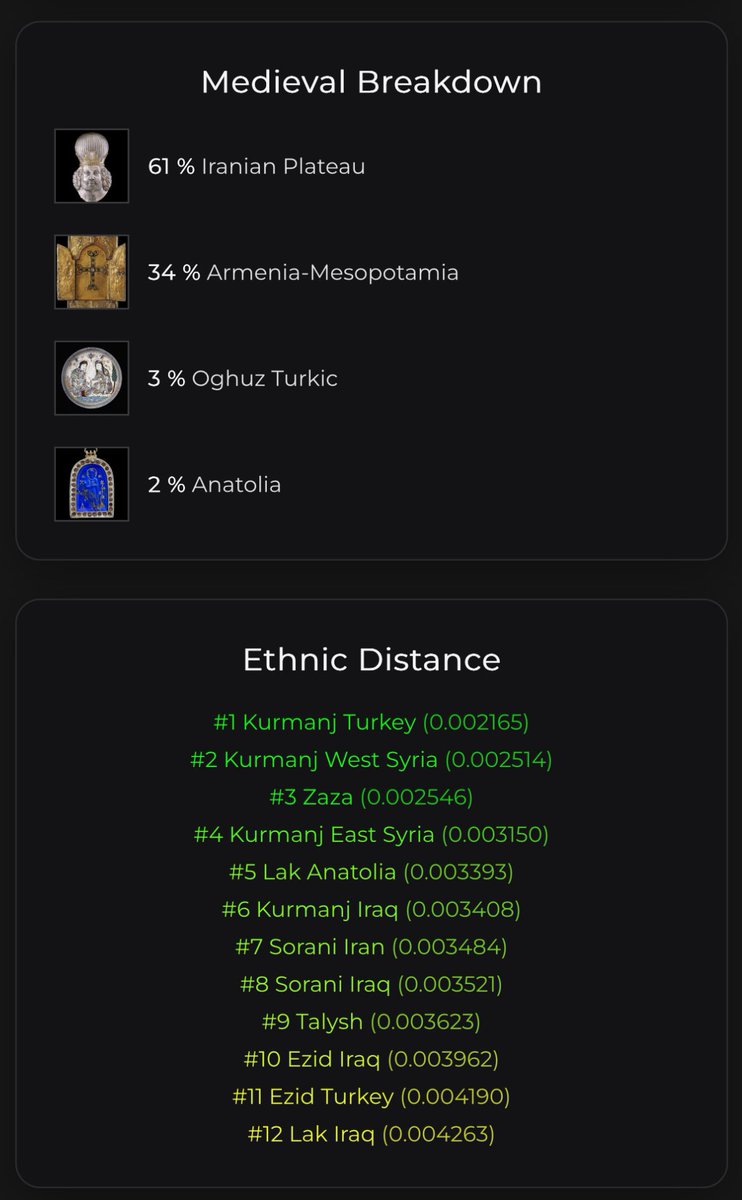
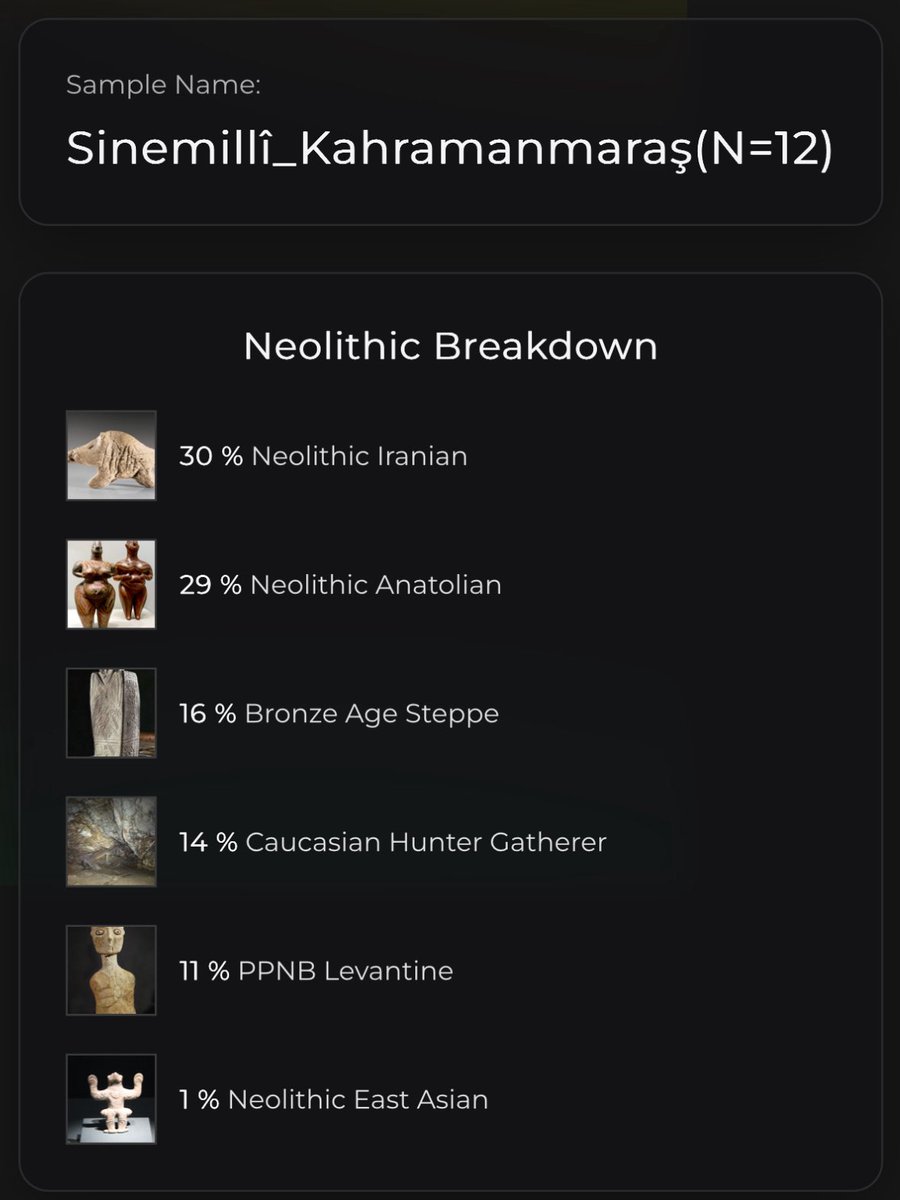
Sinemillî are overwhelmingly J-Z7706>SK1381, a clearly Iranian subclade. https://t.co/WDdokUD1ZB
Their autosomal makeup shows high Medieval Iranian affinity. Very low Turkic input for a group neighboring Turkmens for centuries.
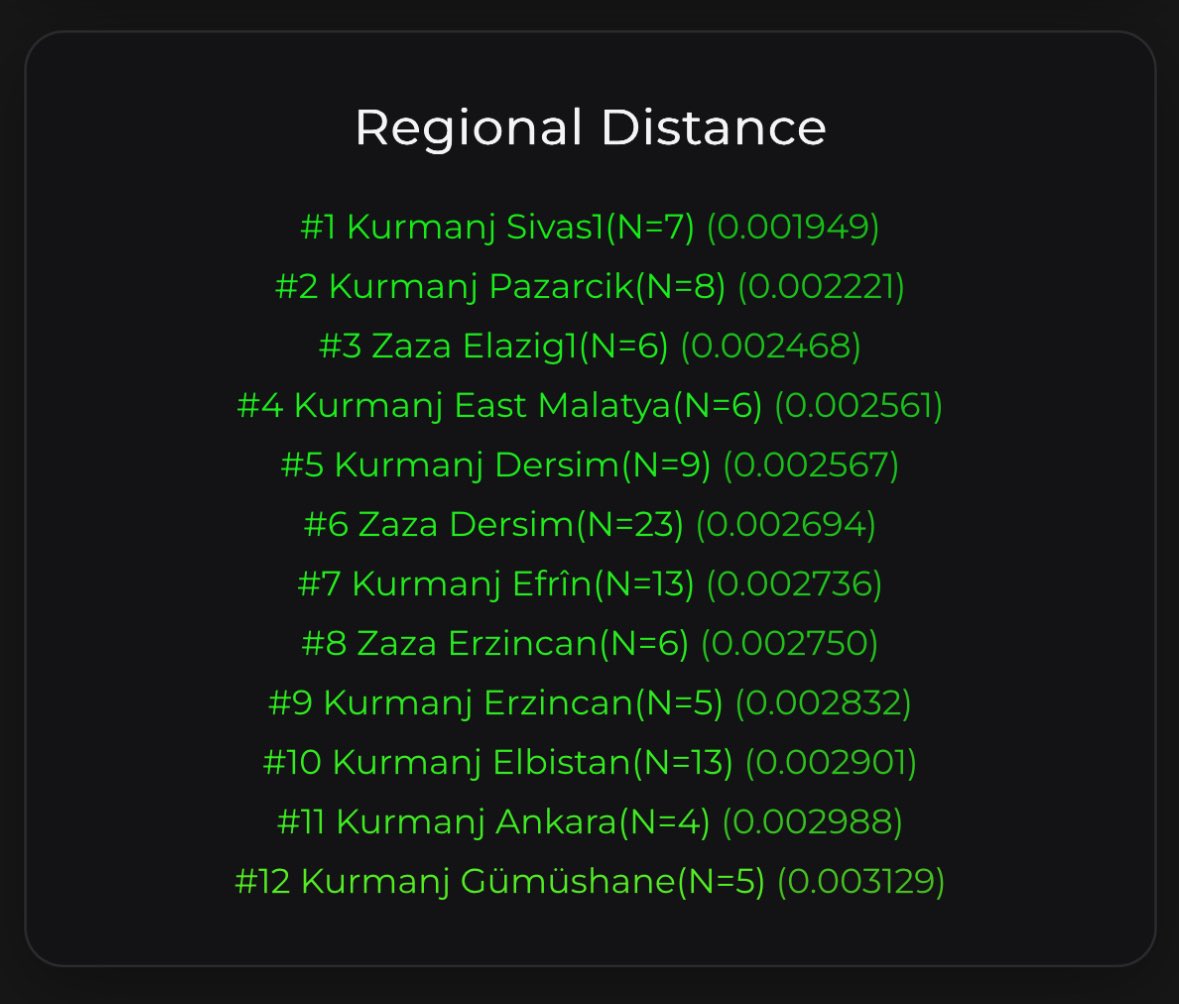
They're indistinguishable from the broader Kurdish/Northwest Iranian cluster. (See pictures attached, average of 12 Sinemillî from Kahramanmaraş, Kayseri and Erzincan provinces)
@atabeykayi@BizkitXurti i don‘t think there is any chance for that since most r1a among bakuri kurds are NOT from arabs, and i din‘t know wether there are any r1a clades that are mainly arab. and even if there are, these clades MUST have come from non-arabs. arabs originally don‘t have r1a.
@hausfrauuu okay gut. weil fände es schade den kindern die schuld zugeben. sie haben die verantwortung die sprache zu lernen aber wenn sie zb türkisch aufwachsen, haben sie wenig bezug unf wenig grund kurdisch zu lernen, was natürlich auch schade ist.
@BizkitXurti turks invented everything, they were the first everywhere and have the strongest and most successful all along.
newroz is their culture and sumerians were also turks bro
What are the origins of the Zazas? The Zazas are a Kurdish subgroup who speak an Adharic-derived language. This linguistic grouping also includes Talysh, Gorani, and various Tatic dialects. The Adharic grouping is an Iranian cluster tied to northwest Iran, distinct from the Caspian Iranian languages such as Gilaki.
This differs from NCS Kurdish, including Kurmanji, Sorani, and Southern Kurdish, which forms a separate linguistic unit. It stems from a Northwestern Iranian branch that developed in southwest Iran and does not share areal features with Zazaki prior to language contact during the medieval period. Therefore, it can be said that the Zazas maintained their language even after integrating into Kurdish society.
One of the main challenges in Kurdish studies is that subdivisions within Kurdish society are not well attested until relatively late in history. Despite this, historical evidence combined with linguistic analysis allows for a partial reconstruction of how and where this Adharic subgroup integrated into Kurdish society.
Hrach Martirosyan is currently working on an Armeno-Iranian corpus exploring Iranian influence on Armenian. He has stated that there was an Iranian language influencing Armenian that was neither Parthian nor Middle Persian, and that Zazaki represents a strong candidate. Agnes Korn supports this view, suggesting that an unattested Western Iranian language, sharing the *r̥ > *ər > ar sound shift with Zazaki and possibly Talysh, contributed to Armenian. The most significant contributor remains Parthian, which has its own distinct developments.
The Mardians of Armenia are a major focus in investigating Zaza origins due to their well-attested presence in the region. It is possible that they represented one of the largest Iranian populations in historical Armenia before the arrival of NCS Kurds. This makes them a likely source of Zazaki-related loanwords in Armenian, since the linguistic affiliations of other Iranian groups in the region, such as Parthian and Old Tatic, are more clearly understood.
The Mardians, an Iranian tribe attested in both northern and southern parts of the Iranian plateau, are referenced in the Armenian highlands as early as the 5th century BC. In his 472 BC tragedy “The Persians,” Aeschylus mentions a Mardian figure named Xanthes, described as a daring chief from the Pontic shore who led his forces into battle. Xenophon records that during the retreat of Greek mercenaries after the Battle of Cunaxa in 401 BC, they were attacked in Armenia by an Achaemenid force that included Mardians, Armenians, and Chaldean mercenaries. Strabo later notes the presence of Mardians in Armenia, describing them as similar to those in Atropatene and Persis, where they had existed since pre-Achaemenid times. He also mentions Kyrtians in Atropatene, possibly indicating early Kurdish movements from Persis, followed by larger migrations during Sassanid and Islamic periods. Plutarch describes Mardian mounted archers serving in Tigranes’s army during the Battle of Artaxata in 68 BC and recounts how a Mardian assisted the Roman forces of Mark Antony during their campaign in the region.
Evidence of Mardians in Armenia is not limited to classical sources. The 7th-century Armenian scholar Ananias of Shirak describes a region called Mardpetakan, which included the district of Mardastan and other areas located between Lake Van and the northern shore of Lake Urmia in Vaspurakan. The title Mardpet, meaning “Mardian chief,” was likely originally used by Mardian leaders and later became associated with the powerful office of Grand Chamberlain under the Arsacid kings of Armenia from 12 to 428 AD. The connection between the title and the office remains debated.
A reference in the Journal of the Royal Asiatic Society from 1923 notes that the Anecdota Syriaca, a collection of Syriac texts compiled by J. P. Land, mentions the Qardawaye, identified as NCS Kurds, living in Assyria alongside a group called the Marudaye. Taken together, linguistic and historical evidence suggests that the northern Mardians are the most likely predecessors of the core Zaza population.
Distinguishing Zazas from NCS Kurds in the medieval period is difficult, as historical sources generally do not differentiate between them. However, by combining early modern records with earlier accounts, several tribal groups can be linked to the Zazas. The most prominent of these is the Dimilî, also known as Dumilî, Dumbulî, or Dunbulî. This group is first mentioned by al-Mas’udi in the 10th century as Dababilah or Dunbuliyyah in Syria. They later appear in a manuscript associated with the proto-Yazidi saint Pir Sini Darani around 1207 or 1208 as Dumlan, and again in the works of al-‘Umari in the 14th century as Dabiliyyah or Danbuliyyah among the Bukhtiyyah Kurds. In Ottoman records, these names were often used to refer broadly to Zazas and are still used by many Sunni Zazas today.
The term “Zaza” itself originates from a tribal name recorded during the Ottoman period. The traveler Evliya Chelebi mentions this group, as well as the Lulu, now known as the Lolan, a Zazaki-speaking tribe. Another historical Zaza tribe is the Suweydi, who ruled the Bingöl region from the medieval period into early modern times. The Pazukî, also known as Bêsikî or Bozukan, may be connected to a group mentioned by al-Mas’udi as Buðikan. Although often identified as a Kurmanji tribe, Sharafkhan writes that its rulers traced their origins to the Suweydi, suggesting possible Zaza roots.
The Emirate of Chamishgezak had a strong Zaza presence, including groups such as the Dêsiman, first mentioned in an 11th-century manuscript by Sheikh Dilo, from whom the name Dersim is derived. Many Kurds from this emirate later joined the Safavids in Iran and contributed to the formation of the Fayli Kurdish tribes, including the Malekshahi, Boli, and Arkawazi.
Genetic evidence may support these connections. A Y-DNA sample from a Malekshahi individual falls within a clade upstream of the largest known Zaza J2a cluster and would likely be classified within it upon further testing. The Mirdasî dynasty of the Euphrates region may also have been Zaza in origin, as their descendants today speak Zazaki. The Ziktê, mentioned by Sharafkhan among pro-Safavid tribes, remain a well-known Zaza group.
In post-Islamic sources, Zazas are consistently identified as Kurds. This reflects not only external classification but also self-identification, as Zazas have historically and continue to identify as Kurds. A notable example is the 19th-century Zaza chieftain Khalaf Agha of the Nêrib tribe, who reportedly declared before battle that they were all brave Kurdish warriors.
In conclusion this suggests that the integration of Zazas, likely descended from northern Mardians, into Kurdish society began relatively early during the formation of Kurdish identity in the region. However, the precise details of this process remain unclear.
Many thanks to @ZarbianHerki who collaborated with me on this post.
Hello!
We're announcing a mass IQ testing project taking place in Southern Kurdistan soon, from the 6th until the 13th
Unfortunately, due to the size of the projects, and the amount of samples we’ll be collecting, we need public funding to keep this project alive.
If you're interested in psychometrics, or if you just want to know what the average IQ of Kurdistan is, please message us
Please, if you can, repost this tweet to spread awareness.
We’ll be using 1 FRI test (MR - WAIS V), 1 VSI test (BP - WAIS V), 1 PSI test (haven’t decided which yet) and one WMI test (DS - WAIS IV translated into Kurdish by us), It’ll take about ~25 minutes (according to the manual, could take longer if the individual is gifted) to administer per individual so it’ll realistically take us at least 1 week to finish.
Due to a lack of funding we won’t be able to test crystallized intelligence, e.g. information and vocabulary
The expected g-loading will be ~0.80-0.85 with an extremely high reliability (will release an exhaustive report when we’re done)
Our methodology will be picking people at random and offering them 5.000 IQD for the completion and permission to post their wresults, ethnic background, ancestry, age and gender. We will not be including samples of ourselves, or our friends as this will result in a much higher result.
Project Supervisor - @Ruzhelat (Tikabli)
Assistants - @Halabjayi_ (Pers), @hama_drnda (Hama)
Erbil Governorate Overseer @hama_drnda
Duhok Governorate Overseer @Ruzhelat
Sulaymaniyah Governorate Overseer - @Halabjayi_
Halabja Governorate Overseer Pers - @Halabjayi_
We’re currently with ~10 people but we’re still currently missing some people, if you live in Bashur and you're willing to help us out, please dm us.
Or if you’re willing to help us out, please donate through these links
expected amount of samples: ~200 (funding will play a big role)
l