I learned to fly before I could even drive.
At 17, the sky taught me that responsibility isn't a personality trait, it’s a system. You can’t charm an engine or negotiate with a checklist you skipped.
I carried that "no-bullshit" mentality into everything: specializing in jet propulsion to understand how things actually work, then heading to Goldman to learn how to price uncertainty. I realized energy is the base layer and risk is a profession.
In the cockpit, bluffing gets you buried. In markets, it gets you quietly wrecked.
I’m building Sphinx because I want the full stack of reality, hardware, software, and markets. It’s the synthesis of everything I’ve earned. I’m not here for generic takes; I’m here to build, to survive, and to keep landing.
Vibe Coding Is the New Product Management
“There���s been a shift—a marked pronouncement in the last year and especially in the last few months—most pronounced by Claude Code, which is a specific model that has a coding engine in it, which is so good that I think now you have vibe coders, which are people who didn’t really code much or hadn’t coded in a long time, who are using essentially English as a programming language—as an input into this code bot—which can do end-to-end coding.
Instead of just helping you debug things in the middle, you can describe an application that you want. You can have it lay out a plan, you can have it interview you for the plan. You can give it feedback along the way, and then it’ll chunk it up and will build all the scaffolding.
It’ll download all the libraries and all the connectors and all the hooks, and it’ll start building your app and building test harnesses and testing it. And you can keep giving it feedback and debugging it by voice, saying, “This doesn’t work. That works. Change this. Change that,” and have it build you an entire working application without your having written a single line of code.
For a large group of people who either don’t code anymore or never did, this is mind-blowing.
This is taking them from idea space, and opinion space, and from taste directly into product. So that’s what I mean—product management has taken over coding. Vibe coding is the new product management.
Instead of trying to manage a product or a bunch of engineers by telling them what to do, you’re now telling a computer what to do. And the computer is tireless. The computer is egoless, and it’ll just keep working. It’ll take feedback without getting offended.
You can spin up multiple instances. It’ll work 24/7 and you can have it produce working output.
What does that mean? Just like now anybody can make a video or anyone can make a podcast, anyone can now make an application. So we should expect to see a tsunami of applications. Not that we don’t have one already in the App Store, but it doesn’t even begin to compare to what we’re going to see.
However, when you start drowning in these applications, does that necessarily mean that these are all going to get used or they’re competitive? No. I think it’s going to break into two kinds of things.
First, the best application for a given use case still tends to win the entire category. When you have such a multiplicity of content, whether in videos or audio or music or applications, there’s no demand for average.
Nobody wants the average thing. People want the best thing that does the job. So first of all, you just have more shots on goal. So there will be more of the best. There will be a lot more niches getting filled.
You might have wanted an application for a very specific thing, like tracking lunar phases in a certain context, or a certain kind of personality test, or a very specific kind of video game that made you nostalgic for something. Before, the market just wasn’t large enough to justify the cost of an engineer coding away for a year or two. But now the best vibe coding app might be enough to scratch that itch or fill that slot. So a lot more niches will get filled, and as that happens, the tide will rise.
The best applications—those engineers themselves are going to be much more leveraged. They’ll be able to add more features, fix more bugs, smooth out more of the edges. So the best applications will continue to get better. A lot more niches will get filled.
And even individual niches—such as you want an app that’s just for your own very specific health tracking needs, or for your own very specific architectural layout or design—that app that could have never existed will now exist.”
@SpatiallyMe Fab, I can't do it on the Galaxy XR :( I'm an Apple user for everything else. I thought the Galaxy XR would be more developer-friendly, but I’ve yet to see anything really special on it. It's only 4 months old though. Looking forward to seeing more from you. thanks!
I caved.
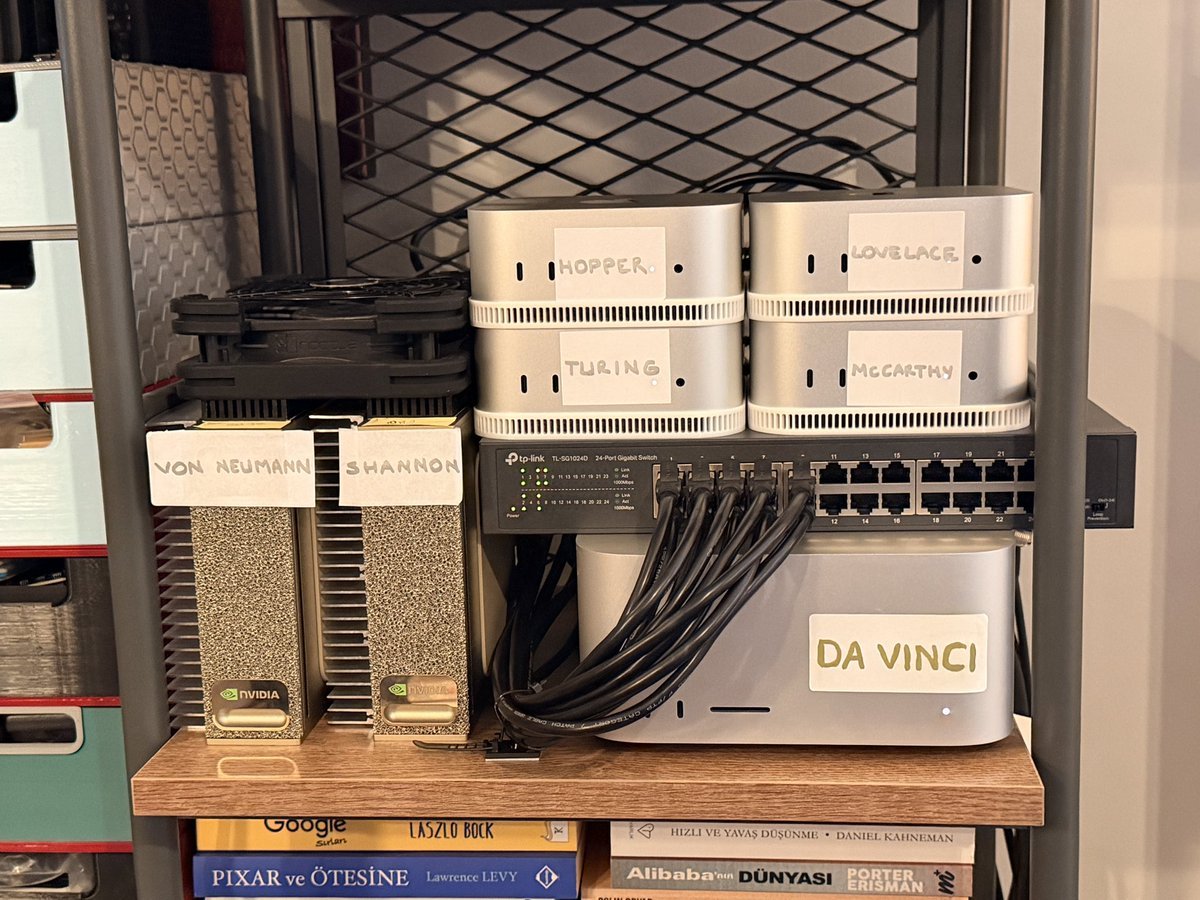
Finally set up a local cluster for Openclaw - but you won't believe what I'm using it for.
Here's my specs:
- 2x Nvidia DGX Spark
- 1x M3 Ultra Mac Studio 512 GB Unified Ram (the overlord "Da Vinci")
- 4x M4 Mac Mini 16 GB
- 2x RasPi 5's
And *this* is where it gets crazy. It's hard to get everything down on paper that they're doing, but here's my best stab at making it digestible for non-Openclaw experts that still exist...
So basically we're using a bespoke neural entanglement protocol, that Da Vinci came up with. He serves as the quantum nexus hub, orchestrating synaptic data flows across the distributed cluster (interfacing the Nvidia devices with the Minis).
Each hour, Da Vinci initializes a pseudo-qubit overlay network that phase-locks the Minis via entangled quanta.
This setup enables my custom Openclaw polymorphic kernel to fractalize all 16 computational workloads.
That may not seem important to you, but basically it means that each node's RISC-V emulated vector units perform holographic tensor decompositions..which means I now have a self-healing mesh that will literally fix itself by creating new superchannels if we hit any throughput bottlenecks.
In the core execution loop, Da Vinci employs a fractal skill deployer to synchronize state vectors among the Minis. This allows the onboard generative algorithms to decompose the algo manifold.
And THIS is where Hopper shines.
He handles the primary stochastic gradient descent...basically a synthetic overclocking, while Turing simulates halting race conditions to preempt any sort of computational deadlocks.
At the same time this is happening, Lovelace and McCarthy are ripping symbiotic reasoning threads, utilizing their own lambda curves by literally morphing the bytecode into emergent AI behaviors.
Yeah. Seriously. They're literally doing that. I couldn't believe when I first asked.
The interplay here is kinda risky, but it creates a vortex of recursive backpropagation...and allows them to check my email every couple of minutes and generate a new twitter thread. It's huge time saver on something that normally takes like 20 seconds.
Anyway I don't want to give away all the sauce right now, but will update later. I'm quite excited about what they're working on next.
@naval the death of careers is really the death of 'someone else's problem.' the opportunity isn't side hustles, it's owning your output. build something, hold the risk, keep the upside. the job is dying because the asset was never yours.