📆Wednesday, 29 October 2025 at 11 ET
Vietnam Firms and Labour Markets Online Seminar
Join Dr. Hoang Pham (@shockmath) for a seminar on how the 2001 US-Vietnam Bilateral Trade Agreement reduced labour market distortions in Vietnam.
Register https://t.co/tbfGnVHQoi
I am presenting a paper on how the US- Vietnam Bilateral Trade Agreement (BTA 2001) affects labor market power distortions in Vietnam’s manufacturing at the Vietnam online seminar organized by @BrianMccaig . Please attend if you are interested.
Reductions in U.S. tariffs on Vietnamese imports reduced labor market distortions in Vietnam.
Join us on Oct 29, 11 am ET, for the next Vietnam online seminar by Dr. Hoang Pham.
Register here https://t.co/tbfGnVHiyK
I have several papers that explore tariff wars using economic models. Here’s what they tell us about likely outcomes (🧵)
TLDR: All countries ultimately lose. While the overall impact isn’t catastrophic for larger economies like the US, it’ll be devastating for small countries.
It's high time to have another look at interesting papers like this one!
"The cost of a global tariff war: A sufficient statistics approach" by Ahmad Lashkaripour.
Article in the Journal of International Economics:
https://t.co/0vQ3QtxpgX
Working paper:
https://t.co/5sfNqumSg3
🚨🚨New paper on "Bank financing of global supply chains," with @lalfaro, Mariya Brussevich, and @CMinoiu. Looking forward to presenting it @ASSAMeeting and at the @sffed next week.
We study how (specialized) banks helped the great reallocation following the 2018-2019 trade tensions. We make 3 main points:
1. In reallocating their sourcing from Chinese suppliers to other Asian countries, U.S. importers face large search costs ($1.9 million, 5% of annual revenue).
2. In response to the tariff-induced input cost shock, tariff-hit importers increased their demand for bank credit
3. Tariff-hit firms with specialized banks (those offering specialized trade finance services to Asian markets) were 15 pps more likely and 3 months faster to establish new supplier relationships than firms with other banks.
In economics, editors, referees, and authors often behave as if a published paper should reflect some kind of authoritative consensus.
So valuable debate happens in secret, and the resulting paper is an opaque compromise with anonymous co-authors called referees.
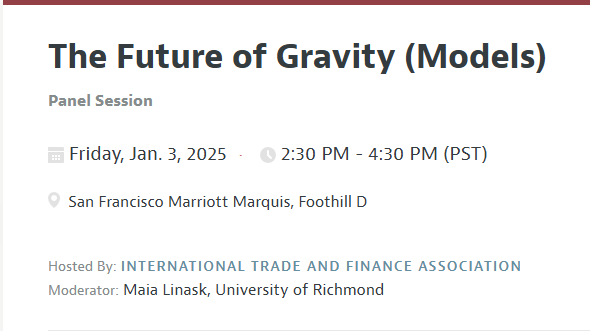
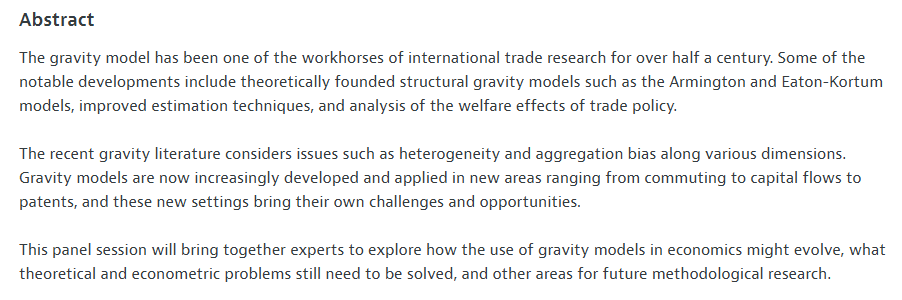
I am delighted to let the world know about this upcoming ASSA panel session on *the future of gravity models* that my colleague Maia Linask and I are organizing, in conjunction with @itfaconference.
@farmerrf Both prominent specific-factors model (short-) and Heckscher-Ohlin model (long-run) have this distributional implications. The problem is how the model is interpreted and political economy of redistribution. Most textbook models assume tariffs are inefficient in redistribution.
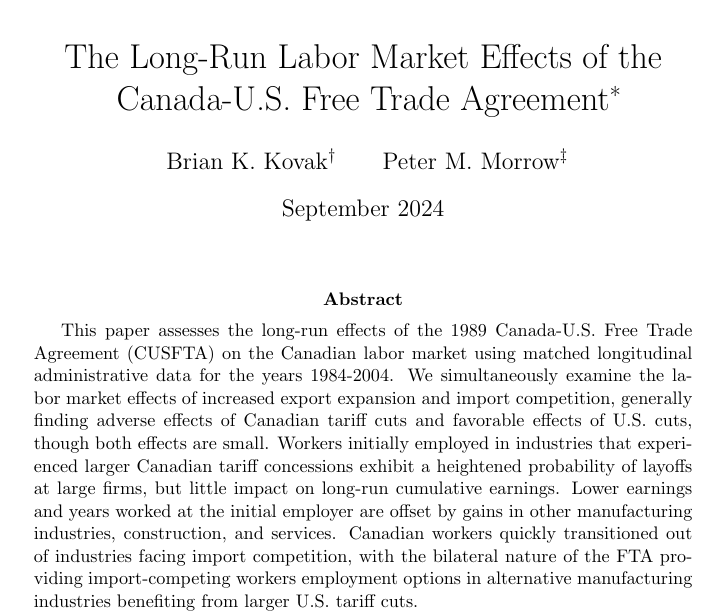
Recently accepted to #REStud, ``The Long-Run Labor Market Effects of the Canada-U.S. Free Trade Agreement,'' from Kovak and Morrow:
https://t.co/snahTSkJxp
Our department is hiring a teaching economics professor at the Vancouver, WA (Portland metro) campus. We begin reviewing applicants on November 1st. Please share with your students on the market interested in a teaching career.
https://t.co/vxZMJ4bDHK
With the focus on the port strike, it’s a great time to share @WoanFoongWong and mine new research on multimodal transport networks. We show how crucial it is to model mode choice and disaggregated congestion in general equilibrium to capture the full economic impacts. 🧵 1/n
Many (most?) teachers nudge students to get the academic support they need.
But what's the optimal way to nudge? How often, when, how, and to what form of support?
Now in print @J_HumanResource: Nick Wilson & I tackle these questions via RCT: 1/ https://t.co/xFdBGprtEO